National September 11 Museum: What to Know Before You Visit
The National September 11 Museum sits beneath the World Trade Center memorial plaza in Lower Manhattan. The 110,000-square-foot underground museum documents the attacks of September 11, 2001, and February 26, 1993, and is one of the most emotionally significant museum experiences in the United States. The outdoor memorial pools are free; museum admission requires a timed ticket.
Quick Facts
- Location
- 180 Greenwich Street, Lower Manhattan, New York, NY 10007
- Getting There
- Subway: E to World Trade Center; 1 to WTC Cortlandt; R, W to Cortlandt St; 2, 3 and other lines to nearby Fulton St
- Time Needed
- 2.5 to 4 hours for museum + memorial; memorial alone takes 45 minutes
- Cost
- Memorial is free. Museum admission: verify current pricing at 911memorial.org before visiting
- Best for
- History, remembrance, architecture, first-time visitors to NYC
- Official website
- www.911memorial.org
What This Place Actually Is
The National September 11 Memorial & Museum is not a typical attraction. It sits precisely where the Twin Towers stood, and that geographic fact shapes every element of the experience. The outdoor memorial, designed by Michael Arad and Peter Walker, opened to the public on September 12, 2011, a day after the tenth anniversary. The museum, which occupies 110,000 square feet mostly below ground, was dedicated on May 15, 2014, and opened publicly on May 21, 2014. Together, they form one of the most carefully considered memorial complexes in the world.
The outdoor memorial is free to visit and open daily from 8:00 am to 8:00 pm. The museum is open from 9:00 am to 7:00 pm, Wednesday through Monday, and is closed on Tuesdays, with occasional Tuesday openings and adjusted hours around September 11 and certain holidays. Admission to the museum requires a ticket; verify current prices at the official website before your visit, as they are updated periodically.
💡 Local tip
The memorial plaza is free and open daily — you do not need a museum ticket to stand at the pools. If you are visiting on a tight budget or limited time, the outdoor memorial alone offers a complete and affecting experience.
The Memorial Pools: Scale, Silence, and Presence
The two memorial pools sit in the original footprints of the North and South Towers. Each pool is roughly an acre in size, making them among the largest man-made waterfalls in North America. Water falls from all four sides into a central square void, then drops again into a smaller square at the base that appears to recede into the earth without a visible bottom. The effect is less decorative than architectural: the pools seem to swallow sound, creating a localized quiet even when the surrounding plaza is busy.
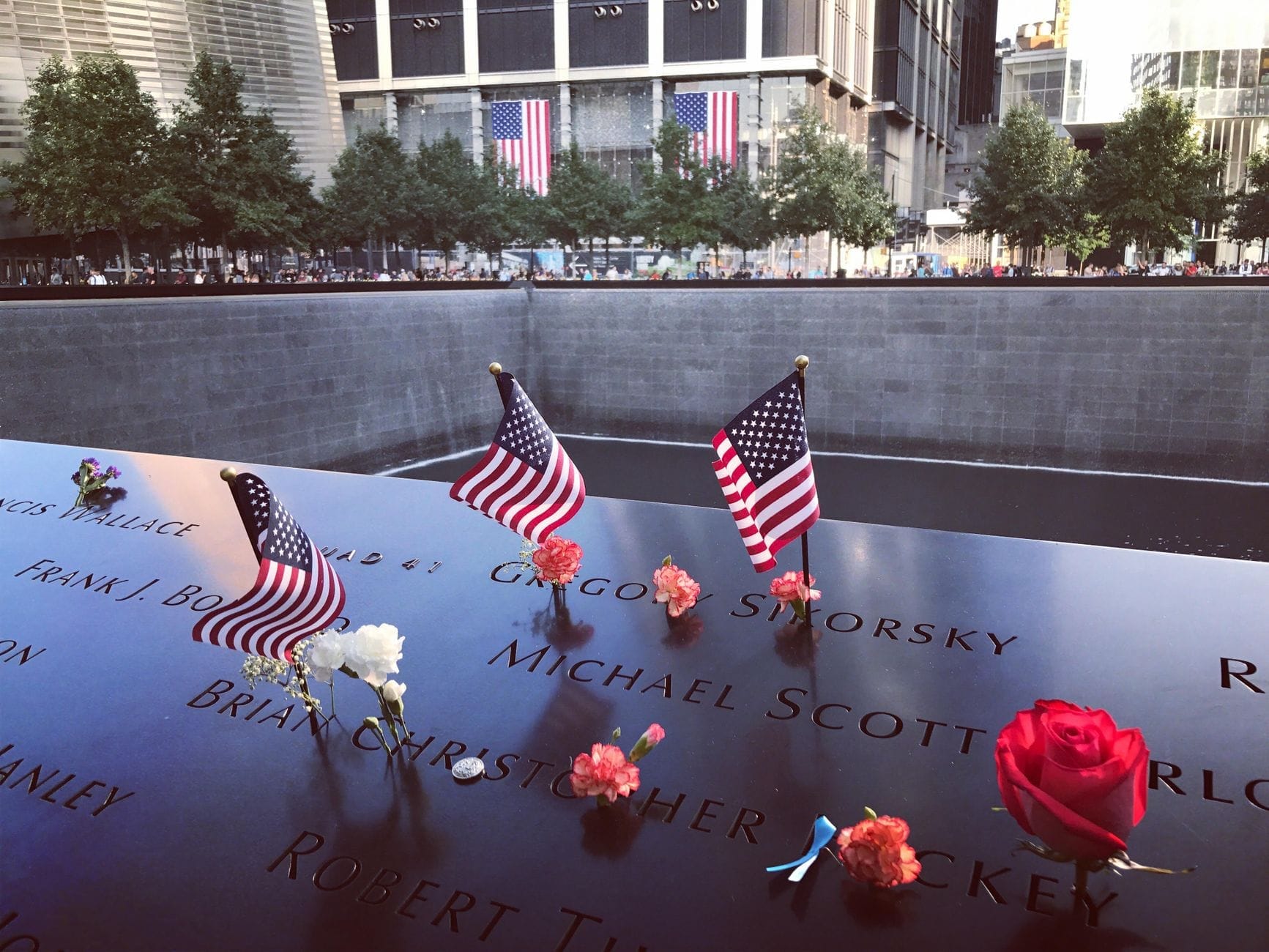
The names of every person killed in the September 11 attacks, and in the February 26, 1993 World Trade Center bombing, are inscribed in bronze parapets along the pool edges. The names are organized by relationships and proximity on the day, not alphabetically, so that colleagues, friends, and first responders who died together remain together in the memorial. On birthdays and anniversaries, museum staff place white roses in the incisions of individual names.
Early morning, between 9:00 am and 10:00 am on weekdays, the plaza is noticeably quieter. The light falls low across the bronze lettering, making the names easier to read and photograph. By midday, particularly in summer, school groups and tour groups fill the plaza and the contemplative atmosphere becomes harder to find. If you are coming specifically to spend time at the pools, aim for the first hour after opening.
Tickets & tours
Hand-picked options from our booking partner. Prices are indicative; availability and final rates are confirmed when you complete your booking.
911 Memorial Museum and Lady Liberty Cruise of NYC
From 69 €Instant confirmationFree cancellationVIP Access 911 Memorial and Museum Admission with Lady Liberty cruise
From 77 €Instant confirmationFree cancellationStatue of Liberty, Ellis Island, and Brooklyn Bridge Happy Hour Cruise
From 49 €Instant confirmationFree cancellationSpirit of New York Dinner Cruise
From 161 €Instant confirmationFree cancellation
Entering the Museum: The Descent
The museum entrance pavilion, designed by Snohetta, is a glass-and-steel structure on the north edge of the plaza. From the outside it reads as restrained, even understated, which is appropriate given what lies below. Once inside, a long ramp descends roughly seven stories underground, past exposed slurry walls that held back the Hudson River during construction of the original towers. Those walls survived September 11, 2001, and structural engineers later described holding them as critical to preventing catastrophic flooding of lower Manhattan's subway tunnels. Standing next to them inside the museum, you are looking at infrastructure that is both a construction artifact and, in a specific sense, a piece of the disaster's history.
At the base of the descent, the scale of the space becomes apparent. The museum extends across the original foundation level, with ceiling heights that reflect where the towers' bases once stood. The two primary exhibition spaces, the Historical Exhibition and the In Memoriam Exhibition, are supplemented by several smaller galleries. The Glade, a quieter room designed for more personal reflection, provides some separation from the denser archival sections.
⚠️ What to skip
The museum contains graphic audio, video footage, and imagery from September 11, 2001. Some content is in restricted areas with clear warnings at the entrance. Parents should be aware that certain sections are not suitable for young children. The museum experience is emotionally intense for most adult visitors regardless of their personal connection to the events.
Inside the Historical Exhibition
The Historical Exhibition occupies two floors and moves through September 11, 2001, in roughly chronological order. It documents the day itself, the rescue and recovery operations, and the global context of the attacks, including the history of al-Qaeda and the preceding 1993 bombing. The presentation relies heavily on primary materials: voicemails, photographs, recovered objects, and recorded testimonies.
Among the artifacts are badly damaged fire trucks, a section of antenna from the North Tower, and the Last Column, a steel beam that was the final piece removed from the site during the recovery effort, covered in inscriptions left by rescue workers. The physical scale of these objects, combined with their documentary weight, gives the exhibition a gravity that purely visual or digital presentations cannot replicate.
The In Memoriam Exhibition is dedicated to individual portraits of the 2,983 people killed in the 1993 and 2001 attacks. Visitors can search by name on touchscreen stations and access recorded memories contributed by family members. This section tends to quiet visitors considerably, even those who have moved quickly through earlier galleries.
How the Experience Changes by Time of Day and Season
The outdoor plaza changes substantially across seasons. In spring and autumn, the approximately 400 white oak trees planted across the memorial grounds are at their most visible, framing the pools with foliage that softens the geometry of the space. One of the trees, known as the Survivor Tree, is a Callery pear that was found damaged at Ground Zero in October 2001, nursed back to health, and replanted at the memorial. It stands slightly apart from the other oaks and is marked with a small sign. In winter the plaza becomes more austere, the pools more prominent against a bare skyline.
The museum interior maintains consistent lighting and temperature year-round, so weather has no direct effect on the underground galleries. However, the entrance queues and the density of the crowds inside are heaviest during summer months and the September 11 anniversary period each year, when additional commemorations take place. Visiting in November through February (excluding the week between Christmas and New Year's) typically means shorter queues and a quieter experience inside.
For a broader understanding of Lower Manhattan's architectural and historical landscape, the New York City architecture guide covers the evolution of the World Trade Center site and the surrounding financial district in more detail.
Practical Logistics: Getting There, Getting In, Getting Around
The memorial address is 180 Greenwich Street, accessible from Liberty Street at Greenwich Street or from West Street. The closest subway options are the E train to World Trade Center, the 1 train to WTC Cortlandt, the R and W to Cortlandt Street, and multiple lines including the 2 and 3 to nearby Fulton Street. The Oculus transit hub, connected to the PATH train serving New Jersey commuters, is directly adjacent to the site and makes for a logical entry point from the west.
The nearby Oculus at the World Trade Center is architecturally striking in its own right and worth a few minutes on the way in or out. Santiago Calatrava's design, with its bone-white ribs and vast interior atrium, serves as the main transit concourse for the site.
Pre-booking museum tickets online is strongly recommended, particularly between May and September and around the September 11 anniversary. Walk-up tickets are sometimes available but not guaranteed on peak days. The museum is fully accessible, with elevators providing step-free access to the underground galleries.
ℹ️ Good to know
Security screening is required for museum entry, similar to an airport check. Bags go through X-ray and visitors pass through metal detectors. Allow an extra 10 to 15 minutes during busy periods. Large backpacks and bags must fit within the size restrictions posted at the entrance.
Setting Expectations: What This Is and Is Not
The museum does not function as light entertainment, and it does not try to. The chronological exhibition covering the day of the attacks includes audio recordings, some of them distressing, from people inside the towers and from first responders. The museum provides clear content warnings before those sections, but visitors who are sensitive to this material should know in advance that the footage and audio are presented without significant softening.
Visitors who find memorials uncomfortable, or who feel this type of site instrumentalizes tragedy, will not be persuaded otherwise by visiting. That is a legitimate position and the museum itself, through its design decisions, acknowledges the tension between documentation, commemoration, and the weight of grief held by families of victims. What the museum does well is give physical reality to events that for many people exist only as television memories.
If you are building an itinerary around Lower Manhattan, the One World Observatory at the top of One World Trade Center sits directly above the memorial site and provides geographic context for the footprint you have just walked through. The Battery Park is a 10-minute walk south and offers a significant change of atmosphere after the intensity of the museum.
First-time visitors to New York City planning a full day in the financial district can combine this with the Wall Street area and the Staten Island Ferry for a day that covers both history and harbor views without additional cost.
Insider Tips
- White roses appear in name inscriptions on the birthdays of victims. If a birthday is meaningful to you personally, the museum's website lists the anniversary calendar and you can time a visit accordingly.
- The Survivor Tree is sometimes overlooked by visitors moving quickly toward the pools. It stands near the South Pool and is labeled with a small interpretive sign. Its background is worth reading before you arrive so the detail registers when you see it.
- Museum audio guides are available and meaningful here in a way they often are not at art museums. The site-specific context provided by recorded first-responder and survivor accounts adds depth that reading panels alone cannot replicate.
- Tuesday closures catch visitors by surprise regularly. The museum is closed on most Tuesdays, with select Tuesday openings throughout the year. If your schedule is tight, verify the day before committing your afternoon to this visit.
- The foundation-level slurry walls are best viewed from the ramp on the descent, before the exhibition proper begins. Many visitors are in a hurry to reach the galleries and walk past these without stopping. Take 60 seconds here: the geology and engineering context becomes relevant when you are standing seven floors below street level.
Who Is National September 11 Museum For?
- First-time visitors to New York City who want to understand the city's contemporary history
- History-focused travelers comfortable with emotionally weighty material
- Architecture and design enthusiasts interested in memorial design and site-responsive building
- Groups with an educational focus, including adults seeking primary-source documentation of modern history
- Visitors combining a half-day in Lower Manhattan with other financial district sites
Nearby Attractions
Other things to see while in Lower Manhattan:
- National September 11 Memorial
The National September 11 Memorial occupies the original footprints of the Twin Towers in Lower Manhattan. The outdoor reflecting pools are free and open daily from 8:00 a.m. to 8:00 p.m. This page covers the memorial plaza; for the underground museum, see our separate museum guide.
- Battery Park
Perched at the southernmost tip of Manhattan, The Battery is a free waterfront park offering sweeping views of New York Harbor, access to the Statue of Liberty and Ellis Island ferries, and nearly four centuries of layered history. It works well at any hour, but rewards those who arrive early.
- Ellis Island National Museum of Immigration
Ellis Island National Museum of Immigration sits in New York Harbor on ground that shaped American history more than almost any other. Reached only by ferry, it offers a deeply affecting look at the 12 million immigrants who passed through between 1892 and 1954, housed in a landmark Beaux-Arts building that has been meticulously restored.
- Governors Island
Governors Island sits just 800 yards off the tip of Lower Manhattan, yet feels worlds apart from the city. A former military post turned public park, its 172 acres offer sweeping harbor views, fort ruins, art installations, cycling paths, and some of the most relaxed open space in New York.