The Oculus at the World Trade Center: Architecture, Memory, and the Daily Commute
Santiago Calatrava's soaring white steel structure above the World Trade Center Transportation Hub is one of New York City's most dramatic public spaces. Free to enter and open nearly around the clock, it connects 11–12 subway lines (depending on how services are counted) and PATH trains while pulling in roughly 200,000–250,000 people a day beneath its ribbed, skylight-lined vault.
Quick Facts
- Location
- 50 Church St., Manhattan, NY 10007
- Getting There
- WTC PATH station (direct); nearby subway lines include 1, A, C, E, 2, 3, 4, 5, J, Z, R, and W via WTC Cortlandt, Cortlandt St, Fulton St, and nearby stations
- Time Needed
- 20–45 minutes to explore the interior; longer if browsing retail
- Cost
- Free to enter (open public space); transit fares and retail purchases extra
- Best for
- Architecture lovers, photographers, first-time visitors to Lower Manhattan
What You're Actually Looking At
The Oculus is the above-ground structure of the World Trade Center Transportation Hub, a major transit interchange operated by the Port Authority of New York and New Jersey. Designed by Spanish-Swiss architect Santiago Calatrava, whose design was unveiled in January 2004, the building took over a decade to construct, with the main station house, the Oculus, opening to the public on March 3, 2016, as part of a broader project spanning the early 2000s to 2016. The result is one of the most structurally ambitious transit buildings in American history.
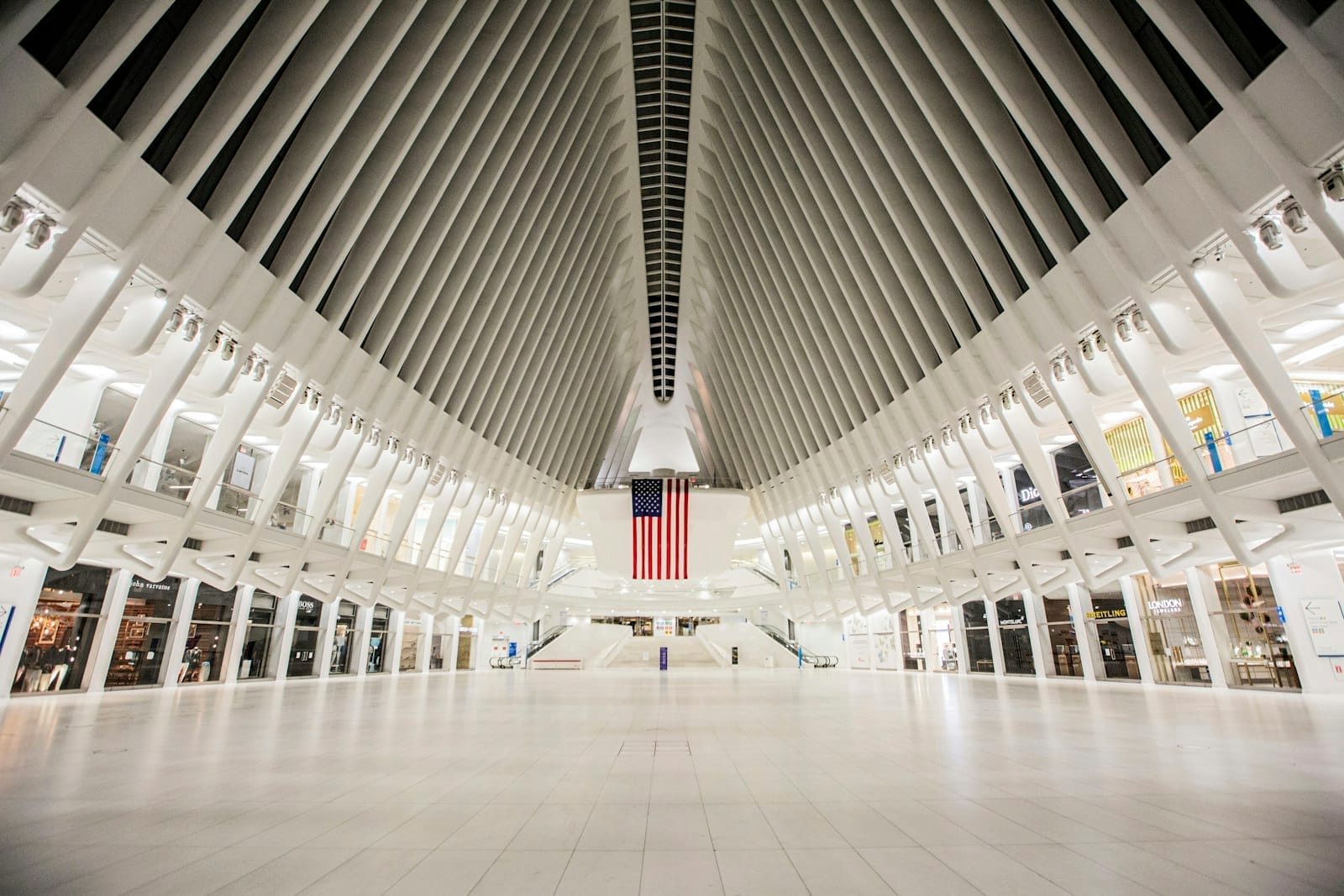
From the outside on Church Street, the Oculus reads as a sequence of white steel ribs fanning outward from a central spine, like a bird caught mid-wing extension. The form is intentional: Calatrava described the concept as a child releasing a dove, a gesture of hope on a site defined by loss. Whether the metaphor translates in person is a matter of individual perception, but the scale is undeniable. The structure rises starkly against the surrounding glass towers of the rebuilt World Trade Center campus, and its pale surfaces shift from bone-white to pale gold depending on the hour and cloud cover.
ℹ️ Good to know
Access to the Oculus is free. The building is open to the public 24 hours a day, 7 days a week, although individual shops and restaurants keep their own hours. No tickets or reservations are required.
Inside the Main Hall: What It Feels Like
The interior surprises people who have only seen photographs. The main hall, called the Westfield World Trade Center shopping concourse, is organized around a central oval floor of white marble, flanked by two levels of retail on either side and enclosed by the arching white steel ribs overhead. The ceiling is not fully enclosed: a narrow skylight runs the full length of the spine, throwing a blade of natural light down the center of the floor throughout the day. On a clear morning, this light arrives sharp and direct. By midday it softens, and by late afternoon it disappears as the angle drops. The best photographs of the interior are taken roughly between 9:00 am and noon on a cloudless day.
The acoustics inside the main hall are unusual. The hard marble and steel surfaces amplify ambient sound, turning the ordinary noise of foot traffic and distant announcements into a low, continuous hum. It is not unpleasant, but it is clearly a functional space that happens to be beautiful, not a designed quietude like a cathedral. Roughly 200,000–250,000 people pass through the hub on an average weekday, and the main concourse reflects that. Weekday mornings between 7:30 am and 9:30 am are dense with commuters moving with purpose. Weekday afternoons and weekends are calmer and better suited to visitors who want to walk the space without being pushed along.
The underground concourses extend outward from the main hall in multiple directions, connecting underground to the 9/11 Memorial plaza, Brookfield Place, the Battery Park City Ferry Terminal, and the base of One World Trade Center. These corridors are clean, well-lit, and genuinely useful for navigating Lower Manhattan in wet weather. The PATH platform itself sits approximately 60 feet below the Oculus floor, and the atrium is designed so natural light filters down through all levels, a rare quality in any subway station.
Tickets & tours
Hand-picked options from our booking partner. Prices are indicative; availability and final rates are confirmed when you complete your booking.
Statue of Liberty, Ellis Island, and Brooklyn Bridge Happy Hour Cruise
From 49 €Instant confirmationFree cancellationSpirit of New York Dinner Cruise
From 161 €Instant confirmationFree cancellationNew York City Highlights bike tour
From 70 €Instant confirmationFree cancellationNew York Statue of Liberty and Ellis Island tour by ferry
From 55 €Instant confirmation
The Site and Its Weight
Understanding the Oculus requires understanding what sits beneath and beside it. The original World Trade Center PATH station was destroyed on September 11, 2001. Rebuilding transit access to this site was one of the first major infrastructure decisions made in the immediate aftermath, both as a practical necessity and as a symbolic commitment to the site's future. The Transportation Hub that emerged from that process is among the most expensive transit buildings ever constructed in the United States.
The Oculus sits adjacent to the 9/11 Memorial, which occupies the footprints of the original Twin Towers, and the 9/11 Museum is accessible from the same campus. Visitors should be aware that the transition between the commercial energy of the Oculus concourse and the reflective atmosphere of the Memorial plaza is abrupt. These are radically different spaces with different emotional registers, and it is worth slowing down as you move between them.
Photography: Practical Notes
The Oculus is one of the most photographed interiors in New York City, and for good reason. The geometry is consistent and dramatic from multiple angles. A few things are worth knowing before you arrive with a camera. The main skylight runs north-to-south along the spine of the building, which means morning light enters from the east and illuminates the western wall of ribs. Afternoon light does the reverse. Wide-angle lenses work well from the ground floor looking up toward the ceiling. The upper retail levels offer a different perspective looking down at the marble floor, which reflects the overhead light cleanly.
One practical complication: this is a working transit hub. Long-exposure photography is difficult during peak commuting hours because the floor is never empty. Weekends between 8:00 am and 10:00 am offer the lowest crowd density inside the main hall. Tripods may attract attention from security staff; handheld shooting is generally unimpeded for visitors.
💡 Local tip
For the best interior light, visit on a clear morning, midweek if possible, arriving before 10:00 am. The skylight blade is most defined in winter when the sun angle is lower.
Getting There and Getting Around
The World Trade Center Transportation Hub is one of the best-connected transit points in Lower Manhattan. PATH trains from New Jersey terminate directly at the WTC station, which sits beneath the Oculus. Multiple NYC subway lines serve the immediate area: the 1 train stops at WTC Cortlandt, the A, C, 2, 3, 4, 5, J, and Z lines at Fulton Street, and the R and W at Cortlandt Street. In total, 12 subway lines have connections to this hub via the underground concourse network, making it reachable from almost anywhere in the city without a transfer. Check current MTA fare information before traveling, as transit fares are updated periodically.
If you are planning a half-day in Lower Manhattan, the Oculus makes a logical anchor point. From here, the 9/11 Memorial, Wall Street, Battery Park, and the Staten Island Ferry terminal are all within a 15-minute walk, and the underground passages allow weather-protected access to much of the immediate campus. For a structured route through the neighborhood, the walking tours guide for New York City covers several Lower Manhattan itineraries.
Retail, Food, and the Commercial Reality
The Oculus houses approximately 350,000–400,000 square feet of retail space across its underground concourse, operating as Westfield World Trade Center. The tenant mix includes international fashion brands, a range of food and coffee options, and specialty retailers. This is not a neighborhood market or a curated local experience; it is a mainstream urban shopping mall that happens to occupy one of the world's most architecturally significant transit buildings. That distinction matters to some visitors and not at all to others.
For practical purposes, the food options in the concourse are useful when you need a quick meal before or after visiting the Memorial. Quality varies by vendor, and pricing reflects the location. If you want a more considered meal nearby, the financial district and Battery Park City have restaurants worth seeking out beyond the immediate complex.
Honest Assessment: Worth Your Time?
The Oculus divides informed opinion. Architecture critics have noted the contrast between its extraordinary cost (publicly reported figures were around $4 billion for the Transportation Hub as a whole) and what some describe as a design that prioritizes spectacle over practical transit function. The building has also been criticized for its uniformly white, climate-sensitive surfaces and maintenance demands. These are legitimate observations.
From a visitor's perspective, the case for spending 20 to 30 minutes inside is straightforward: it is free, it is genuinely unlike any other transit space in the city, and it connects naturally to everything else worth seeing in Lower Manhattan. If you are visiting the 9/11 Memorial or planning to take the Staten Island Ferry for a free view of the harbor, the Oculus is essentially on your route. You do not need to schedule it separately.
Visitors who will not enjoy this space: anyone looking for quiet reflection, historical depth, or a specifically New York character. The interior feels more international than local, more corporate than neighborhood, and the retail context makes sustained contemplation difficult. It is architecture you experience in motion, not in stillness.
⚠️ What to skip
The Oculus sits next to one of the most emotionally significant sites in the city. If you are visiting the 9/11 Memorial on the same day, give yourself adequate time and space between the two. The transition from busy retail concourse to memorial plaza can feel jarring if rushed.
Insider Tips
- The skylight along the spine of the Oculus was designed to open partially on certain days, allowing a sliver of open sky directly above the main concourse floor, although in practice it is rarely opened. If you notice the light looking particularly sharp and unfiltered, look up: the retractable section may be open.
- The underground concourse connects directly to One World Observatory's ground-level entrance, Brookfield Place, and the Battery Park City Ferry Terminal without going outside. On rainy days, you can cover significant distance in Lower Manhattan without seeing the sky.
- For the lowest foot traffic inside the main hall, arrive on a Saturday or Sunday before 10:00 am. The commuting crowds that dominate weekday mornings are entirely absent, and the space reads very differently without the surge of people.
- The upper level of the main concourse offers a view down onto the marble floor that most visitors miss because they walk straight through at ground level. Take the escalators up to the second level and walk the full length of the building from above.
- The PATH trains that run from here connect to Hoboken, Jersey City, and Newark in New Jersey, offering an inexpensive and fast way to see Manhattan from across the Hudson River, a perspective that rivals any rooftop observatory.
Who Is The Oculus (World Trade Center Transportation Hub) For?
- Architecture and design enthusiasts who want to see Calatrava's engineering at full scale
- First-time visitors to Lower Manhattan who want to orient themselves with good transit connections
- Photographers working in available light who can visit on a clear morning
- Travelers combining a visit to the 9/11 Memorial with a broader Lower Manhattan walk
- Commuters and transit users who appreciate functional infrastructure at an exceptional design level
Nearby Attractions
Other things to see while in Lower Manhattan:
- National September 11 Memorial
The National September 11 Memorial occupies the original footprints of the Twin Towers in Lower Manhattan. The outdoor reflecting pools are free and open daily from 8:00 a.m. to 8:00 p.m. This page covers the memorial plaza; for the underground museum, see our separate museum guide.
- National September 11 Museum
The National September 11 Museum sits beneath the World Trade Center memorial plaza in Lower Manhattan. The 110,000-square-foot underground museum documents the attacks of September 11, 2001, and February 26, 1993, and is one of the most emotionally significant museum experiences in the United States. The outdoor memorial pools are free; museum admission requires a timed ticket.
- Battery Park
Perched at the southernmost tip of Manhattan, The Battery is a free waterfront park offering sweeping views of New York Harbor, access to the Statue of Liberty and Ellis Island ferries, and nearly four centuries of layered history. It works well at any hour, but rewards those who arrive early.
- Ellis Island National Museum of Immigration
Ellis Island National Museum of Immigration sits in New York Harbor on ground that shaped American history more than almost any other. Reached only by ferry, it offers a deeply affecting look at the 12 million immigrants who passed through between 1892 and 1954, housed in a landmark Beaux-Arts building that has been meticulously restored.