Staten Island Ferry: NYC's Best Free Ride Across the Harbor
The Staten Island Ferry crosses 5.2 miles of New York Harbor between Lower Manhattan and Staten Island, completely free of charge, 24 hours a day. It passes within about half a mile of the Statue of Liberty and frames the Lower Manhattan skyline in a way no observation deck can replicate.
Quick Facts
- Location
- Whitehall Terminal, 4 South Street, Lower Manhattan (and St. George Terminal, Staten Island)
- Getting There
- South Ferry (1 train) or Whitehall St (R/W trains) subway stations, steps from the terminal
- Time Needed
- About 1 hour for a round trip (25 minutes each way); allow extra time if you explore St. George
- Cost
- Free. No tickets, no MetroCard required. Has been fare-free since 1997.
- Best for
- Budget travelers, photographers, first-time visitors, families, anyone wanting harbor views without the price tag
- Official website
- www.nyc.gov/html/dot/html/ferrybus/staten-island-ferry.shtml
What the Staten Island Ferry Actually Is
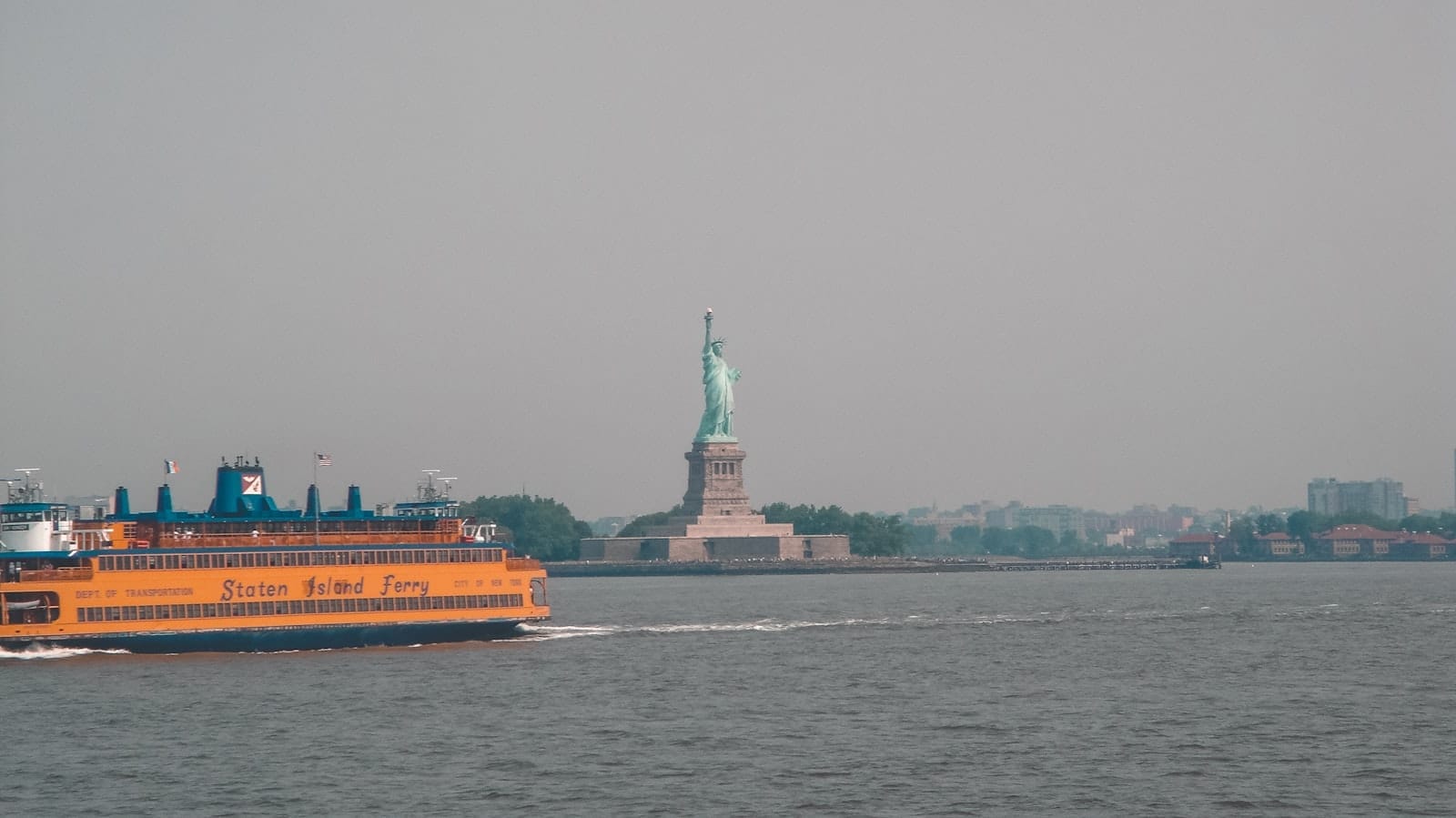
The Staten Island Ferry is a working municipal commuter ferry, not a tourist attraction in the conventional sense. It runs 24 hours a day, 365 days a year, operated by the New York City Department of Transportation, and it happens to offer some of the most dramatic harbor views in the city at absolutely no cost. The route spans roughly 5.2 miles (8.4 km) across New York Harbor, connecting the Whitehall Terminal at 4 South Street in Lower Manhattan with St. George Terminal at 1 Bay Street on Staten Island. Each crossing takes about 25 minutes.
The ferry passes close enough to the Statue of Liberty that you can clearly see her overall form and torch, though fine details like the crown are best viewed with a zoom lens or binoculars. On the return leg toward Manhattan, the Lower Manhattan skyline builds slowly from a low silhouette into a wall of glass and steel. These are views that paid harbor cruises charge $40 or more to approximate. The ferry gives you the same perspective for free, surrounded by the ordinary sounds of a city going about its day: announcements over the PA, the churn of the engines, the occasional fog horn.
⚠️ What to skip
The City of New York warns explicitly that no tickets are required and no one is authorized to sell you ferry tickets. If someone approaches you near the terminal offering to sell tickets, they are scammers. Walk past them.
A Brief History Worth Knowing
Regular steamboat ferry service between Manhattan and Staten Island dates to 1817, when the Richmond Turnpike Company launched crossings. At the time, Staten Island was a relatively isolated rural community, and the ferry was its primary connection to the city's commercial center. The City of New York took over operation of the route in 1905, and it has remained a public service ever since. The fare was eliminated in 1997, a decision that transformed the ferry from a routine commuter link into something more unusual: a major piece of public infrastructure that anyone can use without paying.
The orange-hulled vessels that operate the route today have become one of the more recognizable images of New York Harbor. The fleet includes several large boats capable of carrying thousands of passengers per trip. On weekday mornings, those boats fill with Staten Island residents heading to Manhattan office jobs. By mid-morning, the crowd shifts noticeably toward visitors with cameras.
Tickets & tours
Hand-picked options from our booking partner. Prices are indicative; availability and final rates are confirmed when you complete your booking.
New York Statue of Liberty and Ellis Island tour by ferry
From 55 €Instant confirmationOne day New York City tour: walking, subway and ferry with optional One World Observatory upgrade
From 76 €Instant confirmationFree cancellationStatue of Liberty and Immigration Museum with Ferry and Audio Guide
From 42 €Instant confirmationFree cancellationStatue of Liberty and Ellis Island Ferry Ticket optional Upgrade
From 60 €Instant confirmationFree cancellation
How the Experience Changes by Time of Day
Morning crossings, roughly between 7:00 and 9:30 on weekdays, feel genuinely like commuter transportation. The boats run every 15 to 20 minutes during rush hour, and the passenger mix is mostly locals with coffee and headphones. The light from the east at this hour hits the Lower Manhattan skyline directly, making it a legitimate photography window, though the upper decks are more crowded with people simply trying to get to work.
Midday is probably the most comfortable time for a purely sightseeing crossing. The boats run every 30 minutes, crowds are lighter, and you can position yourself on the outdoor upper deck without jostling for space. The Statue of Liberty is most visible from the right (starboard) side of the boat when heading from Manhattan to Staten Island, and from the left (port) side on the return. The sun is high enough by midday that glare on the water is manageable.
Sunset and dusk crossings are the most photogenic. The sky behind the Statue of Liberty turns pink and amber, and the lights of Lower Manhattan begin to appear before you reach St. George. These sailings draw more visitors specifically for the light, so expect competition for railing space on the outdoor deck. If you plan to photograph the skyline at golden hour, aim for the departure from Staten Island back toward Manhattan, which puts the skyline in front of you as you approach.
Late-night crossings, from midnight onward, are a different experience entirely. The boats are nearly empty, the harbor is quiet except for the engines, and the city lights reflecting off the water are remarkable. For anyone staying in Lower Manhattan who wants a spontaneous and unusual night out, a round-trip on a late-night ferry costs nothing and takes about an hour, including waiting time between boats. It is one of the stranger and more worthwhile things you can do in New York City.
💡 Local tip
For the best Statue of Liberty views, stand on the right (starboard) side of the boat as you leave Manhattan. On the return trip, cross to the left (port) side for an unobstructed view of the Lower Manhattan skyline.
Getting There and Boarding
The Whitehall Terminal is at the southern tip of Manhattan, a short walk from Battery Park and the 9/11 Memorial. The 1 train terminates at South Ferry station, which deposits you almost directly at the terminal entrance. The R and W trains stop at Whitehall Street, a two-minute walk away. If you are coming from Lower Manhattan, the terminal is walkable from Wall Street in about ten minutes.
The boarding process is straightforward. You walk in, follow signs to the boarding area, and get on. There are no tickets, no scanners, no lines to join on normal service days. During rush hour, boarding can be fast and slightly chaotic as commuters stream in, but outside those windows it is entirely relaxed. The terminal has a waiting area, restrooms, and free Wi-Fi. St. George Terminal on the Staten Island side also has Wi-Fi, restrooms, and connections to the Staten Island Railway and MTA bus lines.
Service runs every 30 minutes most of the day and night, and every 15 to 20 minutes during weekday rush hours (approximately 6:00 to 9:30 and 15:30 to 20:00, with weekend service every 30 minutes). On major U.S. holidays, the ferry operates on the weekend schedule. If you arrive and just miss a boat, the next one is never more than 30 minutes away, which makes the ferry easy to work into any Lower Manhattan itinerary without much planning.
What to Do on the Staten Island Side
Most visitors ride to St. George Terminal and immediately reboard the next Manhattan-bound ferry. That is a perfectly reasonable approach and gives you the complete harbor panorama in both directions. But the St. George neighborhood around the terminal has a few things worth a short detour if you have time.
The Staten Island Yankees played minor league baseball at a ballpark a short walk from the terminal for years, though its current status should be verified before making it a reason to extend your stay. The Staten Island Museum at St. George, which focuses on the natural and cultural history of the borough, is located close to the terminal. The neighborhood itself is walkable and notably less crowded than Manhattan, which is its own quiet appeal after a day in Midtown. That said, Staten Island is not a major tourist destination, and if your time in the city is limited to a day or two, the round-trip ferry crossing without extended exploration on the island is the efficient choice.
Photography Tips and Practical Notes
The outdoor upper deck is where you want to be for photos. The boat vibrates and sways slightly, which matters if you are shooting at slow shutter speeds. For sharp images of the Statue of Liberty, you will want a shutter speed of at least 1/250 second to counteract the movement. A telephoto lens in the 70 to 200mm range pulls the statue close and compresses it nicely against the skyline behind.
The indoor cabin has large windows, but reflections and salt residue on the glass make photography from inside largely unreliable. Dress for wind: even on warm days, crossing the harbor generates a wind chill that can be significantly cooler than the temperature on land. In winter, the crossing can be genuinely cold on the exposed deck, and gloves are useful if you are trying to operate a camera.
If harbor views are a priority during your trip, the ferry pairs naturally with a visit to One World Observatory or Top of the Rock for elevated perspectives. The ferry gives you a ground-level, water-level view that no rooftop deck can replicate — they complement each other rather than duplicate. For a broader overview of the best views in New York City, the ferry consistently ranks among the most compelling options despite, or perhaps because of, its zero cost.
Honest Assessment: Who This Is For and Who Might Skip It
The Staten Island Ferry is one of the most consistently satisfying things to do in New York City, largely because expectations are easy to calibrate. It is a boat ride. It costs nothing. The views are genuinely excellent. The Statue of Liberty is visible and close, though you cannot disembark near it on this crossing. If you want to visit Liberty Island and Ellis Island, you need a separate ticketed ferry from Battery Park.
Travelers who might be disappointed: anyone expecting a narrated tour or on-board hospitality will find the ferry barebones by design. There is no commentary, no bar service, no guarantee of seating on the outdoor deck. If you want a proper harbor cruise with food and narration, dedicated tour operators offer that experience. And if reaching the Statue of Liberty itself is the goal, the Statue of Liberty and Ellis Island require a separate ticketed ferry departing from Battery Park.
For first-time visitors, budget-conscious travelers, photographers, and families looking for a manageable and free activity, the ferry is hard to improve upon. It fits naturally into a free things to do in New York City itinerary and works as a standalone hour or as part of a full afternoon exploring the southern tip of Manhattan.
Insider Tips
- To guarantee outdoor deck space with a good railing view, board early and head straight to the upper outdoor deck before finding a seat inside. Once you have a railing spot, it is easy to hold, but claiming one after the boat fills is harder.
- The boat docks and unloads on the same side it boarded, and when you arrive at St. George and want to immediately reboard for Manhattan, you will be directed off the boat during turnaround; re-boarding is quick and you can often reclaim a good deck position.
- On foggy mornings, the crossing takes on a completely different character: the Manhattan skyline disappears into gray and the Statue of Liberty emerges from the mist unexpectedly close. Some photographers specifically target fog days for this effect.
- The ferry runs on holidays when many other attractions are closed or modified. New Year's Day, Thanksgiving, and Christmas Day all operate on the weekend schedule, making a harbor crossing a practical option for those rare days when you have time but fewer choices.
- If you are visiting with children, the engine room area visible through large windows on the lower deck fascinates younger passengers. The sheer scale of the orange boats, which can carry several thousand passengers each, is also genuinely impressive up close at the terminal.
Who Is Staten Island Ferry For?
- First-time visitors who want an iconic New York Harbor view without spending anything
- Photographers targeting golden hour skyline shots or early-morning light on the water
- Families with children who want an active, interesting experience that involves minimal logistics
- Budget travelers building a full New York itinerary without paying for observation decks
- Night owls looking for a quiet, atmospheric late-night experience after the city crowds thin out
Nearby Attractions
Other things to see while in Lower Manhattan:
- National September 11 Memorial
The National September 11 Memorial occupies the original footprints of the Twin Towers in Lower Manhattan. The outdoor reflecting pools are free and open daily from 8:00 a.m. to 8:00 p.m. This page covers the memorial plaza; for the underground museum, see our separate museum guide.
- National September 11 Museum
The National September 11 Museum sits beneath the World Trade Center memorial plaza in Lower Manhattan. The 110,000-square-foot underground museum documents the attacks of September 11, 2001, and February 26, 1993, and is one of the most emotionally significant museum experiences in the United States. The outdoor memorial pools are free; museum admission requires a timed ticket.
- Battery Park
Perched at the southernmost tip of Manhattan, The Battery is a free waterfront park offering sweeping views of New York Harbor, access to the Statue of Liberty and Ellis Island ferries, and nearly four centuries of layered history. It works well at any hour, but rewards those who arrive early.
- Ellis Island National Museum of Immigration
Ellis Island National Museum of Immigration sits in New York Harbor on ground that shaped American history more than almost any other. Reached only by ferry, it offers a deeply affecting look at the 12 million immigrants who passed through between 1892 and 1954, housed in a landmark Beaux-Arts building that has been meticulously restored.