National Museum of the American Indian: A Free Smithsonian Treasure in Lower Manhattan
Housed inside the stunning Alexander Hamilton U.S. Custom House at Bowling Green, the National Museum of the American Indian offers one of the world's most important collections of Native American art, culture, and history. Admission is free, the building alone is worth the trip, and it sits steps from Battery Park in the heart of Lower Manhattan.
Quick Facts
- Location
- One Bowling Green, New York, NY 10004
- Getting There
- Subway 4/5 to Bowling Green; R/W to Whitehall St; 1 to Rector St or South Ferry
- Time Needed
- 1.5 to 2.5 hours
- Cost
- Free — no tickets required
- Best for
- History lovers, architecture fans, budget travelers, families
- Official website
- americanindian.si.edu/visit/ny
What the National Museum of the American Indian Actually Is
The National Museum of the American Indian, George Gustav Heye Center, is a branch of the Smithsonian Institution and one of the most significant repositories of Native American cultural heritage in the world. It opened in this location in 1994, occupying the first two floors of the Alexander Hamilton U.S. Custom House at One Bowling Green. Congress established the broader institution in 1989 with a mandate to work in partnership with Native peoples to steward and interpret collections spanning the Americas.
The museum is free and open daily from 10:00 AM to 5:00 PM, closing only on December 25. There are no timed entry windows, no advance reservations needed for general admission, and no hidden fees. For a Smithsonian institution in the middle of one of the world's most expensive cities, that accessibility is genuinely rare.
💡 Local tip
Arrive by 10:15 AM on a weekday and you'll often have the main rotunda largely to yourself for 30 to 45 minutes — ideal for photography and absorbing the architecture before tour groups arrive.
The Building Is Half the Experience
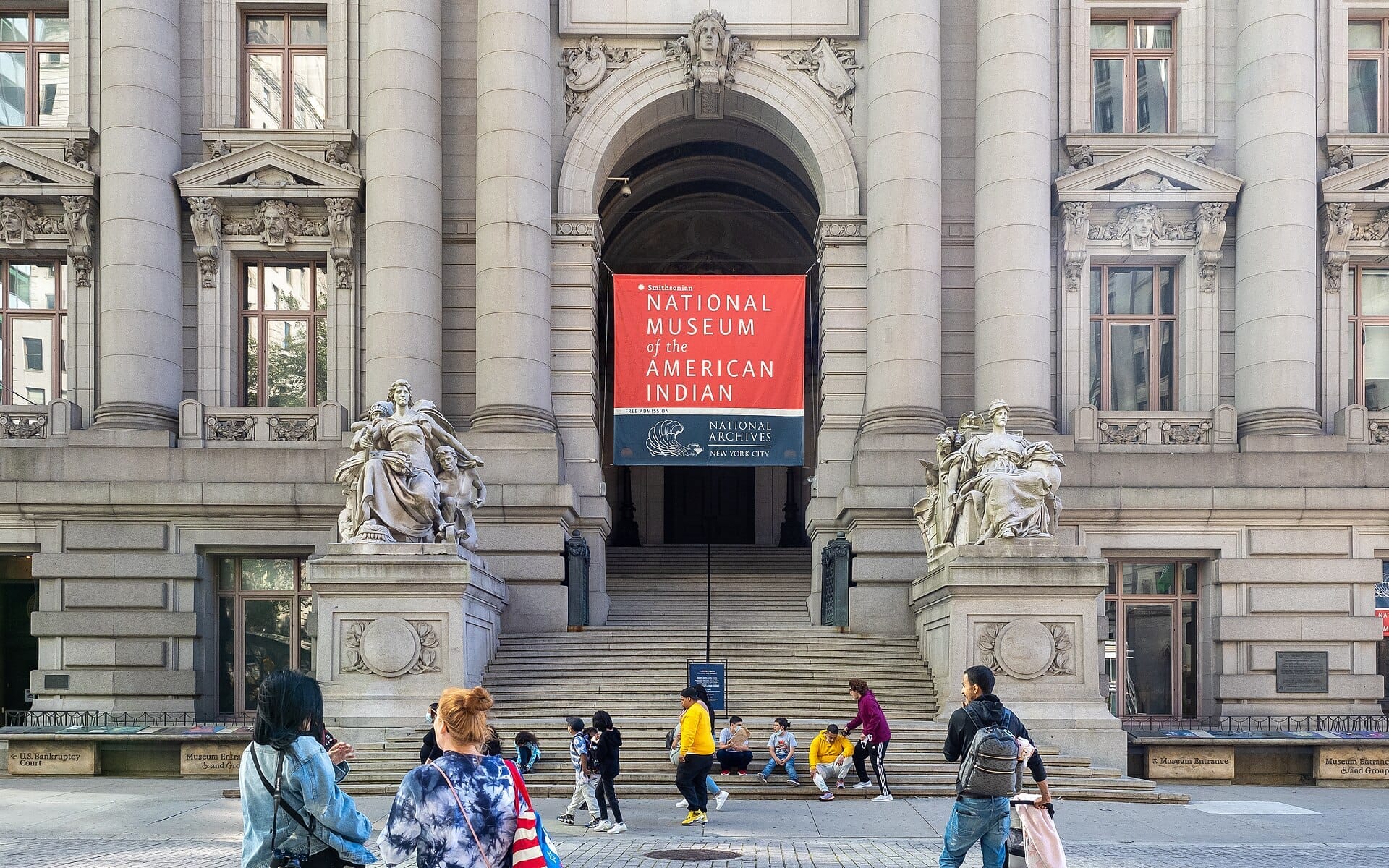
Before you look at a single artifact, pause in the rotunda. The Alexander Hamilton U.S. Custom House was designed by architect Cass Gilbert in the Beaux-Arts style and completed in 1907. Gilbert also designed the Woolworth Building, and the Custom House shares its DNA: massive in scale, obsessive in ornamental detail, and designed to project the authority of the federal government at a time when New York Harbor was processing enormous volumes of international trade.
The oval rotunda is ringed by murals by Reginald Marsh, painted in 1937 as part of a Works Progress Administration commission. They depict ships entering New York Harbor, the Statue of Liberty, skyscrapers, and the machinery of global commerce — a reminder that this building once functioned as the gateway through which vast wealth entered the United States. The ceiling curves overhead with coffered plasterwork and skylights that flood the space with soft, diffused light. The floor is a mosaic of white marble. It's the kind of space that makes you speak quietly without being told to.
Outside, the building's facade on Bowling Green faces one of Manhattan's oldest public spaces, a small oval park that served as a farmers' market and recreational green in the 17th century. Four sculptural figures by Daniel Chester French (who later carved the Lincoln Memorial statue) sit at the base of the building's entry stairs, representing the four continents as imagined in the early 20th century. The fifth continent, America, is placed above the central entrance — a deliberate choice by Gilbert to emphasize New York's position as the commercial heart of the Western world.
The Custom House's exterior stonework repays close attention even before you go inside. If you're building an architecture-focused day, pair this visit with nearby sites like Wall Street and then continue uptown via our New York City architecture guide.
Tickets & tours
Hand-picked options from our booking partner. Prices are indicative; availability and final rates are confirmed when you complete your booking.
Whitney Museum of American Art and Manhattan Walking Tour
From 49 €Instant confirmationFree cancellationNew York American Museum of Natural History and In App Audio Tour
From 0 €Instant confirmationNYC American Museum of Natural History family private tour
From 326 €Instant confirmationFree cancellationNew York City evening lights sail on America 2.0
From 46 €Instant confirmationFree cancellation
The Galleries: What to Expect Inside
The permanent and rotating exhibitions occupy the ground floor and are organized thematically rather than chronologically or geographically, which reflects the museum's collaborative approach with Native communities. Rather than presenting Indigenous peoples as historical subjects to be observed, the exhibitions are designed with tribal nations as active participants in how their cultures are presented and interpreted.
Beadwork, regalia, pottery, weavings, sculptures, and everyday objects from across North, Central, and South America are displayed alongside films, oral histories, and contextual text written in consultation with community members. The museum doesn't shy away from difficult subject matter: colonization, land dispossession, and forced assimilation are addressed directly rather than euphemistically. That intellectual honesty sets it apart from older natural history presentations of Indigenous cultures.
The exhibitions rotate periodically, so the specific shows on view at any given time will vary. Check the official Smithsonian site before your visit to see what's currently installed. Special exhibitions sometimes require more time than the permanent collection alone would suggest, so build in flexibility.
ℹ️ Good to know
The museum runs free public programs including dance performances, film screenings, and curator talks on a rotating schedule. Check americanindian.si.edu/visit/ny for the current calendar before your visit.
How the Experience Changes by Time of Day
Weekday mornings between 10:00 AM and noon are the quietest window. School groups occasionally visit, but they tend to come mid-morning on weekdays and clear out by early afternoon. If you're visiting with children of your own and want a calmer environment, aim for Tuesday or Wednesday mornings.
Midday on weekends brings the largest crowds, particularly in summer and during fall foliage season when Lower Manhattan sees heavier tourist traffic. The rotunda, which is a natural gathering and photograph point, can become congested between roughly 11:30 AM and 2:00 PM on busy days. Even then, the galleries themselves rarely feel overcrowded — the Custom House is simply too large.
Late afternoon, particularly after 3:30 PM, sees visitor numbers drop off noticeably. The quality of natural light in the rotunda is softer and more golden at this hour, which makes it one of the better times for photography. The museum closes at 5:00 PM, so arriving after 4:00 PM limits how much you can cover, but a focused 45-minute visit to the rotunda and one exhibition is entirely feasible.
Getting There and Getting Around the Neighborhood
The most direct subway access is the 4 or 5 train to Bowling Green, which deposits you on Broadway directly across from the Custom House. From there, the front entrance on Bowling Green is about a two-minute walk. Alternatively, the R and W trains stop at Whitehall Street, the 1 train stops at Rector Street or South Ferry, and the J and Z stop at Broad Street. From any of these, the walk is under five minutes.
The museum sits at the southern tip of Manhattan, placing it naturally within a half-day itinerary that also takes in the surrounding waterfront. Battery Park is directly across the street, and the Staten Island Ferry terminal is about a 10-minute walk to the west. The 9/11 Memorial is roughly 15 minutes on foot to the north.
The neighborhood rewards slow walking. Battery Park offers waterfront views toward the harbor and connects to ferry services for the Statue of Liberty and Ellis Island. For a fuller picture of Lower Manhattan's layered history, the 9/11 Memorial sits a short walk north and works well as either a preceding or following stop.
Accessibility and Practical Details
The museum is fully accessible to visitors with disabilities. The ground floor entrance and all exhibitions are wheelchair accessible, and wheelchairs are available on a first-come, first-served basis from security staff at the ground floor entrance. Visitors who require additional accessibility services, such as ASL interpretation or specific accommodations, should contact the museum in advance to discuss arrangements.
There is no coat check, so plan accordingly in winter. The Custom House interior is temperature-controlled and a welcome reprieve from both summer heat and winter cold. Bags are subject to a standard security check at entry. Photography is generally permitted in the galleries without flash, but check current signage for any temporary exhibition restrictions.
⚠️ What to skip
The museum is closed on December 25. On all other federal holidays it remains open, but public programs may be modified. Verify hours during major holidays at americanindian.si.edu/visit/ny.
Who This Museum Is Not For
If you're looking for a large, multi-floor encyclopedic museum experience with dozens of galleries and a full day of content, this is not that. The New York branch occupies only part of the Custom House's ground floor, and even with rotating exhibitions, most visitors cover everything comfortably in under two hours. Visitors expecting the scale of the Metropolitan Museum of Art or the American Museum of Natural History will find this more compact.
The museum also takes a deliberately reflective and sometimes uncomfortable approach to its subject matter. Visitors seeking a straightforward celebration of historical craftsmanship without engagement with the political and historical context of colonization may find the framing challenging. That framing is, in the opinion of most scholars who have written about the museum, precisely what makes it valuable — but it's worth knowing what you're walking into.
If you're building a broader itinerary around New York's cultural institutions, the best museums in New York City guide covers both major and lesser-known options across all five boroughs.
Insider Tips
- The Reginald Marsh murals in the rotunda are rarely discussed in guidebooks but are among the finest examples of WPA-era public art in the city. Look up and take your time with them before heading into the galleries.
- The Custom House's second floor is not part of the museum, but the exterior staircase and facade are publicly accessible and worth photographing from street level. The four Daniel Chester French allegorical figures at the base of the stairs are often overlooked by visitors heading straight for the entrance.
- Free public programs including Native dance performances are held in the rotunda on select days. These are posted on the museum's event calendar and are some of the most memorable free experiences available anywhere in Lower Manhattan. Check the schedule before you go.
- The museum shop carries a well-curated selection of books, jewelry, and art objects made by Native artists. If you're looking for a thoughtful and ethically sourced souvenir from New York, it's one of the better options in the city.
- Combine this visit with the nearby Oculus and the 9/11 Memorial for a full Lower Manhattan half-day that spans architecture, history, and memorial culture without spending anything on admission.
Who Is National Museum of the American Indian For?
- History and cultural heritage travelers who want depth over spectacle
- Architecture enthusiasts drawn to Beaux-Arts civic buildings
- Budget-conscious visitors who don't want to compromise on quality
- Families with older children ready to engage with complex historical narratives
- Travelers doing a Lower Manhattan walking itinerary who want a meaningful indoor stop
Nearby Attractions
Other things to see while in Lower Manhattan:
- National September 11 Memorial
The National September 11 Memorial occupies the original footprints of the Twin Towers in Lower Manhattan. The outdoor reflecting pools are free and open daily from 8:00 a.m. to 8:00 p.m. This page covers the memorial plaza; for the underground museum, see our separate museum guide.
- National September 11 Museum
The National September 11 Museum sits beneath the World Trade Center memorial plaza in Lower Manhattan. The 110,000-square-foot underground museum documents the attacks of September 11, 2001, and February 26, 1993, and is one of the most emotionally significant museum experiences in the United States. The outdoor memorial pools are free; museum admission requires a timed ticket.
- Battery Park
Perched at the southernmost tip of Manhattan, The Battery is a free waterfront park offering sweeping views of New York Harbor, access to the Statue of Liberty and Ellis Island ferries, and nearly four centuries of layered history. It works well at any hour, but rewards those who arrive early.
- Ellis Island National Museum of Immigration
Ellis Island National Museum of Immigration sits in New York Harbor on ground that shaped American history more than almost any other. Reached only by ferry, it offers a deeply affecting look at the 12 million immigrants who passed through between 1892 and 1954, housed in a landmark Beaux-Arts building that has been meticulously restored.