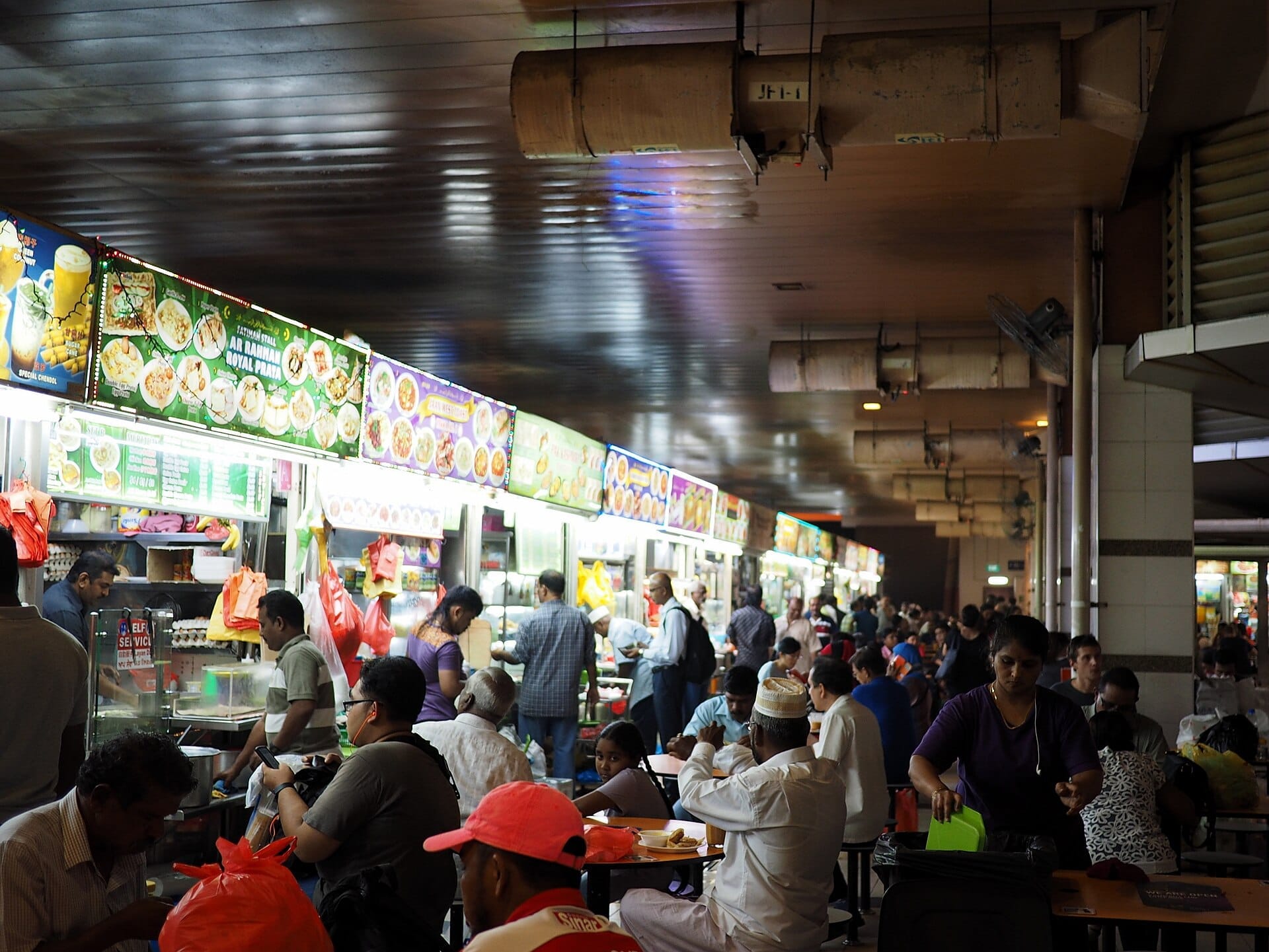
Little India is Singapore's most atmospheric ethnic enclave, centered on Serangoon Road and radiating outward through a dense grid of spice merchants, textile shops, Hindu temples, and hawker stalls. It has anchored the city's South Asian community since the 1820s and remains a living neighborhood, not a theme park version of one.
Little India is where Singapore stops feeling like a managed city-state and starts feeling like something older and less predictable. The air smells of jasmine garlands and turmeric, temple music spills out onto the street at odd hours, and the commercial intensity of Serangoon Road at evening feels closer to Chennai than Changi. It is one of the few neighborhoods in Singapore where the tourist experience and the local one are genuinely the same thing.
Orientation
Little India sits roughly one kilometer north of the Singapore River, in the central region of the island. The neighborhood's backbone is Serangoon Road, which runs north-northeast from Rochor Canal Road through the heart of the district. The rough boundaries are Syed Alwi Road to the north, Jalan Besar and Kampong Kapor Road to the east, and the canal and Race Course Road to the west and south. Campbell Lane, Dunlop Street, Kerbau Road, and Buffalo Road are the cross-streets that matter most for day-to-day navigation.
The neighborhood sits between two distinct zones: Kampong Glam, the Malay-Muslim quarter, lies to the east across Jalan Besar, while the civic district and Orchard Road corridor are accessible to the south. This positioning means Little India is genuinely central, easy to reach from almost any part of the city in under twenty minutes by MRT.
For a wider picture of how Little India fits into the city's network of heritage districts, the where to stay in Singapore guide offers useful spatial context across all major neighborhoods.
Character & Atmosphere
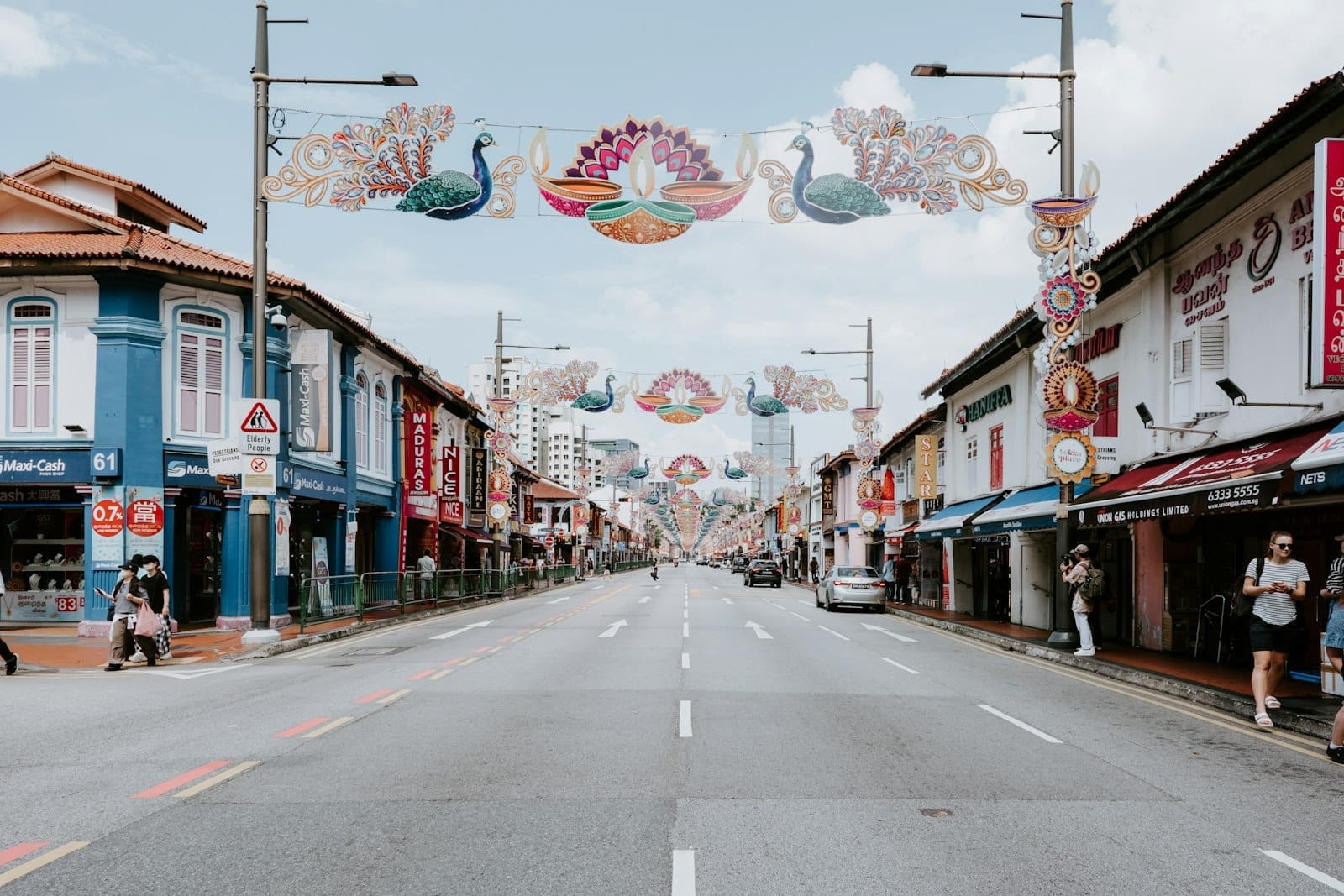
Little India operates on a different clock from the rest of Singapore. Walk along Serangoon Road at seven in the morning and you find flower sellers threading jasmine and marigolds outside temples, wet market vendors at Tekka Centre arranging fish and bitter gourd, and the smell of fresh dosa batter on a griddle drifting from a coffeeshop doorway. The light at that hour is soft and low, cutting between shophouse facades painted in mustard yellow and faded coral.
By mid-afternoon the heat concentrates between the shophouse blocks and foot traffic on the five-foot ways slows. This is when the spice shops, textile merchants, and gold jewelers along Serangoon Road are doing steady business with local residents running practical errands. Tourists are present but rarely outnumber residents. The neighborhood was gazetted as a conservation area in 1989, so the two- and three-story shophouse rows remain largely intact, giving the streets a human scale that Orchard Road has long since abandoned.
After six in the evening, Little India transforms. Migrant workers from South Asia, who make up a significant portion of Singapore's construction and service workforce, gather in large numbers along Serangoon Road, particularly on weekends. The streets become louder, more crowded, and more economically layered than almost anywhere else in Singapore. It is not threatening in any meaningful sense, but if you are expecting the quiet orderliness of the Civic District, Little India on a Saturday night will surprise you. This is one of the neighborhood's genuine appeals: it is the most visibly working-class part of central Singapore.
ℹ️ Good to know
Deepavali (Festival of Lights) transforms Little India each October or November. The stretch of Serangoon Road between Campbell Lane and Race Course Road is decorated with elaborate light installations and draws large crowds. Book accommodation well in advance if you plan to visit during this period. Thaipusam, in January or February, brings a ceremonial procession through the neighborhood and is one of the most visually striking public events in Singapore.
What to See & Do
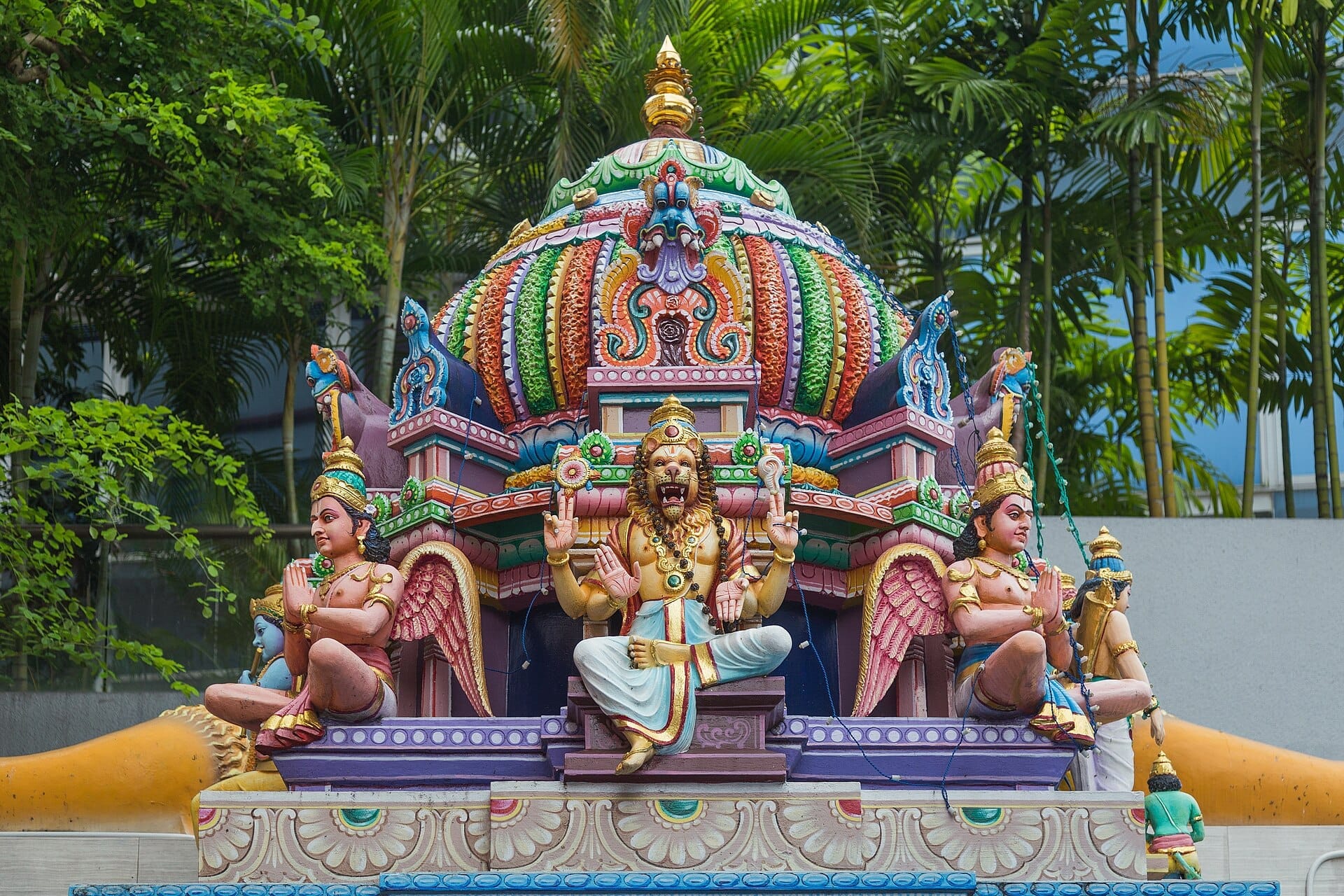
The neighborhood's religious architecture is its most impressive feature. Sri Veeramakaliamman Temple on Serangoon Road, dedicated to the goddess Kali, dates to 1881 and features a towering gopuram (entrance tower) covered in painted deities. It is an active place of worship and the most visually elaborate temple in the district. Remove your shoes before entering and be respectful of ongoing prayers.
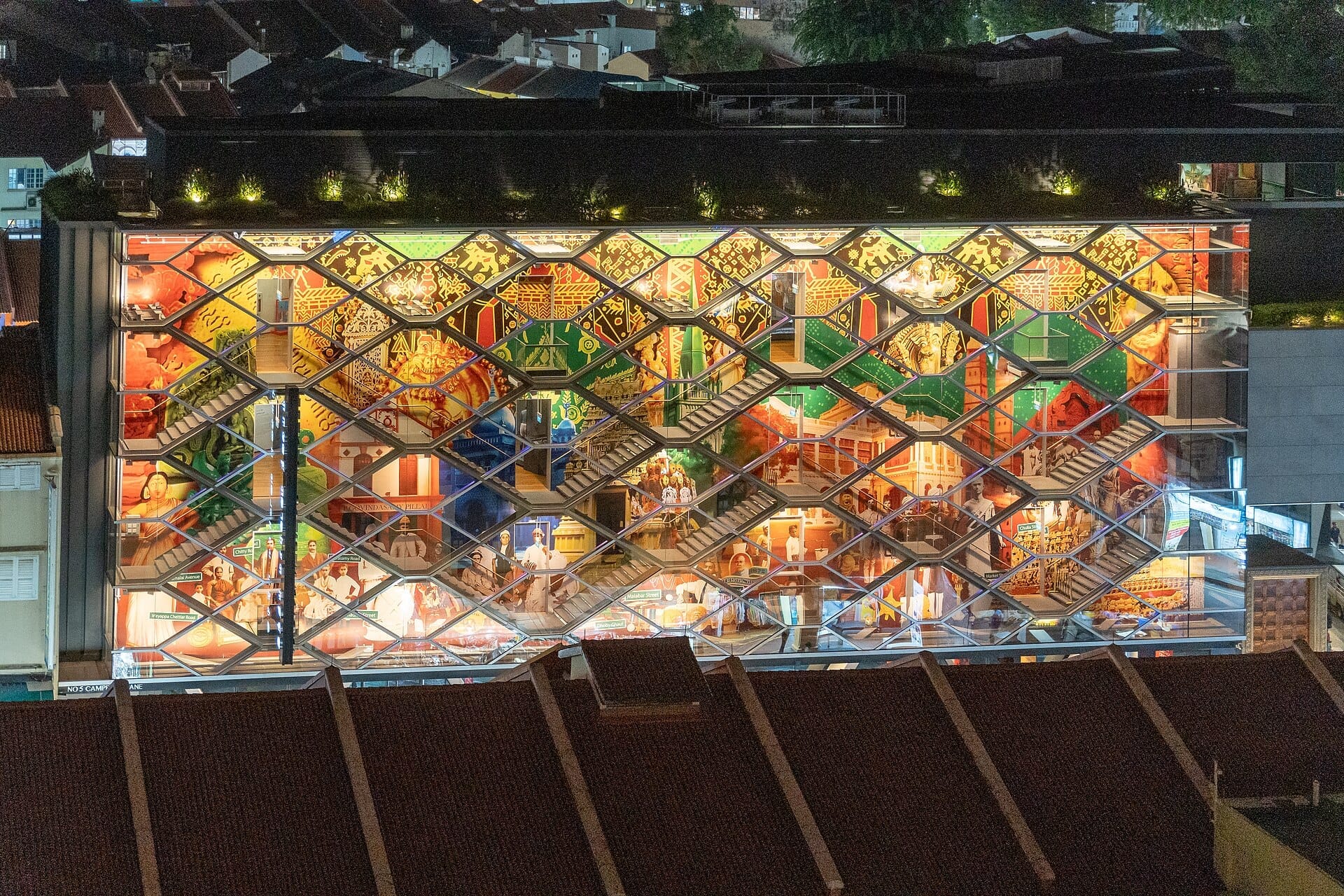
Further north along Serangoon Road, Sri Srinivasa Perumal Temple at No. 397 anchors the neighborhood's northern end. Its gopuram is among the tallest in Singapore and is the starting point of the Thaipusam procession. The temple is an active place of worship. The Indian Heritage Centre on Campbell Lane is the best single resource for understanding how the South Asian community shaped Singapore from the 1820s onward. The permanent galleries cover migration patterns, religious practice, trade networks, and cultural adaptation across four floors of well-curated space.
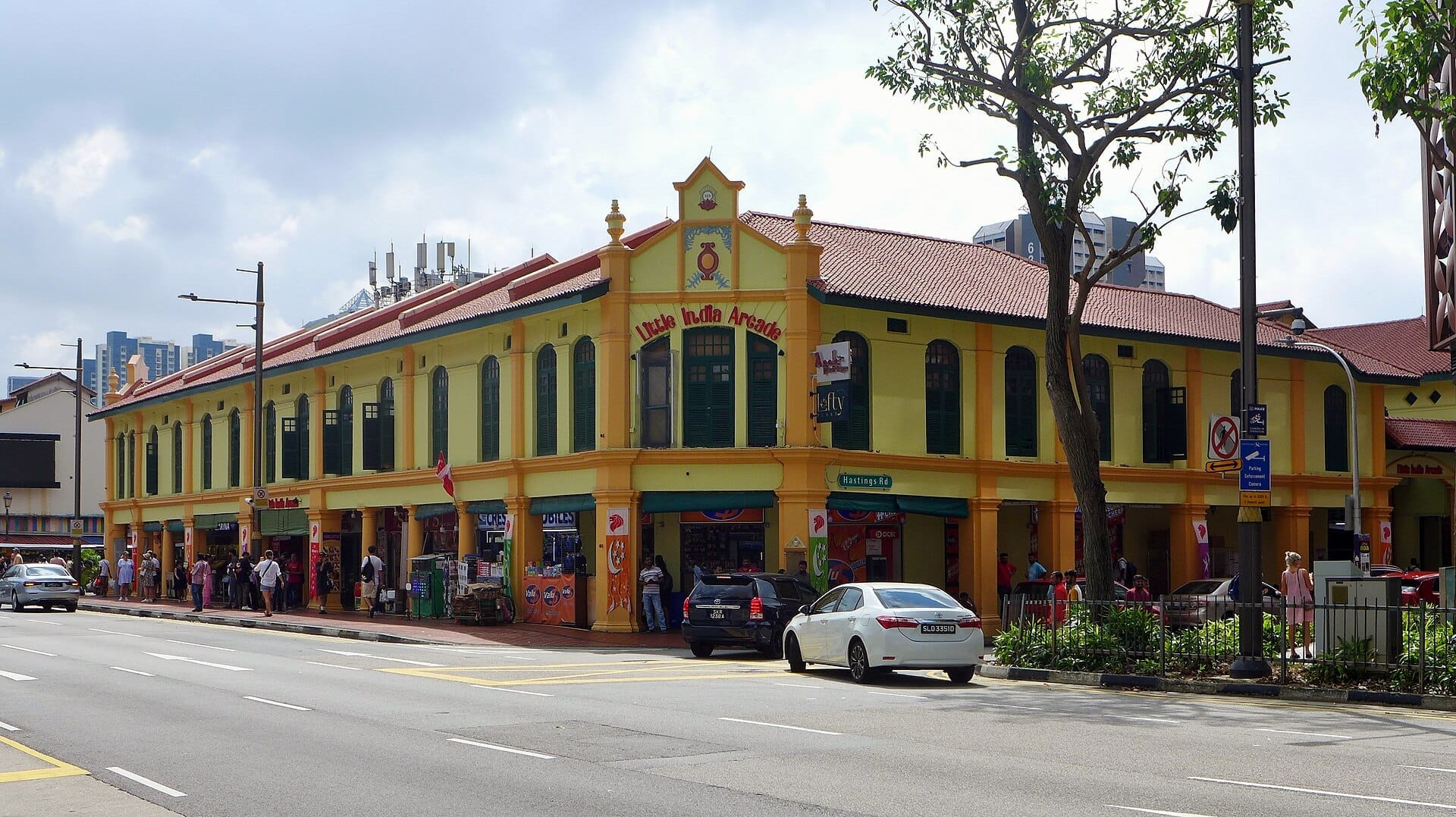
The Little India Arcade at 48 Serangoon Road is a compact block of traditional shops selling everything from brass puja items and incense to Bollywood DVDs and Ayurvedic remedies. It functions as a practical shopping destination for the local community as much as a tourist attraction. Around the corner, the Mustafa Centre at 145 Syed Alwi Road is a phenomenon unto itself: a 24-hour, six-floor retail labyrinth selling electronics, textiles, jewelry, spices, currency exchange, and groceries. It is chaotic, exhausting, and genuinely useful.
Sri Veeramakaliamman Temple (Serangoon Road): active Hindu temple, open to visitors during non-prayer hours
Sri Srinivasa Perumal Temple (397 Serangoon Road): Thaipusam procession starting point
Indian Heritage Centre (5 Campbell Lane): four-floor museum on Singapore's Indian community
Little India Arcade (48 Serangoon Road): traditional shops, spices, religious goods
Mustafa Centre (145 Syed Alwi Road): 24-hour shopping on a grand and disorienting scale
Tekka Centre (665 Buffalo Road): wet market on the ground floor, hawker stalls above
Kerbau Road shophouse row: best-preserved example of Little India's colonial-era streetscape
Eating & Drinking
Little India has some of the most concentrated and affordable South Indian, North Indian, and Sri Lankan food in the city. The Tekka Centre on Buffalo Road is the neighborhood's primary hawker hub, with stalls serving roti prata, biryani, fish head curry, banana leaf rice, and Indian-style mee goreng from early morning through late afternoon. It is a multi-ethnic hawker centre, so you will also find Chinese and Malay stalls, but the Indian food here is the draw.
Banana leaf rice is the format to understand: steamed rice served on a fresh banana leaf with an array of vegetable curries, papadum, and your choice of meat or fish curry ladled over the top. Several long-running restaurants along Race Course Road specialize in this format, and the practice of dining off a leaf on a formica table in a room full of ceiling fans is as close to old-world South Indian restaurant culture as you will find outside South Asia.
For breakfast, the roti prata scene is strong throughout the district. The flatbread is cooked on a large griddle, served with dhal and fish or mutton curry on the side. Kosong (plain) and egg are the standard options, though cheese and onion variations exist. Walk along Dunlop Street or Belilios Road in the morning and you will pass several coffeeshops serving this alongside teh tarik, the pulled milk tea that is Singapore's most democratic drink.
Craft beer bars and casual cafes have opened in the shophouse blocks around Dunlop Street and Hindoo Road over the past decade, catering to the younger crowd that has moved into the area's refurbished boutique guesthouses. These sit comfortably alongside the older establishments without replacing them, so you can have a cold local beer one door down from a decades-old biryani shop without any sense of incongruity.
💡 Local tip
If you want to eat at Tekka Centre, go before noon on a weekday. Stalls sell out of popular items by early afternoon, and weekend crowds make the ground floor particularly intense. The upper floor hawker stalls tend to be less crowded and equally good.
For a broader view of Singapore's hawker culture and what to eat across the island, the Singapore hawker centres guide provides the essential context.
Getting There & Around
Little India MRT station (NE7 on the North East Line, DT12 on the Downtown Line) is the main entry point for most visitors. It deposits you directly onto Serangoon Road at the southern end of the neighborhood. The two-line interchange means you can reach Little India from Clarke Quay (two stops south on the NEL), Bugis (one stop east on the DTL), or Chinatown (three stops south on the NEL) without changing trains.
Farrer Park MRT station (NE8, one stop north of Little India) serves the northern part of the neighborhood, including Mustafa Centre, which is about a five-minute walk from the exit. If you are specifically heading to Mustafa or the temples further along Serangoon Road, Farrer Park is the more convenient exit.
The neighborhood is compact and best navigated on foot. The distance from Little India MRT to Mustafa Centre along Serangoon Road is roughly 600 meters and takes about ten minutes at a relaxed pace. Side streets like Kerbau Road, Campbell Lane, and Dunlop Street are worth the detour and add only a few minutes to any walk. Bus services including routes 23, 64, 65, 67, 131, 139, 147, and 857 run along Serangoon Road for those who want to continue north toward Boon Keng or Geylang.
💡 Local tip
Grab and Gojek both operate throughout Little India. Pickup spots can be congested on weekend evenings along Serangoon Road. If you are leaving after 9 PM on a Saturday, walk one block east to Jalan Besar or one block west to Race Course Road for a less hectic pickup point.
Where to Stay
Little India has a well-developed budget and mid-range accommodation scene, concentrated in the shophouse blocks between Dunlop Street and Dickson Road. This strip of restored heritage buildings has been gradually converted into boutique guesthouses and small hotels over the past two decades. The rooms tend to be compact but the character of the buildings, with their tiled corridors and courtyard light wells, makes up for it.
Staying in Little India puts you within walking distance of Kampong Glam to the east and a short MRT ride from Marina Bay and the civic district to the south. It is a logical base for travelers who want centrality without the premium pricing of the Marina Bay or Orchard Road hotel corridors. The trade-off is noise: Serangoon Road does not go quiet until well past midnight, and weekend nights bring elevated street activity. Rooms on the upper floors of buildings set back from the main road mitigate this significantly.
Little India is best suited to independent travelers who want neighborhood texture over hotel amenity stacks. Families with young children and travelers with mobility concerns may find the crowded pavements and sensory intensity of the main thoroughfare more tiring than charming.
Practical Tips & Honest Assessment
Little India is one of the most photogenic and culinarily rewarding neighborhoods in Singapore, but it helps to visit with realistic expectations. The conservation area protects the shophouse architecture, but not every street inside the boundaries is beautiful. The blocks immediately around Mustafa Centre are commercial and unglamorous, and parts of the neighborhood along Jalan Besar are undergoing ongoing redevelopment.
Safety is not a concern in any serious sense. Singapore has very low violent crime rates across the island, and Little India is no exception. The weekend crowds can feel overwhelming to some visitors, particularly along the stretch of Serangoon Road between the MRT and Syed Alwi Road, but this is a crowd density issue rather than a safety one.
When visiting temples, dress modestly: shoulders and knees covered is the standard expectation. Shoes must be removed at the entrance of all Hindu temples. The Sri Veeramakaliamman Temple and Sri Srinivasa Perumal Temple are both active places of worship, not heritage museums, and visitors are welcome as long as they are respectful of ongoing rituals.
⚠️ What to skip
Little India is one of the noisier central neighborhoods in Singapore. The main temple on Serangoon Road conducts prayers with amplified music at specific times, street vendors are active until late, and weekend evenings bring significant foot traffic and outdoor noise. If you are a light sleeper, request a room at the rear of your hotel or on a higher floor, and consider earplugs for Saturday nights.
Little India pairs naturally with a visit to Kampong Glam to the east: the two neighborhoods are about fifteen minutes apart on foot via Jalan Besar, and together they form the most culturally layered half-day itinerary in central Singapore. See the things to do in Singapore guide for suggested routes combining both districts.
TL;DR
Little India is Singapore's most sensory and culturally specific neighborhood: Hindu temples, spice merchants, gold jewelers, and South Indian food at prices the rest of the city can't match.
Best visited in the morning for the market atmosphere at Tekka Centre or in the evening for the street energy along Serangoon Road, though weekends bring significant crowds.
The Indian Heritage Centre on Campbell Lane is the single best starting point for first-time visitors: it provides historical context that makes everything else in the neighborhood more legible.
Well-suited to independent travelers, food-focused visitors, and anyone interested in Singapore's ethnic heritage. Less ideal for travelers seeking quiet, minimal stimulation, or upscale hotel amenities.
Two MRT lines serve the neighborhood directly, and the compact street grid makes it entirely navigable on foot.
Singapore sits just one degree north of the equator, which means warm, humid weather all year round. But that doesn't mean every month is equal. This guide breaks down the best time to visit Singapore by weather, crowds, festivals, and budget so you can plan a trip that actually works.
Singapore has one of the most efficient public transport systems in the world. This guide covers everything from MRT fares and bus routes to taxis, ride-hailing apps, and how to get from Changi Airport to the city centre without overpaying.
Singapore is compact, well-connected, and surrounded by islands, jungle, and a whole other country just across the Causeway. Whether you want to cycle through mangroves, shop across the border, or laze on a beach, these are the day trips that actually deliver. Here is what to expect, how to get there, and what to skip.
Singapore packs more culinary diversity per square kilometre than almost any city on earth. This guide breaks down the essential dishes, the best hawker centres, neighbourhood food streets, and honest advice on where to spend your appetite and your Singapore dollars.
Singapore's hawker centres are where the city's food culture lives. With over 110 centres and 6,000 stalls serving Chinese, Malay, Indian, and fusion dishes for under $10 SGD, this guide covers everything from the best centres to visit, to unwritten rules locals actually follow.
Whether you have a long weekend or a full week, Singapore rewards every length of stay. This itinerary guide builds day by day, from the essential Marina Bay icons and multicultural neighborhoods to wildlife parks, island escapes, and local food pilgrimages.
Singapore is one of Asia's premier shopping destinations, with low import tariffs, world-class malls, and lively street markets all within a compact city. This guide cuts through the noise to tell you exactly where to shop, what to expect, and how to get the best value.
Singapore is one of the easiest cities in the world to travel with children. World-class wildlife parks, interactive museums, beach days, and theme park thrills are all packed into a compact, safe, and well-connected island. This guide covers the best family attractions in Singapore, organized by experience type so you can plan a trip that keeps kids genuinely excited from morning to night.
Singapore packs an extraordinary range of experiences into just 733 square kilometres. This guide covers the top things to do in Singapore, from world-class attractions and neighbourhood food trails to nature reserves and cultural landmarks, with honest assessments of what's worth your time and money.
Choosing where to stay in Singapore shapes your entire trip. This guide breaks down every major area by character, price range, and practical pros and cons, so you can book with confidence regardless of your budget or travel style.