Indian Heritage Centre: Four Floors of South Asian History in the Heart of Little India
Opened in 2015, the Indian Heritage Centre in Singapore's Little India traces the origins, migration, and cultural contributions of the Indian diaspora across Southeast Asia. Housed in a striking building inspired by ancient stepwells, it is one of the most thoughtfully curated heritage museums in the city.
Quick Facts
- Location
- 5 Campbell Lane, Little India, Singapore 209924
- Getting There
- Little India MRT (NE7/DT11) — turn right out of exit, walk to Campbell Lane
- Time Needed
- 1.5 to 2.5 hours
- Cost
- Free for Singaporeans & PRs; S$8 adult / S$5 child for foreigners
- Best for
- History buffs, families, first-time visitors to Little India
- Official website
- www.indianheritage.gov.sg
What the Indian Heritage Centre Actually Is
The Indian Heritage Centre (Tamil: இந்திய மரபுடமை நிலையம்) is a four-storey, government-run heritage museum dedicated to the history and culture of Singapore's Indian community and its broader diaspora roots across South and Southeast Asia. It opened on 7 May 2015 and covers 3,090 square metres of gallery space across its floors. This is not a temple, not a cultural performance hall, and not a shopping arcade. It is a serious, well-funded museum with permanent galleries, rotating exhibitions, and a small collection of genuine artefacts, archival photographs, and interactive displays.
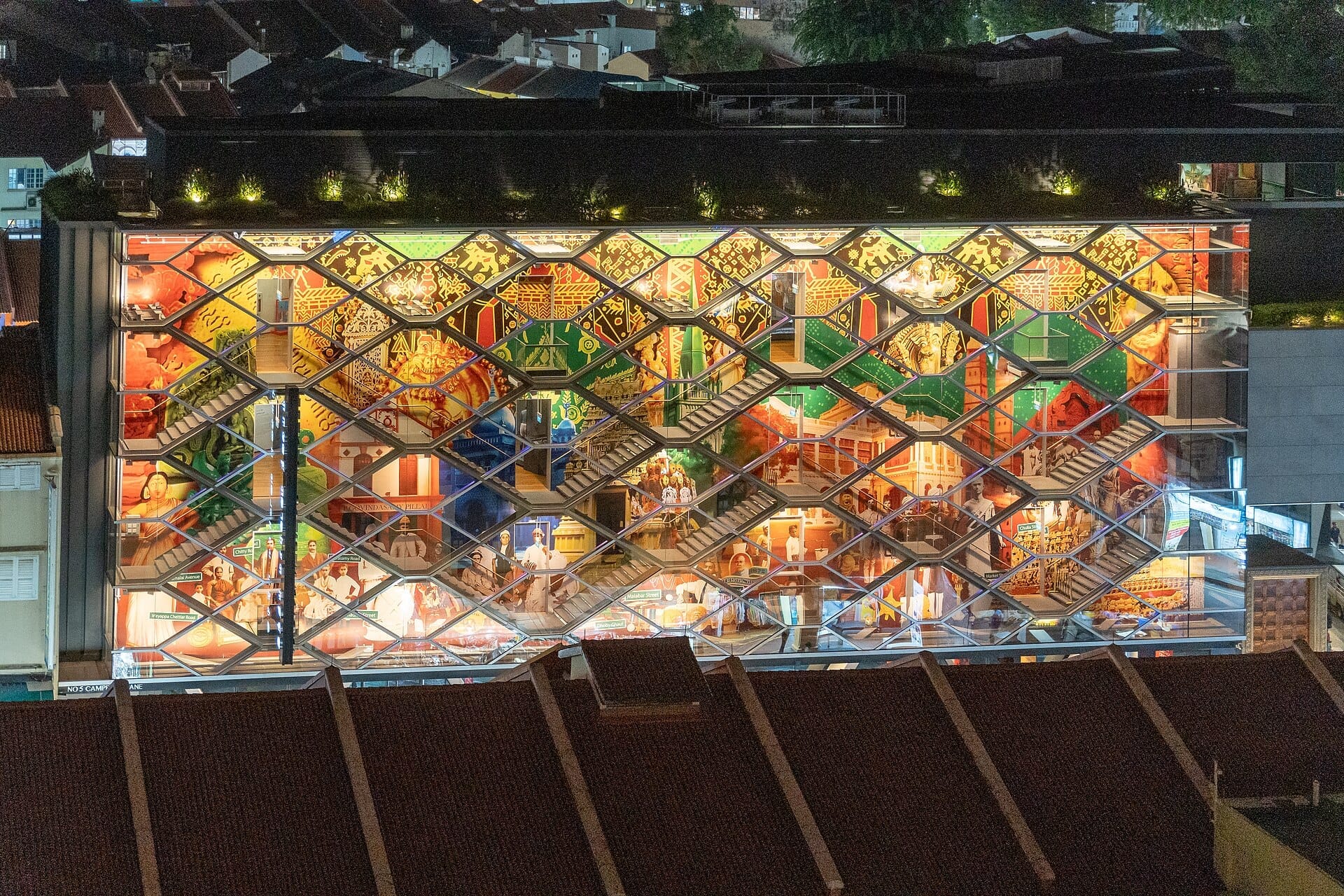
The building itself is worth pausing outside before you enter. Its facade is modelled on a baoli, the ancient Indian stepwell architecture found across Rajasthan and Gujarat, where stepped terraces descend toward water. Here, the motif is translated into a geometric trellis of steps and balconies that climb the exterior wall. On a clear morning, the light catches the lattice in ways that make it worth photographing before the tour groups arrive.
💡 Local tip
The centre is closed on Mondays. Plan your visit for Tuesday through Sunday, and arrive before 11:00 AM if you want the galleries largely to yourself.
The Galleries: What You Will Actually See
The permanent collection is organised chronologically and thematically across four levels. The journey begins on the ground floor with the ancient maritime trade routes that connected the Indian subcontinent to Southeast Asia long before colonial boundaries existed. Artefacts, maps, and illustrations show how Indian merchants, priests, and scholars arrived in this region centuries before Singapore was established as a British trading port in 1819.
As you move upward, the narrative shifts to the colonial era and the waves of Indian migration that followed. The galleries here are detailed and specific: you will see displays on the different communities that made up the 'Indian' diaspora, including Tamil labourers, Sindhi traders, Sikh policemen, Chettiars (Tamil moneylenders), and Bengali professionals. This granularity matters. The Indian community in Singapore was never a monolithic group, and the centre is careful to show its internal diversity through community portraits, clothing, religious objects, and personal testimonies.
Upper floors cover the post-independence period and the role of Indian Singaporeans in building the modern nation. There is a section on languages, another on religious practice across Hindu, Muslim, Sikh, and Christian communities, and a rotating exhibition space on the top level that changes a few times a year. Check the official website before visiting to see what is currently showing.
ℹ️ Good to know
Audio guides are available and add meaningful context, especially for the colonial-era galleries where labels alone can feel sparse. Ask at the ticket counter.
Tickets & tours
Hand-picked options from our booking partner. Prices are indicative; availability and final rates are confirmed when you complete your booking.
Singapore Little India self-guided walking audio tour
From 13 €Instant confirmationFree cancellationAdventure Cove Waterpark™ e-ticket
From 27 €Instant confirmationWild Wild Wet Waterpark Entrance Ticket
From 15 €Instant confirmationLion City bike tour in Singapore
From 55 €Instant confirmationFree cancellation
How the Experience Changes by Time of Day
Early mornings on weekdays are the quietest. The ground floor gift shop is still settling in, the school groups have not yet arrived, and you can take your time with the larger floor maps and introductory panels without navigating around a crowd. The natural light from the building's trellis facade filters into the lobby at this hour in a way that is genuinely pleasant.
Weekend afternoons are a different experience. Family groups, including many Indian-Singaporean families who come specifically for the cultural connection, fill the upper galleries. Children cluster around interactive touchscreens. This is not necessarily a negative: there is a certain energy to seeing a community engage with its own history, and the museum staff are generally present and willing to explain context. But if you are looking for quiet contemplation, stick to weekday mornings.
By late afternoon, the galleries thin out again. This is a good time for the upper floors, where some of the more personal exhibits on post-independence identity tend to reward slower reading without interruption.
The Surrounding Neighbourhood: Little India Context
The Indian Heritage Centre sits at the end of Campbell Lane, one of the more photogenic streets in Little India. Step outside and you are immediately in the working fabric of the neighbourhood: flower garland sellers, textile shops, the persistent smell of incense from nearby temples, and the sound of Tamil music from open shopfronts. The museum provides intellectual framework; the street provides the lived reality. Doing both in the same visit makes each richer.
A short walk from the centre brings you to the Sri Veeramakaliamman Temple, one of the oldest and most visually striking Hindu temples in Singapore, dedicated to the goddess Kali. The temple dates to 1881 and its gopuram (entrance tower) is covered in sculpted figures. Visiting both the museum and the temple on the same morning gives you a layered understanding of Tamil religious culture that neither experience alone provides as completely.
For food, Tekka Centre is a ten-minute walk away. This wet market and hawker centre is one of the most authentic in Singapore for Indian and South Asian cooking, including roti prata, fish head curry, and freshly pressed sugarcane juice. It is best experienced at breakfast or lunch.
Photography and Practical Walkthrough
Photography is permitted in the permanent galleries without flash. The building's interior is relatively dim in some sections, which is good for preservation but means your phone camera may struggle. The baoli-inspired atrium near the staircase is the best architectural shot inside the building, and midday natural light reaches it reasonably well.
The museum is air-conditioned throughout, which is welcome given Singapore's heat. Wear comfortable shoes. The four floors are connected by stairs and a lift, making the centre accessible for visitors with mobility limitations, though specific accessibility facilities are best confirmed with the centre directly before visiting.
Allow at least 90 minutes for a complete visit if you read the exhibit labels carefully. Two hours is more realistic if you engage with the audio guide or interactive stations. The gift shop on the ground floor stocks a small selection of books on Indian-Singaporean history, textiles, and cultural artefacts. The quality is above average for a museum shop.
⚠️ What to skip
The centre is closed on Mondays. Admission fees listed here (S$8 adult, S$5 child for foreigners; free for Singaporeans and Permanent Residents) are verified as of May 2025 but should be confirmed at the official website before visiting.
Is It Worth Your Time? An Honest Assessment
For visitors with a genuine interest in history, migration, or South Asian culture, the Indian Heritage Centre is one of the better-curated heritage museums in Singapore. The collection is thoughtfully assembled, the labelling is clear and detailed, and the building itself is architecturally distinctive in a city where modern glass-and-steel dominates.
Visitors who prefer hands-on or immersive experiences may find some sections more text-heavy than engaging. Children under ten may lose interest by the second floor unless they are specifically engaged with the interactive stations. If your priority is visual spectacle over historical depth, Gardens by the Bay or the ArtScience Museum may be a better fit for a short visit.
Travellers who skip this museum and only walk the street market miss the historical context that makes Little India more than just a sensory experience. The museum does not replace the neighbourhood; it explains it.
Insider Tips
- Pick up a printed floor map at the counter on arrival. The gallery flow is not always intuitive from the staircase landings, and backtracking through floors wastes time.
- The external baoli facade is best photographed in the morning before the street fills with delivery vehicles and foot traffic. Come from the Dunlop Street end of Campbell Lane for a clear frontal shot.
- Free entry for Singaporeans and PRs applies year-round, not just during special promotions. If you are visiting with local friends, confirm this at the counter rather than assuming it applies to the whole group.
- Check the official website's events calendar before your visit. The rotating exhibition space on the upper floor occasionally hosts photography shows or contemporary art installations that are not widely advertised.
- Combine this visit with the nearby Little India Arcade for a complete morning: museum first for context, then the arcade for textiles, traditional goods, and street snacks.
Who Is Indian Heritage Centre For?
- First-time visitors to Singapore who want to understand its Indian community beyond the surface of the neighbourhood
- History and diaspora enthusiasts interested in South Asian migration and colonial-era Southeast Asia
- Families with older children (10+) who can engage with the text-heavy but visually supported galleries
- Photographers interested in heritage architecture and cultural portraiture context
- Travellers spending a half-day in Little India who want more than shopping and eating
Nearby Attractions
Other things to see while in Little India:
- Little India Arcade
Little India Arcade is a free-entry heritage shopping arcade at 48 Serangoon Road, sitting at the heart of Singapore's Indian cultural quarter. Housed in a conserved colonial shophouse block, it trades in jasmine garlands, saris, spices, and religious goods that you will not find in any mall. Compact enough to explore in under an hour, it rewards slow walkers who take time to look and smell.
- Sri Veeramakaliamman Temple
Standing on Serangoon Road since 1855, Sri Veeramakaliamman Temple is Singapore's first temple dedicated to the goddess Kali. Its 18-metre Dravidian tower, crowded with 600 hand-painted stucco figures, is one of the most photographed religious facades in the city. Entry is free, and the daily ritual schedule gives visitors genuine access to living worship.
- Tekka Centre
Tekka Centre at 665 Buffalo Road is one of Singapore's oldest and most atmospheric public markets, blending a working wet market, a packed hawker food centre, and floors of textile and spice traders. Free to enter and open daily from 6:30am to 9pm, it offers a concentrated dose of Indian-Singaporean daily life that no curated attraction can replicate.