Gardens by the Bay: What to Actually Expect (And What's Worth Paying For)
Gardens by the Bay is Singapore's signature green landmark: 105 hectares of sculpted gardens, climate-controlled conservatories, and towering vertical structures that glow after dark. Here is what each section delivers, and how to make the most of your time there.
Quick Facts
- Location
- Marina South, Singapore (behind Marina Bay Sands)
- Getting There
- Bayfront MRT (Circle/Downtown Line), Exit B
- Time Needed
- 3–5 hours for the full experience; 1.5 hrs for outdoors only
- Cost
- Outdoor gardens free; conservatories and attractions charged separately — check official website for current rates
- Best for
- Families, architecture lovers, evening walks, first-time visitors to Singapore
- Official website
- www.gardensbythebay.com.sg
What Gardens by the Bay Actually Is
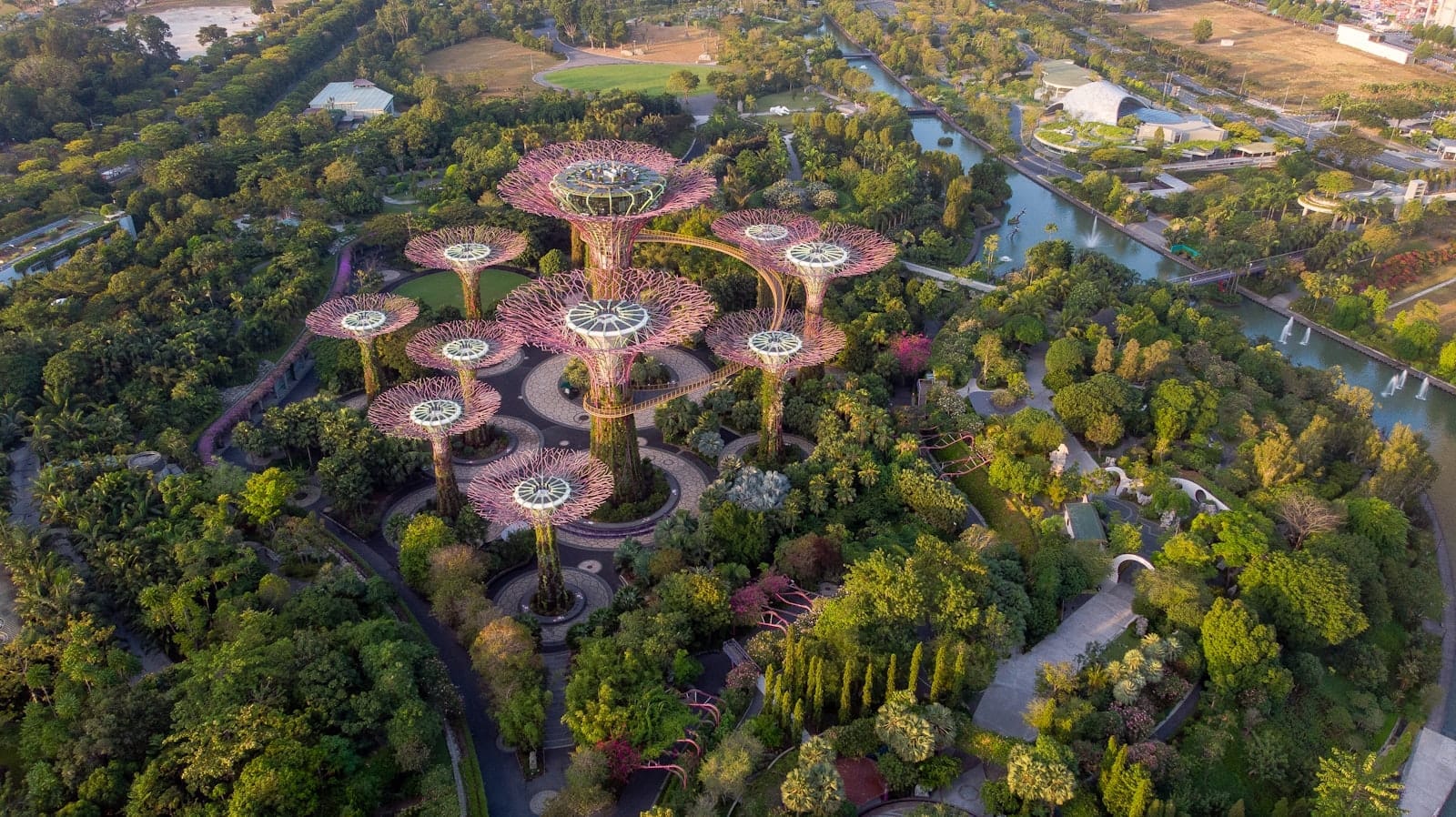
Gardens by the Bay is a 105-hectare public garden and horticultural showcase on reclaimed land at the southern tip of Singapore's city centre. It opened in 2012 as the centerpiece of Marina Bay's urban transformation and has since drawn over 12 million visitors a year. The scale is hard to grasp from photographs: three distinct waterfront gardens, a collection of more than 1.5 million plants from every continent except Antarctica, and a cluster of steel-and-vegetation towers that look unlike anything else on earth.
The gardens divide into three main sections: Bay South (the largest at 54 hectares, and the one most visitors mean when they say 'Gardens by the Bay'), Bay East, and Bay Central. Bay South is where you will find the Supertree Grove, the Flower Dome, and the Cloud Forest. Bay East is quieter and primarily a landscape park facing the sea. Note that the bridge connecting Bay South and Bay East has been completed, so crossing between them on foot is not currently possible.
ℹ️ Good to know
The outdoor gardens (including Supertree Grove and the walking paths) are free to enter and open around the clock. The conservatories and ticketed attractions have their own operating hours and admission fees — check the official website before you go, as prices are updated periodically.
The Supertrees: Better After Dark
The Supertrees are the defining image of modern Singapore. Eighteen of these vertical garden structures rise between 25 and 50 metres above the ground, their steel armatures covered in ferns, bromeliads, orchids, and climbing plants. During the day, they read as impressive engineering. After dark, they become something else entirely.
Every evening, the Supertrees are illuminated for the Garden Rhapsody light and sound show, which runs twice nightly. The trees shift through sequences of colour while ambient music plays across the grove. Crowds gather on the ground and along the OCBC Skyway, the elevated walkway that connects two of the largest Supertrees and gives you a view down into the grove and out across the bay towards Marina Bay Sands. Arriving around 30 minutes before the evening show gets you a good spot on the lawn without feeling pressed in on all sides.
In terms of practical function, the Supertrees are not just decorative. They serve as environmental engineering: twelve of the eighteen are fitted with photovoltaic cells that harvest solar energy, and several act as air exhaust receptacles for the conservatories beneath. The design, by landscape architects Grant Associates and structural engineers Atelier One, won the World Building of the Year award in 2012.
Tickets & tours
Hand-picked options from our booking partner. Prices are indicative; availability and final rates are confirmed when you complete your booking.
Self-guided Singapore exploration tours with downloadable app
From 7 €Instant confirmationNational Orchid Garden Singapore tickets
From 10 €Instant confirmationFree cancellationAdventure Cove Waterpark™ e-ticket
From 27 €Instant confirmationWild Wild Wet Waterpark Entrance Ticket
From 15 €Instant confirmation
Flower Dome: The World's Largest Glass Greenhouse
The Flower Dome holds a Guinness World Record as the largest glass greenhouse in the world, covering 1.28 hectares under a single free-span roof. The temperature inside hovers around a cool 23–25°C, a deliberate contrast to Singapore's typical 30°C-plus heat. The structure was designed by WilkinsonEyre Architects using a grid-shell of curved steel and glass that eliminates internal columns, creating an unobstructed growing space.
Inside, plants are arranged by Mediterranean and semi-arid climate region: baobab trees from Africa, cacti from the Americas, silver-leafed proteas from South Africa, and centuries-old olive trees from the Mediterranean basin. The dome also hosts rotating floral displays that change with the seasons, which is why repeat visitors often find something new. These installations can be impressive or anticlimactic depending on the current show; check the Gardens' event calendar before deciding whether to prioritize this over the Cloud Forest.
Cloud Forest: The Stronger of the Two Conservatories
If you are only going to pay for one conservatory, the Cloud Forest tends to be the one visitors remember. The moment the doors open, cool mist rolls out and the temperature drops noticeably. The structure encloses a 35-metre mountain covered in tropical montane vegetation, including orchids, ferns, mosses, and pitcher plants that would typically be found at altitudes between 1,000 and 3,500 metres above sea level. One of the world's tallest indoor waterfalls cascades down the mountain's face, and the sound of falling water fills the base of the dome.
Visitors take a lift to the top of the mountain and walk a series of aerial walkways spiralling downward through different climate zones. The descent takes around 30–45 minutes depending on how long you linger. The walkways offer views out through the glass canopy toward the city skyline, which creates an unusual sensation: tropical wilderness framed by downtown towers. Children tend to respond well to the waterfall and the carnivorous plant displays. Adults who enjoy botanical detail will find enough to occupy them for an hour.
Timing Your Visit: Outdoors vs. Indoors
Singapore sits about one degree north of the equator, which means midday sun is genuinely harsh, especially from March through October. The outdoor sections of Gardens by the Bay, including the Supertree Grove and the Dragonfly and Kingfisher Lakes, are most comfortable in the early morning (before 9am) or in the hour before sunset. The late afternoon light is also flattering for photography, particularly around the lake edges and along the main Heritage Garden path.
The conservatories are the reverse: they are air-conditioned and make good use of midday hours when outdoor walking is uncomfortable. A practical approach is to do the conservatories between 11am and 2pm, then return outside as temperatures ease and stay for the evening light show. This structure makes a four-hour visit feel paced rather than exhausting.
⚠️ What to skip
Afternoon thunderstorms are common in Singapore, particularly between April and November. The outdoor gardens offer limited shelter. If you plan to spend significant time outside, morning visits or bringing a compact umbrella are both sound strategies.
The gardens sit within the broader Marina Bay district, which is well connected by public transport. The nearest MRT station is Bayfront (Circle Line and Downtown Line), Exit B, which deposits you at the entrance to the conservatories in under a five-minute walk. Alternatively, the Marina Bay Waterfront Promenade links the gardens to the rest of the bay on foot, offering a pleasant 15–20 minute walk from Merlion Park.
Photography and What the Camera Doesn't Show
Gardens by the Bay photographs extraordinarily well, which is part of why it attracts the visitors it does. The Supertrees at night, the Cloud Forest waterfall from the aerial walkways, and the Flower Dome's baobab tree are reliable shots. What photographs don't convey is the smell of the Cloud Forest, a combination of wet earth, moss, and cool mineral mist that is genuinely unusual for a city attraction. That sensory dimension is one of the stronger arguments for visiting in person.
Wide-angle lenses are useful in the conservatories given the scale of the structures. At the Supertree Grove after dark, a tripod and long exposure will capture the light show cleanly, but casual smartphone shots also work given how brightly the trees are illuminated. The OCBC Skyway gives an elevated perspective over the grove that is distinct from ground-level shots, though there is a separate ticketed admission for the walkway itself.
If you want to put Gardens by the Bay in context with Singapore's other major green spaces, the Singapore Botanic Gardens (a UNESCO World Heritage Site) offers a very different experience: older, quieter, and entirely free. The National Orchid Garden within the Botanic Gardens has one of the most comprehensive orchid collections in the world. The two places suit different moods and should not be treated as interchangeable.
Is It Worth It? An Honest Assessment
The outdoor sections of Gardens by the Bay are free and are genuinely worth visiting regardless of your budget. The Supertree Grove at night, in particular, is one of the few things in Singapore that consistently exceeds expectations for first-time visitors. The scale and the light show together produce something that feels considered rather than gimmicky.
The conservatories are a different calculation. The Cloud Forest justifies its admission fee for most visitors. The Flower Dome is excellent if the current floral installation interests you, but can feel like a well-maintained botanical greenhouse if the display is between major shows. If budget is a constraint, prioritize the Cloud Forest and spend the rest of your time outside.
Visitors who find large, crowded, photogenic attractions draining may want to set expectations carefully. On weekends and public holidays, the grounds are genuinely busy, particularly around the Supertrees and the conservatory entrances. If that kind of crowd is not enjoyable, a weekday morning visit is a materially different experience from a Saturday afternoon.
For those building a fuller itinerary in the area, the ArtScience Museum and the Marina Bay Sands observation deck are within comfortable walking distance and pair well with a Gardens visit on the same day. For a broader Singapore itinerary that incorporates all three, see our Singapore itinerary guide.
Insider Tips
- The Garden Rhapsody light show runs twice every evening. The second showing typically draws smaller crowds than the first, especially on weekends.
- The OCBC Skyway elevated walkway and the Cloud Forest are both air-conditioned or shaded. On very hot days, building your visit around these two and doing the Supertree Grove just before sunset makes the outdoor time far more comfortable.
- There is a free shuttle service (the Bay South Garden Shuttle) that runs a loop within Bay South. Useful if you have limited mobility or want to reach the far end of the gardens without retracing your steps.
- The Visitors' Centre opposite the main ticketing booth stocks maps and has staff who can answer questions about which conservatory shows are currently running. Worth a two-minute stop before committing to tickets.
- Weekday mornings between 9am and 11am are significantly quieter than weekend visits. If you have flexibility, a Tuesday or Wednesday visit in the morning is a genuinely different experience from a Saturday afternoon.
Who Is Gardens by the Bay For?
- First-time visitors to Singapore wanting a single attraction that shows the city's investment in design and greenery
- Families with children, particularly for the Cloud Forest waterfall and the Supertree light show
- Architecture and landscape design enthusiasts interested in large-scale sustainable design
- Photographers, especially for evening shots of the illuminated Supertrees
- Travellers spending a day or more in the Marina Bay area who want a low-exertion afternoon option
Nearby Attractions
Other things to see while in Marina Bay:
- ArtScience Museum
Housed in one of Singapore's most recognizable buildings, the ArtScience Museum brings together science, technology, and culture in 21 gallery spaces across 6,000 square metres. It sits at the edge of Marina Bay Sands, making it a natural stop on any Marina Bay itinerary.
- Marina Bay Sands
Marina Bay Sands is Singapore's most recognizable landmark, a three-tower integrated resort crowned by a cantilevered SkyPark and infinity pool 200 metres above the city. Whether you're visiting for the views, the ArtScience Museum, or the mall, here's how to do it right.
- Marina Bay Waterfront Promenade
The Marina Bay Waterfront Promenade is a 3.5-kilometre pedestrian path hugging the western edge of Marina Bay. Free, open around the clock, and anchored by some of Singapore's most recognisable landmarks, it is the city's most rewarding walk for understanding how this island nation presents itself to the world.
- Merlion Park
Merlion Park is Singapore's most photographed landmark — a free, open-air waterfront space anchored by the 8.6-metre Merlion statue facing Marina Bay. It takes about 20 minutes to see, but its position in the heart of the city makes it a natural starting point for exploring the bay.