Merlion Park: Singapore's Iconic Waterfront Statue Explained
Merlion Park is Singapore's most photographed landmark — a free, open-air waterfront space anchored by the 8.6-metre Merlion statue facing Marina Bay. It takes about 20 minutes to see, but its position in the heart of the city makes it a natural starting point for exploring the bay.
Quick Facts
- Location
- One Fullerton, Singapore 049213 (Marina Bay)
- Getting There
- Raffles Place (EW/NS lines) or Promenade (CC/DT lines), ~5–10 min walk from Raffles Place, ~8–10 min from Promenade
- Time Needed
- 20–40 minutes
- Cost
- Free, open 24 hours
- Best for
- First-time visitors, photography, evening waterfront walks
- Official website
- www.visitsingapore.com/see-do-singapore/marina-bay/merlion-park/
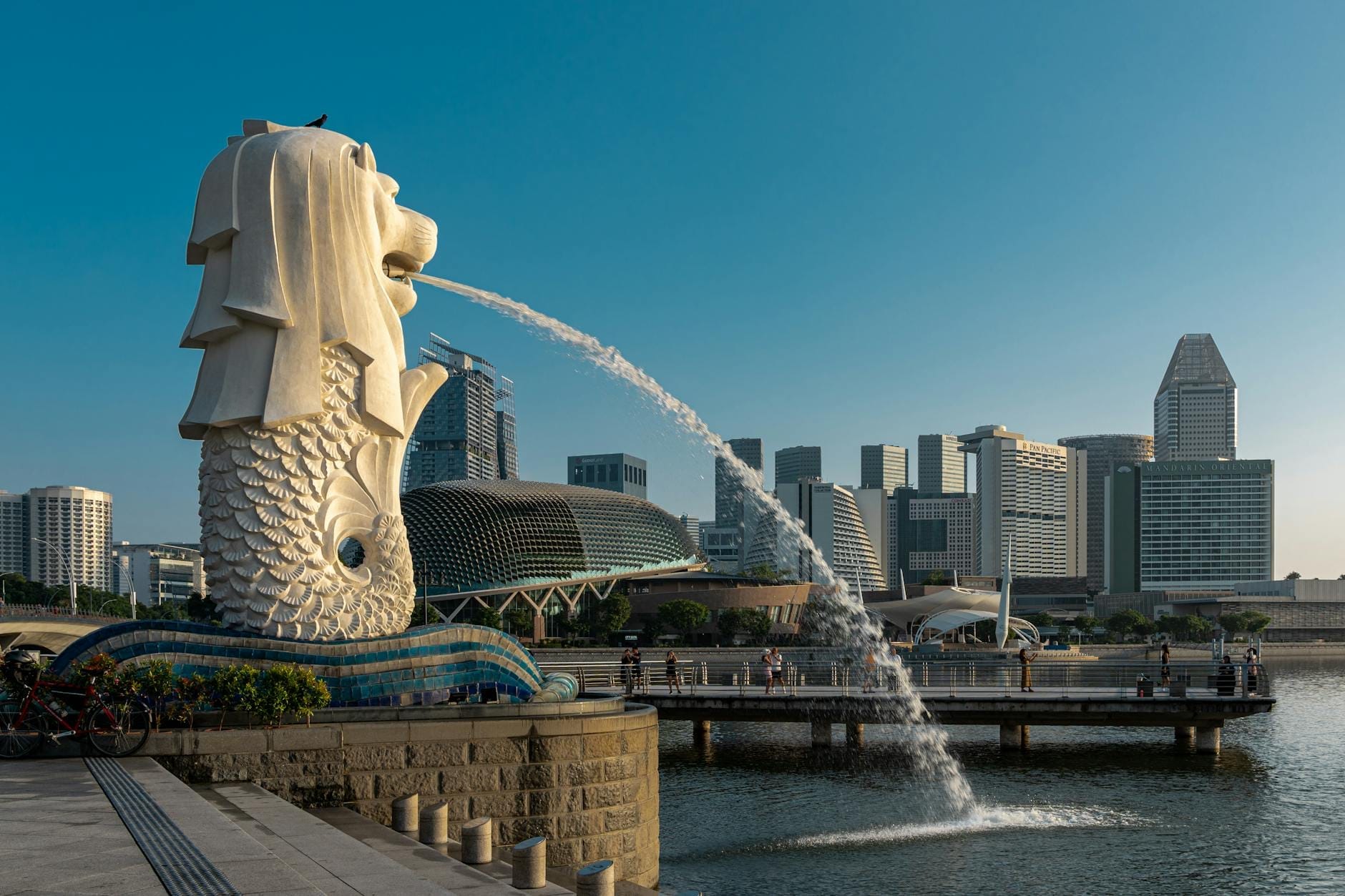
What Merlion Park Actually Is
Merlion Park is a compact, open-air waterfront promenade on the southern shore of Marina Bay, dominated by two statues: the main Merlion (8.6 metres tall, 70 tonnes) and the smaller Merlion Cub (2 metres) beside it. Both face the water, with the full skyline of Marina Bay visible across the bay. Entry is free. There are no ticketing counters, no queues to enter, and no scheduled performances. You walk in, photograph the statue and the skyline behind it, and move on.
The Merlion itself is a half-lion, half-fish figure: the lion head references the founding legend of Singapura (Sanskrit for 'lion city'), while the fish tail represents the city's origins as a fishing village and its seafaring identity. The symbol was designed in 1964 by ichthyologist Alec Fraser-Brunner for the Singapore Tourism Board. The original statue was unveiled on 15 September 1972 by Prime Minister Lee Kuan Yew at the mouth of the Singapore River. In 2002, it was relocated 120 metres to its current position — at a cost of S$7.5 million — to free up the line of sight across the bay.
💡 Local tip
The best photography position is not directly in front of the Merlion but slightly to the right (facing water), where you can frame both the statue and Marina Bay Sands in a single shot. Early morning gives you calm water and cooler temperatures. After dark, the Merlion is lit up and the bay skyline is fully illuminated.
How the Experience Changes by Time of Day
Morning, roughly 7–9am, is when Merlion Park is at its most livable. The light is soft and directional, the crowd is light, and joggers from the nearby CBD loop past the promenade. The air carries a slight saltiness from the bay. The reflecting surface of the water is usually still at this hour, which makes it the most reliable time for clean photographs without boat wake or glare.
Midday is the least comfortable window. Singapore sits about 1 degree north of the equator, and the equatorial sun at noon is direct and intense. There is minimal shade at the park itself. The crowd builds steadily from late morning as tour groups arrive from nearby hotels, and by noon the promenade in front of the statue can feel genuinely crowded.
Late afternoon brings more manageable light after around 4pm, and the crowd temporarily drops before the evening wave arrives. After 7pm, the park transforms noticeably. The Merlion is lit up in white light, Marina Bay Sands glows across the water, and the Gardens by the Bay supertrees are visible in the distance. This is when the space earns its reputation as a skyline viewpoint. If you are timing a visit around the nightly light shows at Marina Bay Sands, the park offers a direct sightline.
⚠️ What to skip
Avoid visiting between 11am and 3pm if you are sensitive to heat. There is no shelter at the waterfront viewing area, and the heat radiating off the granite path adds to the discomfort. Bring water.
Tickets & tours
Hand-picked options from our booking partner. Prices are indicative; availability and final rates are confirmed when you complete your booking.
Adventure Cove Waterpark™ e-ticket
From 27 €Instant confirmationWild Wild Wet Waterpark Entrance Ticket
From 15 €Instant confirmationLion City bike tour in Singapore
From 55 €Instant confirmationFree cancellationLuggage Storage in Singapore
From 7 €Instant confirmationFree cancellation
The Honest Visitor Assessment
Merlion Park is frequently described as one of Singapore's top attractions, and it is also one of the most straightforward to assess: the statue itself is smaller than most visitors expect from photographs. At 8.6 metres, it is notable but not towering. The park is narrow and the viewing area fills up quickly. Many visitors arrive, photograph the statue with the skyline, and leave within 15 minutes.
What makes the visit worthwhile is not the statue in isolation but the position. Merlion Park sits at one of the best vantage points on the entire Marina Bay waterfront. From here, you can see the ArtScience Museum, the three towers of Marina Bay Sands, and the dome of Gardens by the Bay without obstruction. As a landmark orientation point for first-time visitors to Singapore, it functions well.
Visitors who are primarily interested in culture, history, or food will find more substance at nearby sites. The National Gallery Singapore is a 10-minute walk and houses the world's largest public collection of modern Southeast Asian art. The ArtScience Museum is visible across the bay. If you have limited time and are choosing between Merlion Park and one of these, the museums offer more depth.
Who should skip it: travellers on a tight schedule who have already seen the Marina Bay skyline from another viewpoint (the Sands observation deck, the Singapore Flyer, or from a river cruise) may find the visit redundant. The Merlion is part of Singapore's visual identity, but it is not an interactive or immersive experience.
Getting There and Getting Around
The two most convenient MRT options are Raffles Place station (East-West and North-South lines) and Promenade station (Circle and Downtown lines). From Raffles Place, exit toward Fullerton Road and walk south along the river — the park is visible within about 5 minutes. From Promenade, follow the waterfront pedestrian path southwest; it takes around 8–10 minutes.
The park sits at the junction of the Marina Bay waterfront promenade, which connects to the full Marina Bay waterfront promenade loop. You can walk the entire bay circuit — past Marina Bay Sands, through the Helix Bridge area, and back around — in under an hour. This is one of the best pedestrian routes in the city, and Merlion Park is a natural starting or finishing point.
Rideshare and taxis can drop off near the Fullerton Hotel, a heritage landmark directly behind the park that was formerly the General Post Office building, built in 1928 in Palladian Revival style. It gives useful orientation context: the park is at the water's edge, directly in front of the hotel.
Photography Practicalities
The classic Merlion shot frames the statue with Marina Bay Sands rising in the background. To get this, stand on the right side of the viewing platform (when facing the water) and angle slightly left. A 24–35mm equivalent focal length covers both elements comfortably. In the early morning, the water surface often mirrors the skyline, which adds a second layer to the composition.
After dark, the contrast between the illuminated Merlion in the foreground and the neon-and-LED skyline behind it photographs very differently from daytime. Bring a tripod or use a stable surface if you want long-exposure shots. The granite railings along the promenade work as a resting surface for phones and compact cameras.
The Merlion Cub statue (the smaller one near the waterline) is easy to miss. It faces in a slightly different direction and is often surrounded by people queuing to photograph the main statue. It is worth locating for a different angle on the composition.
ℹ️ Good to know
The park is open 24 hours (water spouting 7am–midnight). The night-time visit (7–10pm) consistently offers the richest visual experience, and the evening temperatures are significantly more comfortable than midday. If you can only visit once, evening is the stronger choice.
Connecting Merlion Park to the Wider Marina Bay Area
Merlion Park is most usefully visited as part of a broader Marina Bay itinerary rather than as a standalone destination. The Esplanade Bridge starts at the park's eastern edge and crosses to the Esplanade Theatres on the Bay in about 3 minutes on foot. The Boat Quay dining strip runs along the river immediately to the west, offering dozens of restaurants and bars with water views.
For families with children, the park connects naturally into a half-day Marina Bay loop: Merlion Park in the morning, then across to Gardens by the Bay in the afternoon. The walk between them, via the Helix Bridge and Marina Bay Sands, takes about 20 minutes and covers some of the most architecturally distinctive streetscape in the city.
If you are planning a broader Singapore visit, the Singapore itinerary guide covers how to sequence Marina Bay with other districts across multiple days.
Insider Tips
- The unobstructed view of the full Marina Bay Sands complex is actually better from the Esplanade Bridge, 2 minutes east of the park. Walk there after photographing the Merlion for a broader panorama.
- On weekday mornings before 8am, the promenade is almost empty. Office workers from the CBD pass through on foot and by bicycle but do not stop — you can have the statue nearly to yourself.
- The Fullerton Hotel behind the park was originally the General Post Office (1928). Its neoclassical colonnade is worth a look even if you are not staying there. The hotel's free-entry lobby area is also one of the more pleasant air-conditioned stops in the vicinity.
- During the annual Singapore Night Festival and other light event seasons, the Merlion and surrounding buildings become projection surfaces. Check Singapore Tourism Board event listings before your trip if you are visiting in August or September.
- The granite path between the Merlion and the waterfront railing gets slippery when wet. Singapore receives rainfall year-round, and afternoon showers are common. Wear shoes with grip if you are visiting in the late afternoon.
Who Is Merlion Park For?
- First-time visitors to Singapore wanting to orient themselves around the bay
- Photographers looking for the classic Singapore skyline shot, especially at night
- Travellers building a walking itinerary around Marina Bay
- Families with children on a budget day, combined with Gardens by the Bay
- Early morning joggers and walkers who want a scenic route with minimal crowd
Nearby Attractions
Other things to see while in Marina Bay:
- ArtScience Museum
Housed in one of Singapore's most recognizable buildings, the ArtScience Museum brings together science, technology, and culture in 21 gallery spaces across 6,000 square metres. It sits at the edge of Marina Bay Sands, making it a natural stop on any Marina Bay itinerary.
- Gardens by the Bay
Gardens by the Bay is Singapore's signature green landmark: 105 hectares of sculpted gardens, climate-controlled conservatories, and towering vertical structures that glow after dark. Here is what each section delivers, and how to make the most of your time there.
- Marina Bay Sands
Marina Bay Sands is Singapore's most recognizable landmark, a three-tower integrated resort crowned by a cantilevered SkyPark and infinity pool 200 metres above the city. Whether you're visiting for the views, the ArtScience Museum, or the mall, here's how to do it right.
- Marina Bay Waterfront Promenade
The Marina Bay Waterfront Promenade is a 3.5-kilometre pedestrian path hugging the western edge of Marina Bay. Free, open around the clock, and anchored by some of Singapore's most recognisable landmarks, it is the city's most rewarding walk for understanding how this island nation presents itself to the world.