Little India Arcade: Incense, Silk, and the Soul of Serangoon Road
Little India Arcade is a free-entry heritage shopping arcade at 48 Serangoon Road, sitting at the heart of Singapore's Indian cultural quarter. Housed in a conserved colonial shophouse block, it trades in jasmine garlands, saris, spices, and religious goods that you will not find in any mall. Compact enough to explore in under an hour, it rewards slow walkers who take time to look and smell.
Quick Facts
- Location
- 48 Serangoon Road, Singapore 217959 (District 8, Little India)
- Getting There
- Rochor (DT13) or Jalan Besar (DT22), both Downtown Line, ~5 min walk
- Time Needed
- 30 to 60 minutes for a relaxed browse
- Cost
- Free entry; individual shops set their own prices
- Best for
- Souvenirs, textiles, cultural immersion, photography
What Little India Arcade Actually Is
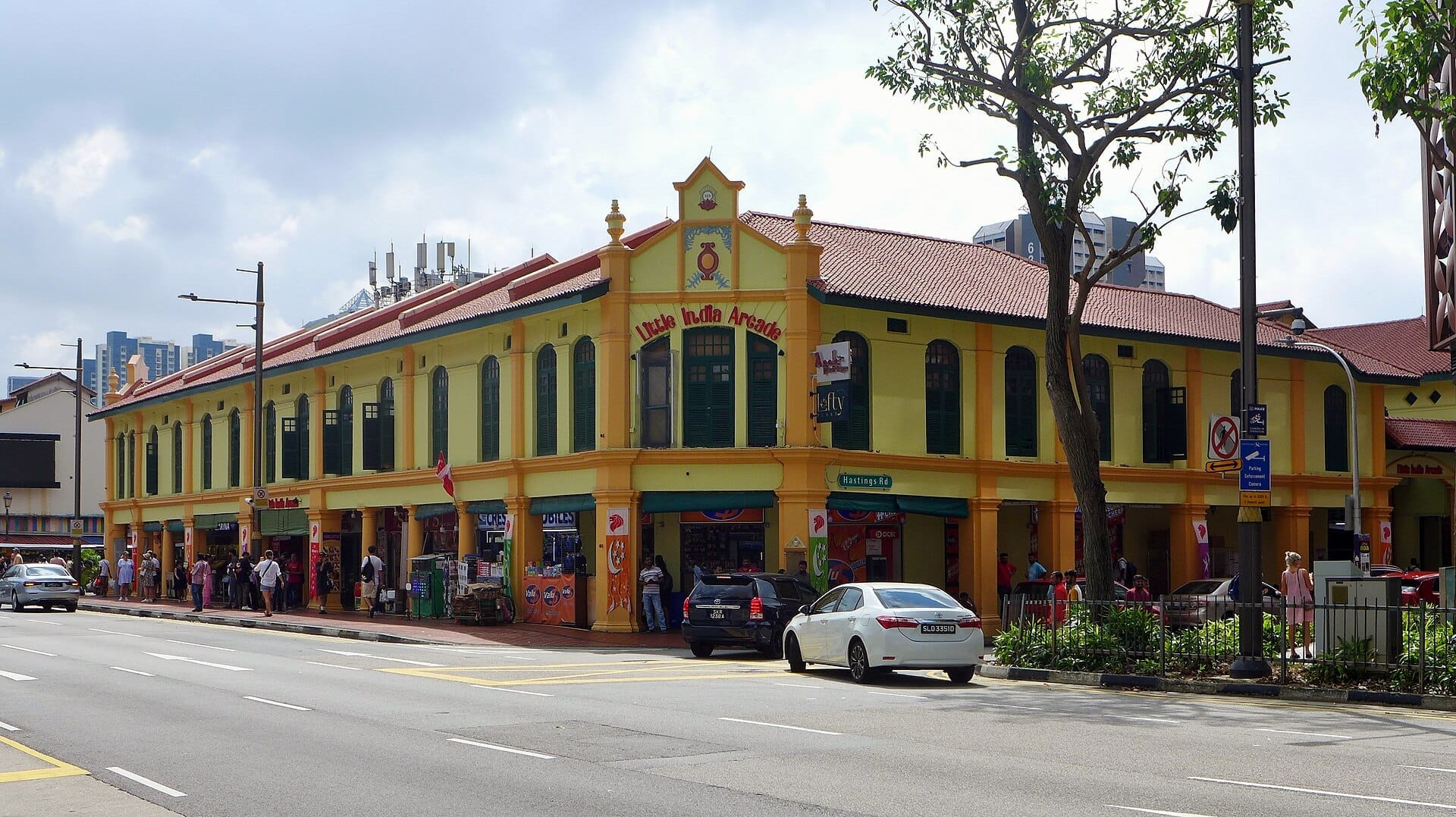
Little India Arcade is a two-storey conservation shophouse block first built in 1913 and conserved as a retail arcade. It sits directly on Serangoon Road, the main artery of Singapore's Indian quarter, and forms part of the Little India conservation area gazetted by the Urban Redevelopment Authority in 1989. That gazette date matters: it is why the terracotta-toned facade, the covered five-foot walkways, and the low ceilings inside have been preserved rather than redeveloped.
Inside, the shophouse format means narrow corridors, low overhangs, and stalls packed tightly on both floors. Roughly 30 to 40 small retailers operate here, selling everything from fresh flower garlands and incense to silk saris, Ayurvedic oils, costume jewellery, religious statues, and brass pooja vessels. This is not a curated cultural experience arranged for tourists. It is a working retail space where locals shop for temple offerings, festival clothing, and household goods. That distinction shapes everything about the visit.
💡 Local tip
Arrive on a weekday morning before 11am if you want a calm browse. Weekends, especially Sunday afternoons, see significantly higher foot traffic as the local Indian community gathers in the area after religious observances.
The Sensory Experience: What You Will Notice First
The smell arrives before you step inside. Fresh jasmine and marigold garlands are strung near the entrance, and the warm, slightly sweet scent mixes with incense smoke drifting from nearby stalls. In the late morning, when flower vendors are restocking, the fragrance is strongest. By afternoon the garlands have often sold down to a handful, and the smell shifts toward the warmer, woodier notes of sandalwood and camphor.
The ground floor is the denser of the two levels. Stalls here tend to stock practical items: fresh flowers sold by the strand for temple use, puja accessories, and small religious figurines. The colours are genuinely striking. Strings of orange marigolds hang at eye level beside bright pink lotus blooms; brass Ganesh statues catch the overhead light; bolts of silk in turmeric yellow, deep red, and electric blue lean against whitewashed walls. Photography here is straightforward since the covered arcade softens direct sunlight, though shop owners occasionally ask you not to photograph their stock without buying.
The upper floor tends to be quieter and houses more textile and clothing retailers, including shops selling traditional kurtas, shalwar kameez, and children's festival wear. If you are looking for fabric by the metre or want a tailor-made item, the upper floor is where to look first.
Tickets & tours
Hand-picked options from our booking partner. Prices are indicative; availability and final rates are confirmed when you complete your booking.
Singapore Little India self-guided walking audio tour
From 13 €Instant confirmationFree cancellationAdventure Cove Waterpark™ e-ticket
From 27 €Instant confirmationWild Wild Wet Waterpark Entrance Ticket
From 15 €Instant confirmationLion City bike tour in Singapore
From 55 €Instant confirmationFree cancellation
Historical and Cultural Context
The Serangoon Road corridor has been associated with Singapore's Indian community since the early 19th century, when Indian labourers, traders, and convicts arrived under British colonial administration. The Indian Heritage Centre, located a short walk away on Campbell Lane, documents this history in detail if you want fuller context before or after visiting the arcade.
The conservation shophouse typology represented by the arcade is specifically a result of post-independence urban policy. Singapore demolished large parts of its colonial-era built fabric during rapid development in the 1960s and 1970s. The 1989 conservation gazettal of Little India, Chinatown, and Kampong Glam was a corrective policy, recognising that the ethnic enclaves had irreplaceable social and architectural value. The arcade's two-storey terracotta facade with arched windows and the five-foot covered walkways (a standard feature of Straits Chinese shophouses, mandated by Stamford Raffles' 1822 town plan) survive precisely because of that policy shift.
The arcade sits within walking distance of several other significant sites in the neighbourhood, including Sri Veeramakaliamman Temple on Serangoon Road and the Tekka Centre wet market and hawker centre directly across the road. Understanding the arcade in that context, as one node in a living neighbourhood rather than a standalone attraction, makes the visit more meaningful.
How the Arcade Changes Through the Day
Early mornings, around 9am, the arcade is quiet enough to hear individual conversations between shopkeepers setting up. Flower stalls open first, as fresh garlands need to reach temples and homes early. The light at this hour is cooler and flatter, which makes the colours in the fabric shops easier to see without glare.
Midday brings the bulk of foot traffic from tourists arriving from nearby MRT stations. The five-foot walkway outside becomes crowded, and the internal corridor can feel congested if multiple tour groups pass through simultaneously. If you are visiting primarily for photography or a considered browse rather than a specific purchase, midday is the least comfortable window.
Late afternoon, roughly 4pm to 6pm, is arguably the most atmospheric. The adjacent Serangoon Road gets busier with commuters and shoppers, the flower vendors are doing brisk trade, and the light is warmer. The arcade itself is active without being overwhelming. This window also works well as the starting point for a wider Little India evening walk, since the neighbourhood's restaurants and street food stalls come into their own after 6pm.
ℹ️ Good to know
Opening hours for individual shops are not formally published. Most retailers appear to open around 9am and close between 9pm and 10pm. A small number are closed on certain days for religious observances. If you are making a specific trip for one particular shop, checking the official website www.littleindiaarcade.com.sg is advisable.
What to Buy and What to Expect When Shopping
The arcade is genuinely good value for a specific category of goods. Fresh flower garlands cost a fraction of what you would pay at a florist elsewhere in Singapore. Incense sticks, sandalwood powder, and camphor tablets are priced for regular local buyers, not tourists. Small brass or resin religious figurines make compact, lightweight souvenirs that travel well.
Textiles require more judgment. Quality varies significantly between stalls. If you are buying silk or cotton fabric, handle it carefully and ask where it is from. Prices are generally lower than in dedicated textile districts in India, but not all fabric sold as silk is pure silk. Bargaining is not standard practice here the way it might be in an open market, but polite negotiation on larger purchases is accepted by some vendors.
For food-related shopping, the arcade itself has limited edible goods, but Tekka Centre directly opposite is a full wet market and hawker centre where you can buy spices, dried goods, and fresh produce. If you are interested in broader Little India shopping, the surrounding blocks on Serangoon Road and the side streets extend the experience considerably.
⚠️ What to skip
The arcade is a genuinely functional retail space, not a museum. Photographing people without asking, handling goods without intent to buy, or hovering in small stalls without engaging will not be well received. Basic market courtesy applies.
Getting There and Getting Around
The easiest transit approach is the Downtown Line MRT. Rochor station (DT13) puts you on Rochor Road, from which Serangoon Road is roughly a 5-minute walk heading northwest. Jalan Besar station (DT22) is a similar distance from the south. Both exits are clearly signed. If you are coming from Marina Bay or Orchard Road, a single MRT line connects you without transfers.
Taxis and ride-hailing vehicles (Grab is the dominant platform in Singapore) can drop directly on Serangoon Road, though the road is often congested on weekend afternoons. Walking from the MRT is more predictable and gives you a ground-level introduction to the neighbourhood before you arrive at the arcade.
The arcade is on level terrain and the ground floor is accessible without stairs. The upper floor is reached by a narrow internal staircase; there is no lift noted in publicly available information, so travellers with mobility limitations should focus their time on the ground level, which holds most of the fresh flowers, pooja goods, and incense stalls.
Who Should Manage Expectations
If you are looking for a large, air-conditioned, well-organised shopping experience, the arcade is not that. The corridors are narrow, ventilation is limited to ceiling fans and natural airflow, and the layout is somewhat informal. On hot afternoons, it can feel stuffy. Visitors expecting the polished presentation of a heritage mall may find it underwhelming.
Similarly, if you have already spent significant time in Indian markets, either in India itself or in similar ethnic enclaves, the arcade's scale, perhaps 30 to 40 shops across two floors, may feel modest. It is best understood as one stop on a wider Little India walk rather than a half-day destination on its own.
Insider Tips
- The flower garland stalls near the entrance sell strings by count or weight. Buying a single fresh jasmine strand costs almost nothing and is a genuinely evocative souvenir that lasts the rest of your day in terms of fragrance.
- If you want to see the arcade at its most photogenic, go on a weekday morning after 9am. The warm overhead light inside the arcade, combined with the colour of the textile stalls, photographs well without needing additional equipment.
- The five-foot walkway running along the front of the arcade on Serangoon Road is one of the better spots in Little India to observe street life at eye level. Sit on the low ledge or step and watch the road for 10 minutes before going inside.
- Several shops on the upper floor carry traditional Ayurvedic products including hair oils and herbal powders at prices significantly below what you would find in health food shops elsewhere in Singapore. Read labels carefully if you have allergies.
- Sri Veeramakaliamman Temple is roughly 300 metres north on Serangoon Road. Combining the arcade visit with the temple and Tekka Centre makes a coherent two-hour neighbourhood circuit that gives a much richer picture of Little India than any single stop.
Who Is Little India Arcade For?
- Travellers wanting an affordable, practical souvenir with genuine cultural origin
- Photographers interested in colour, texture, and street-level urban scenes
- First-time visitors to Little India who want an easy, free-entry introduction to the neighbourhood
- Anyone looking for temple flowers, incense, or religious goods at local prices
- Travellers pairing the visit with a wider Little India walking itinerary
Nearby Attractions
Other things to see while in Little India:
- Indian Heritage Centre
Opened in 2015, the Indian Heritage Centre in Singapore's Little India traces the origins, migration, and cultural contributions of the Indian diaspora across Southeast Asia. Housed in a striking building inspired by ancient stepwells, it is one of the most thoughtfully curated heritage museums in the city.
- Sri Veeramakaliamman Temple
Standing on Serangoon Road since 1855, Sri Veeramakaliamman Temple is Singapore's first temple dedicated to the goddess Kali. Its 18-metre Dravidian tower, crowded with 600 hand-painted stucco figures, is one of the most photographed religious facades in the city. Entry is free, and the daily ritual schedule gives visitors genuine access to living worship.
- Tekka Centre
Tekka Centre at 665 Buffalo Road is one of Singapore's oldest and most atmospheric public markets, blending a working wet market, a packed hawker food centre, and floors of textile and spice traders. Free to enter and open daily from 6:30am to 9pm, it offers a concentrated dose of Indian-Singaporean daily life that no curated attraction can replicate.