Vrijdagmarkt: Ghent's Ancient Market Square and Living History
The Vrijdagmarkt has been the political and commercial heart of Ghent since the 13th century. Free to enter at any hour, it rewards visitors with guild-house architecture, a storied statue, and a Friday morning market that has run for over 800 years.
Quick Facts
- Location
- Vrijdagmarkt, 9000 Ghent, Belgium (historic centre)
- Getting There
- Walk from Korenmarkt (approx. 10 min) or take a De Lijn tram to the city centre
- Time Needed
- 30–60 minutes for the square; 2 hours if visiting on a Friday market morning
- Cost
- Free to enter; market stalls priced individually in EUR
- Best for
- History lovers, architecture, local market culture, photography
- Official website
- visit.gent.be
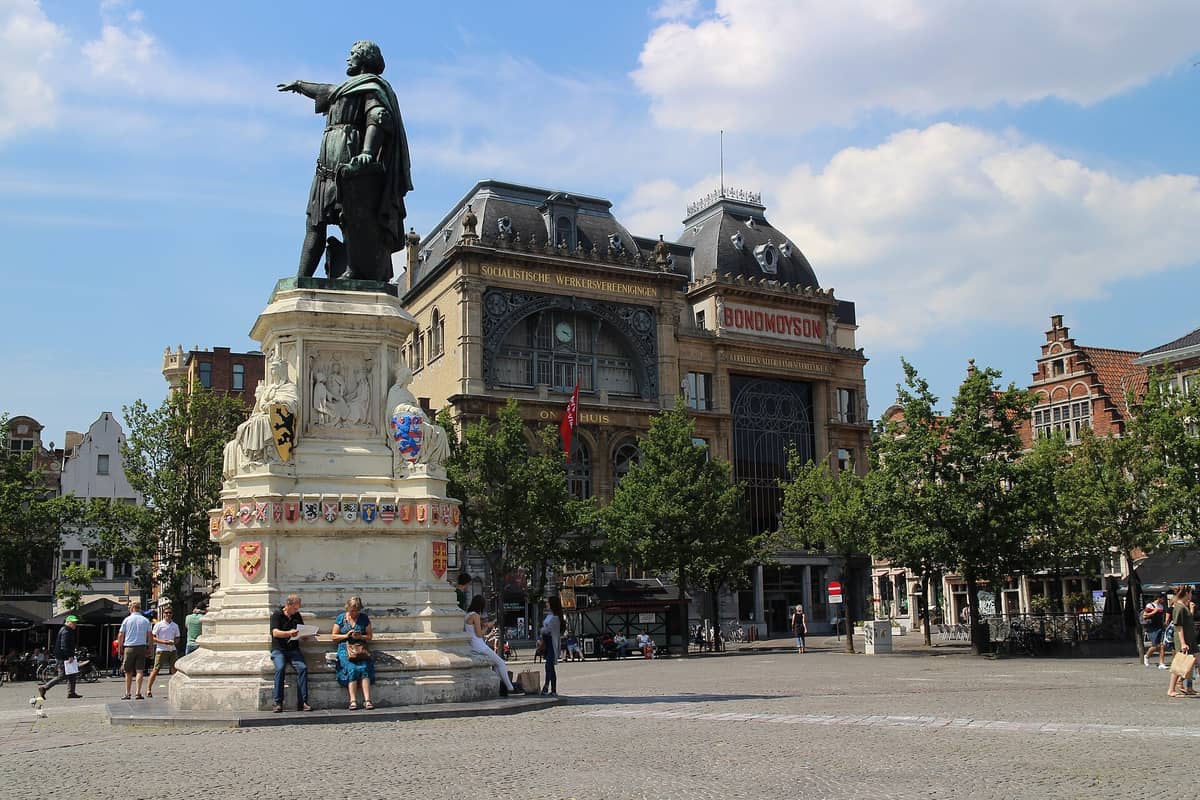
What the Vrijdagmarkt Actually Is
The Vrijdagmarkt is a large, roughly rectangular public square in the heart of Ghent's medieval centre. It is not a ticketed attraction, not a museum, and not a monument you queue to enter. It is a working urban square that has been in continuous use since the late 12th or early 13th century, and the weekly Friday market documented here goes back to 1199, making it one of the oldest recurring markets in Flanders.
On most days the square functions as an open space where locals cut through, sit outside the cafés and brown bars lining the perimeter, or simply cross on their way to the Patershol neighbourhood or Sint-Jacobskerk. On Friday mornings it transforms into a proper street market. Either version is worth your time, but they offer very different experiences.
💡 Local tip
The Friday market runs approximately 07:30–13:00 (some sources list 08:00–13:00). Arrive before 10:00 if you want the full spread of stalls and the liveliest atmosphere. By midday the best produce is gone and vendors start packing up.
The Square's History: 800 Years of Flemish Power
Few squares in Belgium carry as much political weight as the Vrijdagmarkt. During the Middle Ages, this was not simply a place to buy vegetables. It was where Ghent's powerful guilds assembled, where uprisings were organized, and where the city's relationship with its rulers was periodically renegotiated through public spectacle, protest, and sometimes violence.
The square took its current form through urban development in the 13th century, though the market itself predates that. At the centre stands a large bronze statue of Jacob van Artevelde (1290–1345), the Ghent statesman who led the city during the early phase of the Hundred Years' War. On 26 January 1340, King Edward III of England appeared on this square at van Artevelde's invitation, where he was publicly proclaimed as King of France, a declaration that had enormous diplomatic consequences. The statue, cast in the 19th century, depicts van Artevelde in a commanding rhetorical pose, and it still anchors the visual centre of the square today.
The guild houses that ring the square reflect the long dominance of Ghent's trade guilds. Each façade tells part of that story, and spotting the architectural details, stepped gables, carved keystones, guild insignia, rewards slow walkers. For more on how medieval merchant power shaped the city's landscape, the STAM Ghent City Museum provides detailed context.
Later centuries added further layers. In the 19th century, during the industrial era, the square became a focal point for the labour movement. Workers' organizations and socialist trade unions held mass meetings here, and the square retains a reputation in Ghent's collective memory as a place where ordinary people exercised real political influence.
Tickets & tours
Hand-picked options from our booking partner. Prices are indicative; availability and final rates are confirmed when you complete your booking.
Historic Ghent city exploration game
From 10 €Instant confirmationFree cancellationBelgian waffle making workshop and beer tasting in Ghent
From 45 €Instant confirmationFree cancellationTaste of Ghent private chocolate walking tour
From 256 €Instant confirmationFree cancellationSips and stories, a private beer tour in Ghent
From 373 €Instant confirmationFree cancellation
What You Actually See: Architecture and Layout
Walking into the Vrijdagmarkt from any of its entry streets, the first impression is scale. It is a genuinely large square by Belgian standards, big enough that the surrounding buildings do not crowd you. The paving is flat and mostly even, which matters if you are navigating with a stroller or a wheelchair.
The perimeter is defined by a mix of historic guild houses, 19th-century commercial buildings, and a handful of later additions. The Ons Huis building, a historic cooperative building associated with socialist workers' organisations, stands out on the northern edge. Its late 19th-century architecture is ornate in a way that deliberately signals civic ambition from a movement that was not historically associated with grand buildings. Look for the carved reliefs and the symbolic iconography worked into the facade.
The van Artevelde statue dominates the centre. Pigeons congregate on its plinth at all hours. In morning light the bronze takes on a greenish warmth, and the surrounding buildings reflect gold when the sun is low. This is one of the better spots in Ghent for architectural photography, particularly in the hour after sunrise when the square is nearly empty.
The Vrijdagmarkt sits within Ghent's broader historic centre, and from the square you can walk to several of the city's major sights without retracing your steps. Sint-Jacobskerk is a short walk north. The Patershol neighbourhood, Ghent's quietest and most architecturally intact medieval quarter, starts just beyond the square's northwest corner.
How the Experience Changes by Time of Day
Early on a weekday morning the square is quiet. Delivery vehicles roll through, café staff set out chairs, and a few commuters cross without slowing down. The light, especially in spring and autumn, can be remarkable: long shadows from the guild facades stretch across the paving, and the statue reads clearly against a pale sky. This is the moment for unhurried photography.
From around 10:00 onward, foot traffic picks up. The café terraces fill, and on market days the square becomes genuinely crowded. The smell of fresh bread from the food stalls carries across the paving. Vendors sell seasonal produce, flowers, clothing, and household goods, which means the Friday market is not a sanitized tourist market but a real working one. You will hear Dutch, Ghent dialect, and occasionally French. The texture of the scene, the noise level, the slightly chaotic layout of the stalls, feels like something that has genuinely been going on for centuries rather than something staged for visitors.
In the evening, especially in warmer months, the square shifts again. The bars around the perimeter attract a mix of students and older locals. Ghent has a large university population, and the Vrijdagmarkt is one of the places where different parts of the city's demographic mix intersect. It does not have the tourist concentration of the Graslei or the Korenmarkt; it feels more like a place people actually use.
ℹ️ Good to know
The square is within Ghent's low-emission zone (LEZ). If you are arriving by car, check the current LEZ regulations before driving in. There is an underground car park (Parking Vrijdagmarkt) directly beneath the square with lift access to street level.
The Friday Market: What to Expect
The Friday market is the main reason to time your visit deliberately. It runs on Friday mornings and draws a mix of fresh produce, flowers, cheese, bread, clothing, and general goods. It is not a specialty artisan market or a food hall with curated vendors. It is a weekly general market of the kind that has largely disappeared from western European city centres, which makes it worth seeing precisely because it is ordinary.
If you want produce or bread, go early. The best items are typically gone by 11:00. If you want to observe the market at its most animated, go between 09:00 and 11:00 when stalls are fully staffed and the square is at its most alive. The atmosphere carries none of the self-consciousness of tourist-facing markets. Vendors are there to sell to locals, and visitors are a secondary consideration.
⚠️ What to skip
The market does not always cover the entire square. Depending on the season and number of registered vendors, stalls may occupy only part of the space. Do not expect a wall-to-wall market every week.
Getting There and Getting Around
The Vrijdagmarkt is reachable on foot from most of Ghent's central attractions. From the Korenmarkt, which is served by several De Lijn tram lines, the walk takes about 10 minutes through the medieval street grid. From Gravensteen castle, the route passes through the Patershol quarter and takes roughly the same time.
De Lijn operates trams and buses across Ghent from Gent-Sint-Pieters station, which is the city's main rail hub. From Brussels, direct trains reach Gent-Sint-Pieters in approximately 30 minutes. A single De Lijn ride is currently priced at around €3 (verify with De Lijn before travel as fares are subject to change), and the tram connects the station to the city centre in around 5–10 minutes. From there, the Vrijdagmarkt is a short walk.
The square itself is flat and accessible for wheelchair users and pushchairs. The underground car park provides lift access, and the surrounding streets are pedestrian-friendly. During the Friday market, the central area becomes more congested, but the perimeter remains navigable.
For a broader orientation to moving around Ghent, the getting around Ghent guide covers tram lines, cycling routes, and walking distances between major sites.
Honest Assessment: Who Will Love It and Who Might Not
The Vrijdagmarkt rewards visitors who pay attention to urban texture: the proportions of a square, the stories embedded in façades, the way a place changes as the light moves across it. It is not an attraction in the conventional sense. There is no exhibition to see, no guided experience to book, and no single dramatic viewpoint.
Visitors looking for concentrated sightseeing or who are working through a list of Ghent's main monuments may find the square underwhelming unless they visit on a Friday. Those who slow down, take a seat outside one of the perimeter cafés, and spend 30 minutes simply watching the square work, consistently report it as one of their more memorable stops in Ghent. The difference is entirely about approach.
If your primary interest is Ghent's medieval architecture, pairing the Vrijdagmarkt with a visit to Sint-Niklaaskerk and the Ghent Belfry makes logical sense as part of a single walking loop through the historic centre.
Insider Tips
- The north side of the square, near the Ons Huis building, has the best unobstructed view of the van Artevelde statue with the guild facades as background. It is also where professional photographers tend to set up. For cleaner shots, use the golden hour after sunrise on a weekday when the square is nearly empty.
- Several of the bars on the square's perimeter open early and serve proper Belgian café breakfasts, coffee and bread with cheese or cold cuts. These are local regulars rather than tourist cafés, and prices reflect that.
- If you are visiting during the Gentse Feesten in July, the Vrijdagmarkt becomes one of the main festival squares with open-air concerts and street performances. The atmosphere is completely different from the usual market days.
- The street leading northwest from the square into the Patershol quarter contains some of Ghent's oldest and least-altered medieval architecture. It is easy to walk through without noticing the building dates; look up at the gable lines and stone details.
- The underground car park entrance is on the square itself. If you arrive by car, this is the most convenient option, but check the current LEZ regulations for your vehicle before driving into the city centre.
Who Is Vrijdagmarkt For?
- Travellers interested in medieval Flemish history and guild culture
- Photographers seeking an authentic urban square with strong architectural geometry
- Visitors who want to experience a working Belgian market rather than a tourist-oriented one
- Anyone combining the Vrijdagmarkt with a walking loop through the Patershol neighbourhood
- Festival visitors during the Gentse Feesten in July
Nearby Attractions
Other things to see while in Ghent Historic Centre:
- City Pavilion (Stadshal)
Completed in 2012 by Ghent architects Robbrecht & Daem and Marie-José Van Hee, the Stadshal is a free, open public structure spanning roughly 40 metres at Emile Braunplein, surrounded by the Belfry, Town Hall, and St Nicholas' Church. Whether you pass through at noon or after dark, this latticed wooden canopy changes character with the light and the crowd beneath it.
- Design Museum Gent
Design Museum Gent, founded in 1903 and located in Ghent's historic centre, holds a collection of approximately 22,500 objects tracing applied arts and design from the 18th century to the present day. The museum is currently closed for a major expansion and renovation, but its permanent collection and architectural setting make it one of Ghent's most distinctive cultural institutions., holds a collection of approximately 22,500 objects tracing applied arts and design from the 18th century to the present day. The museum is currently closed for a major expansion and renovation, but its permanent collection and architectural setting make it one of Ghent's most distinctive cultural institutions.
- Castle of Gerald the Devil (Geeraard de Duivelsteen)
Built in the 13th century in Scheldt Gothic style, Geeraard de Duivelsteen is one of the most architecturally striking medieval structures in Ghent. From knight's residence to madhouse to event venue, its layered history is as dramatic as its stone facade. The building is not open for regular walk-in visits, but its exterior and occasional scheduled openings make it essential context for understanding Ghent's medieval character.
- Ghent Altarpiece (Adoration of the Mystic Lamb)
Completed in 1432 by Hubert and Jan van Eyck, the Ghent Altarpiece is a 12-panel polyptych (with paintings on both sides of most wings) housed in St Bavo's Cathedral in Ghent's historic centre. It is one of the most technically advanced and historically significant paintings ever made, and seeing it in person requires a ticket, a timed slot, and some preparation.