Vieux Carré: Inside New Orleans' French Quarter Historic District
The Vieux Carré is the oldest neighborhood in New Orleans, founded in 1718 and designated a National Historic Landmark on December 21, 1965. Spanning roughly 78 city blocks (about 85 in the full National Historic Landmark district) bounded by Canal Street, Esplanade Avenue, the Mississippi River, and North Rampart Street, it's a living district of Creole architecture, second-line parades, open-air music, and centuries of layered history — all free to explore at any hour.
Quick Facts
- Location
- Bounded by Canal St., Rampart St., Esplanade Ave., and the Mississippi River, New Orleans, LA 70116
- Getting There
- Riverfront Streetcar along the Mississippi River edge; walkable from Canal St. and the CBD
- Time Needed
- 2 hours minimum; half a day to explore properly; some visitors return across multiple days
- Cost
- Free public access (24/7, no gates or admission)
- Best for
- History lovers, architecture enthusiasts, first-time New Orleans visitors, night-owl travelers
- Official website
- nola.gov/next/vieux-carre-commission/about
What Is the Vieux Carré?
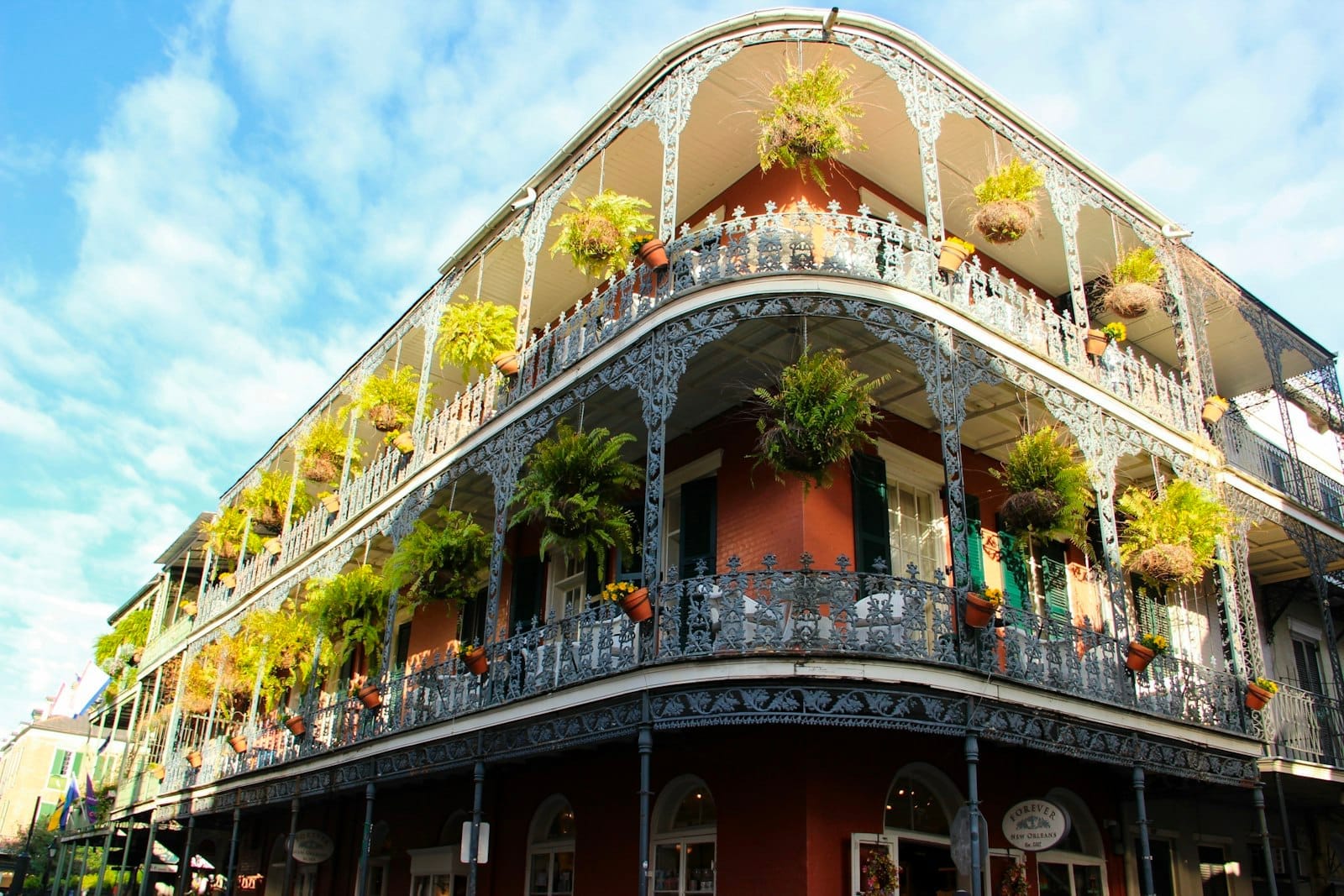
The Vieux Carré — French for 'Old Square' — is the original street grid laid out in 1718 when Jean-Baptiste Le Moyne de Bienville established the French colonial settlement that would become New Orleans. Today it's commonly called the French Quarter, though that name undersells how much Spanish colonial influence actually shaped the physical neighborhood. Most of what you see standing today, the iron lacework balconies, the thick-walled Creole townhouses, the stucco facades, dates from the late 18th century, after two catastrophic fires in 1788 and 1794 leveled much of the original French construction.
The "Vieux Carré Historic District" was designated a National Historic Landmark on December 21, 1965 (NRHP #66000377), and its 78 city blocks are actively overseen by the Vieux Carré Commission, established in 1936 by state law. The commission has real enforcement power over exterior alterations, which is a significant reason why the streetscape has survived urban development pressures that erased comparable districts in other American cities.
ℹ️ Good to know
The Vieux Carré is a living residential and commercial neighborhood — not a theme park. Around 4,000 people call it home. Treat courtyards, residential stoops, and narrow side streets with the consideration you'd give any urban neighborhood.
The Architecture: What You're Actually Looking At
The dominant building type is the Creole townhouse: two or three stories, built to the sidewalk edge with no front setback, featuring a carriageway passage through the ground floor leading to a rear courtyard. Ground floors historically housed commerce; upper floors were residential. The cast-iron galleries that now define the Quarter's visual identity were largely added in the mid-19th century as American prosperity flowed into the district. Earlier buildings used wrought iron, which is heavier and more irregular — look closely at ironwork details and you can often distinguish the two.
Royal Street and Chartres Street preserve the most intact streetscapes. On these blocks, the buildings sit shoulder to shoulder with no gaps, creating a canyon effect that keeps them shaded well into the morning. The thick masonry walls — often brick plastered with stucco tinted in ochre, terracotta, or faded yellow — absorb heat slowly, which made them practical in the subtropical climate before air conditioning. This is architecture shaped directly by its environment.
The French Quarter Visitor Center, operated by the Jean Lafitte National Historical Park & Preserve at 419 Decatur Street (phone: 504-589-3882), offers free walking tour ranger programs and printed neighborhood maps. It's one of the best free resources in the Quarter and worth stopping at early in your visit. Nearby, the St. Louis Cathedral on Jackson Square is the oldest continuously active Roman Catholic cathedral in the United States — a landmark that anchors the upriver end of the district.
Tickets & tours
Hand-picked options from our booking partner. Prices are indicative; availability and final rates are confirmed when you complete your booking.
New Orleans French Quarter and Marigny carriage tour
From 43 €Instant confirmationFree cancellationHistory and haunts carriage tour in New Orleans
From 43 €Instant confirmationSpooky kid-friendly family ghost tour
From 32 €Instant confirmationFree cancellationWalking the Devil's Empire tour with HELLVISION™ in New Orleans
From 32 €Instant confirmationFree cancellation
How the Quarter Changes Through the Day
Early morning, roughly 7 to 10 AM, is when the Vieux Carré most clearly belongs to the people who live and work there. Delivery trucks block the narrow one-way streets. Restaurant staff hose down sidewalks. The smell of last night's spilled drinks lingers on Bourbon Street before heat and cleaning compound dissipate it. The light is soft and the iron balconies cast long horizontal shadows across the pavement. This is the hour for unhurried photography and for understanding the neighborhood as a place rather than a spectacle.
By late morning, tourists begin filling the main corridors — Bourbon Street, Royal Street, and the riverfront edge near Decatur. Jackson Square comes alive with tarot card readers, portrait artists, and street musicians. Midday heat in summer (June through August regularly reaches 90°F/33°C with humidity that makes it feel considerably hotter) pushes many visitors indoors. If you're visiting in summer, plan outdoor walking for before noon or after 5 PM.
Late afternoon to early evening is when the Quarter shifts registers again. Residents reappear. Second-line musicians sometimes drift through side streets. The light on the upper balconies turns golden, and the courtyard restaurants begin seating dinner crowds. By 10 PM the balance tips fully toward nightlife, with Bourbon Street becoming a pedestrian corridor of noise and neon that remains busy until 3 or 4 AM on weekends. Those who find that environment overwhelming should note that one block off Bourbon, the streets are dramatically quieter.
💡 Local tip
For the best combination of light, temperature, and crowd levels, walk Royal Street and Chartres Street between 8 and 10 AM. You'll have the architecture largely to yourself, and the morning light on the plaster facades is exceptional for photography.
Key Anchors Within the District
Jackson Square functions as the geographic and social center of the Vieux Carré. Originally the Place d'Armes — the colonial military parade ground — it was renamed in 1851 to honor General Andrew Jackson. The square itself is a formal garden closed to the public but viewable from its surrounding fence-lined pedestrian perimeter, where street performers, musicians, and artists set up daily. The Pontalba Buildings flanking the square on St. Ann and St. Peter Streets are among the oldest apartment buildings in the United States, completed in 1851.
Bourbon Street is the district's most famous corridor and its most polarizing. The entertainment strip running from Canal Street toward Esplanade Avenue offers open-container bars, daiquiri shops, and live music venues operating at high volume. It's loud, crowded on weekend nights, and heavily oriented toward adult entertainment. If you're traveling with children or seeking quieter cultural experiences, Bourbon Street is easily skipped — the rest of the Quarter offers more depth.
Royal Street runs parallel to Bourbon and feels like a different neighborhood. Art galleries, antique dealers, and independent shops line a stretch of remarkably intact 19th-century buildings. Street musicians often set up on the blocks near St. Louis Street, playing to passing pedestrians rather than bar crowds. This is where the Quarter's reputation for sophistication was historically earned, and it still holds.
The French Market along Decatur Street has operated in some form since 1791, making it one of the oldest public markets in the country. Today it's a mix of produce stalls, craft vendors, and food counters. Quality varies considerably by stall — browse critically rather than buying from the first vendor. The covered sections near Ursulines Avenue tend to be less tourist-saturated.
Historical and Cultural Context
The Vieux Carré sits on one of the few elevated ridges in a city that sits mostly at or below sea level. The original settlers chose this location deliberately: the natural levee formed by Mississippi River sediment deposits provided slightly higher ground in a notoriously flood-prone landscape. The district still sits above the worst flood zones in the city, which is part of why it survived Hurricane Katrina in 2005 with less catastrophic flooding than lower-lying neighborhoods.
The Quarter's cultural identity is Creole — a term that in the New Orleans context refers to the mixed French, Spanish, African, and Caribbean heritage that defined the city's free population of color and its Catholic Creole elite before American annexation in 1803. Congo Square, just outside the Quarter at the edge of Louis Armstrong Park, was the site where enslaved Africans were legally permitted to gather and perform music on Sundays under French and Spanish colonial rule. That practice is widely cited as one of the roots of jazz. Understanding this context gives the neighborhood's musical culture considerably more weight.
The history of the district is inseparable from the history of slavery, the slave trade, and free Black life in New Orleans. The history of New Orleans is more fully understood by visiting sites like the Cabildo museum on Jackson Square alongside the surrounding streets, rather than treating the Quarter as purely an architectural or entertainment destination.
Getting There and Getting Around
The Vieux Carré is walkable from the Central Business District (CBD) — Canal Street, which marks the district's upriver boundary, is about a 15-minute walk from most downtown hotels. The Riverfront Streetcar runs along the district's river edge, connecting the Convention Center to Esplanade Avenue, and is useful for covering the full length without walking. The Canal Street Streetcar stops at the boundary of the Quarter but does not enter it.
Driving into the Quarter is strongly inadvisable for visitors. Streets are narrow, one-way, and frequently blocked by delivery vehicles and pedestrians. Parking lots near Canal Street and along Esplanade Avenue exist, but rates are high during busy periods. Rideshare drop-off works well at the Canal Street end. Once inside, the grid is straightforward and entirely walkable — the longest straight-line dimension is about ten blocks.
⚠️ What to skip
Sidewalks throughout the Vieux Carré are uneven, with raised tree roots, missing pavers, and abrupt grade changes. Wear shoes with real soles. Cobblestoned sections near the riverfront are particularly challenging for anyone with limited mobility. The French Quarter Visitor Center at 419 Decatur St. has partial accessibility — call 504-589-3882 ahead of your visit if accessibility is a concern.
Who Should Manage Expectations
The Vieux Carré rewards visitors who come with some historical curiosity. If you arrive expecting purely a party district, Bourbon Street will deliver that, but you'll miss most of what makes this neighborhood significant. Conversely, if you expect a quiet, museum-like preservation zone, the noise and commercial activity on the main corridors may surprise you. The Quarter is simultaneously a real neighborhood, a UNESCO-caliber architectural resource, a major entertainment district, and a working commercial zone. It doesn't resolve cleanly into any single experience.
Travelers with limited mobility will find significant challenges throughout. Wheelchair users and those with walking difficulties should plan routes in advance and check accessibility notes for any specific venues they intend to visit. Families with young children can visit the Quarter comfortably during daytime hours; the Jackson Square area and French Market are appropriate. Evening visits to the Bourbon Street corridor with children are generally uncomfortable due to adult-oriented entertainment and noise levels.
Insider Tips
- The blocks of Royal Street between St. Louis and Dumaine are often blocked to traffic on weekend mornings for pedestrian use, turning them into an impromptu street fair with musicians and art vendors — no schedule is published, so treat it as a bonus if you encounter it.
- The Pontalba Buildings flanking Jackson Square contain apartments above ground-floor shops. Look up at the AP monogram worked into the ironwork — it stands for Almonaster-Pontalba, the family name of the baroness who commissioned the buildings in 1851.
- The numbered street grid runs perpendicular to the river, not to the compass points. 'Upriver' and 'downriver' (or 'riverside' and 'lakeside') are how locals actually navigate — compass directions will lead you astray on a map.
- The Jean Lafitte National Historical Park Visitor Center at 419 Decatur Street offers free ranger-led walking tours of the Quarter on a first-come, first-served basis. Arrival at opening time is advisable as spots fill quickly.
- If you want to hear live jazz without a cover charge, the corners around Frenchmen Street in the Marigny neighborhood — just across Esplanade Avenue from the Quarter — offer a more local music experience than most Quarter venues, especially on weekends after 10 PM.
Who Is Vieux Carré (The French Quarter Historic District) For?
- First-time visitors to New Orleans who want geographic and cultural orientation before exploring other neighborhoods
- Architecture and urban history enthusiasts interested in Creole and Spanish colonial building traditions
- Nightlife seekers comfortable with a lively, open-container street environment
- Travelers following the roots of jazz and American music history
- Couples looking for a walkable mix of dining, music, and visual spectacle across a single evening
Nearby Attractions
Other things to see while in French Quarter:
- Bourbon Street
Rue Bourbon is one of America's most recognizable streets, stretching 13 blocks through the French Quarter from Canal Street to Esplanade Avenue. The nightlife reputation is well-earned, but the street has genuine historical depth and a quieter, more complex daytime character that most visitors never see.
- The Cabildo
Standing on the edge of Jackson Square since 1799, The Cabildo is the building where the Louisiana Purchase transfer was formally completed in 1803, reshaping a continent. Today it houses the Louisiana State Museum's flagship collection on state history, from colonial rule to Reconstruction, making it the most historically consequential building in New Orleans.
- Café du Monde
Open since 1862, Café du Monde on Decatur Street is the oldest coffee stand in New Orleans and one of the most recognizable spots in the French Quarter. The menu is deliberately simple: beignets dusted in powdered sugar and café au lait made with chicory. What makes or breaks the visit is knowing when to go and what to expect.
- Court of Two Sisters
The Court of Two Sisters on Royal Street is one of New Orleans' most enduring dining institutions, serving a daily jazz brunch buffet in a courtyard that has been gathering people since the 18th century. The combination of live jazz, Creole cuisine, and centuries-old architecture makes it unlike anything else in the city.