Tippu Tip's House: Stone Town's Most Haunting Colonial Address
Tippu Tip's House stands on Suicide Alley in Stone Town's Shangani ward, a crumbling yet striking reminder of the man who was once East Africa's most powerful ivory and slave trader. The building is not open to the public, but its carved wooden door, marble steps, and layered history make it one of the most thought-provoking stops on any Stone Town walk.
Quick Facts
- Location
- Suicide Alley, Shangani Ward, Stone Town, Zanzibar
- Getting There
- 15–25 min walk from Old Fort; no public transit to the door — Stone Town is pedestrian-only in its core
- Time Needed
- 15–30 minutes (exterior only)
- Cost
- Free — exterior viewable from the street; no public admission
- Best for
- History enthusiasts, architecture walkers, those exploring Zanzibar's slave trade past
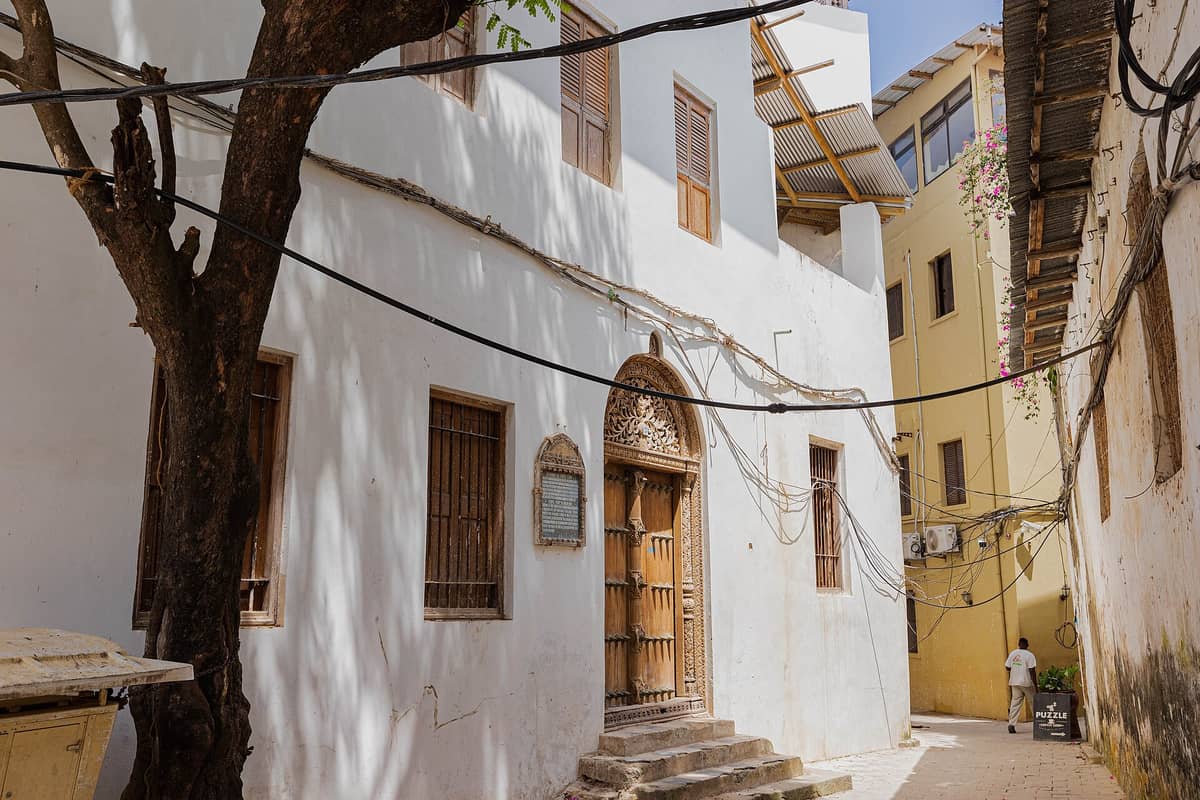
What Is Tippu Tip's House?
Tippu Tip's House is a 19th-century Swahili-Arab townhouse in Stone Town's Shangani ward, historically associated with Hamed bin Mohammed el Murjebi, better known as Tippu Tip. By the 1880s, Tippu Tip controlled vast stretches of Central Africa's trade routes, dealing in ivory and enslaved people on a scale that made him one of the most consequential and controversial figures of the era. He was also, paradoxically, a man who guided and worked alongside European explorers including Henry Morton Stanley and David Livingstone. His Stone Town home reflected that outsized influence: an imposing coral-stone structure on a narrow lane, projecting authority through its carved wooden door and its black-and-white marble entrance steps.
Tippu Tip died in Zanzibar in 1905. The public slave market had closed in 1873; legal slavery in the sultanate ended later, in 1897. The house was later converted into residential flats following the 1964 Zanzibar Revolution, which swept away much of the old merchant class. Today it remains occupied as a private dwelling, which means there is no interior access for visitors. This is not a museum. What you come for is the facade, the context, and the weight of what this address represents.
ℹ️ Good to know
The house is not open to the public. No ticket is required and no guided interior tour exists. Visitors view the exterior from the alley and move on. Plan accordingly — combine this stop with other Shangani-area sights.
The Architecture Up Close
The house sits on Suicide Alley, a lane so narrow that two people walking side by side with bags will brush the walls. The lane got its name not from any documented tragedy but from the near-miss encounters between pedestrians and the occasional donkey or handcart squeezing through. This spatial compression is part of what makes arriving at Tippu Tip's House feel deliberate rather than accidental: the building's facade suddenly fills the frame.
The carved wooden door is the centerpiece. Like the finest examples elsewhere in Stone Town, it is set in a rectangular surround with geometric and floral carvings, though time and humidity have worn the detail. The black-and-white marble steps at the threshold are a status marker from a period when imported marble was a declaration of wealth. The coral-stone walls carry the characteristic pockmarked texture of Zanzibari construction, and patches of old lime plaster survive between sections of exposed stone.
If you want to understand the broader architectural vocabulary of Stone Town, the carved doors here pair well with a focused look at Zanzibar's carved doors as an architectural tradition, and with a visit to the Old Dispensary for a sense of how Indian merchant architecture overlapped with Arab Swahili forms in the same period.
💡 Local tip
Photograph the door in the morning when indirect light fills the alley from the eastern end. By afternoon, the lane falls into deep shadow and detail is hard to capture without a wide aperture or supplementary light.
Tickets & tours
Live prices and dates from our booking partner. If you book, we may earn a commission at no extra cost to you.
Zanzibar catamaran and snorkelling tour to Mnemba Marine Park
From 114 €Instant confirmationFree cancellationNyerere National Park two-day safari with two game drives
From 866 €Instant confirmationFree cancellationSerengeti National Park private three-day safari from Zanzibar
From 2.144 €Instant confirmationFree cancellationZanzibar north coast sunset dhow cruise
From 42 €Instant confirmationFree cancellation
The Man Behind the Address: Historical Context
Understanding why this building matters requires some background on Tippu Tip himself. Born around 1837 in Zanzibar to a mixed Arab-African family with established trading connections, he built an operation that stretched from the East African coast deep into the Congo Basin. At his peak, he commanded private armies, governed territories larger than some European nations, and reportedly controlled more enslaved people than any other individual trader of his era.
He was also a shrewd political operator who cultivated relationships with European powers even as those powers were working to end the trade that made him rich. He served as the Congo Free State's governor of the district of the Falls from 1887 to 1890, a detail that places him at the intersection of two of the most brutal systems operating in 19th-century Africa simultaneously. under King Leopold II, a detail that places him at the intersection of two of the most brutal systems operating in 19th-century Africa simultaneously. His memoirs, dictated in Swahili and later translated, offer a portrait of a man who understood his position with clarity.
For travelers who want to follow the full arc of Zanzibar's slave trade history, the Slave Trade Museum in Stone Town provides the most structured context, and the Mangapwani Slave Caves on the island's northwest coast offer a raw, physical encounter with how that trade functioned at the point of departure. The Zanzibar slave history guide brings all of these sites together if you are building an itinerary around this chapter of the island's past.
When to Visit and What to Expect
Early morning, between 7:30 and 9:30, is the best time to walk Suicide Alley. The light is softer, the narrow lane has not yet accumulated the midday heat radiating off coral stone, and foot traffic is light enough that you can stand in front of the door without blocking local residents trying to get through. By late morning, school runs, delivery carts, and tour groups moving through Shangani make the alley noticeably more crowded.
In the middle of the day, the alley smells of warming stone and the faint salt-and-fish drift that moves through Stone Town from the waterfront a few hundred meters away. By afternoon, if you return, the facade is in shadow and the lane cools slightly. The building does not change with the time of day the way a viewpoint or a beach does, so the visit is brief regardless of when you arrive. The experience is contemplative rather than sensory-rich: you are looking at a wall, a door, and a staircase, and doing the imaginative and historical work yourself.
There is no signage on or around the house explaining who lived there or why it matters. This is both a limitation and, in a strange way, fitting: the building simply exists in the neighborhood, occupied and ordinary-looking from a distance, carrying its history without annotation. Bring your own context, or read up before you arrive.
⚠️ What to skip
Do not attempt to enter the building or knock on doors. This is a private residential property. Treat it as you would any occupied historic home: observe from the public lane and respect the residents' space.
Fitting It Into a Stone Town Walk
Tippu Tip's House works best as one point in a longer walking circuit of Shangani and the surrounding streets rather than as a standalone destination. From the Old Fort, the walk into Shangani takes roughly 15 to 25 minutes through progressively narrower streets. The Shangani ward is one of Stone Town's oldest and most architecturally dense neighborhoods, and the walk there is part of the value.
Africa House Hotel sits close by and is a useful landmark if you are navigating by landmarks rather than by map. From Tippu Tip's House, it is a short walk to the waterfront and to other Shangani-area points of interest. The Forodhani Gardens are worth returning to at dusk if you haven't yet experienced the evening food market that sets up along the seafront promenade. A comprehensive Stone Town walking guide will help you string these stops together without unnecessary backtracking.
Stone Town's core is pedestrian-only or nearly so. Wear shoes that grip on smooth, sometimes damp stone surfaces. The lanes are uneven and occasionally punctuated by shallow drainage channels. If you are visiting during the June to October dry season, the walking is straightforward. The long rains between March and May can leave lanes slick and the air heavy.
Who Will Not Enjoy This Stop
Travelers who prioritize interactive, signage-rich museum experiences will find Tippu Tip's House frustrating. There is nothing to read on site, nothing to purchase, and no guide waiting to explain what you are looking at. If you have limited time in Stone Town and are choosing between this and the Slave Trade Museum, prioritize the museum for depth of content. The House of Wonders remains closed for restoration after the 2020 collapse.
Visitors with mobility challenges should know that Stone Town's lanes, including the approach to Suicide Alley, are unpaved coral stone with irregular surfaces, steps, and no wheelchair access. The House of Wonders and the Old Dispensary offer architectural interest with somewhat more accessible approaches, though Stone Town's terrain is challenging across the board.
For travelers on a tight itinerary who can only absorb a few Stone Town stops, this one requires investment in prior reading to deliver its full weight. The facade alone, without context, is a handsome but unremarkable Swahili-Arab doorway. The context is everything, and the site does not provide it.
Insider Tips
- Read a short summary of Tippu Tip's biography before you arrive. The building communicates nothing without it. Even ten minutes of background transforms the visit from a door-spotting exercise into something genuinely arresting.
- Suicide Alley is genuinely difficult to find without a map or a local landmark to orient from. Download an offline map with the alley marked before you leave your accommodation, as mobile data can be unreliable in Stone Town's densest corridors.
- If you want to photograph the carved door with no people in frame, arrive before 8:00 in the morning on a weekday. Weekend mornings draw more local foot traffic and the occasional early tour group.
- Combine the visit with a walk past the Africa House Hotel to the seafront for an immediate contrast: within five minutes you can move from this dark, confined alley to an open waterfront with Indian Ocean views. The juxtaposition clarifies Stone Town's geography in a way that maps do not.
- Local residents use this lane daily. A brief, respectful acknowledgment rather than standing in the doorway for extended photography is both courteous and will often result in more natural, unguarded photographs of the surrounding streetscape.
Who Is Tippu Tip House For?
- History travelers with a specific interest in 19th-century East African and Indian Ocean trade
- Architecture walkers building a mental picture of Stone Town's Arab-Swahili built heritage
- Travelers following a broader slave history itinerary across Zanzibar's sites
- Photographers interested in textured stone facades, carved doors, and atmospheric narrow lanes
- Independent travelers who are comfortable navigating without on-site interpretation or signage
Nearby Attractions
Other things to see while in Stone Town:
- Darajani Market
Darajani Market, also known as Marikiti Kuu or the Great Market, is a principal market in Stone Town. Dating to 1904, it draws fishermen, spice traders, and local shoppers every morning in a scene that has changed little in over a century. Entry is free, and an hour here tells you more about Zanzibari daily life than any museum.
- Forodhani Gardens
Forodhani Gardens is a seafront park in the heart of Stone Town that doubles as Zanzibar's most celebrated street food market after dark. By day it's a quiet refuge of sea breezes and colonial-era architecture; by evening, dozens of grills and lantern-lit stalls transform it into the social and culinary center of the old city.
- Freddie Mercury Museum
Opened in 2019 on Kenyatta Road in Stone Town's Shangani quarter, the Freddie Mercury Museum occupies the building associated with his childhood. It is a small but carefully assembled tribute to his life, his music, and his largely overlooked Zanzibari origins — making it one of the most personally resonant stops in all of Stone Town.
- Hamamni Persian Baths
Built for Sultan Barghash between 1870 and 1888, the Hamamni Persian Baths were once the grandest public bathhouse in Zanzibar. Today the ruins stand as one of Stone Town's most atmospheric historic sites, offering a quiet counterpoint to the neighborhood's busier attractions.
Planning a trip? Discover personalized activities with the Nomado app.