Zanzibar Carved Doors: Stone Town's Open-Air Gallery of Wood and History
Scattered across the labyrinthine streets of Stone Town, Zanzibar's carved wooden doors are one of the Indian Ocean world's most distinctive architectural traditions. Free to view at any hour, they reward slow, unhurried exploration and reveal centuries of overlapping cultures in a single glance.
Quick Facts
- Location
- Throughout Stone Town, Zanzibar City — highest concentration in Shangani and Malindi districts
- Getting There
- Walk from anywhere in Stone Town; no dedicated transit stop needed. Dala-dala shared minibuses connect the airport to Stone Town.
- Time Needed
- 1–3 hours self-guided; 2–3 hours with a guided walking tour
- Cost
- Free to view (public streetscape). Guided walking tours vary in price — confirm with operators locally.
- Best for
- Architecture lovers, photographers, history readers, slow travelers
- Official website
- zanzibarstonetown.or.tz/stonetown.php
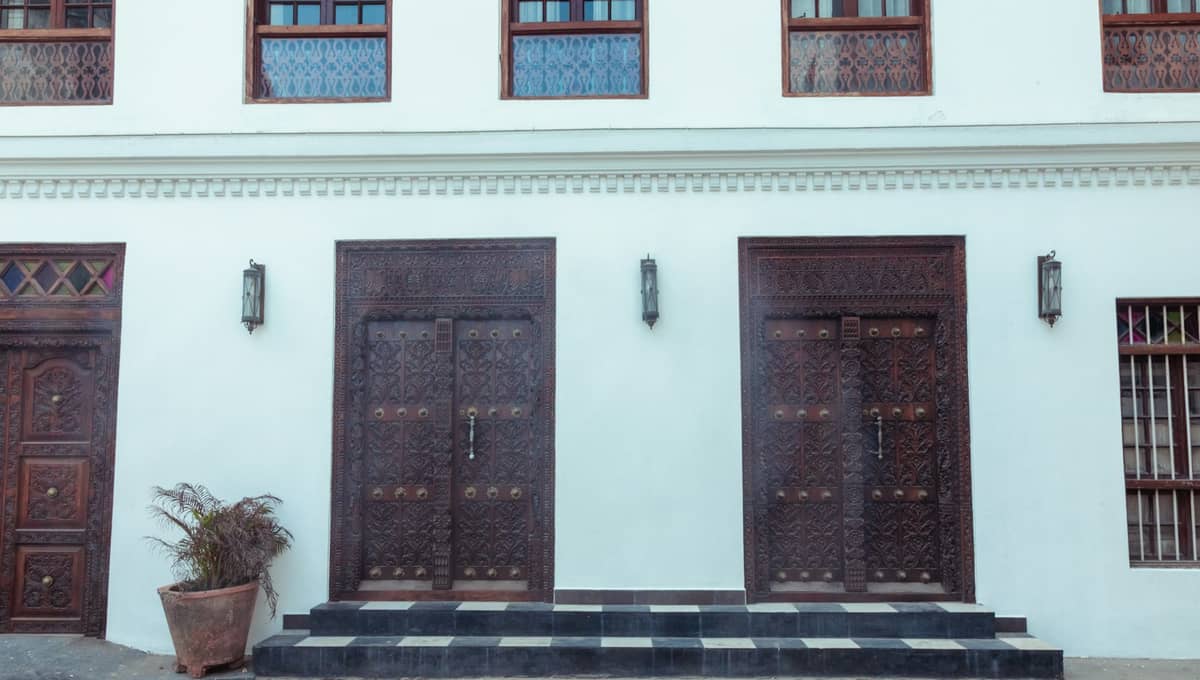
What the Zanzibar Carved Doors Actually Are
The Zanzibar carved doors are not a single attraction you visit and leave. They are embedded into the fabric of Stone Town itself, set into the facades of merchant houses, former palaces, and old trading offices along streets so narrow that the carved canopies overhead almost touch. A 1980s architectural inventory recorded roughly 800 of these doors across the historic center, and while that number has declined over the decades as buildings deteriorate or are renovated without care, hundreds of significant examples survive.
Each door tells a kind of compressed social history. The carvings are not decorative in a casual sense. They were deliberate statements of wealth, piety, and cultural identity made by the merchants and rulers who commissioned them. Motifs include fish (representing fertility and the sea that made Stone Town rich), chains and ropes (symbols of strength in the Arab tradition), lotus flowers and geometric latticework borrowed from Gujarati Indian craftsmen, and Quranic verses worked into the frame. The size and elaborateness of a door was often proportional to the status of the family inside.
ℹ️ Good to know
The Zanzibar Stone Town Heritage Society maintains information on the architectural history of the doors and Stone Town more broadly. Their site is a useful reference before you visit: zanzibarstonetown.or.tz
Two Styles, One Streetscape: Indian and Arab Traditions
Two principal design traditions shaped what you see on Stone Town's streets. Arab-style doors, brought by Omani traders and rulers who dominated the island through the 18th and 19th centuries, are typically rectangular with a relatively plain surround but dense, detailed carving across the door panels themselves. The wood used was often teak or mvule, chosen for its resistance to the coastal humidity. Arab doors tend to sit flush with the building facade, framed by simple square pillars.
Indian-style doors, associated with Gujarati and other South Asian merchants who formed a significant commercial class in 19th-century Stone Town, are structurally different. They often feature a projecting frame with elaborately carved lintels, side posts thick with floral and geometric patterns, and brass studs originally intended to deter war elephants — a design feature imported from the Indian subcontinent where it was functional, and retained here as ornament. The Metropolitan Museum of Art holds one documented Zanzibar carved door dating to the mid-to-late 19th century, with dimensions of 270 by 150 by 26 centimeters, which gives a sense of their physical scale and presence.
This architectural layering is part of what makes Stone Town genuinely significant beyond its photogenic quality. For more on how these two traditions shaped the built environment of the whole city, the Stone Town architecture guide covers the broader urban context in detail.
Tickets & tours
Live prices and dates from our booking partner. If you book, we may earn a commission at no extra cost to you.
Zanzibar catamaran and snorkelling tour to Mnemba Marine Park
From 114 €Instant confirmationFree cancellationSerengeti National Park private three-day safari from Zanzibar
From 2.144 €Instant confirmationFree cancellationZanzibar north coast sunset dhow cruise
From 42 €Instant confirmationFree cancellationZanzibar Prison Island private tour
From 224 €Instant confirmationFree cancellation
How the Experience Changes by Time of Day
Morning is the best time to photograph the doors. Between roughly 7am and 10am, the low-angle light catches the relief carving at an angle that makes every detail pop — the depth of a floral scroll, the texture of a brass stud, the grain of decades-old teak. The streets are cooler, the air carries the smell of baked bread and coffee from small cafes opening their shutters, and foot traffic is light enough to stand in the lane without obstruction.
By midday, Stone Town's streets become considerably hotter and the light flattens into an overhead glare that washes out the carving detail. Many residents retreat indoors. The experience shifts: the lanes feel emptier, almost suspended, and you can study individual doors without feeling self-conscious. The smell of cloves and dried fish drifts from the direction of Darajani, and cats, of which Stone Town has many, congregate in patches of shadow near doorsteps.
Late afternoon, from around 4pm onward, brings a second good light window and returns the streets to life. Children appear, vendors reopen, and the doors are framed by the activity of ordinary residential life — laundry strung across upper floors, voices from courtyards, the sound of the evening call to prayer echoing off close-set walls. This is the version of Stone Town that feels lived-in rather than curated.
💡 Local tip
Bring a compact camera or use your phone camera's portrait mode to capture the shallow depth of field that isolates carved detail against blurred street backgrounds. A small torch or phone flashlight is useful for examining particularly dark or recessed doorways.
Where to Find the Most Significant Doors
The Shangani district, at the western tip of the Stone Town peninsula, and the Malindi area to the north have the highest concentrations of notable doors. Shangani is where the wealthiest Arab and Indian merchants settled, and their former residences still carry some of the most elaborate carvings. The street running roughly parallel to the waterfront between the Old Fort and the Serena Inn passes several standout examples.
Deeper into the residential interior of Stone Town, the doors become less grand and more varied. You will find working-class examples where the carving is simpler and the wood shows more wear, sometimes patched with mismatched timber, painted over, or supplemented with modern metal fittings. These are, in their way, as interesting as the showcase pieces, because they show the tradition adapted across different economic registers rather than preserved only in elite form.
A structured Stone Town walking route will help you navigate between the key concentrations without getting lost in the grid of lanes, which is genuinely disorienting without some orientation. Getting mildly lost is also fine, and often how you find the most unexpected examples.
The Historical Weight Behind the Craft
The golden period for Zanzibar's carved doors was roughly the mid-19th century, when the Omani Sultan Seyyid Said relocated his court from Muscat to Stone Town and the island became the dominant trading hub of the western Indian Ocean. Cloves, ivory, and enslaved people moved through Zanzibar's port in enormous quantities, generating the wealth that funded the elaborate architecture. The doors were part of that display of prosperity.
It is impossible to look at Stone Town's grandest buildings, including the houses fronted by the most elaborate doors, without acknowledging that many were built or financed through the slave trade. The Slave Trade Museum and the Mangapwani Slave Caves address this history directly, and visiting them alongside the door trail gives the carved wood a more complete and honest context.
After the British abolished the slave trade in Zanzibar in 1873 and the broader political economy of the island shifted through the colonial period, the door-carving tradition continued but gradually declined in scale and ambition. Fewer patrons could afford the months of skilled labor that the finest doors required. Conservation today is inconsistent: some doors have been carefully restored, others are visibly decaying, and replacement with plain modern doors happens regularly as buildings change hands or fall into disrepair.
Practical Walkthrough: How to Approach the Doors
Since the doors are part of the public streetscape, there is no entry point, no ticket booth, and no official route. You simply walk. Wear comfortable shoes with some grip — Stone Town's lanes are uneven, sometimes cobbled, sometimes just packed earth, and can be slippery after rain. Light, breathable clothing is appropriate given the heat and the fact that you are moving through a predominantly Muslim residential neighborhood.
A guided walking tour has real advantages here. A good local guide can identify specific doors by their owners, history, or craftsmanship tradition, explain iconographic details you would otherwise pass without understanding, and take you into lanes that are not on any tourist map. Several tour operators in Stone Town offer door-focused or architecture-focused walks; ask at your accommodation for current recommendations, since operators change frequently.
The doors make a natural anchor for a broader exploration of Stone Town's outdoor attractions. The Forodhani Gardens on the waterfront are a ten-minute walk from Shangani and offer a good place to sit and decompress after an hour or two in the lanes. The House of Wonders nearby also rewards a visit for its architectural scale and historical displays.
⚠️ What to skip
Many of the most photogenic doors belong to private residences that are still actively occupied. Photograph from the street rather than stepping into doorways, and ask permission before photographing anyone near their home. Some residents have become understandably tired of being treated as a backdrop.
Honestly: What the Doors Are and Are Not
The Zanzibar carved doors are genuinely worth seeking out, but they work best as a layer of observation rather than a destination in isolation. If you walk Stone Town specifically to see doors and nothing else, you may feel underwhelmed after the first twenty minutes, particularly if you lack the contextual knowledge to read what you are looking at. The experience is cumulative: the fifth or tenth door, understood in relation to what came before it, becomes more meaningful than the first.
Visitors who want a single spectacular, clearly labeled highlight may find the distributed, unmarked nature of the doors frustrating. There is no 'best door' with a sign next to it. The experience rewards patience, curiosity, and a willingness to wander without a fixed objective. Those qualities, incidentally, are also what Stone Town itself most rewards.
If you are planning your Stone Town time carefully, the Swahili culture guide will help you understand the broader social context that makes the door tradition meaningful rather than merely decorative.
Insider Tips
- The door at the former Tippu Tip House (the home of the notorious 19th-century ivory and slave trader) is one of the finest surviving examples in Stone Town and is often cited as a reference point for the Arab style. Look for it in Shangani, though confirm its current location locally as street names in Stone Town are inconsistently signposted.
- Photograph doors in morning light from the east-facing lanes, and in late afternoon from the west-facing ones — you want the sun low and angled across the carving surface, not flat against it.
- If rain is forecast, go anyway. Wet teak deepens in color and the carving detail becomes even more pronounced when the wood is damp. Just watch your footing on slick lane surfaces.
- Ask your guide or guesthouse owner about specific doors that are in the process of being restored — watching craftsmen work on these pieces is a rare insight into a living tradition, not just a historical one.
- Many of the grandest doors are set slightly above street level, on a raised stone step called a baraza. These steps were traditionally social spaces where merchants conducted business and neighbors gathered in the evenings — a detail that reframes the doors as thresholds to public life, not just private wealth.
Who Is Zanzibar Carved Doors For?
- Architecture and design enthusiasts who want to understand how different cultural traditions fused into a single built environment
- Photographers looking for strong texture, pattern, and available-light subjects
- History readers who want to see the physical evidence of Stone Town's 19th-century trading economy
- Slow travelers who prefer wandering with a loose purpose over ticking off ticketed sites
- Anyone spending at least a full day in Stone Town who wants to understand the city beyond its obvious landmarks
Nearby Attractions
Other things to see while in Stone Town:
- Darajani Market
Darajani Market, also known as Marikiti Kuu or the Great Market, is a principal market in Stone Town. Dating to 1904, it draws fishermen, spice traders, and local shoppers every morning in a scene that has changed little in over a century. Entry is free, and an hour here tells you more about Zanzibari daily life than any museum.
- Forodhani Gardens
Forodhani Gardens is a seafront park in the heart of Stone Town that doubles as Zanzibar's most celebrated street food market after dark. By day it's a quiet refuge of sea breezes and colonial-era architecture; by evening, dozens of grills and lantern-lit stalls transform it into the social and culinary center of the old city.
- Freddie Mercury Museum
Opened in 2019 on Kenyatta Road in Stone Town's Shangani quarter, the Freddie Mercury Museum occupies the building associated with his childhood. It is a small but carefully assembled tribute to his life, his music, and his largely overlooked Zanzibari origins — making it one of the most personally resonant stops in all of Stone Town.
- Hamamni Persian Baths
Built for Sultan Barghash between 1870 and 1888, the Hamamni Persian Baths were once the grandest public bathhouse in Zanzibar. Today the ruins stand as one of Stone Town's most atmospheric historic sites, offering a quiet counterpoint to the neighborhood's busier attractions.
Planning a trip? Discover personalized activities with the Nomado app.