Third Man Museum Vienna: Inside the City's Most Cinematic Obsession
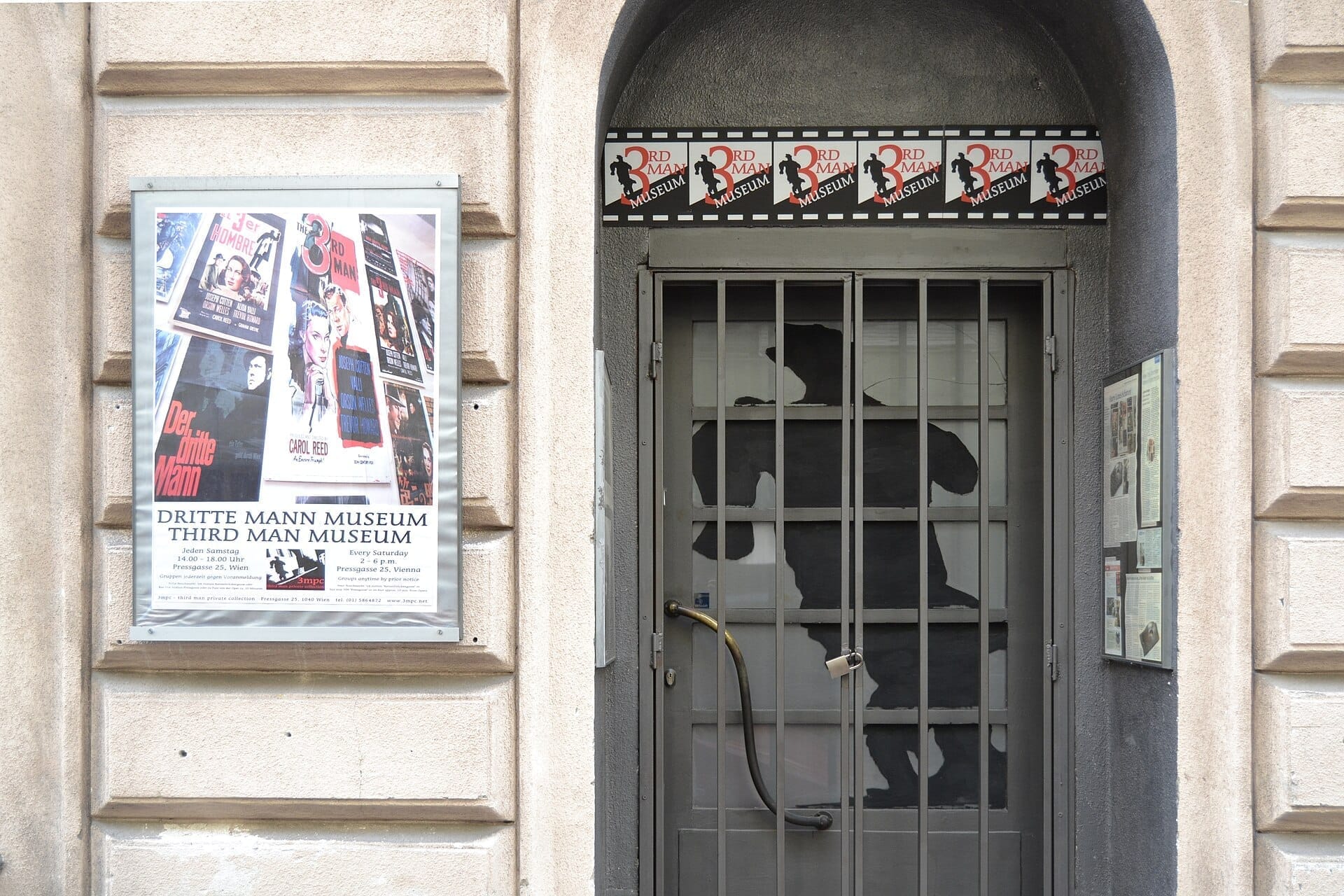
The Dritte Mann Museum on Pressgasse 25 is a privately run shrine to Carol Reed's 1949 film noir classic, spreading across 400 square metres and 16 rooms of props, posters, and post-war Viennese atmosphere. It opens to the public only on Saturday afternoons, which gives the whole visit a pleasingly secretive quality that matches the film perfectly.
Quick Facts
- Location
- Pressgasse 25, 1040 Vienna (4th district, near Naschmarkt)
- Getting There
- U4 Kettenbrückengasse (4-min walk); Bus 59A stop Pressgasse
- Time Needed
- 1.5 to 2 hours
- Cost
- Adults €12 / Concessions €10 / Children (10–16) €8
- Best for
- Film buffs, Cold War history fans, post-war Vienna enthusiasts
- Official website
- www.3mpc.net
What the Third Man Museum Actually Is
The Third Man Museum, or Dritte Mann Museum, opened in 2005 as a privately curated tribute to one of cinema's most celebrated films. Carol Reed's 1949 noir thriller was shot almost entirely on location in a bombed-out, Soviet-occupied Vienna, and the city has never quite stopped trading on that atmospheric legacy. The museum dedicates over 400 square metres across 16 rooms to the film's production history, cultural impact, and the real post-war Vienna that gave it such unsettling texture.
This is not a city-funded heritage attraction with polished interpretive panels. It is the passion project of two private collectors, Karin and Gerhard Strassgschwandtner, who have assembled a remarkable archive of original posters, lobby cards, scripts, photographs, soundtrack memorabilia, and period objects from the late 1940s. The density of objects is almost overwhelming, in the best possible way. You turn a corner and find yourself looking at an original Anton Karas zither, or a collection of film reels from international releases you had never considered.
⚠️ What to skip
The museum opens to individual visitors only on Saturdays from 14:00 to 18:00. Group visits can be arranged on any day by prior appointment. The museum observes a winter break (confirm exact dates on the official website before planning your trip, as closures can extend into spring).
The Film and Why Vienna Was Irreplaceable
Released in 1949, The Third Man stars Joseph Cotten as Holly Martins, an American pulp novelist who arrives in post-war Vienna to visit his friend Harry Lime (Orson Welles), only to find him apparently dead under suspicious circumstances. The film's script, written by Graham Greene, is a study in moral ambiguity, black-market penicillin, and the uneasy coexistence of four occupying powers: American, British, French, and Soviet. Vienna in 1948, when filming took place, was a city of literal and psychological ruins.
What makes the museum compelling even for casual visitors is how it establishes that Vienna was not merely a backdrop. The production team used the actual sewers beneath the city for its climactic chase sequence. The Ferris wheel at the Prater, the bombed-out streets of the inner districts, the baroque facades reflected in puddles of rain: all of it was real, undressed by studio artifice. The museum maps these locations against their present-day counterparts, and you realise how much of the city you can still find if you know where to look.
The museum pairs well with a broader walk through Vienna's cinematic and Cold War geography. The Wiener Riesenrad in the Prater, where Orson Welles delivers the famous 'cuckoo clock' speech, is about 20 minutes away by U-Bahn and remains one of the most evocative film locations still standing in Europe.
Tickets & tours
Hand-picked options from our booking partner. Prices are indicative; availability and final rates are confirmed when you complete your booking.
Viennese wine tasting in a roman wine-cellar
From 36 €Instant confirmationFree cancellationVienna, City of Many Pasts: guided city tour with a friendly historian
From 114 €Instant confirmationFree cancellationImperial Vienna 72-hour hop-on hop-off bus
From 55 €Instant confirmationFree cancellationSkip-the-Line Entrance with Guide to Schonbrunn Palace and Gardens
From 45 €Instant confirmationFree cancellation
Moving Through the 16 Rooms
The layout follows a loose chronological and thematic logic, beginning with the political and physical state of Vienna in the late 1940s and working through the film's pre-production, casting decisions, and technical challenges. Early rooms establish historical context: occupation zones, the black market, displaced populations. This is not filler. Understanding what Vienna actually looked and felt like in 1948 makes the subsequent film material land with much greater force.
Mid-sections of the exhibition focus on production: original call sheets, costume details, correspondence between Reed and Greene, and photographs from the set that show how improvised much of the filming was. There is a strong focus on Anton Karas, the Viennese zither player Reed supposedly discovered in a wine tavern and who recorded the entire score in two weeks. The resulting theme became one of the most recognised pieces of film music ever written, and the museum gives it proper attention.
Later rooms track the film's international distribution, censorship battles in different countries (the American studio wanted a happier ending; Reed refused), and its long critical afterlife. The exhibition closes with material on the sewer tours and walking routes that still take film enthusiasts around the city today. By the time you exit onto Pressgasse, you are already mentally mapping the streets.
💡 Local tip
Audio guides are available and strongly recommended. Many of the objects lack extensive printed labels, and the audio content adds significant depth to the production photographs and period documents.
Visiting on a Saturday Afternoon: What to Expect
Saturday afternoons bring a specific kind of visitor to this museum: people who have done their research, film students, serious cinephiles, Vienna historians. The atmosphere is quiet and focused. This is not a place where school groups jostle past you. Crowds rarely feel excessive, even on popular weekends, partly because the opening hours are so limited and partly because the subject matter self-selects for patient, curious visitors.
The building itself sits on a residential block a short walk from the Naschmarkt. The entrance is at the corner of Pressgasse and Mühlgasse. Note the 11 steps at the entrance: the building is not fully accessible for wheelchair users, and the swinging entry doors are 90 cm wide. Assistance dogs are permitted. Arrive close to 14:00 if you want the full two hours without feeling rushed toward closing time.
The immediate neighbourhood rewards a brief walk before or after your visit. The Naschmarkt is a few minutes on foot, and the Karlskirche is within easy walking distance. This whole stretch of the 4th and 5th districts has a lived-in, unpretentious quality that feels closer to the Vienna of the film than the grand ceremonial boulevards of the Ringstrasse.
Getting There
The most direct approach is the U4 metro line to Kettenbrückengasse, which deposits you about four minutes on foot from the museum entrance. From Karlsplatz (served by U1, U2, and U4), the walk takes approximately ten minutes through quiet residential streets. Alternatively, Bus 59A runs from the State Opera stop at Oper/Karlsplatz; the third stop is Pressgasse, right at the door. There is no dedicated parking, but the surrounding streets have metered spots.
If you are navigating Vienna's public transport for the first time, the getting around Vienna guide covers fare zones, day passes, and the logic of the U-Bahn network in useful detail.
Photography and Practical Notes
Photography is generally permitted inside the museum for personal use, though you should confirm with staff at the entrance. The lighting is deliberately moody in several rooms, which suits the subject matter but makes sharp handheld shots more difficult. A phone with good low-light performance will serve you better than a large mirrorless camera with a slow lens.
No reservation is required for individual visitors during the Saturday public hours. Simply arrive, pay at the door, and collect your audio guide. The admission price is reasonable given the depth and quality of the collection, especially compared to some of Vienna's larger, more institutional museums where you pay significantly more for a smaller fraction of genuine engagement.
ℹ️ Good to know
The museum is embedded within Vienna's wider Cold War and twentieth-century history landscape. For broader historical context on Vienna during the World War II period and its aftermath, see the dedicated history resources covering that era.
Insider Tips
- Check the official website at www.3mpc.net before planning your trip. The museum observes a winter break that can extend into March or even later in some years. Many visitors make the trip on a Saturday only to find a locked door.
- The Naschmarkt sewer entrance nearby is one of the actual locations used in the film's chase sequence. You can walk past it before or after your museum visit and the juxtaposition with the museum's photographs is striking.
- Saturday openings attract a small but informed crowd. If you visit early in the afternoon and strike up a conversation with other visitors or the staff, you will often hear details and anecdotes that go well beyond what the labels say.
- Group bookings on any day of the week are available and may offer a more private, guided experience if you are travelling with a film-focused group or want a curator-led walkthrough.
- Pair your visit with the Third Man sewer tour, which departs from a separate location in the city and takes you into the actual underground passages used during filming. The museum provides context; the sewer tour provides the physical sensation.
Who Is Third Man Museum For?
- Film historians and serious cinephiles who want deeper context than a location tour provides
- Cold War history enthusiasts interested in the occupation of Vienna and post-war European politics
- Visitors who have already seen The Third Man and want a physical encounter with the production's artefacts
- Travellers who prefer small, specialist museums with real curatorial depth over large survey institutions
- Anyone combining the Naschmarkt, Karlskirche, and the 4th district into a half-day walking itinerary
Nearby Attractions
Other things to see while in Belvedere & Landstraße (3rd District):
- Albertina Modern
Opened in 2020 inside the landmark Künstlerhaus building at Karlsplatz, Albertina Modern is Vienna's dedicated space for modern and contemporary art. Across 2,500 square metres, it offers a counterpoint to the Habsburgs-and-Old-Masters narrative that dominates so many of the city's museums.
- Belvedere Gardens
Stretching between two palaces built for Prince Eugene of Savoy, the Belvedere Gardens form one of Central Europe's finest Baroque garden compositions. Entry to the main gardens is free, and the grounds shift dramatically in character from early morning calm to afternoon crowds and golden evening light.
- Heeresgeschichtliches Museum (Museum of Military History)
Housed in a striking Moorish-Byzantine arsenal building from the 1850s, the Heeresgeschichtliches Museum is one of the oldest purpose-built military history museums in the world. At just €3.50 admission, it offers an unexpectedly deep dive into Austria's military and political past, including the actual car in which Archduke Franz Ferdinand was assassinated in 1914.
- Hundertwasserhaus
Hundertwasserhaus is a municipal apartment block in Vienna's 3rd district that looks like it was painted by a child and designed by a forest. The exterior is free to view any time, and the adjacent Hundertwasser Village gives you a place to linger. Here is what a visit actually involves.