Wiener Riesenrad: Vienna's Historic Giant Ferris Wheel
Standing 64.75 metres above the Prater since 1897, the Wiener Riesenrad is one of Europe's oldest surviving ferris wheels and one of Vienna's most recognisable landmarks. This guide covers what the experience actually feels like, the best times to ride, how to get there, and whether it lives up to the price.
Quick Facts
- Location
- Riesenradplatz 1, 1020 Wien (Leopoldstadt / Prater entrance)
- Getting There
- U-Bahn U1 to Praterstern station, then a short walk into the Prater
- Time Needed
- 45–90 minutes including the museum passage and one full rotation
- Cost
- Standard ticket €14.50; verify current pricing at wienerriesenrad.com
- Best for
- Families, first-time visitors, photography, and history enthusiasts
- Official website
- wienerriesenrad.com/en/home-2
What the Wiener Riesenrad Actually Is
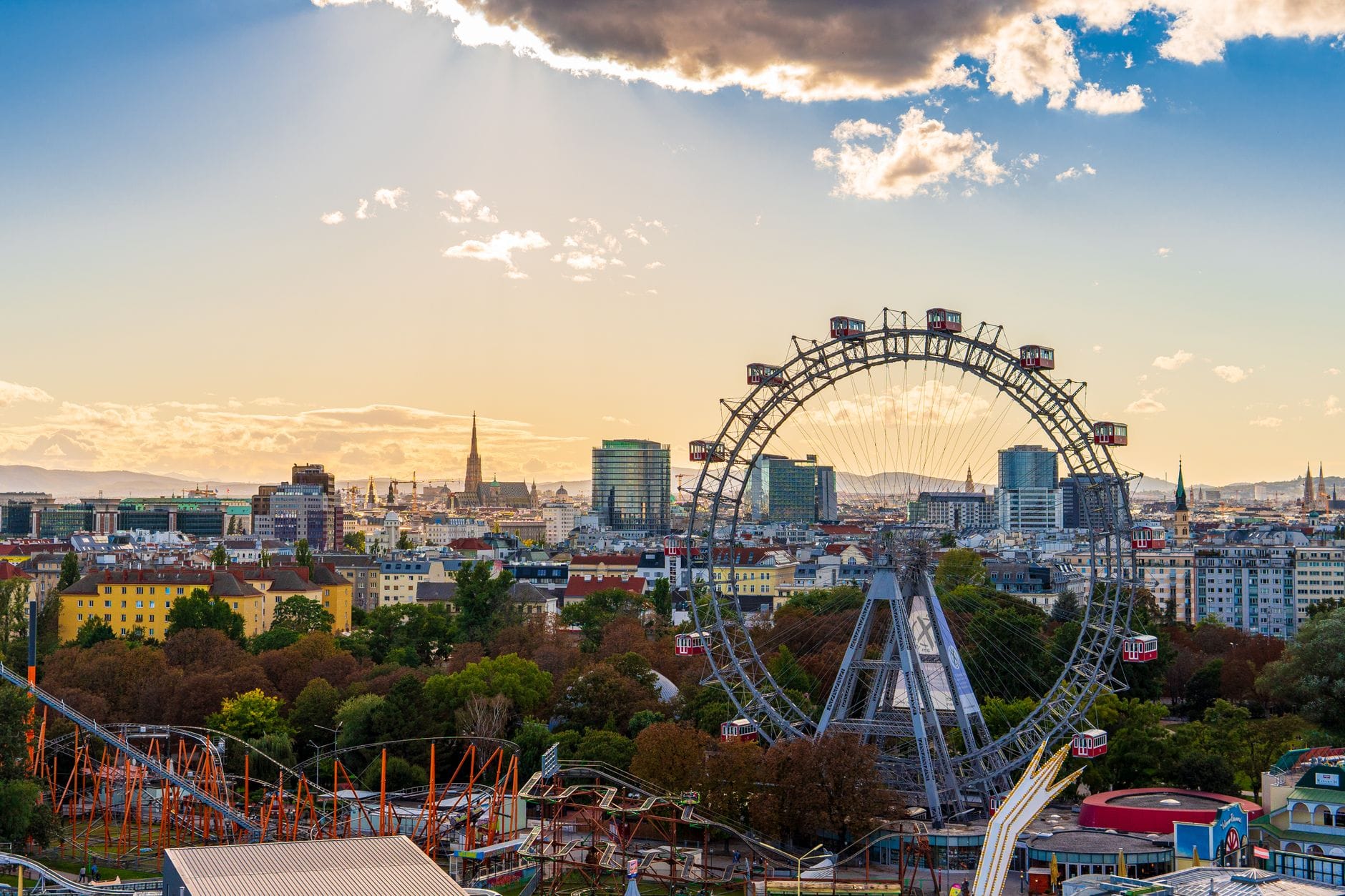
The Wiener Riesenrad is a 64.75-metre tall wooden-cabined ferris wheel that has been rotating slowly above Vienna's Prater park since 1 July 1897. It was constructed to mark the 50th jubilee of Emperor Franz Joseph I's reign, and it remains one of the oldest operating ferris wheels in the world. The wheel turns on a single fixed axle, carrying 15 red gondola cabins, each large enough to hold a small group of standing visitors. It moves slowly enough that you can track landmarks across the city skyline as you ascend.
The structure itself is visually arresting long before you board it. Arriving along the main Prater alley, the wheel appears above the treeline as a dark iron skeleton, its spokes giving it an almost industrial quality that sets it apart from modern theme-park rides. Up close, the scale becomes clearer: each gondola is roughly the size of a vintage railway carriage, and the riveted metalwork carries the patina of more than a century of weather and use.
ℹ️ Good to know
Before you ride, you pass through a series of small diorama rooms at ground level that tell the story of Vienna and the wheel itself. The museum section adds roughly 20–30 minutes and is included in the standard ticket price.
The Historical Weight of the Structure
Few viewpoints in Vienna carry as much biographical weight as this one. The Riesenrad opened at the height of the Austro-Hungarian Empire, when Vienna was a city of around two million people and one of the most powerful capitals in Europe. The wheel was designed by British engineer Walter Bassett Basset and originally had 30 gondolas; the number was reduced to 15 after wartime damage. The wheel survived two World Wars, a partial destruction in 1945, and postwar reconstruction to become a deliberate symbol of Viennese resilience.
Its cultural resonance deepened considerably in 1949, when the wheel appeared in Carol Reed's film 'The Third Man', with Orson Welles delivering the famous 'cuckoo clock' speech from inside one of the gondolas. That scene, filmed in black-and-white with the wheel creaking and the city spread below, embedded the Riesenrad into the broader imagination of postwar Europe. The museum section inside the wheel's base references this connection directly.
For visitors interested in Vienna's broader postwar cultural history, the Third Man Museum in the 4th district explores the film and the era in considerable depth and pairs well with a Riesenrad visit.
Tickets & tours
Live prices and dates from our booking partner. If you book, we may earn a commission at no extra cost to you.
Wiener Melange coffeehouse experience
From 34 €Instant confirmationFree cancellationSelf-guided digital scavenger hunt in Wiener Neustadt
From 13 €Instant confirmationImperial Vienna 72-hour hop-on hop-off bus
From 55 €Instant confirmationFree cancellationSkip-the-Line Entrance with Guide to Schonbrunn Palace and Gardens
From 45 €Instant confirmationFree cancellation
What You See From the Top
At the apex of the rotation, you are roughly 64 metres above the Prater. The view opens across a wide arc: the dense green canopy of the Prater itself fills the foreground to the south, while the Danube Canal and the broader city grid extend to the west. On clear days, you can identify St. Stephen's Cathedral by its geometric tiled roof, and the Ringstrasse's monumental buildings form a loose arc across the horizon. To the northeast, the Danube and the modern Donaucity towers provide a visible contrast between old Vienna and its 21st-century expansion.
The gondolas have large windows on all sides, so sightlines are reasonable throughout the rotation. That said, the glass tends to reflect interior light in the evenings, which can affect photographs. Morning visits, with lower sun angles and softer light, generally produce cleaner shots. If you are coming specifically to photograph the city from above, a morning ride on a clear day is significantly more rewarding than an evening one, despite what the atmosphere of the night-time visit might suggest.
💡 Local tip
For a sharper photograph through the gondola windows, press your lens or phone camera flush against the glass to eliminate reflections. This works especially well on the upper arc of the rotation, facing west toward the city centre.
How the Experience Changes by Time of Day
The Wiener Riesenrad opens at 09:00 and runs until 23:45 (hours can vary by season; verify at wienerriesenrad.com before visiting). The early morning is the quietest window, with almost no queue and the Prater itself largely empty. The atmosphere is genuinely calm: the wheel turns, the city below is just waking up, and the smell of damp grass from the park drifts up through the ventilation gaps in the gondola. If you have children and want to avoid crowds, 09:00 to 10:30 is by far the best window.
By mid-morning and into the afternoon, tourist groups arrive and the queue at the ticket booth grows. The Prater's adjacent amusement facilities also open, bringing more noise and foot traffic. The experience becomes noticeably more chaotic between roughly 11:00 and 17:00, particularly on weekends and in peak summer months. This is not a dealbreaker, but the queuing time can stretch to 30 minutes or more on busy days.
Evening rides have their own appeal. The wheel is illuminated after dark, and the city lights across the horizon create a softer, more atmospheric effect than the daytime skyline. The Prater's fairground rides operate at full volume by this point, and there is a certain nostalgic quality to the whole scene. The trade-off is that photographing through the lit gondola windows becomes harder, and the queue can still be significant until around 21:00.
Getting There and Practical Logistics
The most straightforward route is the U-Bahn U1 line to Praterstern station. From the station exit, the Riesenrad is visible almost immediately: walk into the Prater through the main entrance arch and the wheel appears directly ahead. The walk takes under five minutes. Praterstern is a major interchange hub, so connections from most parts of Vienna are direct or require only one transfer.
The wheel sits at the entrance to the Prater, Vienna's large public park and leisure ground in the Leopoldstadt district. The Prater extends for several kilometres beyond the fairground and is well worth exploring on foot or by bike before or after your ride.
Standard tickets cost €14.50 as of the most recent official tourism listings. This includes both the museum walk-through and the ride itself. Tickets are available at the booth on-site; pre-booking online via the official website is possible and can save time during busy periods. The attraction has accessibility provisions, though the gondola entry involves a step up and the moving-entry mechanism (the wheel does not fully stop for boarding) requires a degree of mobility. Check the official accessibility details at wienerriesenrad.com before visiting if this is relevant to your group.
⚠️ What to skip
The wheel does not stop completely for boarding and exit. Passengers step on and off a moving gondola, which moves slowly but continuously. This may be challenging for visitors with limited mobility, young toddlers, or those with vertigo. Assess this honestly before queuing.
Honest Assessment: Is It Worth It?
The Wiener Riesenrad is not the highest viewpoint in Vienna, nor the sharpest. The Donauturm offers a significantly higher and more panoramic view. The Riesenrad's value lies elsewhere: in its age, its narrative weight, and the specific quality of seeing Vienna from a slowly rotating Victorian iron wheel that has been doing this since the Habsburg era. That context transforms what could be a generic tourist ride into something more considered.
For first-time visitors to Vienna, it earns its place as an orientation experience. For repeat visitors who have seen the city from multiple angles, it is worth revisiting for the museum content and the evening atmosphere rather than the view itself. Visitors who prioritise elevated panoramas should also consider the Gloriette at Schönbrunn or the Kahlenberg hill for a different perspective on the city.
If you are building an itinerary around Vienna's viewpoints and outdoor landmarks, the Vienna attractions overview covers the full range of options across all price points.
Who might want to skip it: travellers with a strong fear of heights or who find slow enclosed rides uncomfortable; visitors with very limited time who have already seen Vienna from the Belvedere or another elevated point; and travellers primarily interested in Habsburg interiors or music history, for whom the €14.50 could be better spent elsewhere.
What to Combine It With Nearby
The Riesenrad sits at the edge of one of Vienna's best green spaces. A walk along the Hauptallee, the long chestnut-lined avenue cutting through the Prater, is one of the more relaxed ways to spend an hour in the city. The avenue runs flat for several kilometres and is shared by joggers, cyclists, and families. Renting a bike near Praterstern and cycling the full length of the Hauptallee before or after your ride is a natural pairing.
The Leopoldstadt district surrounding the Prater also has its own particular character, shaped significantly by its history as Vienna's former Jewish quarter. The Jewish Museum Vienna is worth including in a broader half-day in the district for visitors interested in that history.
Insider Tips
- Arrive at opening time (09:00) on a weekday to board with no queue and the Prater almost entirely to yourself. The contrast with midday crowds is considerable.
- The museum section at ground level before the ride is easy to rush through, but the scale models of the original 30-gondola wheel and the Third Man film references are genuinely interesting. Budget 20 minutes rather than treating it as a corridor to the boarding point.
- If you want the classic postcard view of the wheel itself rather than from inside it, walk about 200 metres back toward Praterstern along the main approach lane. In late afternoon, the low sun catches the iron structure from the west and the lighting is far more interesting than at midday.
- The adjacent Prater amusement park is one of the oldest funfairs in the world and worth a short walk even if you are not riding anything. The Calafati carousel and the old dodgems areas have a time-capsule quality that most visitors walk straight past.
- Gondolas can be rented privately for events including dinners served inside the cabin during the rotation. This is a premium-priced option but a genuinely unusual experience for special occasions. Book directly through the official website well in advance.
Who Is Wiener Riesenrad (Giant Ferris Wheel) For?
- First-time visitors wanting a physical orientation to Vienna's layout from above
- Families with children aged 5 and up who want a manageable, visually impressive activity
- Photography enthusiasts interested in the wheel's structure and the cityscape on clear mornings
- History-minded travellers who appreciate the Habsburg and postwar cultural context
- Couples looking for an atmospheric evening ride with the Prater lit below
Nearby Attractions
Other things to see while in Leopoldstadt (2nd District):
- Augarten
Augarten is Vienna's oldest Baroque park, a 52.2-hectare public green space in Leopoldstadt that has been open to the public since 1775. Alongside formal allées and open lawns, it houses the Vienna Porcelain Manufactory, a contemporary arts center, and two hulking World War II flak towers that make this one of the most historically layered parks in any European capital.
- Prater
The Wiener Prater is one of Europe's great urban parks: 6 square kilometres of chestnut-lined avenues, meadows, and a working amusement park that has been entertaining Viennese since the 18th century. Entry to the park is free, the Riesenrad is unmistakable on the skyline, and the Hauptallee is one of the finest walking and cycling corridors in any capital city.
Planning a trip? Discover personalized activities with the Nomado app.