Vienna Prater: The Full Guide to the Park, Wurstelprater and Giant Ferris Wheel
The Wiener Prater is one of Europe's great urban parks: 6 square kilometres of chestnut-lined avenues, meadows, and a working amusement park that has been entertaining Viennese since the 18th century. Entry to the park is free, the Riesenrad is unmistakable on the skyline, and the Hauptallee is one of the finest walking and cycling corridors in any capital city.
Quick Facts
- Location
- Leopoldstadt (2nd District), Vienna. Main amusement access at Riesenradplatz, 1020 Vienna.
- Getting There
- Praterstern station (U1, U2 metro lines, S-Bahn, trams and buses)
- Time Needed
- 1–2 hours for Wurstelprater and Riesenrad; half a day if walking or cycling the Hauptallee
- Cost
- Park and Wurstelprater area: free. Individual rides: approx. €3–€15 each. Riesenrad: verify current price before visiting.
- Best for
- Families, joggers, casual visitors, fans of retro fairground atmosphere
- Official website
- www.praterwien.com/en/home
What the Prater Actually Is (and Why It Confuses First-Time Visitors)
The Wiener Prater is two places sharing one name. The first is a sprawling green park of roughly 6 square kilometres, one of the largest urban recreational areas in any European capital. The second is the Wurstelprater, a traditional amusement park that occupies a corner of that green space and has been operating in some form since 1895. Visitors who arrive expecting a theme park find a park. Visitors expecting nothing but greenery stumble onto carnival rides and Bratwurst stands. Both groups are usually pleasantly surprised.
The park traces its origins to 1162, when it was first documented as a meadow (from the Latin "pratum"). For centuries it served as an imperial hunting ground, but in 1766 Emperor Joseph II opened it to the public as a recreational space for Vienna's residents, a decision that shaped the character of Leopoldstadt permanently. Today the park is freely accessible year-round, with no gates, no ticket booths, and no closing time.
ℹ️ Good to know
The Wurstelprater area itself is accessible 24 hours a day, all year. Individual rides and attractions set their own hours. The main season runs from approximately 15 March to 31 October, with typical opening hours around 11:00.
The Hauptallee: Vienna's Finest Urban Corridor
The spine of the green Prater is the Hauptallee, a dead-straight avenue stretching approximately 4.5 kilometres from Praterstern to the Lusthaus, lined on both sides by around 2,500 horse chestnut trees. In late April and early May, these trees bloom simultaneously and the effect is remarkable: a cathedral ceiling of white and pink flowers above a wide, flat road closed to private cars.
In the early morning, the Hauptallee belongs to runners and cyclists. The surface is smooth, the air still carries traces of dew, and the avenue is genuinely quiet for a major city. By midday on a sunny weekend it fills with families on hire bikes, inline skaters, and groups walking dogs. Late afternoon in summer brings a warm golden light through the chestnut canopy that photographers regularly seek out. The avenue's width (it was designed for imperial carriages) means it never feels congested even when busy.
Bicycles can be hired near Praterstern, making the Hauptallee one of the easiest and most rewarding short rides in the city. For more cycling and outdoor options around Vienna, the Vienna hiking and outdoor guide covers the wider network of routes beyond the Prater.
Tickets & tours
Hand-picked options from our booking partner. Prices are indicative; availability and final rates are confirmed when you complete your booking.
Strauss Dinner Show
From 99 €Instant confirmationFree cancellationMadame Tussauds Vienna Admission Tickets
From 0 €Instant confirmationGiant Ferris Wheel tickets in Vienna
From 14 €Instant confirmationMadame Tussauds Vienna tickets
From 27 €Instant confirmationFree cancellation
The Wurstelprater: Old-Fashioned Fairground, Deliberately Preserved
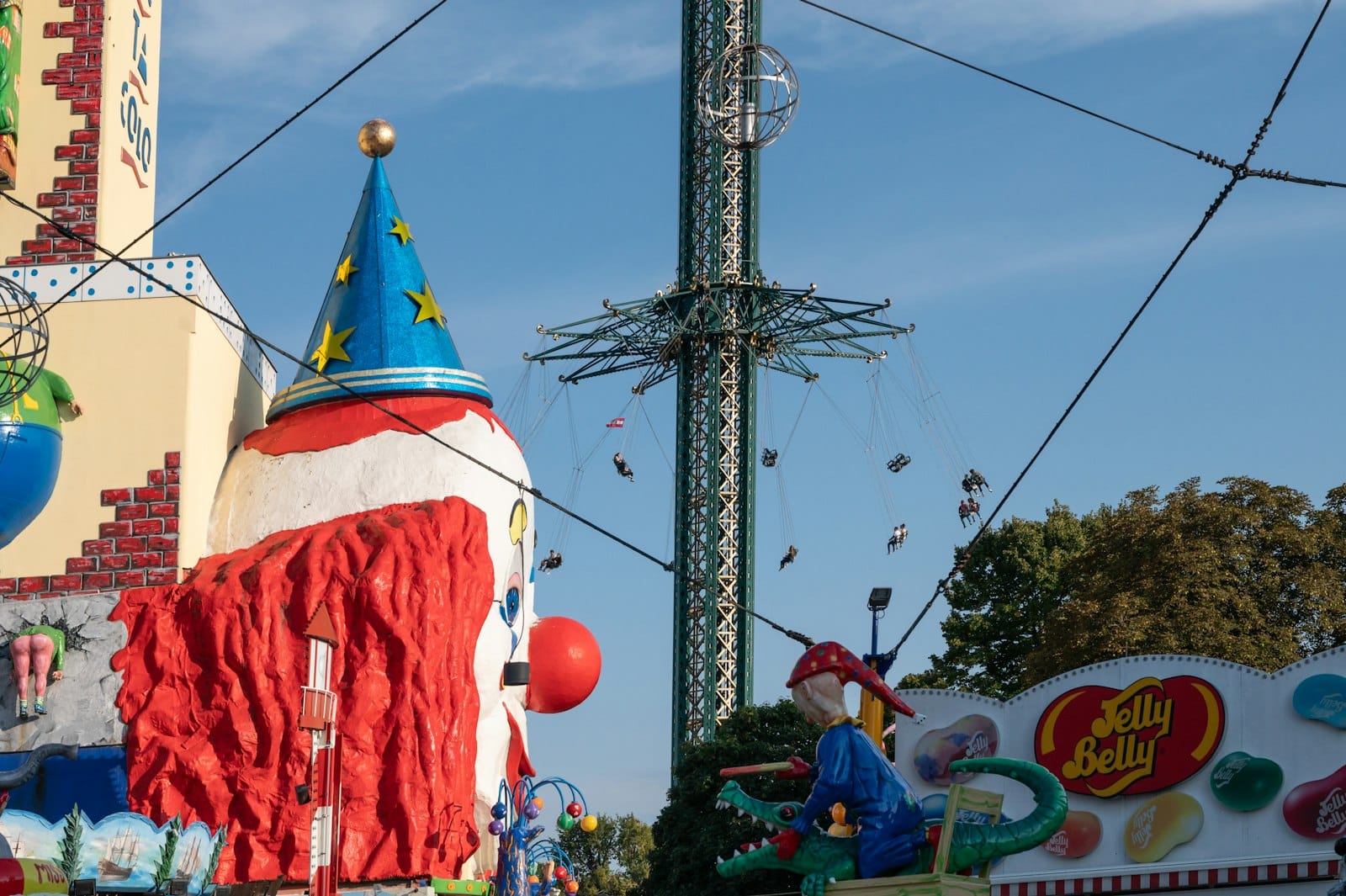
The Wurstelprater is not trying to compete with modern theme parks and makes no apology for that. It is a collection of independently operated rides, shooting galleries, bumper cars, small roller coasters, and food stalls that have accumulated over more than a century. The overall aesthetic is somewhere between nostalgic and faded, which is precisely why many visitors prefer it to slicker alternatives.
Individual rides are paid for separately, which means you can spend as little or as much as you like. Prices typically range from around €3 to €15 depending on the attraction. There is no park-wide admission fee and no pressure to buy a day pass. Families often pick two or three rides, grab a sausage from one of the food stands, and call it a satisfying afternoon without breaking the budget.
The atmosphere shifts noticeably by time of day. In the mid-morning, stall operators are still setting up and the area has a relaxed, unhurried quality. By early afternoon on weekends it gets livelier, with children queuing for rides and the smell of roasting chestnuts (in autumn) or grilled sausages drifting across the paths. Weekend evenings in summer can be genuinely lively, with the lights of the rides reflecting off the surrounding trees.
💡 Local tip
If you are visiting with young children, the Wurstelprater suits them well: rides are accessible, distances between attractions are short, and there is no single expensive gate ticket to justify.
The Wiener Riesenrad: Vienna's Defining Landmark
The Wiener Riesenrad, the Giant Ferris Wheel at the edge of the Wurstelprater, is one of the most recognisable structures in Vienna. Built in 1897, it stands 64.75 metres tall and rotates at a stately pace, offering elevated views across the city and the park below. Unlike modern observation wheels, its red gondolas are enclosed wooden cabins, each large enough to hold a group. The whole ride takes about 20 minutes.
The Riesenrad carries genuine historical weight. It survived heavy bombing in World War II and was rebuilt, making it one of the few pre-war structures in this part of the city still in its original use. It also featured in the 1949 film "The Third Man", a detail that film enthusiasts will appreciate. If you have an interest in that era of Viennese history, the Third Man Museum in the 4th district digs into the story thoroughly.
For photography, the wheel reads well in the late afternoon when the sun angles from the west and catches the red paintwork. The views from inside the gondolas are best on clear days; overcast conditions reduce the sense of distance significantly. The Riesenrad is a separately ticketed attraction within the Wurstelprater. Verify current prices directly through the official site before visiting, as they are updated periodically.
Getting There and Moving Around
Praterstern station sits directly at the park's main entrance and is served by the U1 and U2 metro lines, S-Bahn suburban rail services, and several tram and bus routes. From central Vienna, it is a short, straightforward journey: the U1 connects directly from Stephansplatz in under ten minutes. The station itself is large and well-signed.
Once inside the park, the Wurstelprater and Riesenrad are a short walk from the Praterstern exit. The Hauptallee begins immediately and is flat, wide, and easily navigated on foot, by bike, or with a pushchair. The park's scale means that walking the full Hauptallee to the Lusthaus and back is a dedicated outing, not a quick detour. For an overview of getting around Vienna by public transport, the guide to getting around Vienna covers all the practical details.
Accessibility is generally good. The main paths, including the Hauptallee, are paved and level. The Wurstelprater area has some uneven ground between attractions, but is largely manageable with a wheelchair or pushchair. Individual rides have their own boarding requirements; check the specific attraction if accessibility is a priority.
When to Visit and What to Expect by Season
The Prater changes character dramatically across the year. Spring (April and May) is arguably the most photogenic season: the chestnut trees are in bloom, temperatures are mild (commonly between 10 and 20°C), and the Wurstelprater has reopened after the quieter winter months. Early autumn, particularly September and October, is similarly pleasant, with cooler air and changing leaf colour along the Hauptallee.
Summer weekends draw the largest crowds. The park gets warm (July and August averages are typically in the 20–27°C range), and the Wurstelprater operates at full capacity. If you are visiting in summer and want a quieter experience, weekday mornings are the right call. For a broader sense of what Vienna offers across different seasons, the guide to Vienna in summer is a useful starting point.
Winter visits are quieter. Many of the Wurstelprater's rides operate reduced hours or close during the off-season (1 November to 14 March), though some remain open and weather-dependent. The green Prater is accessible year-round and has its own winter atmosphere, particularly on frost-clear days when the bare chestnut trees create a skeletal corridor along the Hauptallee. Vienna's winters are real: temperatures frequently hover near 0°C, so dress accordingly.
⚠️ What to skip
Rain affects the experience noticeably in the Wurstelprater: outdoor rides may close temporarily, and the fairground paths become muddy underfoot. The Hauptallee, being paved, remains walkable. Check the weather before planning a rides-focused visit.
Honest Assessment: Who Should Manage Their Expectations
The Prater is sometimes oversold as a single attraction when it is really a large public space with several distinct components. Visitors who arrive expecting a compact, curated experience may feel slightly disoriented by its scale and informality. The Wurstelprater, in particular, is not a polished theme park: some rides are dated, signage is not always clear in English, and the overall quality varies between independently run stalls.
Visitors primarily interested in museums, palaces, or Habsburg history will find more concentrated content elsewhere. The Kunsthistorisches Museum or the Hofburg Palace offer a very different kind of depth. The Prater rewards those who approach it as a place to spend time rather than tick off a checklist.
Insider Tips
- The Lusthaus at the far end of the Hauptallee is a restored 18th-century pavilion with a café. Most visitors turn back before reaching it, so it offers a quiet stop after the 4.5 km walk with far fewer tourists than the Wurstelprater end.
- Hire bikes near Praterstern rather than walking the Hauptallee on foot if time is short. The full avenue is 4.5 km each way, and cycling lets you take in the chestnut canopy at a comfortable pace without committing the full half-day that walking requires.
- The Riesenrad gondola views are best on clear days with visibility beyond 20 km. If there is low cloud or haze, the visual payoff is significantly reduced. Check the forecast and consider skipping the ticket if conditions are poor.
- Weekday mornings in the Wurstelprater mean virtually no queues on rides, and several of the better food stalls are open from mid-morning. It is the same experience as a weekend afternoon at roughly a third of the wait time.
- The Prater meadows (Praterwiese) to the south of the Hauptallee are used by locals for picnics, football, and informal gatherings. Bringing food and spending an hour there gives a more genuinely local experience than the amusement area does.
Who Is Prater For?
- Families with children of mixed ages who want flexible, pay-as-you-go entertainment without a high entry cost
- Joggers and cyclists looking for a flat, car-free route in the middle of the city
- Visitors interested in early 20th-century Vienna who want to see the Riesenrad in its original context
- Travellers spending two or more days in Vienna who want an afternoon that is not museum-focused
- Anyone visiting in late April or May when the chestnut trees along the Hauptallee are in full bloom
Nearby Attractions
Other things to see while in Leopoldstadt (2nd District):
- Augarten
Augarten is Vienna's oldest Baroque park, a 52.2-hectare public green space in Leopoldstadt that has been open to the public since 1775. Alongside formal allées and open lawns, it houses the Vienna Porcelain Manufactory, a contemporary arts center, and two hulking World War II flak towers that make this one of the most historically layered parks in any European capital.
- Wiener Riesenrad (Giant Ferris Wheel)
Standing 64.75 metres above the Prater since 1897, the Wiener Riesenrad is one of Europe's oldest surviving ferris wheels and one of Vienna's most recognisable landmarks. This guide covers what the experience actually feels like, the best times to ride, how to get there, and whether it lives up to the price.