The Courtauld Gallery: World-Class Impressionism in Somerset House
Set inside the neoclassical grandeur of Somerset House on the Strand, the Courtauld Gallery holds one of the finest collections of Impressionist and Post-Impressionist paintings in the world. From Manet's A Bar at the Folies-Bergère to Van Gogh's Self-Portrait with Bandaged Ear, the experience is intimate, expertly curated, and far less crowded than London's larger institutions.
Quick Facts
- Location
- Somerset House, Strand, London WC2R 0RN (West End)
- Getting There
- Temple (District/Circle) or Embankment (Bakerloo/Northern/District/Circle), both 5–8 min walk
- Time Needed
- 1.5 to 3 hours for the full collection
- Cost
- Timed tickets required; prices vary by exhibition — check courtauld.ac.uk/gallery. Art Fund members: free entry to the permanent collection
- Best for
- Art lovers, architecture fans, quiet cultural mornings
- Official website
- courtauld.ac.uk/gallery
What Is the Courtauld Gallery?
The Courtauld Gallery is a dedicated art museum within Somerset House, a sweeping 18th-century neoclassical building on the Strand in central London. Unlike the sprawling national museums just a short walk away, the Courtauld is compact and focused. Its collection spans over 33,000 objects — paintings, drawings, prints, sculptures, ceramics, and decorative arts — covering the medieval period through to the present day, with the Impressionist and Post-Impressionist holdings forming the undisputed centrepiece.
The collection was assembled largely through the generosity of private donors, beginning with the textile magnate Samuel Courtauld, who gave his personal collection of French Impressionist paintings to the institute he founded in 1931. What resulted is an ensemble of works that would be the envy of any major city: Manet, Monet, Degas, Renoir, Cézanne, Gauguin, Seurat, and Van Gogh are all represented, many with paintings that routinely appear on lists of the most important artworks in Britain.
💡 Local tip
Book timed tickets online before you visit — the Courtauld operates a ticketed entry system, and popular time slots fill up, especially on weekends. Check courtauld.ac.uk/gallery for current prices and availability.
The Setting: Somerset House and the Strand
Somerset House is itself worth arriving early to appreciate. The building was designed by Sir William Chambers and substantially completed in the late 18th century, replacing an earlier Tudor palace that once stood on the site. The courtyard is one of the finest neoclassical spaces in London — broad, symmetrical, and flanked by Portland stone arcades. In winter it becomes an ice rink; in summer the 55 fountains in the courtyard are switched on and children wade through them on hot days. Either way, it sets a tone that is quietly spectacular.
The Gallery occupies the north wing of Somerset House, with its entrance from the main courtyard. The building's riverside terrace faces the Thames, and a short walk from the entrance puts you in view of Waterloo Bridge and the South Bank. Visitors combining the Courtauld with a walk along the Thames embankment will find the geography rewards it: the Somerset House courtyard, the embankment, and the approach to Covent Garden to the north all connect naturally into a half-day loop.
Tickets & tours
Hand-picked options from our booking partner. Prices are indicative; availability and final rates are confirmed when you complete your booking.
Official National Gallery highlights 1-hour guided tour
From 22 €Instant confirmationFree cancellationLondon National Gallery Entrance Ticket and Self-Guided Tour
From 9 €Instant confirmationBritish Museum and National Gallery Semi-Private Guided Tour
From 125 €Instant confirmationFree cancellationLondon National Gallery Ticket and Self-Guided Tour in Spanish
From 15 €Instant confirmation
The Collection: What You Will Actually See
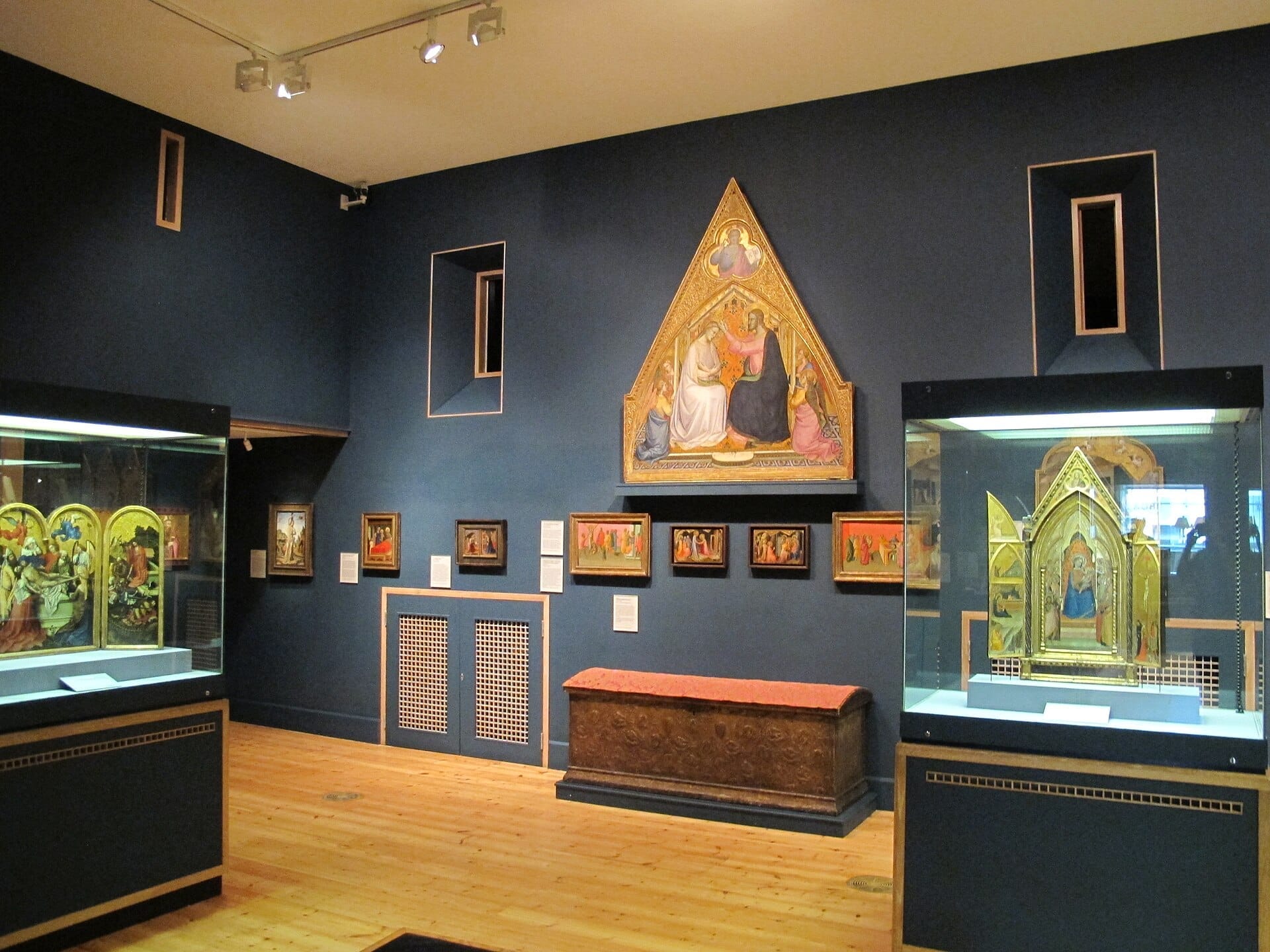
The permanent collection is displayed across several beautifully proportioned gallery rooms, most with natural light filtered through tall windows. The scale is deliberately human: you can stand close to the paintings without elbowing past tour groups, and there is rarely a sense of sensory overload.
The Impressionist and Post-Impressionist rooms are the heart of it. Manet's A Bar at the Folies-Bergère (1882) is the undisputed anchor: a large, complex canvas that rewards extended looking. The barmaid's direct gaze, the mirrored reflection that refuses to match her position, and the dense crowd visible behind her make it one of the most psychologically loaded paintings of the 19th century. Van Gogh's Self-Portrait with Bandaged Ear (1889), painted shortly after his breakdown in Arles, hangs nearby and consistently draws a small, quiet crowd. Both works are smaller in person than most visitors expect.
Beyond these anchors, the collection contains Cézanne's multiple studies of card players, Degas' ballet and bathing scenes, Gauguin's Tahitian paintings, and Seurat's studies for A Sunday on La Grande Jatte. Earlier galleries hold medieval altarpieces and Renaissance works on panel, including pieces by Cranach and Bruegel the Elder. The upper rooms include 20th-century holdings and rotating contemporary exhibitions. The overall effect is of a private collection made public rather than an institutional survey — personal, selective, and cumulative in its emotional impact.
ℹ️ Good to know
The Courtauld holds over 33,000 objects in total, though only a portion is on display at any time. Temporary exhibitions run alongside the permanent collection, often drawing on the gallery's exceptional holdings of drawings and works on paper.
Visiting by Time of Day: When to Come
The Courtauld opens at 10:00 and closes at 18:00; check the website for current last-entry times as these can change. Weekday mornings, particularly Tuesday through Thursday, are the calmest. The gallery attracts a notably thoughtful crowd: researchers, art students from the adjacent Courtauld Institute, retired professionals, and serious tourists who have deliberately sought it out rather than stumbled in from the street. The noise level in the rooms is low even on busier days.
Weekend afternoons are the most congested, particularly when a major temporary exhibition is running. The Impressionist rooms can feel tight when more than two or three groups converge, so if your primary goal is undisturbed time with the Manet or Van Gogh, a weekday mid-morning slot is the reliable choice. Midday on any day tends to see a brief surge as visitors arrive after nearby lunch spots.
Natural light through the gallery windows changes the paintings noticeably through the day. The warm late-afternoon light on the Impressionist canvases is particularly affecting, and if you can time an exit through the Somerset House courtyard around 17:00 in summer, the long shadows across the fountain courtyard make for a graceful ending to the visit.
Getting There and Practical Logistics
Somerset House sits on the Strand, one of central London's main east-west roads. The closest Tube stations are Temple on the District and Circle lines (roughly a 5-minute walk north along Surrey Street) and Embankment on the District, Circle, Bakerloo, and Northern lines (about 8 minutes along the embankment). Charing Cross station (National Rail, Bakerloo and Northern lines) is approximately 10 minutes on foot and adds more route flexibility from outer London.
Multiple bus routes stop on the Strand or nearby, making the gallery accessible from most parts of central London without a Tube journey. Visitors on a wider West End day can pair the Courtauld with the National Gallery on Trafalgar Square (roughly 10 minutes' walk west) or the National Portrait Gallery immediately next door to the National Gallery. For those working through a longer London itinerary, the geography clusters well with Trafalgar Square and the South Bank.
💡 Local tip
If you arrive by Tube at Temple, approach Somerset House via the Victoria Embankment rather than the Strand for a more scenic entrance — you pass the Thames and enter through the river-facing side of the building.
Photography, Accessibility, and What to Bring
Photography of the permanent collection is permitted for personal, non-commercial use. Flash and tripods are not allowed, and some temporary exhibitions may have additional restrictions. The rooms are well-lit for handheld shooting, though the glass on several paintings reflects overhead lighting at certain angles — mid-morning with lower ambient light tends to produce cleaner results.
The gallery provides a cloakroom for bags and coats, which is worth using if you plan to spend more than an hour — the rooms are not large and a full pack becomes unwieldy. There is a café within Somerset House and additional food options in the wider courtyard and along the Strand.
For accessibility, the Courtauld has worked to improve physical access within the Somerset House building, but the historic structure means step-free routes may not be available to all areas. Contact the gallery directly or check the official website before visiting if step-free access is a requirement. The gallery also runs a programme of talks, family events, and school visits — details are published on its website.
Worth Knowing: Is It Worth Your Time?
The Courtauld is exceptional for the density of masterworks in a small space. It is not overhyped. A visitor who spends two focused hours here will leave with a clearer understanding of late 19th-century painting than one who spends six hours in a larger national collection. The intimate scale — so different from the crowds at theTate Modern — is itself part of the value.
That said, the gallery is not free, and the ticket price means it warrants realistic expectations. Visitors whose primary interest is British art, contemporary work, or non-European collections may find the focus too narrow. The building is beautiful but not interactive, and there are no large-scale installations or immersive experiences. If you arrive expecting the scale of the British Museum, you will be surprised by how quickly you reach the end — though that is a feature, not a flaw, for those who know what they are coming for.
For those planning a longer stay in London, the Courtauld works well as part of a focused art and culture day in the West End. Pairing it with the National Gallery and a walk through the West End makes for one of the most culturally coherent days the city offers.
Insider Tips
- Art Fund membership pays for itself quickly if you visit several paid galleries on a trip — the Courtauld offers free entry to the main collection for Art Fund members, though some special exhibitions may carry an additional charge.
- The Somerset House courtyard café fills up quickly at lunchtime. If you want to eat on site, aim for before midday or after 14:00 to avoid queuing for a table.
- The Courtauld Institute of Art — the academic institution attached to the gallery — is one of the world's leading art history research centres. Free public lectures and symposia are often listed on the Institute's website and are open to general visitors.
- For the clearest view of Manet's A Bar at the Folies-Bergère without other visitors in front of you, aim for a weekday opening slot at 10:00. The room is typically quiet for the first 30–40 minutes.
- The riverside terrace on the south side of Somerset House is accessible from inside the building and offers a view of the Thames and Waterloo Bridge that most visitors miss entirely — worth five minutes on the way out.
Who Is The Courtauld Gallery For?
- Art enthusiasts with a specific interest in Impressionism and Post-Impressionism
- Visitors wanting a world-class museum experience without the crowds of major national institutions
- Architecture and heritage lovers drawn to Somerset House's neoclassical courtyard
- Travellers pairing a gallery visit with a wider West End or Strand walking itinerary
- Art Fund members looking to use their membership at a high-quality London gallery
Nearby Attractions
Other things to see while in West End:
- British Library
The British Library holds over 170 million items spanning thousands of years of human thought, from the Magna Carta to Beatles lyrics. Entry to the building and permanent collection galleries is free, making it one of the most rewarding stops in central London for curious travellers.
- British Museum
The British Museum holds one of the world's great collections of human history and culture, spanning two million years across more than 60 free galleries. Entry to the permanent collection is free, but knowing how to navigate the scale of it makes the difference between a rewarding visit and an overwhelming one.
- Carnaby Street
Carnaby Street is the pedestrianised shopping district in Soho that defined the look of 1960s London and continues to draw fashion lovers, food hunters, and curious walkers today. Free to explore and five minutes from Oxford Circus, it rewards those who slow down and wander its connecting lanes.
- Coal Drops Yard
Coal Drops Yard is a redeveloped Victorian industrial estate in King's Cross, now home to independent retailers, restaurants, and bars set beneath strikingly restored brick vaults. The public outdoor spaces are free to enter and a short walk from King's Cross St Pancras station.