Stradun (Placa): Dubrovnik's Great Limestone Promenade
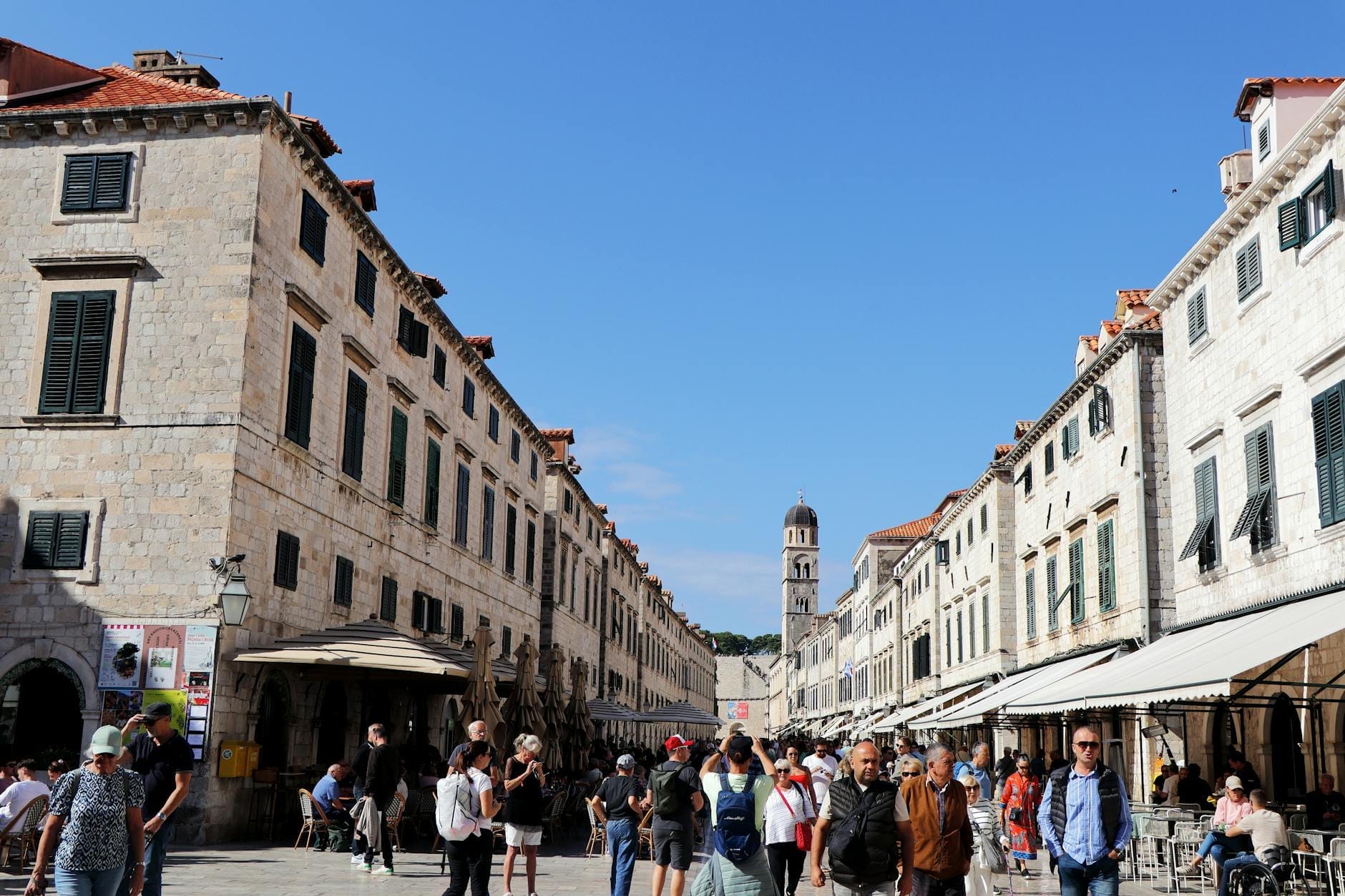
Stradun, officially called Placa, is the main street of Dubrovnik's UNESCO-listed Old Town — a 300-metre sweep of polished limestone connecting Pile Gate to Luža Square. Free to walk at any hour, it anchors some of the city's most significant landmarks and shifts completely in character from dawn to midnight.
Quick Facts
- Location
- Old Town Dubrovnik (between Pile Gate and Ploče Gate)
- Getting There
- Libertas buses stop at Pile Gate (west end); buses 1A, 1B, 3, 8
- Time Needed
- 30 min (walk-through) to 3+ hours (with landmarks)
- Cost
- Free (City Walls ticket required separately)
- Best for
- First-time visitors, architecture, evening walks, photography
What Stradun Actually Is
Stradun is the spine of Dubrovnik's Old Town. Officially named Placa (from the Latin 'platea,' meaning broad street), it stretches approximately 300 metres from Pile Gate in the west to Luža Square in the east, cutting straight through the heart of the medieval city. The name Stradun derives from the Venetian 'stradone,' meaning big street, a reminder of the long commercial relationship between Ragusa (Dubrovnik's former name) and Venice.
The street was originally a shallow sea channel separating two early settlements: the Roman town on the rocky island of Ragusa to the south, and the Slavic settlement on the mainland to the north. The channel was filled in during the 11th and 12th centuries, and the resulting street gradually became the civic and commercial centre of the Republic of Ragusa. What you walk on today is the physical seam where two communities merged into one city.
The pavement itself is worth a moment's attention. Flat slabs of polished limestone, worn smooth by centuries of foot traffic, create a surface that mirrors sunlight during the day and lamplight after dark. On dry mornings, the stone glows almost white. After rain, it turns to a deep pearl grey with a mirror-like sheen. It is one of the most photographed surfaces in Croatia, and for good reason.
How the Street Changes Through the Day
Arrive at 6 AM and Stradun belongs to a different city. Street cleaners are still at work, café owners are stacking chairs, and the limestone reflects a pale early light uninterrupted by shadows. The silence is genuine. You can hear your own footsteps echoing off the baroque facades on either side. This is the hour photographers come for, and it genuinely earns the effort of an early alarm.
By 10 AM the first cruise ship groups begin filtering through Pile Gate and the density increases rapidly. Midday between June and August is when Stradun is at its most crowded. The heat concentrates between the stone buildings, the shade is limited, and moving freely requires patience. If you are arriving during peak summer months, either come early or accept that a midday stroll will be slow and warm.
💡 Local tip
For the best photography and the most comfortable walk, aim for the street before 8 AM or after 8 PM. The evening atmosphere — café tables out, warm light on the stone, the bell tower silhouetted against the sky — is genuinely one of Dubrovnik's better experiences.
After around 9 PM, Stradun softens into an evening promenade. Families walk slowly with ice cream. Couples sit on the low stone steps of church facades. The tourist rush has receded and what remains feels much closer to the traditional Dalmatian 'korzo' — the social evening walk that has been a feature of coastal Croatian life for generations. The bars and restaurants along the side streets are at their liveliest, and the bell tower is lit against a dark sky.
Tickets & tours
Live prices and dates from our booking partner. If you book, we may earn a commission at no extra cost to you.
Mostar and Kravice Waterfalls excursion from Dubrovnik
From 120 €Instant confirmationFree cancellationDubrovnik Old Town Tour ith Cable Car Ride
From 56 €Instant confirmationFree cancellationMostar and Kravice Waterfalls full-day tour with pickup from Dubrovnik
From 66 €Instant confirmationFree cancellationSea kayaking experience in Dubrovnik
From 46 €Instant confirmationFree cancellation
The Architecture on Either Side
One of the first things careful observers notice is the unusual uniformity of the buildings lining Stradun. The ground floors are almost entirely shops, each with a rounded doorway of a consistent height and width. The upper floors are residential, with shuttered windows at regular intervals. This was not planned from the start. A catastrophic earthquake in 1667 destroyed much of the city, killing roughly a third of the population. Dubrovnik was rebuilt under strict municipal guidelines that standardised the facade dimensions along Placa, creating the coherent baroque streetscape visible today.
The facades are pale stone, many showing the patina of 350 years. Look up at the first-floor windows and you will see the original iron grille work still in place on many buildings. The uniformity can initially feel almost stage-set, but it is architecturally authentic. For more context on the buildings and fortifications framing the street, a walk along the Dubrovnik City Walls offers an aerial view of the entire Old Town layout, including the roof line of Stradun visible below.
The Landmarks You Will Pass
Starting from the western end at Pile Gate, the first landmark is the Large Fountain of Onofrio, a 15th-century domed structure that once marked the end of an aqueduct system bringing water into the city from a spring 12 km away. Its 16 carved masks originally spouted water (some still do), and it served as a public wash point for visitors entering the city gates. In summer, tourists routinely sit on its base, which was not its intended use but has become an informal tradition.
Moving east, you will pass the Franciscan Monastery on your left, which contains one of the oldest continuously operating pharmacies in Europe, founded in 1317. The monastery cloister is accessible via a separate entrance fee and rewards those who step off the main street for 20 minutes. The contrast between the noise of Stradun outside and the stone-columned quiet of the cloister is immediate.
At the eastern end, the street opens into a small square where several landmarks converge: Sponza Palace, the only major civic building to survive the 1667 earthquake largely intact; Orlando's Column, the 15th-century stone knight that served as the symbolic freedom pole of the Republic; and the Church of St. Blaise, the patron saint of Dubrovnik, whose facade faces directly down the length of the street.
- Large Onofrio's Fountain (west end, near Pile Gate)
- Franciscan Monastery and Old Pharmacy (north side, near Pile Gate)
- Church of St. Saviour (small, west end)
- Sponza Palace (east end, Gothic-Renaissance, 16th century)
- Orlando's Column (east end square)
- Church of St. Blaise (east end)
- Rector's Palace (south of Luža Square)
- Dubrovnik Bell Tower (adjacent to east-end square)
Getting There and Moving Around
The most straightforward approach is from Pile Gate at the western end. Libertas city buses (lines 1A, 1B, 3, and 8) stop directly outside the gate, connecting to Lapad, Gruž harbour, and the wider city. If arriving from the cruise port at Gruž, bus line 1A runs the route. Taxis and Uber drop-offs are permitted near Pile Gate but cannot enter the pedestrianized Old Town itself.
Stradun is entirely pedestrianized and flat, with no steps along its main length, which makes it one of the more accessible parts of the Old Town for visitors with mobility considerations. Be aware that the polished limestone can be slippery when wet. Flat-soled shoes or trainers are strongly recommended over sandals with smooth soles, especially after rain.
⚠️ What to skip
The limestone surface becomes genuinely slick after rain. Flip-flops or smooth-soled sandals are a practical risk in wet conditions. Shoes with grip are worth wearing if there is any chance of a shower.
Stradun is free to walk at any hour. Accessing the City Walls, which run above and around the Old Town, requires a separate paid ticket purchased at one of the wall access points. For current prices and opening hours, check the Dubrovnik City Walls guide before your visit, as hours change seasonally.
Who Will Love This, and Who Might Not
Stradun rewards visitors who treat it as a starting point rather than a destination. Walk the full length, then turn into the narrow side streets (called 'kale') that lead upward toward the city walls or downward toward the sea. The Old Town's character lives in those narrower passages, not on the main boulevard. The side streets are where you find quieter cafés, small churches, local laundry still hanging between windows, and the occasional cat ignoring everyone.
Visitors who arrive expecting a quiet, undiscovered experience will be disappointed during the summer months, particularly July and August. Dubrovnik is one of the most visited cities in the Mediterranean relative to its size, and Stradun absorbs most of that traffic. If your priority is atmosphere over architecture, consider visiting in May, early June, or late September. The best time to visit Dubrovnik guide covers this trade-off in detail.
Travelers who want something more off the beaten track should note that Stradun is, by design, the central artery. It cannot be anything other than well-known. Those seeking more obscure corners of the Old Town will find them, but they branch off from this street. It is not possible to explore the historic core without passing through Stradun multiple times.
Photography Notes
The classic long shot of Stradun is taken from near Pile Gate looking east toward the Bell Tower. The geometry is naturally strong: the parallel facades converge toward the tower at the vanishing point. Early morning gives you this with empty foreground. Wide-angle lenses work well. For the reflective wet-stone effect, visit shortly after rain and shoot at a low angle. The Dubrovnik photography guide covers specific times and angles throughout the Old Town.
For an elevated perspective looking down onto Stradun, the City Walls offer clear sightlines, though this requires purchasing a wall ticket. The cable car up to Mount Srđ is too high to frame the street itself, but gives you the full Old Town layout in context.
Insider Tips
- The side alleys (kale) running perpendicular to Stradun lead to far quieter cafés than anything on the main strip. Prices drop noticeably once you are two streets away from the main boulevard.
- The Small Onofrio's Fountain near the eastern end is often overlooked in favour of the large dome at the western end. It sits tucked into the square near Orlando's Column and dates from the same 15th-century water system — worth a close look at the carved stone detail.
- If you want to photograph the Bell Tower without crowds, the open square at the eastern end of Stradun is much emptier before 9 AM. After that, tour groups cluster here regularly until evening.
- The Franciscan Monastery cloister is entered from a door on Stradun itself, just past St. Saviour's Church on the left (north) side. Most people walk past it. The Romanesque cloister inside is architecturally exceptional and rarely as crowded as the street outside.
- Stradun has a Dubrovnik Summer Festival stage set up in the open square at its eastern end during July and August. If you are visiting during that period, check the festival schedule — some evening performances are free to watch from the periphery.
Who Is Stradun (Placa) For?
- First-time visitors orienting themselves in the Old Town
- Architecture and history enthusiasts tracing the Republic of Ragusa
- Evening walkers enjoying the traditional Dalmatian korzo atmosphere
- Photographers working with polished stone reflections and baroque geometry
- Families with young children who need flat, pedestrian-safe ground
Nearby Attractions
Other things to see while in Old Town (Stari Grad):
- Banje Beach
Banje Beach is Dubrovnik's closest and most photographed beach, sitting just east of the Old Town walls with direct views of the medieval fortifications and Lokrum Island. It's a pebbly, organized beach with free public access, paid lounger rentals, and a restaurant-bar that runs well into the night. Convenient, yes. Quiet, no.
- Buža Bar
Buža Bar is a no-frills open-air bar carved into a gap in Dubrovnik's ancient city walls, perched directly above the Adriatic Sea. Reached through a low iron-gated hole in the stonework, it offers cold drinks, cliff-jumping, and some of the most dramatic coastal views in the Mediterranean. There is no admission charge, no kitchen, and no pretense.
- Cathedral of the Assumption of the Virgin Mary
Rising from the rubble of a 1667 earthquake, the Cathedral of the Assumption of the Virgin Mary anchors the heart of Dubrovnik's Old Town with its commanding Baroque dome and a treasury that holds relics spanning a millennium. It's quieter than the city walls and more revealing than most visitors expect.
- Dominican Monastery & Museum
Built from 1225 and shaped through the 15th century, the Dominican Monastery in Dubrovnik's eastern Old Town holds one of Dalmatia's finest collections of medieval and Renaissance art. The Gothic-Renaissance cloister, a Titian altarpiece from 1554, and works by the Dubrovnik School of painters make this one of the most intellectually rewarding stops in the city.
Planning a trip? Discover personalized activities with the Nomado app.