Sponza Palace: Dubrovnik's Most Storied Landmark on Luža Square
Sponza Palace stands at the eastern end of the Stradun as one of the few buildings in Dubrovnik's Old Town to survive the catastrophic 1667 earthquake intact. Built between 1516 and 1521, this Gothic-Renaissance structure served as a customs house, mint, and warehouse before becoming home to the Dubrovnik State Archives and a quietly moving memorial to those killed in the 1991-1992 Homeland War.
Quick Facts
- Location
- Luža Square, Old Town, Dubrovnik (at the eastern end of the Stradun)
- Getting There
- Walk from Pile Gate along the Stradun (5-7 min); Libertas buses (now rebranded as local lines) stop near Pile Gate
- Time Needed
- 20-45 minutes for exterior and courtyard; longer if the memorial is open
- Cost
- Exterior and courtyard generally free to enter; confirm any memorial room admission on-site
- Best for
- Architecture enthusiasts, history seekers, photography, slow travelers
- Official website
- tzdubrovnik.hr/lang/en/get/spomenici/5430/sponza_palace.html
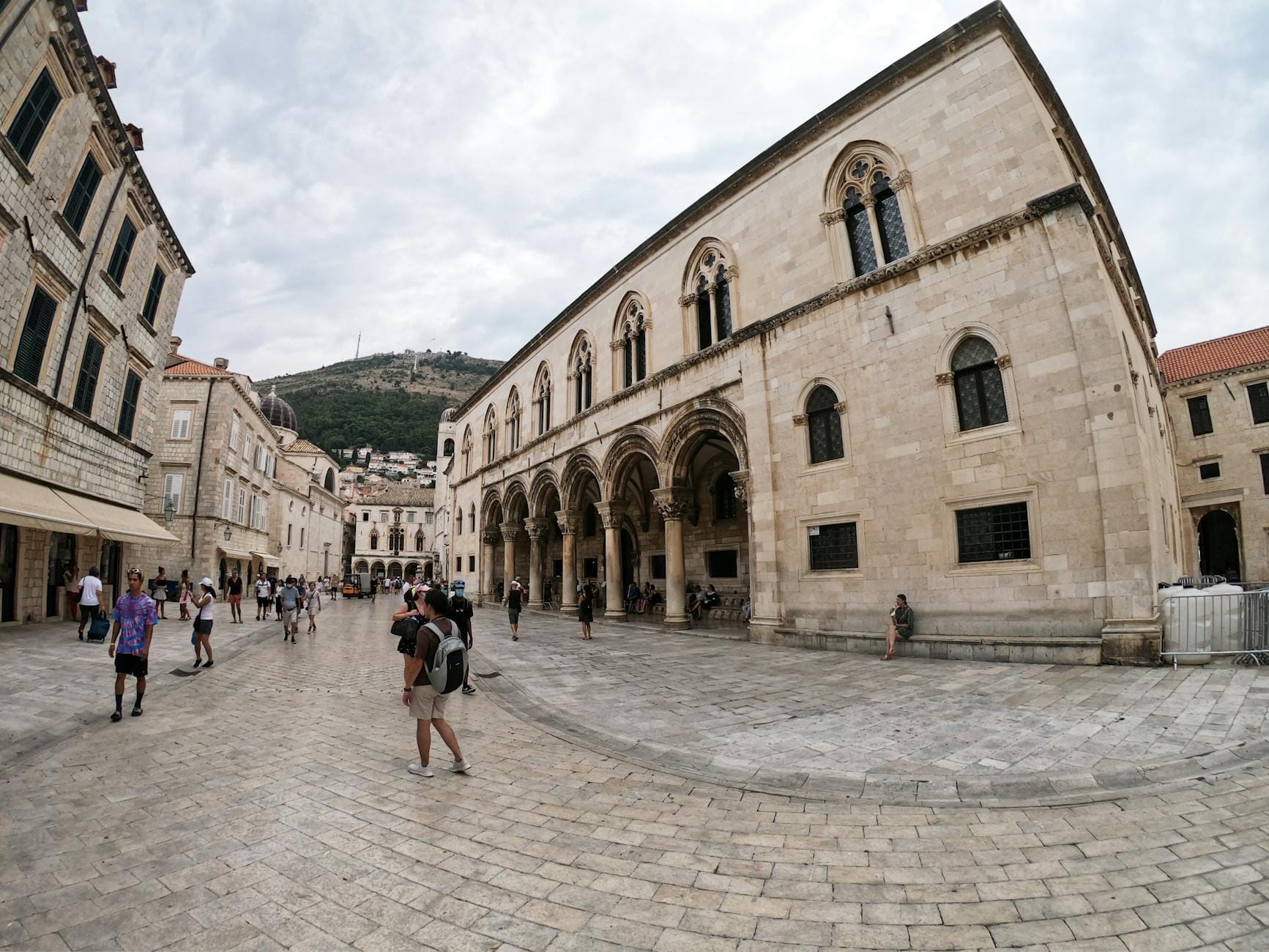
What Is Sponza Palace and Why Does It Matter?
Sponza Palace, known in Croatian as Palača Sponza and sometimes called Divona, has presided over Luža Square since 1521. For most visitors, it registers first as the photogenic backdrop behind Orlando's Column and the Bell Tower. But spend a few minutes reading its facade and you begin to understand that this is not just a backdrop. It is one of the best-preserved pieces of late-Gothic and early-Renaissance architecture in the entire Adriatic.
Unlike much of Dubrovnik's built fabric, Sponza Palace survived the devastating 1667 earthquake that reshaped almost everything around it. That accident of survival makes it invaluable: it stands as direct physical evidence of how the Republic of Ragusa's civic architecture looked at its peak of maritime power.
Today the palace houses the Dubrovnik State Archives, considered among the richest and most complete municipal archives in Europe, with records stretching back to the 13th century. A separate room within the palace serves as a memorial to the defenders of Dubrovnik killed during the 1991-1992 Homeland War. These two functions sit in unusual but appropriate combination: a building defined by the keeping of records, now also keeping the memory of a more recent siege.
Architecture: Reading the Facade
The palace was designed by Paskoje Miličević Mihov and built between 1516 and 1521. The stonework on the loggia and the sculptural details are attributed to the Andrijić brothers, who were among the most accomplished stonemasons working on the Dalmatian coast at the time. What makes the building visually distinctive is the way it transitions between two architectural vocabularies on the same facade.
The ground-floor loggia is purely Gothic in character: pointed arches, slender colonettes, stone tracery in the spandrels. Move your eyes upward and the first floor shifts into Renaissance mode, with rounded arches, classical proportions, and a row of six windows that feel simultaneously lighter and more formal. The top floor is plainer, almost domestic. The effect is not confused but layered, a snapshot of the moment when one architectural era was giving way to another.
Above the entrance portal, a Latin inscription translates roughly as: 'Our weights and scales are not allowed to cheat; when I weigh goods, God weighs me.' It is a sobering reminder that this was first and foremost a place of commerce and customs control, and that the Republic of Ragusa took the integrity of its trade very seriously.
💡 Local tip
Photography tip: The palace facade photographs best in the late afternoon, when the low western sun throws the carved stone details into sharp relief. In the morning, Luža Square is often in shadow until around 9-10am depending on the season.
Tickets & tours
Live prices and dates from our booking partner. If you book, we may earn a commission at no extra cost to you.
Mostar and Kravice Waterfalls excursion from Dubrovnik
From 120 €Instant confirmationFree cancellationDubrovnik Old Town Tour ith Cable Car Ride
From 56 €Instant confirmationFree cancellationMostar and Kravice Waterfalls full-day tour with pickup from Dubrovnik
From 66 €Instant confirmationFree cancellationSea kayaking experience in Dubrovnik
From 46 €Instant confirmationFree cancellation
Inside: The Courtyard and the Memorial Room
The interior courtyard is a genuine reward. It is rectangular, colonnaded on the ground floor, and surprisingly quiet given that it sits a few steps from one of the most photographed squares in the Adriatic. The stone here has the pale, almost powdery quality of Dalmatian limestone after centuries of wear. On a warm day, the air inside the courtyard is noticeably cooler than on the square, and the sound of the crowds outside softens considerably.
The Memorial Room for Defenders of Dubrovnik occupies part of the ground floor. It contains photographs of the young men and women killed during the 1991-1992 siege, when Yugoslav People's Army and Montenegrin forces besieged and bombarded the city. The room is modest in scale but not in impact. Visitors who step in quietly tend to linger longer than expected. It is one of the few places in the Old Town where the recent war is acknowledged directly, without deflection into history tourism.
ℹ️ Good to know
The Dubrovnik State Archives housed here hold records dating back to the 13th century, including diplomatic correspondence, trade contracts, and health regulations from the Republic of Ragusa. The archives are not open for general public browsing, but their presence explains the building's continued civic importance.
Luža Square: Understanding the Immediate Context
Sponza Palace does not stand in isolation. Luža Square, the widened eastern terminus of the Stradun, concentrates more major monuments per square meter than almost anywhere else in Croatia. To the south is St. Blaise's Church, the Baroque patron saint's church built in the early 18th century. To the southwest stands the Rector's Palace, another important Gothic-Renaissance building. Orlando's Column, the medieval stone pillar that once served as the civic flagpole and a symbol of Ragusan freedom, stands directly in front of Sponza's loggia.
The square functions at different paces throughout the day. Early morning, before 8am, it belongs mostly to delivery workers, stray cats, and the occasional runner. By mid-morning the tour groups arrive in earnest, and by midday in summer the flagstones radiate heat and the crowds make it hard to stand still and simply look. Come back at dusk, when the stone glows amber and the tour groups have dispersed toward dinner, and Luža Square reveals why the Republic of Ragusa was so deliberate in its civic planning.
When to Visit and Practical Logistics
The palace exterior is visible at any hour. Access to the courtyard and the memorial room follows operational hours that should be confirmed locally on arrival, as verified opening times were not available at the time of writing. There is no confirmed admission charge for the general public areas, but this should also be checked on-site.
Sponza Palace is about a seven-minute walk from the Pile Gate, the main western entrance to the Old Town. Follow the Stradun east all the way to the end; the palace is impossible to miss on your left as the square opens up. If you are arriving by sea, the Fort of St. John and the Old Port are a short walk south, making Luža Square a natural first or last stop on a port-based visit.
⚠️ What to skip
July and August crowd warning: Luža Square receives very heavy foot traffic from cruise passengers between approximately 10am and 5pm. If your visit coincides with multiple ships docking simultaneously, the square can feel genuinely unpleasant. Arriving before 9am or after 6pm transforms the experience.
For those planning a longer Old Town visit, consider pairing Sponza Palace with a walk along the city walls, which provide elevated views directly down onto Luža Square and the palace roof. Seeing it from above gives a clearer sense of the building's footprint and its relationship to the surrounding streetplan.
Is Sponza Palace Worth Your Time?
For visitors on a very tight schedule who are choosing between paid attractions, Sponza Palace may be easy to rationalize as a quick exterior look and nothing more. That would be a mistake. The courtyard takes five minutes to reach and delivers a quality of stone craftsmanship that justifies the small detour from the square. The memorial room, for those who enter it, adds a dimension that most Old Town sightseeing entirely lacks.
Travelers who are primarily interested in beaches, nightlife, or Game of Thrones locations will find Sponza Palace peripheral to their interests. It rewards slowness and some prior knowledge of Ragusan history. Without that context, it is a beautiful building that gets passed in under a minute. With it, the carved inscription above the door, the Gothic-Renaissance seam in the stonework, and the silence of the courtyard all become part of a coherent story about a small republic that survived for centuries by being extremely careful about weights, records, and memory.
If you want that context before you arrive, the Old Town walking tour guide covers the history of Luža Square and its monuments in sequence, which makes the physical visit considerably more rewarding.
Insider Tips
- The loggia at the base of the palace is a legitimate shortcut and shelter point. Locals use it as a covered walkway when it rains, and it keeps the sun off during the hottest part of the day. Standing inside it also gives you the best angle on the colonette capitals.
- If you look at the palace from Orlando's Column, you can see clearly where the Gothic ground floor ends and the Renaissance first floor begins. This transition point is one of the most discussed details among architecture students visiting Dubrovnik, and pointing it out to travel companions tends to make the building click into focus.
- The Latin inscription above the main entrance ('Our weights and scales do not cheat; when I weigh goods, God weighs me') is frequently cropped out in photographs because visitors stand too close. Step back to the middle of the square and use a short telephoto to capture both the full facade and the inscription in context.
- The memorial room inside operates on a schedule that can vary seasonally. If it is closed on first visit, ask locally about opening hours rather than assuming it is permanently shut.
- Luža Square hosts outdoor concerts and cultural events during the Dubrovnik Summer Festival (typically July-August). If the festival is running, Sponza Palace's loggia and courtyard sometimes form part of the performance backdrop, which is worth timing deliberately.
Who Is Sponza Palace For?
- Architecture enthusiasts who want to see Gothic-Renaissance stonework in exceptional condition
- History-focused travelers interested in the Republic of Ragusa and its civic institutions
- Photographers working on Old Town composition shots, particularly at dusk
- Visitors who want to understand the 1991-1992 Homeland War in a tangible, respectful setting
- Slow travelers who prefer depth over volume and want one location that layers multiple centuries of meaning
Nearby Attractions
Other things to see while in Old Town (Stari Grad):
- Banje Beach
Banje Beach is Dubrovnik's closest and most photographed beach, sitting just east of the Old Town walls with direct views of the medieval fortifications and Lokrum Island. It's a pebbly, organized beach with free public access, paid lounger rentals, and a restaurant-bar that runs well into the night. Convenient, yes. Quiet, no.
- Buža Bar
Buža Bar is a no-frills open-air bar carved into a gap in Dubrovnik's ancient city walls, perched directly above the Adriatic Sea. Reached through a low iron-gated hole in the stonework, it offers cold drinks, cliff-jumping, and some of the most dramatic coastal views in the Mediterranean. There is no admission charge, no kitchen, and no pretense.
- Cathedral of the Assumption of the Virgin Mary
Rising from the rubble of a 1667 earthquake, the Cathedral of the Assumption of the Virgin Mary anchors the heart of Dubrovnik's Old Town with its commanding Baroque dome and a treasury that holds relics spanning a millennium. It's quieter than the city walls and more revealing than most visitors expect.
- Dominican Monastery & Museum
Built from 1225 and shaped through the 15th century, the Dominican Monastery in Dubrovnik's eastern Old Town holds one of Dalmatia's finest collections of medieval and Renaissance art. The Gothic-Renaissance cloister, a Titian altarpiece from 1554, and works by the Dubrovnik School of painters make this one of the most intellectually rewarding stops in the city.
Planning a trip? Discover personalized activities with the Nomado app.