Rector's Palace Dubrovnik: Gothic Architecture, Republic History, and a Museum Worth Your Time
The Rector's Palace (Knežev dvor) stands at the civic heart of Dubrovnik's Old Town, a rare blend of Gothic and Renaissance stonework that once housed the Republic of Ragusa's most powerful office. Today it holds the Cultural History Museum and hosts summer concerts in its atrium, making it one of the more rewarding indoor stops in the city.
Quick Facts
- Location
- Ul. Pred Dvorom 1, Old Town Dubrovnik (between St. Blaise Church and the Cathedral)
- Getting There
- Walk east along Stradun from Pile Gate; the palace is at the far end, roughly 5 minutes on foot
- Time Needed
- 45 minutes to 1.5 hours depending on interest in the museum collection
- Cost
- Admission fee applies; covered by the Dubrovnik City Pass — verify current prices with Dubrovnik Museums before visiting
- Best for
- History enthusiasts, architecture lovers, visitors seeking shade and quiet away from the Stradun crowds
What the Rector's Palace Actually Is
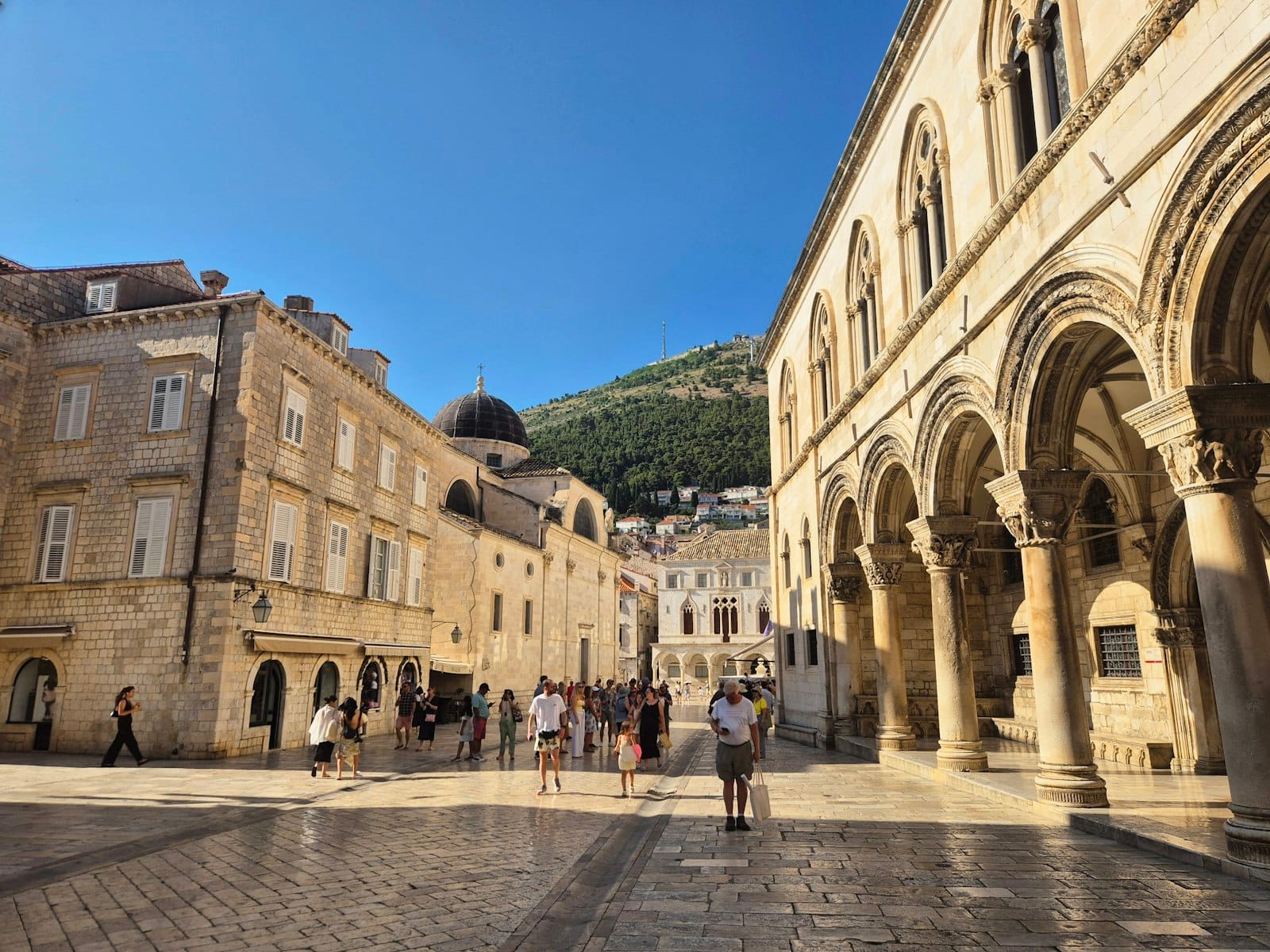
The Rector's Palace, known in Croatian as Knežev dvor, is the most architecturally complex secular building in Dubrovnik's Old Town. It sits on Ul. Pred Dvorom, a short street that connects the Stradun to the Cathedral quarter, flanked by the Church of St. Blaise on one side and the Cathedral of the Assumption on the other. The building you see today is the product of centuries of reconstruction: fires, a catastrophic explosion, and the 1667 earthquake all reshaped it, which is why the facade reads as a layered conversation between Gothic and Renaissance styles rather than a single unified vision.
From roughly the 14th century through 1808, this was the seat of the Rector of the Republic of Ragusa, the chief executive of one of Europe's most sophisticated pre-modern city-states. The office came with an unusual constraint: the Rector served a single one-month term and was forbidden from leaving the palace during that period except for official business. That detail alone tells you something about how seriously Ragusa took the idea of preventing any one person from accumulating too much power.
ℹ️ Good to know
The Rector's Palace is now administered by Dubrovnik Museums. Admission is included in the Dubrovnik City Pass, which covers several other major sites. Verify current opening hours and ticket prices directly with Dubrovnik Museums before your visit, as these change seasonally.
The Architecture: What to Look For on the Facade
The ground-floor loggia is the first thing that stops people. Six arches carried on columns create a covered portico facing the street, and the capitals on those columns are worth examining closely. They are not uniform: some are late Gothic in character, with detailed figurative carving, while others lean toward early Renaissance restraint. The main portal is similarly hybrid, with a Gothic pointed arch framing a door surround that already shows Renaissance influence in its proportions.
Onofrio della Cava, the Neapolitan architect who designed much of the post-1435 reconstruction, brought southern Italian Gothic-Renaissance sensibility to Ragusa. But subsequent damage and rebuilding introduced other hands and other periods. The result is a building that rewards close reading rather than a single impression from across the street. If you arrive when the light is raking across the facade, typically in the late afternoon, the relief carving in the stonework becomes considerably more legible.
The atrium, which you enter through the loggia, is one of the quieter courtyards in the Old Town. It hosts classical music concerts during the Dubrovnik Summer Festival, and the acoustic quality of the space makes these performances genuinely memorable rather than just a tourist backdrop.
Tickets & tours
Live prices and dates from our booking partner. If you book, we may earn a commission at no extra cost to you.
Mostar and Kravice Waterfalls excursion from Dubrovnik
From 120 €Instant confirmationFree cancellationDubrovnik Old Town Tour ith Cable Car Ride
From 56 €Instant confirmationFree cancellationMostar and Kravice Waterfalls full-day tour with pickup from Dubrovnik
From 66 €Instant confirmationFree cancellationSea kayaking experience in Dubrovnik
From 46 €Instant confirmationFree cancellation
The Cultural History Museum Inside
The palace currently houses Dubrovnik's Cultural History Museum, spread across the ground floor and upper rooms. The collection covers furniture, portraits of Rectors, weapons, coins, and civic artifacts from the Republic of Ragusa period. For visitors with a serious interest in the political and material culture of the republic, it is the most substantive indoor collection in the city. For visitors who want a quick visual hit, it is unlikely to hold attention for more than 30 to 40 minutes.
The Rector's study and reception rooms on the upper floor give the strongest sense of how the building actually functioned. The scale is deliberately modest for a seat of government: Ragusa was not interested in theatrical displays of power in the way that Venice or Florence were. The furniture is period-appropriate but not extravagant, and the room proportions reinforce the republic's preference for competence over spectacle.
One section of the building was historically used as an armoury and, at different periods, as a prison. Some of the ground-floor spaces retain a heavier, more utilitarian character that contrasts with the elegance of the loggia. Worth noting for anyone thinking about photography: the interior lighting is uneven, and some of the smaller display rooms are quite dim. A camera that handles low light is useful, though many of the most satisfying shots are in the atrium rather than the gallery rooms.
When to Visit and How the Experience Changes
Mornings are the most comfortable time to visit, particularly between opening and around 10:30 AM before cruise ship groups begin working their way through the Old Town. The palace sits far enough from Pile Gate that it does not get hit by the earliest wave of day-trippers, giving you a window of relative calm in the atrium and upper rooms.
By midday in summer, the Pred Dvorom street outside is at peak congestion, with groups flowing between St. Blaise Church, the Cathedral, and the palace. The building itself stays cool thanks to thick stone walls, which makes it a practical refuge during the hottest part of a summer afternoon even if you are not deeply interested in the museum collection. The atrium especially holds its temperature well.
💡 Local tip
If you are visiting in July or August during the Dubrovnik Summer Festival, check whether a concert is scheduled in the atrium. Evening performances here, with the Renaissance courtyard lit at night, are a considerably better use of the space than a standard daytime museum visit.
The palace is a short walk from both the Stradun and the Cathedral of the Assumption, so it fits naturally into a circuit of the civic core without requiring a detour.
Practical Walkthrough: How to Move Through the Site
Entry is through the loggia on the street-facing side. Spend a few minutes in the atrium before heading inside: the proportions of the courtyard and the quality of the stone carving on the arcade columns are among the finest details in the building. The bust of Miho Pracat, a wealthy Ragusan merchant and the only person honoured with a statue inside the palace during the republic's lifetime, stands in the atrium and is worth noting as an index of how selective that society was with public recognition.
The museum is organized across multiple rooms and floors. If time is limited, prioritize the Rector's rooms on the upper level and the atrium itself. The coin and weapons collections are specialized enough that casual visitors can move through them quickly without missing the essential character of the place.
Accessibility within the palace is limited by the historic nature of the structure: stairs are the primary means of reaching upper floors, and the stone surfaces throughout can be uneven. Visitors with mobility considerations should check current accessibility arrangements with Dubrovnik Museums directly.
Who Should Visit and Who Can Skip It
The Rector's Palace is genuinely worthwhile for anyone interested in the political history of the Adriatic, in late Gothic and early Renaissance architecture, or in the specific character of Ragusan civic culture. It is also a reasonable stop for visitors who want a cooler, quieter hour away from the street-level heat of the Old Town in summer.
Visitors who are primarily here for beaches, nightlife, or the Game of Thrones filming locations will likely find the museum component underwhelming. The palace exterior is worth a look regardless, but the interior collection asks for genuine curiosity about the republic's history to feel like time well spent. If you are working through the Old Town's major sites on a tight schedule, the Dubrovnik city walls and the Franciscan Monastery offer more immediately striking experiences.
Families with young children may find the pace of the museum difficult to sustain, though the atrium is an easy stop for a few photographs and a moment out of the midday crowd.
Insider Tips
- The bust of Miho Pracat in the atrium is the only statue of a private citizen commissioned inside the palace during the republic's existence — a small detail that says more about Ragusan values than most of the explanatory panels.
- If you have the Dubrovnik City Pass, use it here: the palace is one of the better value inclusions given standalone admission prices for multiple Old Town sites add up quickly.
- Late afternoon light from the west catches the loggia columns at an angle that makes the stone carving far more three-dimensional in photographs than the flat midday light. Plan facade photography for roughly 4 to 6 PM in summer.
- The atrium is used as a concert venue during the Dubrovnik Summer Festival (typically July and August). A ticketed evening concert here is worth prioritising over a standard daytime visit if your dates align.
- The palace is adjacent to the Cathedral and St. Blaise Church, so grouping all three into a single 90-minute circuit of the civic core makes efficient use of your time rather than returning separately.
Who Is Rector's Palace For?
- History and architecture enthusiasts interested in the Republic of Ragusa
- Visitors looking for a cool, covered space during peak summer heat
- Photography focused on Gothic-Renaissance stone detail and courtyard composition
- Travellers attending Dubrovnik Summer Festival concerts in the atrium
- Anyone using the Dubrovnik City Pass who wants to get full value from their coverage
Nearby Attractions
Other things to see while in Old Town (Stari Grad):
- Banje Beach
Banje Beach is Dubrovnik's closest and most photographed beach, sitting just east of the Old Town walls with direct views of the medieval fortifications and Lokrum Island. It's a pebbly, organized beach with free public access, paid lounger rentals, and a restaurant-bar that runs well into the night. Convenient, yes. Quiet, no.
- Buža Bar
Buža Bar is a no-frills open-air bar carved into a gap in Dubrovnik's ancient city walls, perched directly above the Adriatic Sea. Reached through a low iron-gated hole in the stonework, it offers cold drinks, cliff-jumping, and some of the most dramatic coastal views in the Mediterranean. There is no admission charge, no kitchen, and no pretense.
- Cathedral of the Assumption of the Virgin Mary
Rising from the rubble of a 1667 earthquake, the Cathedral of the Assumption of the Virgin Mary anchors the heart of Dubrovnik's Old Town with its commanding Baroque dome and a treasury that holds relics spanning a millennium. It's quieter than the city walls and more revealing than most visitors expect.
- Dominican Monastery & Museum
Built from 1225 and shaped through the 15th century, the Dominican Monastery in Dubrovnik's eastern Old Town holds one of Dalmatia's finest collections of medieval and Renaissance art. The Gothic-Renaissance cloister, a Titian altarpiece from 1554, and works by the Dubrovnik School of painters make this one of the most intellectually rewarding stops in the city.
Planning a trip? Discover personalized activities with the Nomado app.