Large Fountain of Onofrio: Dubrovnik's 600-Year-Old Gateway Landmark
Standing just inside Pile Gate on the Stradun, the Large Fountain of Onofrio is a 15th-century engineering triumph that once supplied an entire medieval city with fresh water. Free to visit at any hour, it's one of Dubrovnik's most photographed and historically layered stops, and easy to miss the details if you don't know what you're looking at.
Quick Facts
- Location
- Stradun (Placa), just inside Pile Gate, Old Town Dubrovnik
- Getting There
- Bus lines 1A, 1B, 3 to Pile stop; 5-minute walk through Pile Gate
- Time Needed
- 10–20 minutes at the fountain; combine with a full Stradun walk
- Cost
- Free, open 24 hours
- Best for
- History lovers, photographers, first-time visitors to Old Town
What Is the Large Fountain of Onofrio?
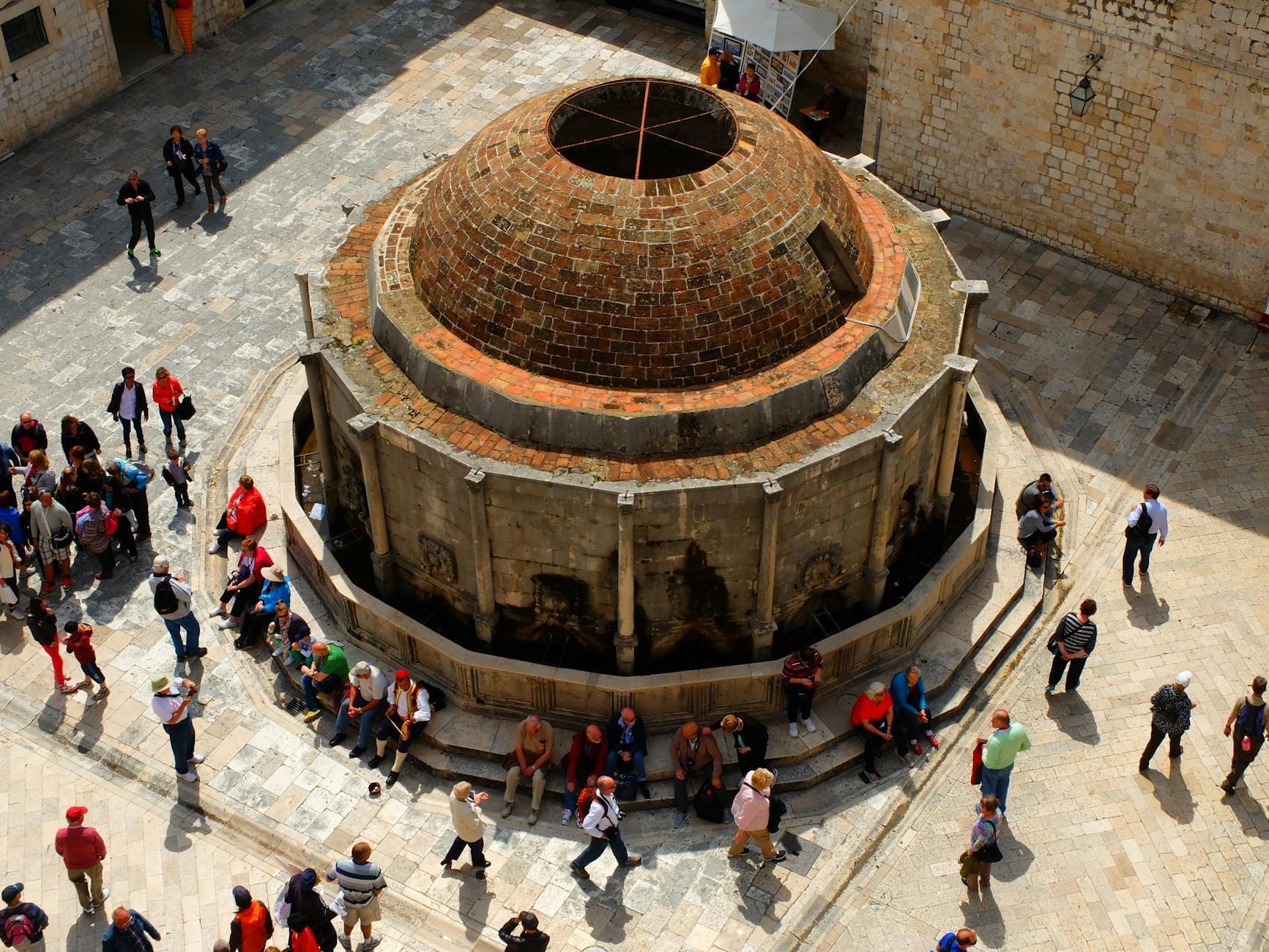
The Large Fountain of Onofrio (Velika Onofrijeva česma in Croatian) sits at the western end of the Stradun, the main limestone thoroughfare of Dubrovnik's Old Town, immediately after you pass through the Pile Gate. It is hard to miss: a wide, 16-sided polygonal dome roughly six metres across, its pale stone exterior ringed by 16 carved maskerons, human-like faces with open mouths that once poured a continuous stream of fresh water into the trough below. Today most of the spouts run dry, but the structure itself is intact and in better condition than the historical record might suggest.
Built between 1438 and 1440 under the direction of Italian architect Onofrio della Cava, the fountain was the endpoint of a 12-kilometre aqueduct carrying water from the Rijeka Dubrovačka river to the city. For a medieval republic dependent on trade and with a population living inside a walled city, reliable fresh water was a genuine security concern. This fountain, alongside a smaller companion at the other end of the Stradun, made that security possible for roughly four and a half centuries.
💡 Local tip
The tap water in Dubrovnik's Old Town is drinkable. If any of the fountain spouts are active when you visit, locals and informed travellers do drink from them, though the flow is inconsistent.
Architecture and Historical Context
The fountain's original form was considerably more elaborate than what you see today. Before the catastrophic earthquake of 1667, the structure was topped with additional sculptures and decorative stonework that gave it a grander, more vertical profile. The earthquake stripped much of this ornamentation away, leaving the lower drum and dome that now defines the silhouette. What survived intact are the 16 maskerons: each a slightly different face carved from local limestone, their expressions ranging from serene to faintly comic. These aren't mere decoration. Each maskeron served a functional role, directing water pressure outward from a central cistern through channels cut into the stone.
A small replica of a dog was added to the fountain in 2016, a nod to local legend and a detail that sparks curiosity but little historical consensus. It's a minor addition that occasionally confuses visitors who assume it's original. It isn't, and the plaque nearby makes no grand claims about it.
For context on how this fountain fits into the broader medieval cityscape, the nearby Sponza Palace and Rector's Palace both date to roughly the same era and reflect the Republic of Ragusa's investment in civic infrastructure and public architecture during the 15th century.
Tickets & tours
Live prices and dates from our booking partner. If you book, we may earn a commission at no extra cost to you.
Mostar and Kravice Waterfalls excursion from Dubrovnik
From 120 €Instant confirmationFree cancellationDubrovnik Old Town Tour ith Cable Car Ride
From 56 €Instant confirmationFree cancellationMostar and Kravice Waterfalls full-day tour with pickup from Dubrovnik
From 66 €Instant confirmationFree cancellationSea kayaking experience in Dubrovnik
From 46 €Instant confirmationFree cancellation
The Experience: What It Feels Like to Visit
The moment you step through Pile Gate into the Old Town, the fountain fills your field of vision on the left side of the opening square. In summer, the area around it is densely crowded by mid-morning, with tour groups forming loose rings around the structure and guides speaking in six languages simultaneously. The fountain functions partly as a meeting point, partly as a photo backdrop, and partly as a natural rest stop where people perch on the stone ledge of the water trough and sort through bags or consult maps.
The ledge around the base is wide and smooth enough to sit on. The stone stays cool even in direct sun, because the dome casts a partial shadow across the trough for much of the afternoon. In the heat of July or August, this makes it a genuinely practical place to pause before setting off down the Stradun.
Early mornings, before 8 a.m., tell a different story. The square is nearly empty. Street cleaners work the Stradun, the light is low and golden against the pale limestone, and the fountain reads as something genuinely old rather than as a prop in a crowd scene. If you're staying in the Old Town, this is the window when the fountain makes its strongest impression.
ℹ️ Good to know
Photography tip: Shoot the maskerons individually with a wide-aperture lens in the early morning or late afternoon when side-light picks up the carved texture. Full-face shots of the dome work best from slightly elevated ground, which you won't have here, so focus on close details rather than wide establishing shots.
How It Fits Into Your Dubrovnik Itinerary
The Large Fountain of Onofrio is not an attraction that demands dedicated time, but it rewards attention from anyone who pauses long enough to read the architecture rather than just photograph it. It sits naturally at the start of any Old Town walking tour, and most visitors pass it twice: once entering through Pile Gate and once returning. If you're using the Dubrovnik City Pass, the fountain itself needs no ticket, but the pass covers nearby paid attractions you'll want to combine into the same morning.
The fountain is about 200 metres from the entrance to the Franciscan Monastery, which contains one of Europe's oldest functioning pharmacies, dating to 1317. Combining both takes under an hour and covers a significant stretch of medieval history in a compact space.
If you're approaching from outside the walls, buses on the Libertas network stop at Pile, placing you directly in front of the gate. Visitors arriving by cruise ship from Gruž port typically take Bus 1A or 1B to Pile, a journey of roughly 20 to 25 minutes depending on traffic.
Honest Assessment: Worth Your Time?
The fountain is worth five to ten deliberate minutes for anyone interested in medieval urban infrastructure or Dalmatian stonemasonry. It is not worth rearranging your schedule around. Its importance is historical and contextual rather than visually spectacular: the dome is not particularly tall, the interior is not accessible, and without some background knowledge, it reads as a handsome but unremarkable stone structure.
That said, it is free, it is always open, and it is directly on the path between Pile Gate and every other major attraction in the Old Town. There is no scenario in which a visitor to Dubrovnik's Old Town does not pass it. The question is simply whether you stop and look or keep walking.
Travellers who find medieval architecture engaging will want to study the maskerons closely: no two faces are identical, and the variation in expression and carving quality suggests different hands at work on the same commission. Those with no particular interest in history will still appreciate it as a landmark and orientation point. Those expecting an active, splashing fountain as a centrepiece may be disappointed: most spouts don't run.
⚠️ What to skip
In peak summer (July to August), the square around the fountain becomes extremely congested between 10 a.m. and 6 p.m. If the crowd density bothers you, visit before 8 a.m. or after 8 p.m., when the limestone reflects the evening light and the area is significantly quieter.
Accessibility and Practical Notes
The fountain sits on the broad, flat limestone surface of the Stradun square, directly accessible from Pile Gate without steps. The ledge of the water trough provides seating at a comfortable height for most adults. The approach from Pile Gate involves a short sloped section of cobblestone, which can be uneven for wheelchair users or those with limited mobility. There are no specific mobility aids at the fountain itself.
No tickets are needed and no staff are present. The fountain is a public civic monument, not a managed tourist site, so there are no opening or closing times to worry about. It is lit at night, and the evening light on the dome is softer and more atmospheric than the harsh midday sun, which bleaches the limestone into something close to white.
Insider Tips
- Count the maskerons: there are exactly 16, one per face of the polygon. Each is subtly different. Finding the most unusual expression is a good way to slow down and actually look at the stone carving.
- The fountain is a useful free water source if any spouts are active. Ask a local before drinking, as flow is inconsistent, but the water supply in the Old Town is generally safe from the tap.
- For the cleanest architectural photograph without tourists, arrive before 8 a.m. on any day of the week. Summer mornings see the Stradun swept and nearly empty in this window.
- The 2016 dog replica on the fountain is not historical. If a guide tells you it dates to the 15th century, that's inaccurate. The original sculptural decoration was lost in the 1667 earthquake.
- Use the fountain as your orientation anchor. Everything in Old Town radiates from this point: the Stradun runs east toward the Bell Tower, the walls entrance is minutes away, and the Franciscan Monastery is immediately to your right as you enter.
Who Is Large Fountain of Onofrio For?
- First-time visitors to Dubrovnik's Old Town looking for an orientation landmark
- History and architecture enthusiasts interested in medieval civic engineering
- Photographers working on early morning shoots along the Stradun
- Travellers on a budget: free, always open, no advance planning needed
- Families with children who enjoy the novelty of 16 different carved stone faces
Nearby Attractions
Other things to see while in Old Town (Stari Grad):
- Banje Beach
Banje Beach is Dubrovnik's closest and most photographed beach, sitting just east of the Old Town walls with direct views of the medieval fortifications and Lokrum Island. It's a pebbly, organized beach with free public access, paid lounger rentals, and a restaurant-bar that runs well into the night. Convenient, yes. Quiet, no.
- Buža Bar
Buža Bar is a no-frills open-air bar carved into a gap in Dubrovnik's ancient city walls, perched directly above the Adriatic Sea. Reached through a low iron-gated hole in the stonework, it offers cold drinks, cliff-jumping, and some of the most dramatic coastal views in the Mediterranean. There is no admission charge, no kitchen, and no pretense.
- Cathedral of the Assumption of the Virgin Mary
Rising from the rubble of a 1667 earthquake, the Cathedral of the Assumption of the Virgin Mary anchors the heart of Dubrovnik's Old Town with its commanding Baroque dome and a treasury that holds relics spanning a millennium. It's quieter than the city walls and more revealing than most visitors expect.
- Dominican Monastery & Museum
Built from 1225 and shaped through the 15th century, the Dominican Monastery in Dubrovnik's eastern Old Town holds one of Dalmatia's finest collections of medieval and Renaissance art. The Gothic-Renaissance cloister, a Titian altarpiece from 1554, and works by the Dubrovnik School of painters make this one of the most intellectually rewarding stops in the city.
Planning a trip? Discover personalized activities with the Nomado app.