St Paul's Gate, Rhodes: The Forgotten Gateway Between Two Harbours
St Paul's Gate (Πύλη Αγίου Παύλου) is one of the lesser-visited fortifications built by the Knights of St John in the 15th century, standing at the point where Mandraki and Kolona harbours almost touch. Free, always accessible, and rich with carved heraldic detail, it rewards visitors who take the time to slow down on the Old Town waterfront.
Quick Facts
- Location
- northwest end of Kolóna Harbour, Rhodes Old Town, Greece
- Getting There
- 10-minute walk south along the waterfront from Mandraki Harbour
- Time Needed
- 15–30 minutes
- Cost
- Free – exterior landmark, open 24/7
- Best for
- History enthusiasts, architecture lovers, early-morning walkers
What Is St Paul's Gate?
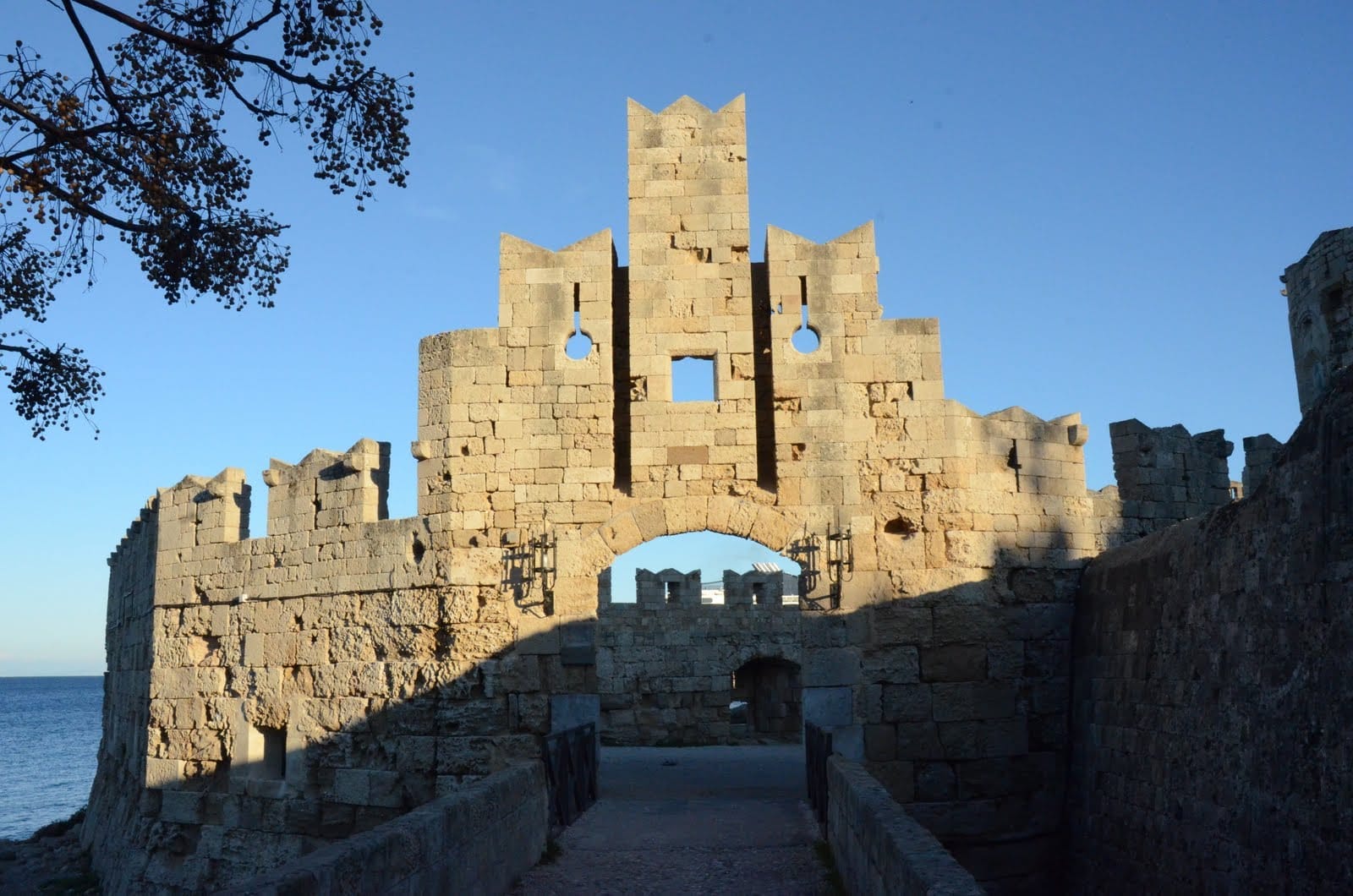
St Paul's Gate, known in Greek as Πύλη Αγίου Παύλου, occupies one of the most strategically loaded positions in the entire fortification system of Rhodes Old Town. It sits at the northwest end of Kolona Harbour, the point where the commercial port and the smaller inner harbour of Mandraki were once separated only by this narrow defensive passage. For the Knights of St John, controlling this chokepoint meant controlling who entered the city from the sea on its northern flank.
Most visitors reach the gate almost by accident, following the waterfront promenade south from Mandraki and suddenly finding themselves face-to-face with a pale limestone arch decorated with carved coats-of-arms that most people mistake for decoration rather than read as a ledger of political power. Take a moment here. This stonework is a document.
ℹ️ Good to know
St Paul's Gate is an outdoor, unenclosed landmark with no ticket booth or staff. It is freely accessible at all hours. There is nothing to queue for, and nothing to book.
History: Who Built It and Why
The gate was constructed by the Knights of St John in the second half of the 15th century, with construction associated with the period around 1461 to 1467 under Grand Master Orsini (not Zacosta), and subsequent repair and embellishment recorded around 1477 under Grand Master Pierre d'Aubusson (in office 1476–1503). The coats-of-arms of both Pope Sixtus IV and d'Aubusson are carved into the stonework, along with a marble relief of Saint Paul himself, giving the gate its name and its sacred legitimacy.
The Knights of St John understood that the harbour approaches were the most vulnerable points of any island fortification. A fleet could anchor in Mandraki while a smaller force slipped through the Kolona side, and St Paul's Gate was the physical answer to that tactical problem. Its position adjacent to Freedom Gate (Eleftherias Gate) reinforces how layered this defensive system was: multiple checkpoints, each with its own symbolic heraldry, each asserting Hospitaller authority over the sea lanes.
The broader story of the Knights' military engineering is explored in our Knights of Rhodes history guide, which covers the full arc from their arrival in 1309 to their expulsion by the Ottomans in 1522.
The gate was nearly destroyed during World War II, a period that caused significant damage to the Old Town's fabric. The structure visible today was substantially rebuilt in 1951, which is worth keeping in mind when assessing its 'original' character. The carved marble panels, however, are considered to preserve authentic medieval craftsmanship.
Tickets & tours
Hand-picked options from our booking partner. Prices are indicative; availability and final rates are confirmed when you complete your booking.
Sunset catamaran cruise with dinner in Rhodes
From 70 €Instant confirmationFree cancellation3-Hour All Inclusive Sun and Sea Swimming Cruise in Rhodes
From 55 €Instant confirmationFree cancellationRhodes Sunset Cruise with Greek BBQ and Unlimited Drinks
From 65 €Instant confirmationFree cancellationPalace of the Grand Master Ticket and Audio Tour by App
From 30 €Instant confirmation
The Physical Experience: What You Actually See
The gate presents as a rounded archway of pale limestone rising from a low sea-level bastion. Up close, the surface has the granular, salt-weathered texture typical of Rhodes Old Town's fortifications: not pristine, not ruined, but worn in the specific way that outdoor stonework ages when exposed to Aegean wind and humidity for centuries.
The carved heraldic panels are set above the main arch. The coat-of-arms of Grand Master d'Aubusson is the more elaborately worked of the two: a quartered shield with fleur-de-lis and other devices that identify his lineage. The marble relief of Saint Paul is modest in scale, easy to overlook from a distance, but worth examining closely for the quality of the carving. Saint Paul's association with Rhodes is genuine: Acts 21:1 places him sailing past the island on his journey to Jerusalem, and the nearby bay that bears his name at Lindos is named for an earlier visit tradition.
The gate sits at water level, with the harbour immediately to the east. The smell at this spot is salt-heavy and faintly fishy in the mornings when fishing boats have been active, shifting to sunscreen and exhaust as the day progresses and tourist traffic builds along the promenade. The sound profile is similarly time-dependent, which matters for how you experience the place.
Best Time to Visit and How the Gate Changes by Hour
Early morning, between 7am and 9am, is when the gate reads most clearly as a serious fortification rather than a scenic backdrop. The light comes in low from the east across the harbour, raking across the carved stone and sharpening the relief detail on the heraldic panels. The promenade is quiet at this hour: a few joggers, the occasional fisherman, almost no tourist groups. The gate feels genuinely old.
By mid-morning, tour groups arriving from cruise ships docked at Rhodes Port begin passing through the area. Most walk straight through Freedom Gate a few metres away and do not stop at St Paul's Gate at all, which is either frustrating or ideal depending on your perspective. The gate is rarely crowded regardless of the time of day. Even at peak summer midday, you are unlikely to wait for a clear photograph.
💡 Local tip
For photography, the gate faces roughly westward into the harbour. Late afternoon light (after 4pm in summer) falls directly on the carved panels and produces warm, shadow-rich images without the harsh overhead glare of midday. Bring a wide-angle lens if you want the gate and the harbour in the same frame.
In summer, the waterfront path between Mandraki and St Paul's Gate becomes genuinely hot between 11am and 3pm. There is no shade on the path itself. Visitors who are sensitive to heat should plan accordingly, wearing light clothing and carrying water. The cobblestone and paved surfaces reflect heat noticeably.
Getting There and the Waterfront Walk
The most natural approach is on foot along the northern waterfront of Rhodes Old Town, starting from Mandraki Harbour. The walk takes roughly 10 minutes at an easy pace, following the harbour edge south past the windmills and the Fort of St Nicholas promontory on the opposite shore. The gate becomes visible as you round the northwestern corner of the Old Town walls.
There is no dedicated parking at the gate. Visitors arriving by car are better served by the car parks in the New Town near Mandraki and continuing on foot. Taxis can drop at the northern gate area, and from there it is a short walk along the walls.
The gate makes natural sense as part of a longer walk combining the harbour gates of Rhodes Old Town with the Fort of St Nicholas at the end of the Mandraki breakwater. Together these three points form a coherent tour of the Knights' sea-defence system in under two hours.
Accessibility and Practical Notes
The waterfront promenade approaching the gate is paved and relatively flat, making it manageable for most visitors. However, the Old Town immediately behind the gate involves cobblestone streets and uneven surfaces that are genuinely difficult for wheelchair users and anyone with significant mobility limitations. The gate itself, as an exterior feature of the fortification wall, does not have an interior to enter, so there are no steps required to see the main carved features.
There are no facilities at the gate: no toilets, no café, no shade structure. The nearest facilities are back along the promenade toward Mandraki, where several kiosks and cafés operate during the tourist season. Plan accordingly, particularly in July and August.
⚠️ What to skip
Visiting at night is possible since the gate is lit and the promenade is open, but much of the carved detail becomes invisible without direct illumination. A torch or phone light helps if you want to examine the heraldic panels after dark.
Context: Where St Paul's Gate Fits in the Old Town
St Paul's Gate is part of the extensive UNESCO-listed fortification system of Rhodes Old Town, one of the best-preserved medieval walled cities in Europe. The full circuit of walls is approximately 4 kilometres. Within that system, St Paul's Gate is one of the smaller, less celebrated entry points, particularly compared to the heavily photographed Palace of the Grand Master further inside the walls or the Street of the Knights running down from it. That relative obscurity is part of its appeal.
Travellers who focus exclusively on the major interior monuments of the Old Town often miss the harbour-side fortifications entirely. The gates along the waterfront read differently from the inland defences: they were designed to be seen from ships approaching port, projecting authority and warning in equal measure. Standing at St Paul's Gate and looking back toward the sea gives a spatial sense of what arriving by ship in the 15th century would have communicated: this city is defended, organised, and not casually entered.
Who might not enjoy this stop: visitors with very limited time in Rhodes who need to prioritise. The gate is architecturally significant and historically interesting, but if you have only a few hours in the Old Town, the Palace, the Street of the Knights, and the Archaeological Museum will deliver more content per minute. St Paul's Gate is best suited to people who want texture and context over headline attractions.
Insider Tips
- The marble relief of Saint Paul above the arch is easy to miss because it sits high and is weathered to nearly the same tone as the surrounding limestone. Step back about 5 metres from the arch and look upward on the seaward face to locate it clearly.
- Freedom Gate (Eleftherias Gate) is only a few metres from St Paul's Gate and is the more elaborate of the two in terms of current presentation. Visit both in the same stop rather than planning separate visits.
- The stretch of water immediately east of the gate is part of Kolona Harbour, which retains some working-boat activity early in the morning. If you are interested in photographing traditional fishing vessels with medieval stonework in the background, this is one of the best spots in Rhodes.
- The 1951 reconstruction after WWII damage means the gate is structurally more robust than it looks. The worn appearance is partly authentic medieval weathering and partly the natural aging of post-war reconstruction stonework. Both are historically interesting layers.
- Including St Paul's Gate in a broader walking route along the northern waterfront keeps your day efficient. Start at the Fort of St Nicholas at sunrise, walk east past the Mandraki windmills, then continue to St Paul's Gate before the Old Town fully wakes up.
Who Is St Paul's Gate For?
- Architecture and medieval fortification enthusiasts who want to read the full defensive system of the Old Town, not just the headline monuments
- Photographers looking for early-morning harbour-and-stonework compositions with minimal crowds
- Visitors following the Knights of St John history trail through Rhodes Old Town
- Travellers who prefer free, self-guided exploration over ticketed sites
- Anyone spending more than two days in Rhodes who has covered the main interior attractions and wants to explore the waterfront walls in depth
Nearby Attractions
Other things to see while in Rhodes Old Town:
- Archaeological Museum of Rhodes
Housed in the 15th-century Hospital of the Knights, the Archaeological Museum of Rhodes brings together artifacts spanning the Archaic to Roman periods, including celebrated Hellenistic marble statues and intricate floor mosaics. It is one of the most historically layered museum experiences in the Aegean, where the building itself is as compelling as the collection inside.
- Hammam Turkish Baths
Built in 1558 during the Ottoman occupation, the Great Hamam is the sole surviving bathhouse within Rhodes' UNESCO-listed Medieval Town. Currently closed to the public but recently restored, it remains one of the most architecturally distinctive buildings in Arionos Square, worth understanding in context before you arrive.
- Harbour Gates
The Harbour Gates mark the medieval boundary between Mandraki Harbour and the walled city built by the Knights of Saint John. Free to visit at any hour, they are the most atmospheric entry point into Rhodes Old Town, framing a view that has barely changed in six centuries.
- Palace of the Grand Master of the Knights of Rhodes
The Palace of the Grand Master of the Knights of Rhodes is the most architecturally commanding structure in the medieval city. Built in the early 14th century and dramatically restored under Italian rule, it anchors the northwestern corner of the Old Town with towers, colonnaded courtyards, and a permanent collection that spans antiquity to the Ottoman period.