Squero di San Trovaso: Inside One of Venice's Last Working Gondola Boatyards
Squero di San Trovaso is one of the few remaining gondola boatyards still operating in Venice, a centuries-old workshop where craftsmen build and repair the city's iconic black boats. The compound itself is closed to casual visitors, but the view from across Rio San Trovaso is one of Dorsoduro's most quietly rewarding stops.
Quick Facts
- Location
- Dorsoduro 1097, Rio San Trovaso, Venice (Dorsoduro sestiere)
- Getting There
- Accademia (lines 1, 2) or Zattere (lines 2, 5.1) — about 5 minutes on foot from Accademia and 3–4 minutes from Zattere
- Time Needed
- 15–30 minutes to observe from outside; allow longer if combining with nearby sights
- Cost
- Free to view from the canal embankment; guided visits inside the yard are available by advance arrangement and charge a fee
- Best for
- History lovers, photographers, those curious about Venetian craft traditions
- Official website
- http://www.squerosantrovaso.com
What Is the Squero di San Trovaso?
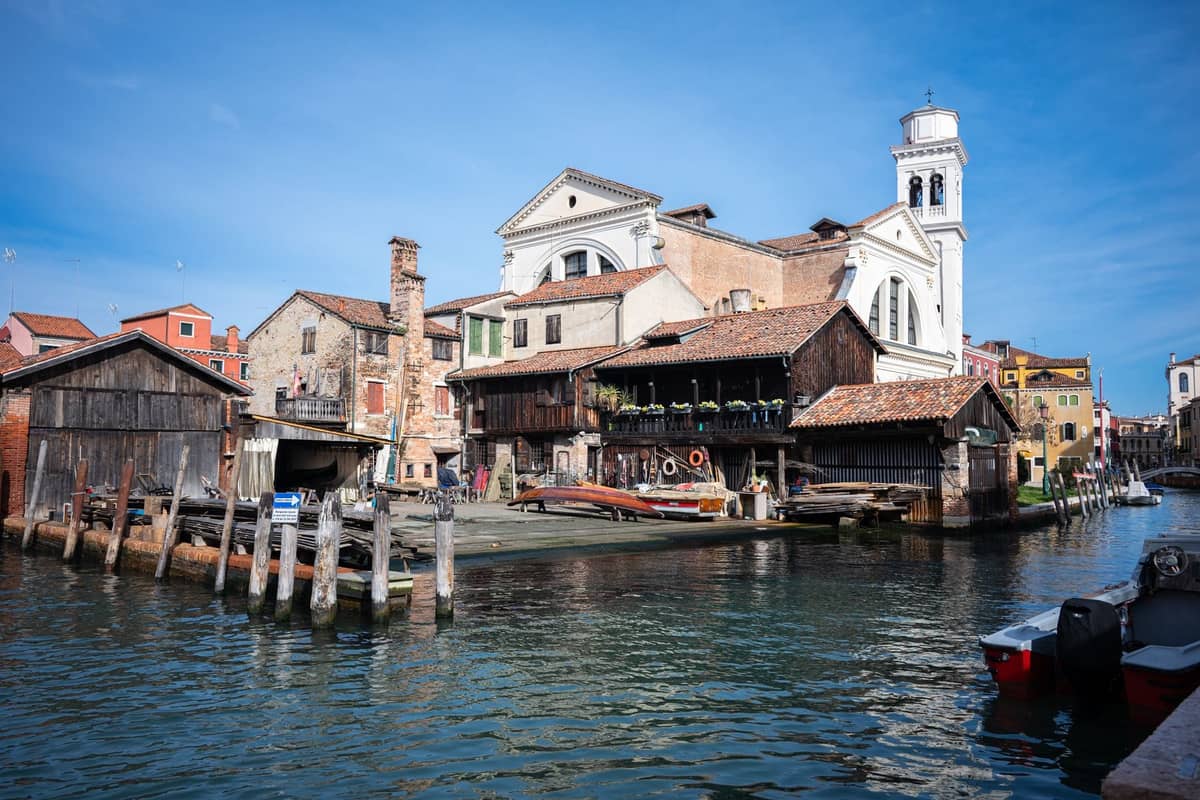
The Squero di San Trovaso is a working gondola boatyard, one of only a handful still operating in the entire lagoon city. A squero is the Venetian word for this type of specialized workshop, and this particular yard sits along Rio San Trovaso in the Dorsoduro sestiere, pressed between the water and a small courtyard of wooden buildings that look more like an alpine farmhouse than anything you would expect to find in central Venice.
At its peak, Venice supported dozens of squeri producing the thousands of gondolas that once served as the primary mode of urban transport. Today, gondolas number around 430 and the boatyards have dwindled accordingly. San Trovaso is widely cited as dating to the 17th century, making it a rare survivor of a craft tradition that shaped the city's identity more than almost any other.
The squero sits just a few minutes' walk from the Accademia Bridge, making it a natural addition to any walk through Dorsoduro. It requires no ticket and no reservation to observe from the outside, which is how most visitors experience it.
ℹ️ Good to know
The boatyard is not open for casual walk-in visits. You observe it from across the Rio San Trovaso canal, looking into the open yard from the opposite embankment. Guided visits inside are available by advance arrangement and are typically offered on weekdays — check the official website or authorized tour partners for details.
The Architecture: Why It Looks Like It Belongs in the Mountains
The most striking thing about the Squero di San Trovaso is its appearance. The main building is a low, timber-framed structure with a sloping roof and a wide eave overhang — the kind of construction you associate with the Dolomites or the Friulian foothills, not a canal-side workshop in one of Europe's most densely built cities.
This is not a coincidence. The craftsmen who historically staffed Venice's boatyards often came from the Cadore valley and other alpine communities in the Veneto region, and they built their workshops in the style they knew from home. The design was also practical: the wide roof provided cover for drying timber and working on the delicate asymmetric hull of a gondola out of the rain.
The yard slopes gently down to the water, allowing gondolas to be hauled out of the canal and worked on directly on the ramp. From across the rio you can see this inclined wooden apron clearly, usually with gondolas or sandoli at various stages of repair resting on it. The surrounding walls are weathered and functional, with none of the ornamental quality of the palazzi a few streets away. It looks exactly like a working boatyard should.
Tickets & tours
Hand-picked options from our booking partner. Prices are indicative; availability and final rates are confirmed when you complete your booking.
Doge's Palace skip-the-line tour
From 67 €Instant confirmationFree cancellationVenice Legends, Anecdotes and Ghost Stories Tour
From 35 €Instant confirmationFree cancellationGhosts and legends tour of Venice
From 29 €Instant confirmationFree cancellationSkip-the-line guided tour of Doge's Palace and Saint Mark's Basilica
From 106 €Instant confirmationFree cancellation
The Gondola Craft: What the Boatyard Actually Does
A gondola is not a simple boat. Each one is built from eight different types of wood, shaped into an asymmetric hull that compensates for the weight of the standing gondolier and allows straight travel with a single oar. The construction of a single gondola takes around two months of skilled work and involves a precise set of measurements that have been refined over centuries.
At San Trovaso, craftsmen handle both new construction and the ongoing repair cycle that keeps active gondolas in service. The boats require regular maintenance, including re-caulking, repainting with the traditional flat black finish, and periodic replacement of structural components. On a good morning, you can watch this work from across the canal: a gondola hull inverted on the ramp, a worker applying pitch or sanding a plank, the smell of varnish and sawdust drifting across the water.
If you want to understand what goes into a gondola before visiting, the gondola guide covers the history and pricing of rides in more detail.
💡 Local tip
Visit on a weekday morning, when activity in the yard is usually highest and the low morning light from the east catches the wooden structures well. The yard is generally much quieter on Sundays and public holidays.
How to Visit: Viewing from the Canal
The standard approach is to walk along the Fondamenta Bonlini, the embankment on the opposite side of Rio San Trovaso from the boatyard. From here you have a clear, unobstructed view of the entire compound: the main building, the slipway, and whatever boats are currently in the yard. There is no fence or wall blocking the view, and the canal is narrow enough that you can see into the workshop interior when the doors are open.
The distance across the rio is small enough for a telephoto lens to isolate individual details, but a standard lens or even a phone camera captures the full scene well. The best light for photography arrives in the morning. By afternoon, particularly in summer, the yard is in shadow and the contrast flattens. If acqua alta affects the area, the embankment may be partially flooded; worth checking conditions in autumn and winter.
You can also approach from the Campo San Trovaso side, which is where the Church of San Trovaso stands. This gives a different angle on the complex and a sense of the boatyard's relationship to the surrounding neighborhood. The campo itself is quiet and unpretentious, a good spot to sit and observe if you want to spend more than a few minutes here.
⚠️ What to skip
The boatyard observes its own working schedule and there is no guarantee that boats will be actively under repair when you visit. If the yard appears empty or closed, it may simply be a slow day or a period between commissions. Manage expectations accordingly.
Getting There and the Surrounding Walk
From the Accademia vaporetto stop, cross the Accademia Bridge, turn right along the fondamenta, and follow the canal south for about five minutes. Alternatively, get off at the Zattere stop and walk north through Dorsoduro for roughly the same distance. Neither route is complicated, though Venice's street signs require attention. The squero is signed in the area and most maps show it accurately.
The surrounding neighborhood rewards a longer walk. The Zattere promenade along the Giudecca Canal is a few minutes south and offers open water views that contrast with the narrow rios near the boatyard. The Gallerie dell'Accademia, Venice's primary collection of Venetian paintings, is a short walk north. Together with the squero, these form a natural half-day loop through Dorsoduro.
Dorsoduro has fewer crowds than San Marco and is genuinely pleasant to navigate on foot. The streets near the squero are residential and functional, with local bakeries and a wine bar or two mixed in among the sotoporteghi. It gives you a more grounded sense of the city than the area around the Rialto or Piazza San Marco.
The Bottom Line
The Squero di San Trovaso is not an interactive experience. You cannot go inside, watch a guided demonstration, handle tools, or speak with craftsmen during a casual visit. What you get is a view of an authentic working compound from a distance, and depending on the day, that view might include active work or an empty yard.
For travelers who are primarily interested in the cultural history of Venice and its relationship to the water, this matters. Seeing a space where gondolas are still actually made and repaired, in a building that has survived since the 17th century, is genuinely meaningful. For travelers who need interaction and narrative to engage with a place, the squero may feel like a detour.
If you are traveling with young children, the squero visit is brief and low-stimulation. Pair it with something more engaging nearby, such as a walk to Campo Santa Margherita, which has open space and a lively market atmosphere. For those with a serious interest in Venetian craft, the Murano glass workshops offer the kind of up-close demonstration that San Trovaso cannot.
💡 Local tip
The squero is free to observe, which makes it a natural addition to any walk rather than a dedicated destination. Build it into your route between the Accademia and the Zattere rather than treating it as a standalone stop.
Insider Tips
- Weekday mornings between roughly 8:30 and 11:30 are when craftsmen are most likely to be actively working on boats. Arriving at midday or on a weekend often means an empty yard.
- The view from directly in front of the Fondamenta Bonlini is the clearest, but walking a little further north along the same embankment gives you a slightly elevated angle that shows the full slope of the boatyard ramp more clearly.
- The smell of the boatyard, varnish, pine resin, and water-soaked timber, is something most visitors do not anticipate. On warm mornings it drifts quite far and adds considerably to the sensory experience.
- If you see gondoliers waiting near the squero, they are usually there for maintenance or pickup, not to offer rides. The official gondola stations are at designated traghetto points and embarkation areas throughout the city.
- Groups and smaller parties can arrange guided entry to the yard itself by advance booking. Contact the boatyard directly through the official website or a licensed tour operator well in advance; individual visitors cannot just walk in without a reservation.
Who Is Squero di San Trovaso For?
- Architecture and craft history enthusiasts who appreciate working heritage buildings
- Photographers looking for a scene that captures traditional Venice without the crowds
- Slow travelers building a half-day walk through Dorsoduro
- Anyone curious about how gondolas are actually made and maintained
- Budget-conscious visitors who want authentic experiences without admission costs
Nearby Attractions
Other things to see while in Dorsoduro:
- Accademia Bridge (Ponte dell'Accademia)
The Ponte dell'Accademia is a wooden pedestrian bridge spanning the Grand Canal between San Marco and Dorsoduro. Free to cross at any hour, it delivers what many consider the most photographed canal view in Venice, with a sweeping upstream panorama toward the Rialto. It also sits at the heart of one of the city's most rewarding walking neighborhoods.
- Basilica di Santa Maria della Salute
Standing at the mouth of the Grand Canal where it meets St Mark's Basin, the Basilica di Santa Maria della Salute is one of the most recognizable silhouettes in Venice. Built as a vow to the Virgin Mary after the plague of 1630–1631, this baroque octagonal church took 56 years to complete and remains an active place of worship, a repository of significant art, and one of the finest viewpoints in the city.
- Ca' Rezzonico — Museum of 18th Century Venice
Ca' Rezzonico is a palazzo on the Grand Canal that houses the Museum of 18th-Century Venice. Three floors of frescoed ballrooms, lacquered furniture, Tiepolo paintings, and period pharmacy recreations make it one of the most immersive museum experiences in the city.
- Campo Santa Margherita
Campo Santa Margherita is the largest square in Dorsoduro and one of the few places in Venice where locals genuinely outnumber tourists. A flat, open campo ringed with cafes, a daily market, and a student-fueled nightlife scene, it offers a rare window into how Venetians actually use their city.