Shanghai Maglev Train: Riding the World's Fastest Scheduled Train
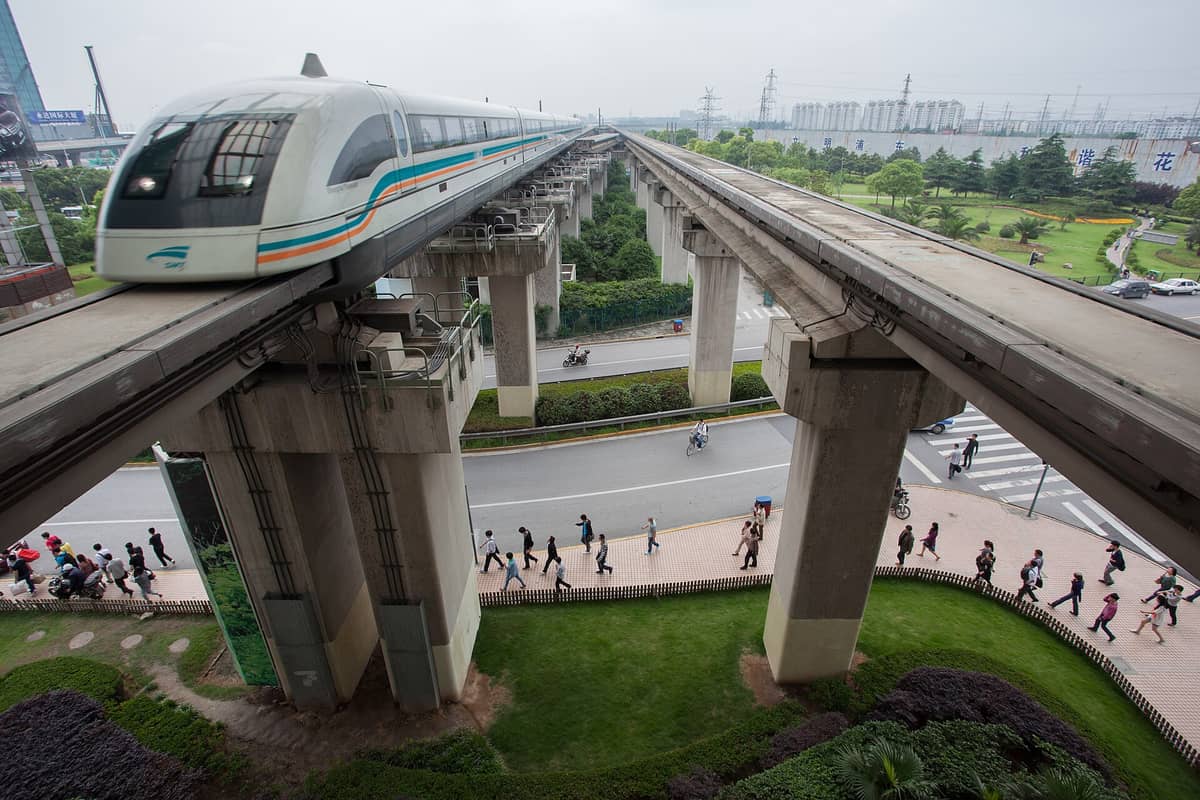
The Shanghai Maglev Train covers the roughly 30 km between Pudong International Airport and Longyang Road Station in just about 7–8 minutes, at a regular commercial speed of 300 km/h (the line was designed for 431 km/h). It is one of the few attractions in the city that doubles as actual transport — a genuine engineering spectacle that most travelers experience once and remember for years.
Quick Facts
- Location
- Longyang Road Station to Pudong International Airport, Pudong New Area, Shanghai
- Getting There
- Metro Lines 2, 7, or 16 to Longyang Road Station, then follow signs to Maglev platforms
- Time Needed
- 7–8 minutes per ride; allow 20–30 minutes for ticketing and platform access
- Cost
- ¥50 one-way economy; ¥40 one-way with same-day flight boarding pass; ¥80 round-trip economy; ¥100 VIP one-way
- Best for
- Tech enthusiasts, airport transfers, families with curious kids, first-time visitors to Shanghai
- Official website
- http://www.smtdc.com/en
What the Shanghai Maglev Train Actually Is
The Shanghai Maglev Train is not a tourist ride in the conventional sense. It is a fully operational commercial transit line and one of the few maglev services travelers can ride as ordinary airport transport. Operated by Shanghai Maglev Transportation Development Co., Ltd., the line runs roughly 30 km between Longyang Road Station in Pudong and Shanghai Pudong International Airport (PVG), completing the journey in about 7 to 8 minutes at a regular commercial speed of 300 km/h.
Commercial service launched on 1 January 2004, making it the world's first high-speed commercial maglev line. The technology, developed through a partnership with the German Transrapid consortium, uses electromagnetic levitation to lift the train roughly 10 mm above the guideway, eliminating wheel-on-rail friction entirely. The result is a ride that is quieter than you expect, smoother than almost any train you have been on, and over before you have fully processed what is happening.
💡 Local tip
Sit on the right side of the train (when departing from Longyang Road) for the best chance of seeing an oncoming train pass in the opposite direction. The combined closing speed of two trains exceeds 800 km/h, and the moment lasts less than a second — easy to miss if you are not watching.
The Ride: What to Expect Minute by Minute
Boarding at Longyang Road, the train looks more like a low-slung aircraft fuselage than anything you associate with rail. The nose is aerodynamically tapered, and the carriages sit noticeably lower than a standard metro train. Platforms are clean, climate-controlled, and rarely crowded outside of peak airport rush hours.
Acceleration is the first thing that registers. Within the first 90 seconds, the train reaches speeds that would be impossible to achieve in a car on any road in China. A digital speedometer display mounted at the front of each carriage counts upward in real time, and passengers invariably crane their necks to watch it climb toward 300 km/h. At peak speed the landscape outside blurs into horizontal streaks of grey and green, and nearby structures create a slight visual compression effect. There is almost no noise beyond a faint hum.
Then the braking begins, and the train decelerates just as smoothly as it accelerated. By the time passengers fully register that the fastest part of the trip is over, the doors open at Pudong Airport. For many visitors, the instinctive reaction is mild disbelief that it ended so quickly.
Tickets & tours
Hand-picked options from our booking partner. Prices are indicative; availability and final rates are confirmed when you complete your booking.
Shanghai city and Zhujiajiao water town private tour with lunch
From 371 €Instant confirmationFree cancellationShanghai private tour with iconic landmarks of the old and new city
From 284 €Instant confirmationFree cancellationShangai Yuyuan Garden entrance tickets
From 9 €Instant confirmationFree cancellation
Is It Worth Taking? Honest Assessment
This depends entirely on what you want from it. As a pure airport transfer, the Maglev has a significant limitation: it only goes as far as Longyang Road, not into central Shanghai. To reach the Bund, People's Square, or Jing'an from the airport, you still need to transfer to Metro Line 2 at Longyang Road, adding 30 to 45 minutes and a separate fare to the journey. The full combined cost of Maglev plus metro is noticeably higher than simply taking the metro all the way from the airport to the center.
As a deliberate experience, however, it is hard to argue against. Nowhere else on earth can a traveler legally ride a commercially operated train at over 400 km/h. If you are arriving in Shanghai for the first time, it frames the city well: a place that treats extraordinary engineering as an unremarkable part of daily transit. Those who appreciate Shanghai's architectural ambition will find the Maglev fits perfectly into the city's broader narrative of building at a scale and speed few places attempt.
Travelers on tight budgets, or those heading straight to a hotel in Lujiazui or Jingan, may reasonably conclude that Metro Line 2 from the airport is the smarter choice. That is a fair call. But if you have the flexibility, taking the Maglev at least once, even as a round-trip joyride from Longyang Road, adds something genuinely unusual to a Shanghai trip.
ℹ️ Good to know
Economy one-way fare is ¥50, reduced to ¥40 with a same-day flight boarding pass. Round-trip economy costs ¥80. VIP class (wider seats, front carriage) costs ¥100 one-way or ¥160 round-trip, with round-trip tickets valid for 7 days. Children under approximately 1.2 m ride free with a paying adult. Verify current fares before travel, as prices are subject to change.
Getting There: Longyang Road Station
The city-side terminus is Longyang Road Station, located at approximately No. 2100 Longyang Road, Pudong New Area. The Maglev station sits adjacent to the metro station of the same name, which is served by Lines 2, 7, and 16. From central Shanghai, Metro Line 2 is the most direct connection, running through Lujiazui, People's Square, and Jing'an Temple before reaching Longyang Road in around 30 to 40 minutes.
At Longyang Road, follow the overhead signs for the Maglev, which are clearly marked in both Chinese and English. The ticketing hall is separate from the metro concourse. Tickets can be purchased at staffed counters or self-service machines, which accept cash and most major Chinese payment apps. Credit card acceptance at machines can be inconsistent, so have an alternative payment method ready.
At Pudong Airport, the Maglev station sits in the transport hub between Terminal 1 and Terminal 2. After clearing customs and collecting luggage, follow ground transportation signs toward the Maglev, which is well signposted throughout the arrivals areas of both terminals.
Operating Hours and Frequency
Trains run daily from approximately 06:45 to 21:40 from Longyang Road and from around 07:02 to 21:42 from Pudong Airport, with departures roughly every 15 to 20 minutes in both directions. From Pudong Airport toward Longyang Road, the first train departs around 07:02 and the last regular service runs around 21:42. No significant seasonal schedule variations are currently noted. Verify current timetables with the operator before travel.
⚠️ What to skip
If your flight arrives after 21:00, check whether late trains are still running before counting on the Maglev. The two late-night trains from the airport to Longyang Road cover some evening arrivals, but Metro Line 2 or a taxi may be the safer fallback for very late landings.
Photography and the Best Seat
The speedometer display at the front of each car is the primary photo target for most passengers, and it photographs well in good light. Point your camera at the display and frame the reading at peak speed. Video is arguably more satisfying than stills for capturing the blur of the passing landscape.
Window photography of the passing scenery is largely unrewarding: the route cuts through Pudong's outer industrial and residential belt, not through the skyline views you associate with Shanghai's best photography locations. The real photographic moment is the passing of an oncoming train, visible for less than a second from the right-hand window seats on a Longyang Road departure. Sit facing the direction of travel, right side, and keep your phone or camera aimed low at the adjacent guideway.
Early morning departures, around 07:00 to 09:00, offer the cleanest window light and fewer passengers crowding the front displays. Midday rides during weekdays tend to be the quietest overall, while weekend afternoons can draw more visitors specifically riding for the experience rather than catching a flight.
Accessibility
Both Longyang Road and Pudong Airport Maglev stations have escalators and elevators connecting platforms with concourses, and the trains feature wide doors with level boarding from the platform, making them accessible for wheelchair users and passengers with strollers or large luggage. Passengers requiring assistance are advised to contact the service center at the station or reach the operator through the official site at smtdc.com. The ride duration is short enough that standing, if necessary, is not a hardship, though all passengers receive a seat during normal operations.
Fitting the Maglev Into Your Shanghai Trip
Most visitors encounter the Maglev as part of their airport arrival or departure. A practical approach: take the Maglev from the airport to Longyang Road on arrival, then connect to Metro Line 2 for the rest of the journey. On departure, allow an extra 20 to 30 minutes compared to taking the metro all the way. For those specifically seeking it as an experience, a round-trip from Longyang Road takes under 30 minutes including platform time and costs ¥80, which is a reasonable price for something this unusual. If you are planning a full day in Pudong and want to combine several stops, the Lujiazui Riverside Promenade, the Shanghai Tower, and the Maglev can be grouped into a single afternoon without much backtracking.
The Maglev does not connect to most central tourist areas directly, so it is worth reviewing your overall transport plan. A clear overview of how to move around the city is covered in the getting around Shanghai guide, which compares metro, taxi, and Maglev options in context.
Insider Tips
- Present your same-day boarding pass at the ticket window before purchasing. The discounted fare of ¥40 (versus ¥50) applies to passengers with a valid same-day flight, but you must ask at the staffed counter rather than use the self-service machine, as not all machines process the discount automatically.
- VIP class occupies the front carriage and offers slightly wider, higher-backed seats. The real advantage is positioning: you have the clearest forward view of the speedometer and the track ahead. Worth the extra cost if you are riding purely for the experience.
- The oncoming train effect is the ride's single most dramatic moment and it is invisible if you are on the wrong side or not paying attention. On departures from Longyang Road, sit right-side window, face forward, and watch the adjacent inbound guideway from roughly two minutes into the journey.
- If you are arriving at Pudong Airport with a large group and heavy luggage, factor in that the Maglev still requires a metro transfer at Longyang Road before reaching most hotels. A taxi or Didi from the airport may be faster door-to-door despite the longer travel time on paper.
- The round-trip ticket (¥80 economy) is valid for up to 7 days according to current operator information, making it possible to ride to the airport and back on different days if, for example, you are seeing off a travel companion. Confirm the validity window at the ticket counter when purchasing.
Who Is Shanghai Maglev Train For?
- First-time visitors to Shanghai who want to start their trip with something genuinely extraordinary
- Families with children who are fascinated by engineering, speed, or trains
- Travelers arriving at or departing from Pudong Airport who want to make the transfer itself memorable
- Tech and infrastructure enthusiasts interested in commercial magnetic levitation technology
- Anyone with 30 spare minutes near Longyang Road looking for a fast, unusual side experience
Nearby Attractions
Other things to see while in Pudong:
- Century Park
Century Park is the largest ecological urban park in downtown Shanghai, stretching across Pudong's grid of glass towers and wide boulevards. Since May 2024, entry is free and the fences are gone, making it one of the most accessible green spaces in the city. Whether you come at dawn for tai chi or late afternoon for a lakeside stroll, the park rewards visitors who know how to read it.
- China Art Museum
The China Art Museum occupies the striking red former China Pavilion built for Expo 2010, making it one of the most architecturally dramatic museum experiences in Shanghai. Permanent collections are free, the scale is genuinely impressive, and most visitors are surprised by how much is on display across multiple floors.
- Jin Mao Tower
Standing 420.5 metres above Pudong's Lujiazui financial district, Jin Mao Tower is one of Shanghai's most architecturally distinctive skyscrapers. Its 88th-floor observatory delivers panoramic views across the Huangpu River and the historic Bund, while the building's pagoda-inspired silhouette remains one of the most recognisable on the city skyline.
- Lujiazui Riverside Promenade
The Lujiazui Riverside Promenade stretches roughly 2.5 km along Binjiang Avenue in Pudong, offering unobstructed views of the Bund from the opposite bank. It is open 24 hours, costs nothing to walk, and delivers one of the most dramatic urban skylines on earth at any time of day.