China Art Museum: Inside Shanghai's Colossal Red Pavilion
The China Art Museum occupies the striking red former China Pavilion built for Expo 2010, making it one of the most architecturally dramatic museum experiences in Shanghai. Permanent collections are free, the scale is genuinely impressive, and most visitors are surprised by how much is on display across multiple floors.
Quick Facts
- Location
- No. 205 Shangnan Road, Pudong New Area, Shanghai
- Getting There
- Metro Line 8 to China Art Museum Station (Exit 3); or Line 7 to Yaohua Road Station (Exit 1)
- Time Needed
- 2 to 3 hours for a thorough visit; 1 hour if you focus on highlights
- Cost
- Free for permanent exhibitions; typically CNY 20–50 for special exhibitions and around CNY 20 for the animated Qingming scroll (verify before visiting)
- Best for
- Modern Chinese art, architectural photography, rainy-day culture, families
- Official website
- http://www.artmuseumonline.org
What Is the China Art Museum?
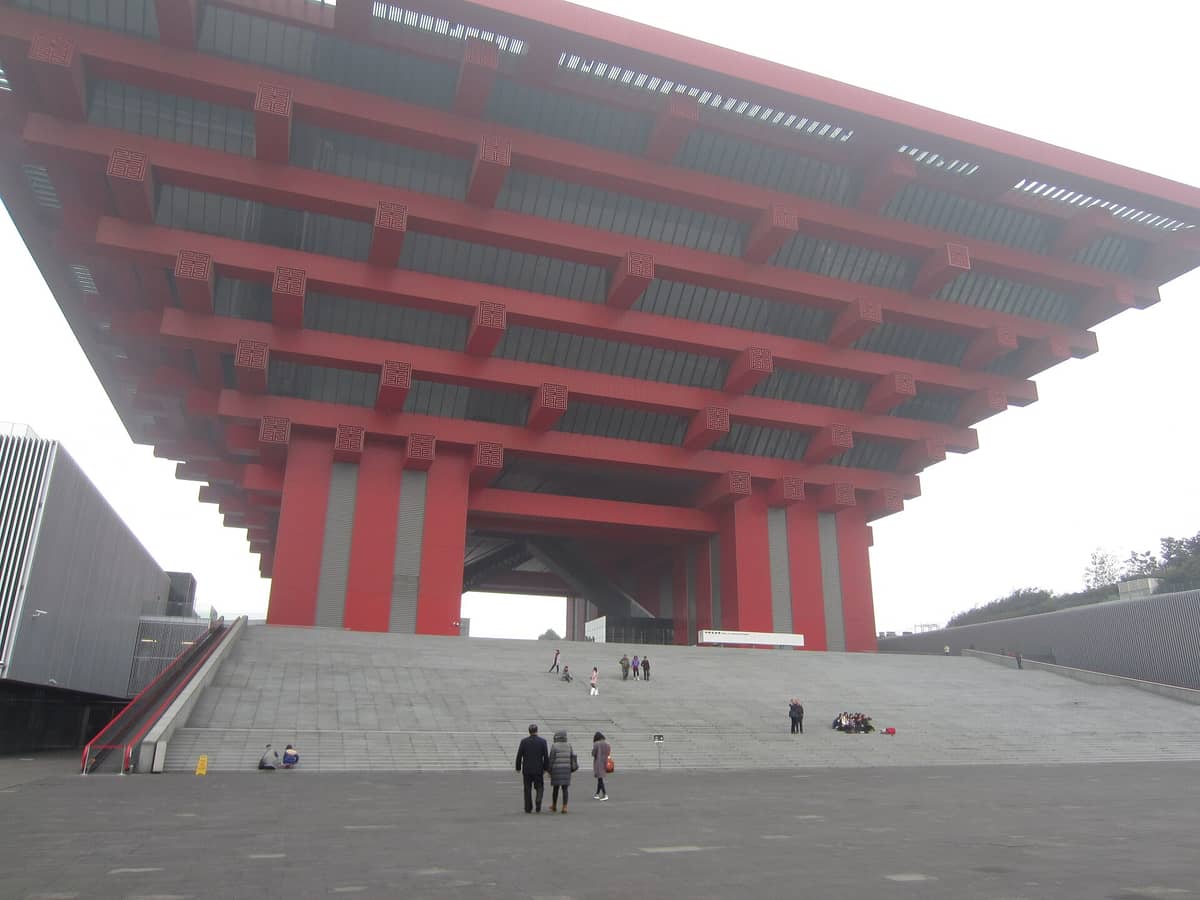
The China Art Museum, known in Chinese as 中华艺术宫 (Zhonghua Yishugong), is one of the largest modern art museums in Asia. It occupies the former China Pavilion built for Expo 2010 Shanghai, an immediately recognizable structure whose deep crimson exterior and stacked, bracket-like tiers draw from classical Chinese timber architecture while operating at a scale that feels closer to an airport terminal than a traditional pavilion. Since opening as a museum in 2012, it has become the primary institution in Shanghai dedicated to modern Chinese fine art.
The building sits in the southern part of Pudong New Area, on what was the Expo 2010 site. The surrounding district still carries the slightly open, park-like quality of a post-expo landscape, giving the museum a grand, uncrowded setting that you rarely find with institutions of this size in central Shanghai. The nearest landmarks are the Huangpu River waterfront to the north and the Mercedes-Benz Arena to the west.
ℹ️ Good to know
Entry to permanent exhibitions is free, but a valid passport is required for registration at the entrance to obtain your free ticket. Arrive with your passport, not just a photo of it, as staff check the physical document.
The Architecture: A Pavilion Built to Impress
Before you spend a minute thinking about the art inside, the building itself demands attention. The structure rises approximately 63 metres and was designed to reference the dougong, the interlocking wooden bracket system used in classical Chinese architecture for over two thousand years. The result is a layered, cantilevered form that widens as it climbs, like an inverted pyramid rendered in deep red steel and concrete. From street level, the visual weight of it is genuinely arresting.
Photography around the exterior works best in the morning, when low-angle sunlight catches the horizontal layers of the facade and reduces the harsh glare that flattens the structure in midday light. The plaza in front provides a wide enough sightline to capture the full building without a wide-angle lens. In overcast conditions, the red tones actually read better against a grey sky than against bright sunshine.
If architectural scale interests you, this pairs naturally with a broader look at Pudong's built environment. The Shanghai Tower and Jin Mao Tower are roughly 20 minutes away by metro, and together they represent a near-complete survey of what Shanghai has built since 1990. For a wider perspective on the city's architectural history, the Shanghai architecture guide covers the full range from colonial-era Bund buildings to Pudong's skyline.
Tickets & tours
Hand-picked options from our booking partner. Prices are indicative; availability and final rates are confirmed when you complete your booking.
Shanghai city and Zhujiajiao water town private tour with lunch
From 371 €Instant confirmationFree cancellationShanghai private tour with iconic landmarks of the old and new city
From 284 €Instant confirmationFree cancellationShangai Yuyuan Garden entrance tickets
From 9 €Instant confirmationFree cancellation
What's Inside: The Permanent Collection
The museum's permanent collection focuses primarily on Chinese art from the late 19th century through to the contemporary period, with particular depth in oil painting, ink painting, and sculpture from the Republican era, the early People's Republic period, and the post-reform decades after 1978. The collection includes works by major figures in modern Chinese art history, offering a coherent narrative of how Chinese visual culture evolved through repeated political and social upheaval.
The galleries are spread across multiple floors connected by broad ramps and elevators. One of the most discussed pieces in the permanent collection is a monumental reproduction of the panoramic Song Dynasty painting 'Along the River During the Qingming Festival,' rendered as an animated digital installation that cycles through day and night sequences. It is popular with visitors of all ages and attracts consistent crowds regardless of what temporary exhibitions are running alongside it.
Scale is a defining characteristic of the space. Ceilings are exceptionally high, particularly on the upper floors, and the galleries feel generous rather than crowded. Even during peak visiting hours on a weekend, the sheer floor area means you can move through most rooms without the shoulder-to-shoulder compression found in smaller Shanghai museums.
💡 Local tip
Pick up a floor map at the entrance desk. Navigation is not immediately intuitive — the building's unusual geometry means it's easy to skip an entire floor without realising it. The map also identifies which galleries contain the temporary paid exhibitions versus free permanent rooms.
Temporary Exhibitions and What They Cost
Alongside the permanent collection, the museum hosts rotating special exhibitions that typically require a separate ticket. Pricing for these has generally been in the CNY 20 to around CNY 50 range, though exact figures change with each exhibition and should be verified on the official website or at the entrance before you plan around them. These temporary shows have covered international partnerships, retrospectives of individual Chinese artists, and themed surveys of particular movements or periods.
If you are visiting primarily for the permanent collection, you will not feel shortchanged skipping a paid show. The free galleries alone provide more than enough material for a two-hour visit. If the temporary exhibition aligns with your interests, the additional cost is relatively modest by international museum standards.
Timing Your Visit: When to Come and When to Avoid
Tuesday through Friday mornings are consistently the quietest periods. Arriving at or shortly after the 10:00 opening allows you to move through the main galleries with minimal competition for sightlines and benches. Weekend afternoons, particularly on Saturdays, see the largest crowds, concentrated around the animated Qingming Festival installation and the ground-floor atrium.
The museum is closed on Mondays, except during national public holidays when it follows a separate schedule. Last admission is at 17:00 for a museum that closes at 18:00, which is a tighter window than it sounds given the size of the building. If you arrive at 16:30, you will not see everything.
Shanghai's climate shapes the experience here more than you might expect. The rainy meiyu season, typically from June into early July, and the typhoon-influenced wet spells from July through September make the China Art Museum an excellent choice for a full indoor day. The best time to visit Shanghai in terms of weather is generally April through May or October through November, when temperatures are comfortable for combining an indoor visit here with outdoor exploration of the Expo site and waterfront.
⚠️ What to skip
The museum closes on Mondays year-round (except national public holidays). Many visitors travelling from central Shanghai or Puxi plan a Pudong day and arrive to find the doors shut. Check the schedule before making the trip.
Getting There: Practical Transit Details
The most direct public transit option is Metro Line 8 to China Art Museum Station, using Exit 3, which deposits you directly in front of the building's main plaza. Journey time from People's Square is approximately 20 to 25 minutes. Metro Line 7 to Yaohua Road Station (Exit 1) is an alternative that involves a short walk, useful if you are coming from the northern Pudong direction.
Several bus routes stop near the junction of Pudong Nan Road and Shangnan Road, including routes 164, 454, 576, 734, 786, 818, 978, 981, Tunnel Line 1, and Zhounan Line. Bus travel is slower but useful if you are combining the museum with other stops in southern Pudong or crossing from Puxi via one of the tunnel routes.
For visitors using ride-hailing apps, give the driver the address as No. 205 Shangnan Road, Pudong New Area. Didi Chuxing is widely used in Shanghai and accepts in-app payment. For a full rundown of how to move around the city, the getting around Shanghai guide covers metro lines, buses, taxis, and ride-hailing in detail.
Accessibility, Practicalities, and What to Bring
The museum provides wheelchair rental and baby carriage rental services for visitors, and the building's ramps and elevator system make most floors accessible without stairs. Wear comfortable shoes regardless: the gallery floors are hard, the distances between rooms are considerable, and there are few places to sit within the exhibition spaces themselves.
Photography is generally permitted in the permanent galleries without flash, though individual exhibitions may have restrictions — look for signage at each gallery entrance before shooting. The interior atrium and facade are among the most photogenic spaces in Pudong and well worth planning for. A wide-angle lens or a phone with an ultra-wide mode handles the high ceilings and large-scale works more successfully than standard focal lengths.
There is a cafe and a museum shop on the premises. Neither is particularly remarkable, but both are useful for a mid-visit break given that the nearest alternative cafes require a walk out of the immediate complex. Bring water if you run warm, as the building's scale means more walking than visitors typically anticipate.
Honest Assessment: Who Will Love It and Who Should Skip It
The China Art Museum is genuinely impressive in terms of scale, collection depth, and the quality of its building. For anyone interested in the trajectory of modern Chinese art, it offers something that cannot easily be found elsewhere in Shanghai at this level of comprehensiveness and at no entry cost for the core collection.
That said, English-language labelling in the permanent galleries is inconsistent. Some rooms have detailed bilingual panels; others offer only Chinese text. Visitors without reading ability in Chinese will find certain sections harder to contextualise. If that matters to you, consider downloading an audio guide app or going with a guided tour. Travellers after a tight half-day itinerary focusing on the Bund or the Former French Concession may find the distance to Pudong a deterrent. The museum works best as the anchor of a dedicated Pudong day rather than a quick detour. For a broader look at what Shanghai's museum scene offers, the best museums in Shanghai guide helps put it in context alongside the Shanghai Museum, the Natural History Museum, and the Power Station of Art.
Visitors who enjoy contemporary art presented in industrial or repurposed spaces might also want to compare the experience with the Power Station of Art, Shanghai's other major institution for modern and contemporary work, located across the river in Xuhui. The two museums take different approaches to the same broad category of art, and seeing both in a single trip rewards the comparison.
Insider Tips
- The animated 'Along the River During the Qingming Festival' installation runs on a cycle. If you arrive just after it resets to the daytime scene, wait a few minutes rather than leaving early — the night sequence is more visually dramatic and worth seeing.
- The upper floors of the museum offer partial elevated views across the southern Pudong skyline through the building's windows. These are easy to miss if you follow the main gallery circuit without stepping out to the perimeter corridors.
- If you want to photograph the exterior without tour groups in the frame, arrive within the first 30 minutes of opening on a weekday. By mid-morning, school and tour groups tend to gather on the plaza.
- The museum's ramp system between floors makes for a slower ascent than elevators but gives you better sightlines into the atrium — worth taking once for the spatial experience of the building itself.
- Passport registration at the entrance can create a short queue on busy weekends. Having your passport open to the photo page before you reach the desk saves a minute or two when the line is long.
Who Is China Art Museum For?
- Travellers with a specific interest in modern Chinese art history and how it developed from the 1900s to today
- Architecture enthusiasts who want to experience the former China Expo Pavilion from the inside as well as the outside
- Families with older children who respond well to the interactive animated Qingming Festival installation
- Budget-conscious visitors looking for a full half-day of serious culture at no cost
- Rainy-day visitors needing a large, covered, genuinely engaging indoor option in Pudong
Nearby Attractions
Other things to see while in Pudong:
- Century Park
Century Park is the largest ecological urban park in downtown Shanghai, stretching across Pudong's grid of glass towers and wide boulevards. Since May 2024, entry is free and the fences are gone, making it one of the most accessible green spaces in the city. Whether you come at dawn for tai chi or late afternoon for a lakeside stroll, the park rewards visitors who know how to read it.
- Jin Mao Tower
Standing 420.5 metres above Pudong's Lujiazui financial district, Jin Mao Tower is one of Shanghai's most architecturally distinctive skyscrapers. Its 88th-floor observatory delivers panoramic views across the Huangpu River and the historic Bund, while the building's pagoda-inspired silhouette remains one of the most recognisable on the city skyline.
- Lujiazui Riverside Promenade
The Lujiazui Riverside Promenade stretches roughly 2.5 km along Binjiang Avenue in Pudong, offering unobstructed views of the Bund from the opposite bank. It is open 24 hours, costs nothing to walk, and delivers one of the most dramatic urban skylines on earth at any time of day.
- Oriental Pearl Radio & Television Tower
The Oriental Pearl Tower is the defining landmark of Shanghai's Pudong skyline, a 468-metre structure whose pink-lit spheres have symbolised China's economic transformation since 1994. This guide covers what you actually see at each level, when to go, how much it costs, and whether it's worth your time.