Jin Mao Tower: Shanghai's Art Deco Skyscraper With a View Worth the Climb
Standing 420.5 metres above Pudong's Lujiazui financial district, Jin Mao Tower is one of Shanghai's most architecturally distinctive skyscrapers. Its 88th-floor observatory delivers panoramic views across the Huangpu River and the historic Bund, while the building's pagoda-inspired silhouette remains one of the most recognisable on the city skyline.
Quick Facts
- Location
- No. 88 Century Avenue, Lujiazui, Pudong New Area, Shanghai
- Getting There
- Lujiazui Station, Metro Line 2 (short walk from the station)
- Time Needed
- 1 to 2 hours for the observatory; allow extra time for the Skywalk
- Cost
- Adult ¥120 | Child (100–130 cm) ¥50 | Student ¥90 | Senior (70+) ¥100 | Skywalk package ~¥288–¥368 (verify before visiting)
- Best for
- Skyline photography, architecture enthusiasts, first-time visitors to Pudong
- Official website
- http://www.jinmao88.com
What Jin Mao Tower Actually Is
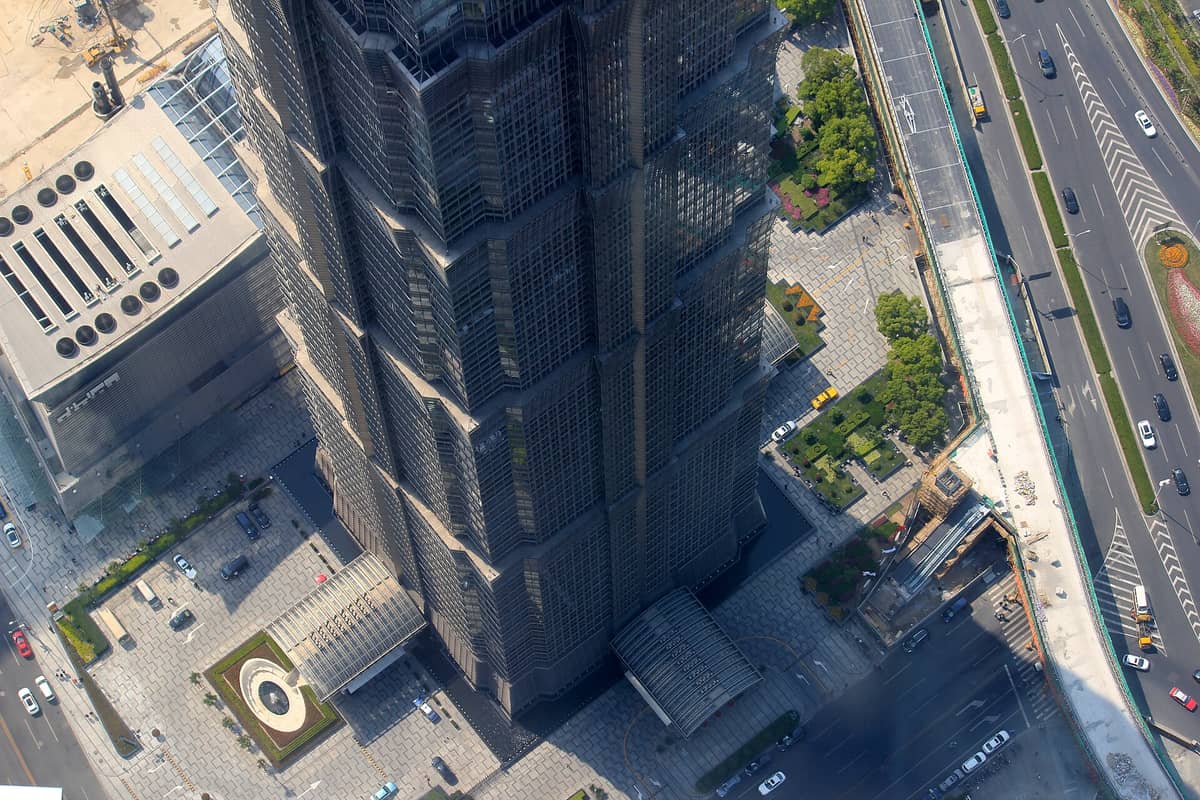
Jin Mao Tower (金茂大厦) is a 420.5-metre, 88-floor supertall skyscraper completed in 1999 in Shanghai's Lujiazui financial district. When it opened, it was among the tallest buildings on earth and the defining symbol of Pudong's rapid transformation from farmland to financial hub. Since then, taller neighbours have arrived — the Shanghai World Financial Center and the Shanghai Tower now flank it closely — but Jin Mao Tower has aged into something its competitors lack: genuine architectural character.
The building was designed by the American firm Skidmore, Owings and Merrill. The brief was to create a tower rooted in Chinese tradition without resorting to pastiche. The result draws heavily on the proportional logic of classical Chinese pagoda architecture: a tiered, tapering silhouette of stainless steel and glass with setbacks that echo the repeated rhythms of a multi-storey pavilion. The number 88 appears throughout — the floor count, the address on Century Avenue, the observatory branding. In Chinese culture, eight is associated with prosperity, and the repetition was deliberate.
The tower holds more than just an observation deck. Floors 3 to 50 are office space. Floors 53 to 87 house the Grand Hyatt Shanghai, which wraps around a cylindrical interior atrium that rises 152 metres from the 56th floor — one of the tallest hotel atriums in the world. Visitors heading to the Shanghai World Financial Center or Shanghai Tower nearby may find those observatories offer marginally higher vantage points, but Jin Mao Tower remains a distinctive experience of its own.
ℹ️ Good to know
Observatory hours are generally 08:30–21:30 daily, with last entry at 21:00. Ticket prices and hours change — confirm on the official site (jinmao88.com) or at the ticket counter before your visit.
The Observation Deck: What You'll Actually See
The JIN MAO Observatory 88 occupies the entire 88th floor and offers wide glass views from the top of the tower. The elevator ride from the ground-floor lobby to the top takes roughly 45 seconds — fast enough to feel faintly disorienting. When the doors open, you step directly into a 360-degree panorama at about 340 metres above street level.
On clear days, the westward view across the Huangpu River is the one most visitors photograph: the neo-classical European facades of the Bund laid out in a neat row, the river traffic cutting through the brown water below, and the low-rise density of older Shanghai stretching beyond. Looking down, Century Avenue points straight toward you like a runway, flanked by the angular geometry of Lujiazui's tower cluster. On unusually clear autumn or winter mornings, visibility can extend 50 kilometres or more.
One detail worth noting: the viewing platform has a downward-angled glass section at floor level in some positions. Stepping onto it produces a vertigo-inducing view straight down the tower's exterior. Not everyone will want to, but those who do tend to linger. The glass feels thick and secure, though it looks anything but.
⚠️ What to skip
Shanghai's air quality varies significantly. On hazy summer days — common from June through August — visibility from the top can be limited to just a few kilometres, reducing the quality of the panorama. Autumn (October to November) tends to bring the clearest skies and the best views.
Tickets & tours
Hand-picked options from our booking partner. Prices are indicative; availability and final rates are confirmed when you complete your booking.
Shanghai city and Zhujiajiao water town private tour with lunch
From 371 €Instant confirmationFree cancellationShanghai private tour with iconic landmarks of the old and new city
From 284 €Instant confirmationFree cancellationShangai Yuyuan Garden entrance tickets
From 9 €Instant confirmationFree cancellation
Morning, Afternoon, or Dusk: When to Go
The observatory opens at 08:30, and early arrivals on weekday mornings have the floor largely to themselves. The light at this hour is sharp and angled, good for photography across the river without the blown-out contrast that midday brings. Queues at the lifts are short, and the deck feels spacious.
Midday and weekend afternoons are the busiest periods. Domestic tour groups arrive in organized waves, and the observation floor can become genuinely crowded by noon. If you visit at this time, expect to wait for a clear position at the windows and to share the railing at the glass floor sections.
Dusk, roughly 30 minutes before and after sunset, is the most rewarding time for most visitors. The Bund's heritage buildings begin to illuminate from the river side, and the tower lights of Lujiazui shift from reflective glass to glowing gold and white. The sky transitions through orange and grey above the western skyline. Crowds are moderate at this hour — larger than morning but less chaotic than the midday peak. The last entry is at 21:00, and the full city-lights view at night is worth staying for if you arrive at dusk and wait it out.
The Skywalk: An Outdoor Option for Those Who Want It
Jin Mao Tower also offers a Skywalk experience on a narrow outdoor ledge at the upper floors. Participants are harnessed to a safety track and walk the perimeter of the tower at height with unobstructed open air. The experience is operated in small groups and has firm eligibility restrictions: participants must be aged 10 to 60, meet physical health requirements, and cannot have relevant medical conditions. The combined Skywalk and observatory package is priced around ¥288–¥368 for adults, though promotional rates appear on third-party ticketing platforms. Verify current prices and availability directly before planning around it.
The Skywalk is not a standard tourist activity and is not suitable for everyone. If heights cause significant anxiety, the standard observatory glass enclosure is already challenging enough. The Skywalk is for those who specifically want an outdoor, unmediated exposure to the altitude, not simply a better view.
The Grand Hyatt Atrium: A Detail Most Visitors Miss
One of the most architecturally striking experiences inside Jin Mao Tower does not require an observatory ticket. The Grand Hyatt Shanghai, which occupies floors 53 to 87, has a lobby and bar areas on the hotel floors. The interior atrium is a hollow cylinder of rooms and walkways spiraling upward for 152 metres. Looking up from the lowest hotel floor produces a dizzying spiral of balconies receding into a circular opening at the top.
Visiting the atrium requires taking the hotel elevator rather than the observatory lift. There is no charge to enter the hotel lobby, but ordering a drink at one of the hotel bars — which offer the same interior view — is a reasonable way to justify the time. This is not widely advertised and most visitors streaming through the tower's main lobby toward the observatory tickets never see it.
Getting There and Practical Logistics
Jin Mao Tower is located at 88 Century Avenue in Lujiazui, Pudong. The simplest way to arrive is by Shanghai Metro Line 2, alighting at Lujiazui Station. From exit 1 or 2, the tower is a 5-minute walk east along Century Avenue. The building is immediately identifiable by its stepped, tiered silhouette between the flat-topped Shanghai World Financial Center and the tapered Shanghai Tower.
Taxis and ride-hailing via Didi are also convenient. Tell the driver '金茂大厦' (Jin Mao Dasha) or simply show the address on your phone. Drop-off is on Century Avenue directly in front of the main entrance. Journey time from central areas across the river — such as People's Square or the Bund — is roughly 15 to 25 minutes by road, depending on traffic.
Tickets can be purchased at the ground-floor ticket counter or through third-party platforms online. Buying in advance online is generally faster at the entrance and sometimes cheaper. The security screening and bag check at the base of the building is standard for skyscrapers of this type in Shanghai, and adds a few minutes to entry.
💡 Local tip
Photography tip: Bring a lens cloth. The interior glass panels collect smudges from other visitors pressing close for photos, and your shots will show every fingerprint if the glass is between you and the view. The best positions for a clear, unobstructed angle are at the corners of the observation floor.
Honest Assessment: Is Jin Mao Tower Worth It?
Jin Mao Tower competes directly with two taller neighbours in Lujiazui — the Shanghai World Financial Center (with its distinctive trapezoid opening at the top) and the Shanghai Tower (the tallest building in China at 632 metres). Both offer observatories at greater heights. For the highest possible vantage point, Shanghai Tower wins by a significant margin. For the most dramatic sky-box design, the SWFC's 100th-floor open-air observation space is worth considering.
What Jin Mao Tower offers instead is architectural coherence and moderate crowds compared to its neighbours at peak times, plus the unique interior atrium experience in the hotel floors. The pagoda-influenced exterior also means Jin Mao Tower is one of the most photographed elements of the Lujiazui skyline when viewed from the Bund — it appears in thousands of photographs of Shanghai's east bank. Standing inside it, looking back west toward the Bund, puts you on the other side of one of the world's most recognisable urban panoramas.
If you only have time for one observatory in Pudong, consider your priorities: height and modernity favor Shanghai Tower, architectural drama at the top favors SWFC, and pagoda heritage design with the hotel atrium bonus favors Jin Mao. For visitors doing the full Lujiazui waterfront on a single day, Jin Mao Tower fits naturally into a circuit that can also include a walk along the riverside promenade.
Who should skip it: travelers with significant fear of heights will find the glass floor sections and high-speed elevator distressing rather than enjoyable. Visitors who have already done Shanghai Tower's observatory, and have limited time, will see a lower and partially familiar perspective. Families with very young children will find the experience short and potentially underwhelming for the price.
Insider Tips
- The Grand Hyatt atrium on the hotel floors (accessible via hotel elevators, no observatory ticket required) is one of Shanghai's most striking interior architectural spaces. Ride up and look straight up the 152-metre spiral — most visitors never see it.
- Arrive at 08:30 on a weekday and you will likely have the observatory nearly to yourself for the first 30 to 45 minutes. Weekend mornings see organized tour groups arriving early, so the weekday opening window is genuinely quieter.
- For photography of the full Lujiazui tower cluster — including Jin Mao Tower itself — the best angle is from the Bund promenade across the river at dusk. Jin Mao Tower's pagoda tiers are most visible in that view, especially when its lights are on.
- The observatory floor has a refreshment counter. Prices are high, as expected, but having a drink while watching the light change at dusk is a reasonable way to extend your time without feeling rushed out.
- If you plan to visit multiple Lujiazui observatories, check for any combined or sequential ticket promotions. Policies and pricing change, but discounts for visiting more than one tower on the same day have appeared periodically on local ticketing platforms.
Who Is Jin Mao Tower For?
- First-time visitors to Shanghai wanting to understand the Pudong skyline from the inside
- Architecture enthusiasts interested in the pagoda-inspired design and the Grand Hyatt atrium
- Photographers targeting dusk city-lights shots across the Huangpu River toward the Bund
- Travelers combining a morning or evening walk along the Lujiazui waterfront promenade
- Visitors who want a high-altitude experience with slightly fewer crowds than the tower next door
Nearby Attractions
Other things to see while in Pudong:
- Century Park
Century Park is the largest ecological urban park in downtown Shanghai, stretching across Pudong's grid of glass towers and wide boulevards. Since May 2024, entry is free and the fences are gone, making it one of the most accessible green spaces in the city. Whether you come at dawn for tai chi or late afternoon for a lakeside stroll, the park rewards visitors who know how to read it.
- China Art Museum
The China Art Museum occupies the striking red former China Pavilion built for Expo 2010, making it one of the most architecturally dramatic museum experiences in Shanghai. Permanent collections are free, the scale is genuinely impressive, and most visitors are surprised by how much is on display across multiple floors.
- Lujiazui Riverside Promenade
The Lujiazui Riverside Promenade stretches roughly 2.5 km along Binjiang Avenue in Pudong, offering unobstructed views of the Bund from the opposite bank. It is open 24 hours, costs nothing to walk, and delivers one of the most dramatic urban skylines on earth at any time of day.
- Oriental Pearl Radio & Television Tower
The Oriental Pearl Tower is the defining landmark of Shanghai's Pudong skyline, a 468-metre structure whose pink-lit spheres have symbolised China's economic transformation since 1994. This guide covers what you actually see at each level, when to go, how much it costs, and whether it's worth your time.