Lujiazui Riverside Promenade: Shanghai's Best Free Skyline Walk
The Lujiazui Riverside Promenade stretches roughly 2.5 km along Binjiang Avenue in Pudong, offering unobstructed views of the Bund from the opposite bank. It is open 24 hours, costs nothing to walk, and delivers one of the most dramatic urban skylines on earth at any time of day.
Quick Facts
- Location
- Binjiang Avenue riverside promenade near No. 1588, Lujiazui, Pudong New Area, Shanghai
- Getting There
- Metro Line 2 – Lujiazui Station (about 10–12 min walk to riverfront via Binjiang Avenue); other Pudong stations serve different sections of the riverside path
- Time Needed
- 45–90 minutes for the full promenade; longer if combining with nearby towers
- Cost
- Free (no ticket required). Nearby observation decks charge separately: approx. ¥120–¥200 per venue
- Best for
- Skyline photography, evening walks, first-time visitors to Shanghai, couples
What the Lujiazui Riverside Promenade Actually Is
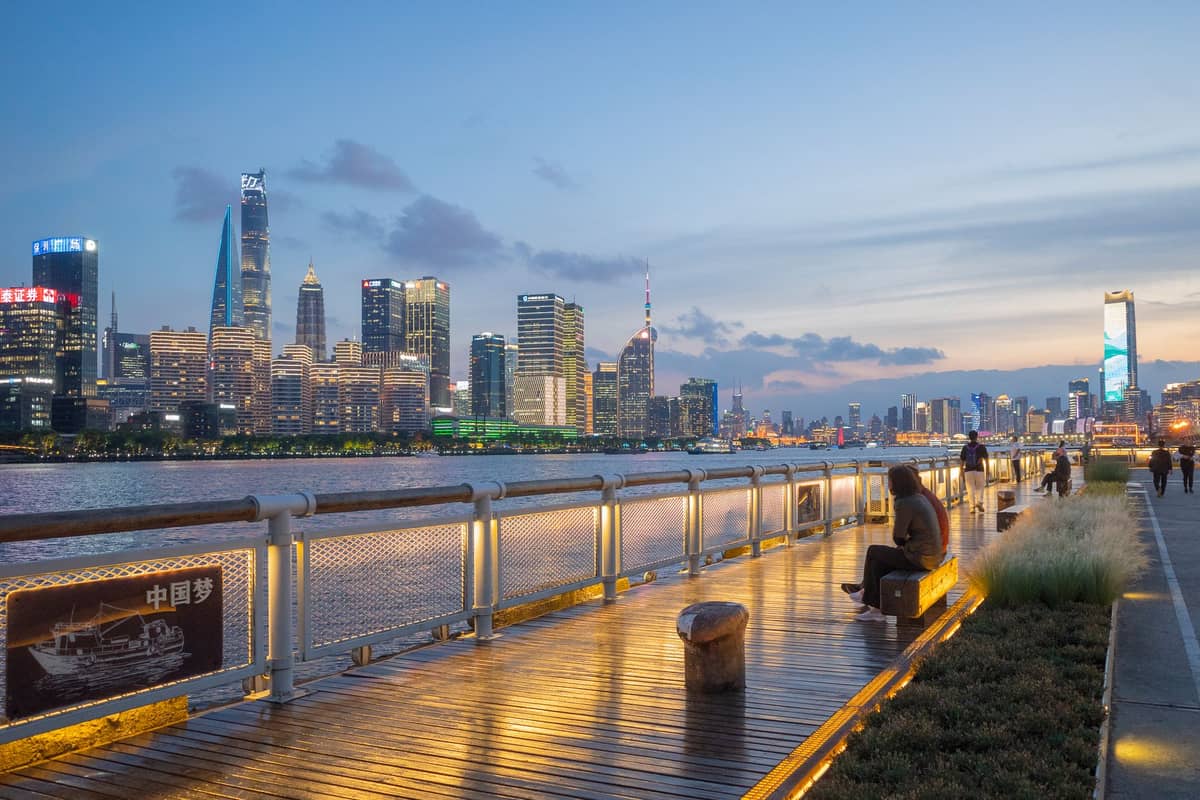
The Lujiazui Riverside Promenade (陆家嘴滨江大道, also called the Lujiazui Riverside Walkway) is a flat, paved public waterfront path running along the west-facing bank of Pudong New Area. Its roughly 2.5 km stretch along Binjiang Avenue puts visitors directly across the Huangpu River from the Bund, Shanghai's colonial-era banking strip. That positioning is the entire point: no fence, no ticket counter, no queue. Just open sky, a wide granite-paved esplanade, and one of the most photographed urban panoramas in Asia directly in front of you.
Behind you as you face the river stands the cluster of towers that defines the modern Lujiazui skyline: the Oriental Pearl Tower with its twin spheres, the tapered needle of the Shanghai Tower (China's tallest building at 632 metres), the bottle-opener profile of the Shanghai World Financial Center, and the pagoda-stepped crown of the Jin Mao Tower. This means you are simultaneously looking at two completely different eras of Shanghai architecture, separated by a few hundred metres of brown river water.
💡 Local tip
If you want the Bund promenade view and the Pudong tower view in one trip, walk the Lujiazui promenade first, then catch a public ferry from the nearby Dongchang Road pier across to the Bund side. The crossing takes just a few minutes and is one of the cheapest river crossings in the city during operating hours.
How the Experience Changes by Time of Day
Early morning, roughly 6:00 to 8:00, is the promenade at its most local. Older residents from the surrounding Pudong residential blocks arrive to walk, practise tai chi on the wider plaza sections, or stand silently at the railing watching the river traffic. Cargo barges move upstream, their foghorns carrying across the water. The light is soft and directional, good for photography without the harsh contrast of midday. Crowds are thin enough that you can stand at the railing and take your time.
Midday is the least rewarding window. The summer sun (June through August, when temperatures regularly exceed 32°C) reflects brutally off the water and the pale stone of the esplanade. There is minimal shade for most of the 1.5 km stretch. If you visit between 11:00 and 14:00 in summer, bring sun protection, carry water, and consider whether the experience is worth it compared to doing it at dusk instead. In spring and autumn, midday is fine.
Sunset and the hour immediately after is when the promenade reaches peak drama. The Bund's neoclassical facades glow amber and then gold as the sun drops behind Puxi. Photography conditions are excellent: the river surface catches the colours, and the Pudong towers begin to light up before the sky has fully darkened, giving you a window where both the architectural detail and the illumination are visible at once. This window, typically 18:00 to 20:00 depending on season, draws the largest crowds of the day. Expect shoulder-to-shoulder density near the most iconic viewpoints by 19:00 on weekends.
After 21:00, the crowds thin significantly. The Bund buildings and the Pudong towers stay illuminated until around 22:00–23:00 on regular nights, longer on public holidays. The promenade at this hour has a calmer, more contemplative feel: couples walking slowly, photographers setting up tripods, the distant sound of pleasure boats on the river. The cooler air makes it genuinely comfortable for much of the year.
⚠️ What to skip
During Shanghai's plum rain season (June to early July) and typhoon-affected weeks (July to September), the promenade can be exposed and wet with little shelter. Check the forecast: if heavy rain is expected, the experience drops sharply. The towers behind you and the ferry dock area offer some cover, but the open riverfront does not.
Tickets & tours
Hand-picked options from our booking partner. Prices are indicative; availability and final rates are confirmed when you complete your booking.
Shanghai city and Zhujiajiao water town private tour with lunch
From 371 €Instant confirmationFree cancellationShanghai private tour with iconic landmarks of the old and new city
From 284 €Instant confirmationFree cancellationShangai Yuyuan Garden entrance tickets
From 9 €Instant confirmationFree cancellation
Historical and Urban Context
Lujiazui was farmland and fishing village into the late 1980s. The transformation began in 1990 when China formally designated Pudong New Area as a Special Economic Zone, and Lujiazui was earmarked as Shanghai's new financial district. Within two decades, the skyline that now appears on virtually every visual representation of modern China had been built from scratch. The promenade was developed as part of the district's public riverfront infrastructure, turning what had been industrial riverbank into accessible public space.
The contrast with the Bund across the water is not accidental. The Bund's buildings date primarily from the 1910s to 1930s, constructed during the era of foreign concessions when Shanghai was divided into British, French, American and other administered zones. Walking the Lujiazui Riverside Promenade while facing those facades makes the city's compressed sense of historical time tangible in a way that no museum exhibit quite replicates. For a deeper look at both riverbanks together, the Huangpu River cruise is worth considering as a complement to the promenade walk.
The Lujiazui financial zone sits within Pudong New Area, a district that also contains Shanghai Pudong International Airport and extends far east of the river. The promenade itself occupies just a narrow strip of this vast district, but it functions as its most public-facing, pedestrian-scale space. Those curious about the broader character of the area can read more in the Pudong neighbourhood guide.
Walking the Promenade: A Practical Route
Exiting Lujiazui Station on Metro Line 2, follow the signs toward the river. The walk from the station takes roughly 10 to 12 minutes through the base of the tower cluster, past the circular Century Avenue intersection. You will smell river air before you see it: a faint mineral-and-mud scent particular to the Huangpu, which is a working river, not a decorative one.
The promenade proper has no official start gate. Most visitors enter at the section closest to the Oriental Pearl Tower, where a small plaza provides the clearest unobstructed sightline to the Bund. From here, you can walk northwest along the waterfront, with the river on your left and the Lujiazui tower cluster gradually shifting position behind you. The texture underfoot is smooth paved stone; there are benches at intervals, and a low railing separates the walkway from the river edge. The surface is flat throughout, which makes it comfortable for most walkers.
The ferry dock for the Bund crossing sits near the southern end of the promenade circuit at Dongchang Road Ferry Pier. If you are combining this walk with time on the Bund side, this is your connection point. Ferries run regularly during daytime hours and on selected evening routes; verify current schedules and fares at the dock, as these change. The crossing itself provides a brief but memorable river-level perspective on both skylines simultaneously.
ℹ️ Good to know
The promenade connects loosely into a longer Pudong riverside walkway that extends beyond Lujiazui in both directions. The 1.5 km Lujiazui section is the most photographed and most visited stretch, but if crowds are heavy, walking further south toward Dongchang Road tends to thin them out.
Photography: What Actually Works Here
The classic shot from the Lujiazui Riverside Promenade frames the Bund's neoclassical roofline across the river with some foreground interest: the railing, a passing boat, another visitor silhouetted against the light. This works best at blue hour, the 20 to 30 minutes after sunset when the sky retains enough colour to balance the artificial lighting. A wide-angle lens between 16mm and 24mm (full frame equivalent) captures the breadth of the Bund panorama without distortion. For the towers behind you, a longer focal length isolates individual structures.
For daytime shots, overcast days produce more even light on the Bund facades than direct sun, which creates harsh shadows in the noon hours. The Lujiazui Riverside Promenade appears in many Shanghai photography guides precisely because the angle from Pudong gives you the full Bund sweep in a single frame; the reverse angle (the Pudong towers from the Bund side) is equally iconic and covered separately in our Bund Promenade guide. If you want to understand why both views appear constantly in Shanghai's visual identity, the best photo spots in Shanghai guide gives useful context.
Tripods are generally tolerated on the promenade, though weekend evenings can get too crowded to set one up without inconveniencing other walkers. Early morning is the realistic window for long-exposure or time-lapse work.
Combining the Promenade with Nearby Attractions
The promenade sits at the base of three of Shanghai's most recognisable towers, each with a paid observation deck. The Shanghai Tower is the tallest and most modern of the three, with a fast elevator and a high-floor observation experience. The Shanghai World Financial Center offers the glass-floor "skywalk" element. The Oriental Pearl Tower is the most visually distinctive from the outside and contains a history museum at its base. All three charge separate admission (approximately ¥120–¥200 per person; verify current prices at each venue before visiting). None of them are part of the free promenade experience.
If you plan to spend more than a half-day in Pudong, the Shanghai History Museum at the base of the Oriental Pearl Tower provides context for much of what you see when looking back across the river at the Bund. Combining the promenade walk with a visit there, plus the ferry crossing to the Bund, makes for a coherent half-day circuit that covers the city's historical and contemporary identities in a single sweep.
Be honest with yourself about tower fatigue. Visiting all three observation decks in a single day is exhausting and expensive, and the marginal difference in view between them is smaller than their marketing suggests. Pick one based on your priorities: height, glass floor, or architectural significance. The promenade below is the one element all three share for free.
Who Should Manage Expectations
The Lujiazui Riverside Promenade is not a place of great subtlety. It is a wide, open concrete-and-stone waterfront path in a financial district. There are no craft markets, no interesting alleyways, no particular food culture along the strip itself. If you are looking for the atmospheric, lived-in Shanghai of older neighbourhoods, lanehouses, and local restaurants, this is the wrong place. The Former French Concession and areas like Tianzifang serve that appetite far better.
Visitors who find large modern financial districts aesthetically uninteresting will feel little connection to the Lujiazui towers behind them. The appeal of this promenade is specifically the view across the water to the Bund, and the ability to stand at river level and feel the scale of the city. If neither of those things matters to you, the 45 minutes is probably better spent elsewhere.
Insider Tips
- Arrive at the promenade between 6:30 and 8:00 on a weekday morning to find it genuinely quiet. Locals do their morning exercises here, and you can claim a prime spot at the railing for unobstructed Bund photos without a crowd.
- The public ferry from the Dongchang Road pier to the Bund side is one of the most underused daytime transitions in the city. It costs around ¥2, takes only a few minutes, and gives you a mid-river perspective on both skylines that no promenade or bridge replicates.
- The illuminated skyline runs until roughly 22:00–23:00 on standard nights but extends later on major Chinese public holidays including National Day Golden Week (early October) and Chinese New Year. If you are visiting during a holiday period, check the specific lighting schedule, as the displays can be more elaborate.
- The section of the promenade directly in front of the Oriental Pearl Tower is the most crowded at all hours. Walk 200–300 metres south toward Dongchang Road and you will find equally good Bund sightlines with noticeably thinner crowds.
- The promenade itself has minimal shade, but the IFC Mall and several commercial complexes on Lujiazui's landward side are useful for air-conditioning breaks in summer, food, and accessible toilets. Plan your entry and exit points around these rather than hoping to find facilities on the riverfront itself.
Who Is Lujiazui Riverside Promenade For?
- First-time visitors to Shanghai who want the canonical city panorama at no cost
- Photographers targeting the Bund skyline from the Pudong side, especially at blue hour
- Couples looking for an evening walk with a dramatic backdrop
- Travellers combining a river-level walk with an observation deck visit to one of the adjacent towers
- Anyone with limited time who wants to understand the city's dual identity, colonial-era Puxi and modern Pudong, in a single 90-minute circuit
Nearby Attractions
Other things to see while in Pudong:
- Century Park
Century Park is the largest ecological urban park in downtown Shanghai, stretching across Pudong's grid of glass towers and wide boulevards. Since May 2024, entry is free and the fences are gone, making it one of the most accessible green spaces in the city. Whether you come at dawn for tai chi or late afternoon for a lakeside stroll, the park rewards visitors who know how to read it.
- China Art Museum
The China Art Museum occupies the striking red former China Pavilion built for Expo 2010, making it one of the most architecturally dramatic museum experiences in Shanghai. Permanent collections are free, the scale is genuinely impressive, and most visitors are surprised by how much is on display across multiple floors.
- Jin Mao Tower
Standing 420.5 metres above Pudong's Lujiazui financial district, Jin Mao Tower is one of Shanghai's most architecturally distinctive skyscrapers. Its 88th-floor observatory delivers panoramic views across the Huangpu River and the historic Bund, while the building's pagoda-inspired silhouette remains one of the most recognisable on the city skyline.
- Oriental Pearl Radio & Television Tower
The Oriental Pearl Tower is the defining landmark of Shanghai's Pudong skyline, a 468-metre structure whose pink-lit spheres have symbolised China's economic transformation since 1994. This guide covers what you actually see at each level, when to go, how much it costs, and whether it's worth your time.