Huangpu River Cruise: Shanghai's Most Cinematic Journey on Water
A cruise on the Huangpu River places you between two of the most photogenic waterfronts on earth: the colonial stone facades of the Bund on one bank and the science-fiction skyline of Lujiazui on the other. Whether you go at midday or after dark, the experience distills Shanghai's split identity into a single, slow-moving panorama.
Quick Facts
- Location
- Shiliupu Tourist Wharf, East Zhongshan Road No.2, Huangpu District, Shanghai (near the southern end of the Bund)
- Getting There
- Metro Lines 2 & 10, East Nanjing Road Station (use Exit 1 or 7), then a 10–15 minute walk south along the Bund waterfront
- Time Needed
- 45–75 minutes on the boat; allow 30 extra minutes for queuing and boarding
- Cost
- Approx. ¥100–150 per person depending on route, duration and time of day (night cruises command higher prices). Verify before visiting.
- Best for
- First-time visitors, photography, couples, families wanting a relaxed overview of Shanghai's skyline
What the Huangpu River Cruise Actually Is
The Huangpu River Cruise, known officially in Chinese as 浦江游览 (Pujiang Cruise) and operated by Shanghai Huangpu River Cruise Company (上海浦江游览有限公司), runs sightseeing boats along the Huangpu River, the historic working waterway that bisects central Shanghai. This is not a dinner-theater cruise or a novelty attraction. It is a serious vantage point for understanding how Shanghai's urban fabric was assembled: a century of European-style banking architecture on the western bank, three decades of record-breaking high-rise construction on the eastern bank, and a river that has been carrying cargo, passengers, and ambition for hundreds of years in between.
Most visitors board at Shiliupu Tourist Wharf, located at approximately 481–551 East Zhongshan Road No.2, Huangpu District. This wharf sits just south of the main Bund promenade, close enough to walk to from the historic waterfront strip but far enough that the crowds thin out noticeably. A second, smaller boarding point at Jinling East Road Pier (141 Zhongshan East 2nd Road) offers a slightly different entry experience with its own ticketing and schedule.
ℹ️ Good to know
Tickets are sold through the official 浦江游览 (Huangpu River Cruise) mini-programs on WeChat and Alipay, and through the Suishenxing transport app. Walk-up tickets are also available at the pier. Prices and departure times should be verified on the day of your visit, as they vary by season and route.
Two Banks, Two Centuries: What You See
As the boat clears the wharf and turns northward, the Bund's neoclassical and Art Deco facades line the western horizon in a long, unbroken parade. These buildings, constructed mostly between the 1900s and 1930s when Shanghai was a treaty port, include the former Hongkong and Shanghai Banking Corporation building (now a Shanghai Pudong Development Bank branch), the Customs House with its distinctive clock tower, and dozens of others that once housed the trading empires of British, French, American, and Japanese firms. Seen from the river, they form the kind of unified streetscape that urban planners today could not deliberately engineer: grand, slightly mismatched, and improbably coherent.
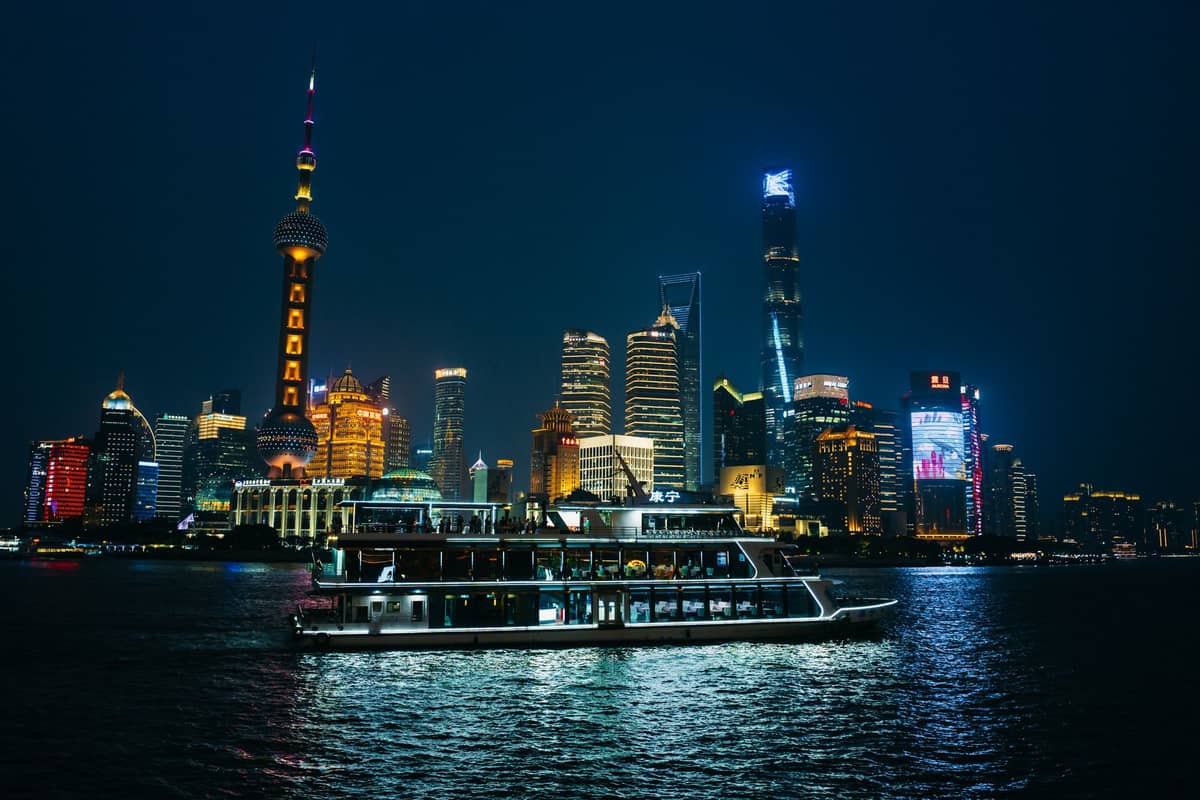
On the eastern bank, the Lujiazui financial district rises without apology. The Oriental Pearl Tower's two pink spheres, the tapered silhouette of the Jin Mao Tower, the bottle-opener profile of the Shanghai World Financial Center, and the twisting mass of Shanghai Tower, currently the world's third-tallest building, cluster within a few hundred meters of each other. Seen from river level, the scale becomes visceral in a way that no rooftop observation deck can replicate. For more on navigating these towers, see the guide to Shanghai Tower and the nearby Lujiazui Riverside Promenade.
Between the two banks, the river itself is busy with working vessels: container barges moving slowly upstream, tugboats, and the cross-river ferries that still carry residents between Puxi and Pudong for just a few yuan. Watching commercial freight traffic share the waterway with tourist cruisers gives a sense of the Huangpu's continued practical importance, not just its postcard value.
Tickets & tours
Hand-picked options from our booking partner. Prices are indicative; availability and final rates are confirmed when you complete your booking.
Shanghai city and Zhujiajiao water town private tour with lunch
From 371 €Instant confirmationFree cancellationShanghai private tour with iconic landmarks of the old and new city
From 284 €Instant confirmationFree cancellationShangai Yuyuan Garden entrance tickets
From 9 €Instant confirmationFree cancellation
Day Versus Night: How the Experience Changes
The daytime cruise, departing roughly from mid-morning onward, offers the clearest views of the Bund's architectural details: the stone carvings above doorways, the layering of classical columns and Art Deco setbacks, the patina on copper roofs. The light is best in the morning before haze builds, and the river traffic is at its most active, giving the journey an industrial energy that the night cruise lacks.
The night cruise is the one most visitors choose, and for good reason. After dark, both banks light up in a coordinated display: the Bund buildings are illuminated with warm, restrained golden lighting that emphasizes their horizontal mass, while the Lujiazui towers shift through synchronized LED displays. The reflections on the river stretch and distort the lights into abstract shapes. Evening departures typically begin around 18:00, aimed squarely at the dusk-to-night window. The most dramatic moment tends to come around 30–40 minutes into the cruise, when the boat turns and both skylines are simultaneously visible.
💡 Local tip
For the night cruise, board at least 20 minutes before your intended departure. Demand is highest on weekends and public holidays, particularly during Golden Week (early May and early October). Arriving at the pier by 18:30 for a 19:00 or 19:30 departure gives you a reasonable buffer.
There is a transitional hour, roughly 17:30 to 19:00 depending on season, when the sky graduates from blue to indigo and the building lights come on before the sky goes fully black. This is arguably the most rewarding window for photographers, capturing both the daytime texture of the buildings and the beginning of the illuminated display in a single frame. This window also tends to be less crowded than the peak late-evening departures.
Practical Walkthrough: Getting There and Boarding
The most straightforward route to Shiliupu Wharf is via Metro Lines 2 or 10 to Nanjing East Road Station. Take Exit 10 and walk south along the Bund waterfront for approximately 15 minutes. The walk itself is part of the experience: you pass the central Bund promenade, the flags outside the former consulates, and the steady flow of visitors photographing the Pudong skyline from the western bank. The pier is signposted in both Chinese and English once you reach the southern section of the waterfront.
Alternatively, if you are already exploring the Bund promenade, the wharf is a natural southern terminus to the walk. You can combine both in a single afternoon and evening without backtracking.
At the pier, tickets for standard sightseeing cruises (the 45-minute route is the most common) are priced at approximately ¥120–150 for night departures and slightly lower for daytime slots, with premium routes reaching around ¥150. Prices and routes change seasonally, so treat these figures as a reasonable baseline and verify at the window or through the official WeChat mini-program before visiting. Payment by Alipay or WeChat Pay is easiest; some booths accept cash.
The boats themselves are multi-deck vessels with both indoor and outdoor viewing areas. The outdoor upper deck is where you want to be for photography and for the full sensory experience: the smell of the river, the low engine hum, the occasional blast from a passing cargo barge. On colder evenings (Shanghai winters can drop to around 4–7°C), the enclosed lower deck with its large windows is a reasonable alternative, though condensation can affect photography.
Photography: Where to Stand and What to Expect
Bring a camera or phone with a reliable low-light mode for night cruises. The boat moves at a steady, moderate pace, but the combination of vibration, low light, and distant subjects means that optical image stabilization makes a real difference. A lens or camera setting equivalent to 24–70mm covers most useful compositions. Wide angle captures the full skyline panoramas; a slightly longer focal length compresses the Lujiazui towers into a denser cluster.
For static shots of the Bund and Lujiazui from land rather than water, the best photo spots in Shanghai guide covers the prime waterfront positions, rooftop bars, and elevated viewpoints that complement what the cruise offers.
The port (left) side of the boat faces the Bund for most of the northward journey; the starboard (right) side faces Pudong. If you are prioritizing one skyline, position yourself accordingly before departure. Most visitors shuffle between sides, which works fine on a boat with open deck space.
Honest Assessment: Is It Worth It?
The Huangpu River Cruise earns its place on a Shanghai itinerary because it offers a perspective that no land-based viewpoint replicates: you see both skylines simultaneously, from water level, in motion. The Oriental Pearl Tower looks very different from the river than it does from the top of the Shanghai Tower, and the Bund's classical facades read as a coherent architectural ensemble when viewed from across the water in a way they simply do not from the sidewalk.
That said, it is not a substitute for spending time on the Bund itself, and it does not replace the aerial perspective you get from a tower observation deck. Think of it as the third point of a triangle: the Bund at street level, an observation deck like that of the Shanghai World Financial Center, and the river cruise together give a genuinely complete reading of the city's two-bank geography.
Visitors who find boat journeys tedious, or who have very limited mobility (accessibility details for ramps and gangways are not published in detail by the operator, so check directly before visiting), may find the 45-minute return cruise less rewarding than expected. The boat does not stop anywhere along the route. If you become seasick easily, note that the Huangpu is a river, not open sea, and the motion is gentle, but it is not entirely still.
⚠️ What to skip
Avoid the cruise during typhoon season (July to September) if a storm warning is active. Operators cancel or curtail services during weather alerts. The meiyu rainy season in June to early July can also bring low visibility and heavy rain that significantly diminishes the experience on the open deck.
Before and After: Combining the Cruise with Nearby Attractions
The area around Shiliupu Wharf connects naturally to several of Shanghai's most significant sites. To the north, the Bund promenade leads toward Rockbund Art Museum and the heritage buildings of the North Bund. Heading slightly inland from the pier, Yuyuan Bazaar and the adjacent Yu Garden are within a 10–15 minute walk, making a full day's itinerary easy to construct without needing to cross the city.
If you are arriving at the wharf in the late afternoon with time to spare before the evening cruise, the southern Bund area has several outdoor terraces and waterfront cafes where you can watch the river traffic and the light change over Pudong. This transitional period, sitting at the water's edge as the towers begin to glow, is one of the more quietly satisfying experiences the Bund neighborhood offers.
Insider Tips
- Book through the official 浦江游览 WeChat or Alipay mini-program to secure a specific departure time on busy weekends. Walk-up tickets are available but popular evening slots fill up during peak seasons and public holidays.
- Shiliupu Pier 2 (No. 551 East Zhongshan Road No.2) opens only from 17:00 and caters specifically to evening cruises. If you want the dusk-to-night window, this is the better pier to head for, as it tends to feel slightly less chaotic than Pier 1 at peak times.
- The upper open deck fills quickly. Board as soon as the gangway opens and move immediately to the bow or upper rear deck for unobstructed views. The middle sections fill with tour groups who tend to station themselves along the railings and stay put.
- Autumn, specifically October and November, offers some of the best cruise conditions: mild temperatures (15–22°C), lower humidity than summer, and cleaner air than the muggy July-August period. Spring (April–May) is a close second.
- Warm layers matter for evening cruises even in late spring and early autumn. River wind at boat speed drops the perceived temperature noticeably. A light jacket is useful from March through May and again from September onward.
Who Is Huangpu River Cruise For?
- First-time visitors to Shanghai who want a single experience that contextualizes the whole city
- Architecture and photography enthusiasts wanting to capture both skylines from water level
- Couples looking for a relaxed evening activity with a dramatic backdrop
- Families with children, who tend to enjoy the novelty of the boat and the spectacle of the lit-up skyline
- Travelers with only one or two days in Shanghai who need to cover maximum ground efficiently
Nearby Attractions
Other things to see while in The Bund:
- Rockbund Art Museum
Housed in the former Royal Asiatic Society building completed in 1933, Rockbund Art Museum brings serious contemporary art to one of Shanghai's most storied streets. From rotating exhibitions across multiple floors to a sixth-floor café with views toward the Huangpu River, it rewards visitors who want more than a walk along the waterfront.
- The Bund Promenade
The Bund Promenade stretches 1.5 kilometres along the Huangpu River in central Shanghai, placing you between two of the world's most dramatic skylines: a row of early-20th-century colonial financial buildings on one side, and the glass-and-steel towers of Lujiazui on the other. Entry is free, access is around the clock, and no ticket or reservation is needed.