Yuyuan Bazaar (豫园商城): Shanghai's Old Town Marketplace Explained
Yuyuan Bazaar is the sprawling commercial precinct surrounding Yu Garden and the City God Temple in Shanghai's Old Town district of Huangpu. Part traditional marketplace, part tourist hub, it rewards visitors who know how to navigate it — and frustrates those who don't.
Quick Facts
- Location
- No. 265 Middle Fangbang Road, Huangpu District, Shanghai (Old Town / Nanshi)
- Getting There
- Metro Lines 10 and 14, Yuyuan Garden Station — then a short walk east into the bazaar
- Time Needed
- 1.5 to 3 hours for the bazaar; add another 1–2 hours if visiting Yu Garden
- Cost
- Bazaar precinct: free to enter. Yu Garden (adjacent, ticketed): approx. ¥40 peak season, ¥30 off-season — verify before visiting
- Best for
- Snacking on traditional Shanghai street food, souvenir shopping, and pairing with a visit to Yu Garden or the City God Temple
What Yuyuan Bazaar Actually Is
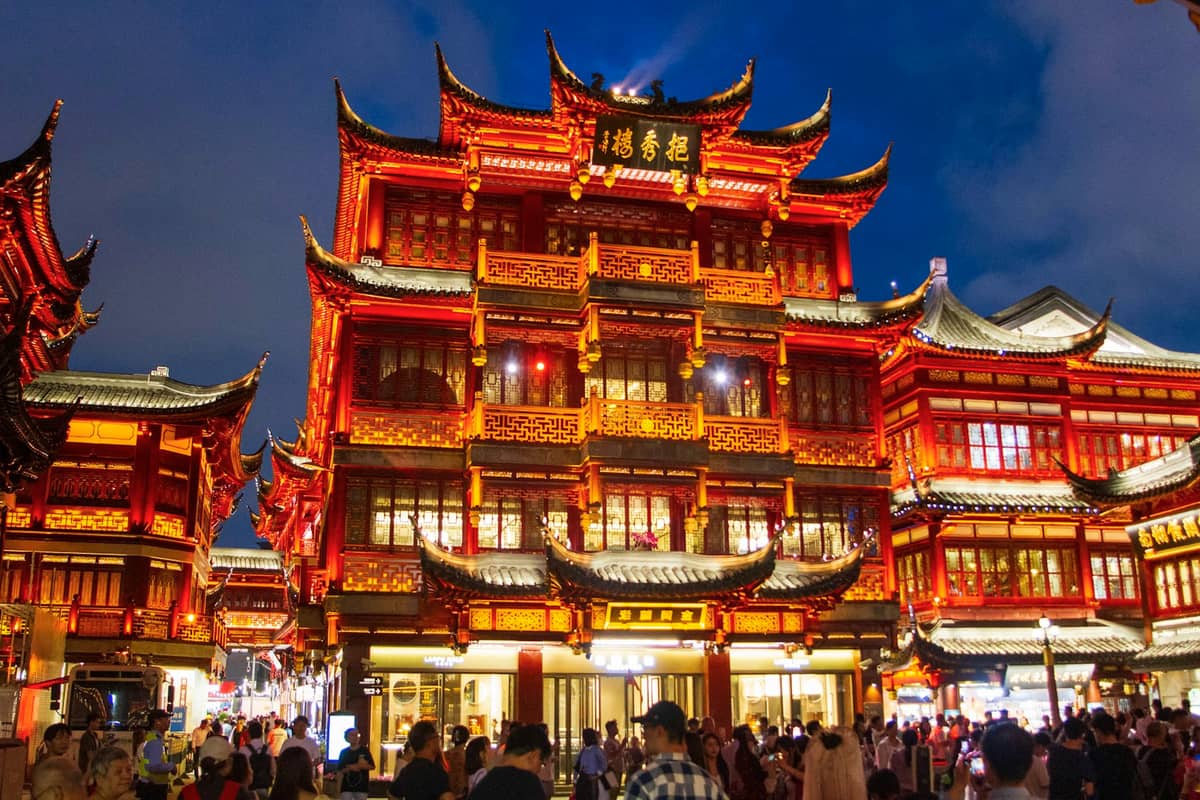
Yuyuan Bazaar (豫园商城) is not a single building or a covered market. It is an open commercial district in Shanghai's Huangpu district — a dense cluster of traditional-style shophouses, food stalls, souvenir outlets, tea houses, and restaurants that wrap around Yu Garden and the City God Temple. The architecture borrows from the classical Chinese style: upturned rooflines, whitewashed walls, red lanterns, and zigzag bridges over lotus ponds. From street level, the effect is genuinely atmospheric, especially before the crowds arrive.
The bazaar predates its current tourist-commercial format by centuries. The area grew organically as a marketplace serving pilgrims visiting the City God Temple (Chenghuang Miao) and wealthy visitors touring Yu Garden, which was originally constructed as a private garden during the Ming dynasty in the 16th century. As tourism expanded over the following centuries, the surrounding lanes filled with vendors, herbalists, craftspeople, and food sellers. Today's precinct is a more polished version of that tradition, with some blocks catering almost entirely to tourists and others still serving daily local life.
ℹ️ Good to know
The bazaar precinct itself is open 24 hours and free to enter. Yu Garden (the classical garden inside) is a separate ticketed attraction with its own opening hours — typically 09:00–16:30, last entry 16:00, closed most Mondays except statutory holidays. Always verify current hours before visiting.
How the Experience Changes Throughout the Day
The difference between arriving at 08:30 and arriving at 12:00 is significant. Early morning, before 09:00, the bazaar is cool and relatively quiet. The smell of frying sesame balls (jian dui) and soup dumpling steam drifts from the food stalls that open earliest. Shopkeepers sweep their entrances. The stone paving of the main pedestrian lanes is damp and clean. Older locals practice tai chi near the pond. This is when the architectural character of the precinct is easiest to appreciate without being jostled.
By mid-morning, particularly on weekends and public holidays, the main lanes fill rapidly. The Nine-Turn Bridge (Jiuqu Bridge) over the central pond — the distinctive zigzag stone walkway leading to the Huxinting Teahouse — becomes a bottleneck. Photography becomes difficult because of the sheer number of people in frame. Noise levels rise sharply: the recorded promotional calls from shops, the smell of incense from the temple precinct, and the general press of a dense crowd combine into something that some visitors find exhilarating and others exhausting.
Late afternoon, from around 16:00, brings a second wave as Yu Garden closes and visitors spill back into the bazaar. Evenings, particularly on weekends, are popular because the red lanterns illuminate the rooflines and the whole precinct softens into something more photogenic. If you are focused on atmosphere rather than shopping, evening is worth considering.
💡 Local tip
Visit on a weekday morning for the most manageable crowd levels. Public holidays — especially Chinese New Year, National Day Golden Week (first week of October), and the Mid-Autumn Festival — draw enormous crowds and should be treated as a different experience entirely.
Tickets & tours
Hand-picked options from our booking partner. Prices are indicative; availability and final rates are confirmed when you complete your booking.
Shangai Yuyuan Garden entrance tickets
From 9 €Instant confirmationFree cancellationShanghai city and Zhujiajiao water town private tour with lunch
From 371 €Instant confirmationFree cancellationShanghai private tour with iconic landmarks of the old and new city
From 284 €Instant confirmationFree cancellation
The Food: What Is Worth Eating
The food at Yuyuan Bazaar is one of its genuine strengths, provided you focus on the right stalls. The most iconic item is the xiaolongbao (soup dumplings) from Nanxiang Steamed Bun Restaurant (南翔馒头店), which has occupied a traditional building overlooking the central pond for over a century. Queues form early and rarely disappear before closing time. The dumplings themselves are thin-skinned, generously filled with pork and hot soup, and noticeably different from the versions served at most generic dumpling shops. Eating them at the upstairs window table, looking out over the zigzag bridge and pond, is one of the more satisfying experiences the bazaar offers.
Beyond soup dumplings, look for stalls selling fried sesame balls, glutinous rice cakes, crab shell pastries (xie ke huang), and tanghulu (candied fruit skewers). The soup dumpling tradition in Shanghai runs deep, and the bazaar is one of the better places to sample it alongside other traditional Shanghainese snacks in one concentrated area.
A note on pricing: food here costs more than at neighborhood restaurants elsewhere in the city. That is the trade-off for location. Sit-down restaurants inside the bazaar are significantly more expensive than the street stalls, and quality at the mid-range restaurant tier is inconsistent. The sweet spot is the dedicated snack stalls and the long-established institutions like Nanxiang.
Shopping: What to Buy and What to Ignore
The bazaar is divided, unofficially, into a tourist-facing retail layer and a more specialized craft and antiques layer. The dominant tier sells what you will find in gift shops across China: printed fans, calligraphy brushes, silk scarves, jade figurines of varying quality, lacquerware boxes, and mass-produced Ming-style furniture. These items are not necessarily bad, but the price-to-quality ratio depends entirely on your ability to assess the goods and negotiate.
The more interesting shopping is in the antiques and curio market section, particularly around Fangbang Middle Road and the Old Street (Shanghai Old Street / 上海老街), which runs along the southern edge of the bazaar area. Here you will find old coins, Mao-era memorabilia, ceramic shards, vintage propaganda prints, pocket watches, and assorted curiosities of doubtful but entertaining provenance. Real antiques exist alongside fakes, and the line is rarely clear. Treat it as browsing, not investment.
For a broader picture of where Yuyuan Bazaar fits within Shanghai's shopping landscape, the Shanghai shopping guide covers the city's full range of markets and retail districts.
Yu Garden and the City God Temple: What to Add to Your Visit
Yu Garden (豫园) is the classical Chinese garden at the center of the precinct, and it deserves separate consideration from the bazaar. Built beginning in 1559 during the Ming dynasty by Pan Yunduan as a private retreat for his father, the garden occupies around 20,000 square meters and contains ornamental rockeries, pavilions, koi ponds, covered walkways, and sculpted walls. The Grand Rockery (Dajiashan) is the standout feature — a structure of huangshi stone roughly 12 meters high that took three years to build. Yu Garden was damaged during the Small Swords Society Uprising in the 1850s and later restored; the current form reflects a combination of original Ming design and later restorations.
Admission to Yu Garden is separate from the bazaar. Ticket prices (approximate, verify before visiting): around ¥40 per adult during peak season (April–June, September–November) and ¥30 during off-season (July–August, December–March). Children under 130 cm or under six enter free; seniors over 60 and students receive approximately half-price. For full context on the garden itself, see the dedicated Yu Garden attraction guide.
The City God Temple (Chenghuang Miao) is the functioning Taoist temple within the bazaar compound. Entry requires a separate ticket. The temple is actively used for religious observance, and the smell of incense is constant and heavy — pleasant for some visitors, overpowering for others. It fits naturally into the broader landscape of Shanghai's temples and offers a grounding counterpoint to the commercial activity surrounding it.
Getting There, Accessibility, and Practical Notes
The standard approach is Metro Line 10 to Yuyuan Garden Station. From the station, the bazaar's distinctive upturned rooflines are visible within a few minutes' walk heading east. The walk from People's Square (roughly 1.5 km south) is also manageable and passes through the Old Town grid, giving useful context for the surrounding neighborhood.
Accessibility within the bazaar is limited in places. The main lanes are paved and generally flat, but the zigzag bridges have steps, some of the older lanes have raised thresholds, and the interior of Yu Garden features uneven stone paths, stairs, and rockery terrain that is difficult for visitors with mobility limitations. The busiest sections, particularly around the central pond and the Nanxiang queue, are not practical for wheelchair users during peak hours.
The currency is Chinese yuan (CNY/RMB). Mobile payments via Alipay and WeChat Pay are the dominant payment method at most stalls; some vendors accept cash, fewer accept international cards directly. Having either a local mobile payment method set up or sufficient cash (¥100 in small notes) is advisable.
⚠️ What to skip
The bazaar is one of the more heavily touristed areas of Shanghai, which makes it a target for common tourist scams: aggressive tea ceremony invitations, 'art student' approaches, and overpriced goods sold without marked prices. Agree on prices before ordering or purchasing anything from unlicensed vendors. For more on staying safe, the Shanghai scams and safety guide covers the key patterns to recognize.
Who Will Love This, and Who Should Reconsider
Yuyuan Bazaar works well for first-time visitors to Shanghai who want a concentrated introduction to traditional architecture, street food, and crafts in one walkable area. It pairs naturally with Yu Garden and the City God Temple into a half-day itinerary that covers a genuine slice of Old Town history. Visitors traveling with children generally find it engaging: the food stalls are approachable, the koi pond is a draw, and the architecture is distinctive enough to prompt curiosity.
Visitors who have already explored similar precinct-style markets in other Chinese cities — Chengdu's Jinli, Chongqing's Ciqikou — may find Yuyuan familiar territory. The formula is consistent. That said, the historical depth here, anchored by a genuinely significant Ming dynasty garden and an active Taoist temple, gives it more substance than many comparable precincts. If authenticity in commercial settings matters to you, managing expectations is key: the bazaar is curated, polished, and in places explicitly designed for tourists. It is not a living neighborhood market in the way that the surrounding Old Town side streets still are. For a deeper sense of Shanghai's layered urban fabric, the less-visited corners of Shanghai offer a useful contrast.
Visitors with limited time who are choosing between this and other major Shanghai experiences should note: Yuyuan Bazaar without Yu Garden is a shopping and eating experience with good atmosphere. Yuyuan Bazaar with Yu Garden is a more rounded cultural half-day. The combination is the better version of the visit.
Insider Tips
- The Nanxiang Steamed Bun Restaurant has a takeaway window on the ground floor with shorter waits than the sit-down queue. If you are comfortable eating xiaolongbao standing up near the pond, this saves 20–40 minutes.
- The zigzag bridge photographs best in early morning light (around 07:30–09:00) when the pond surface is still and there are few people on the bridge. By 10:00 on any weekend, getting a clean shot is nearly impossible.
- Shanghai Old Street (上海老街), running along Fangbang Middle Road just south of the main bazaar, is quieter and has a higher density of antiques stalls and older-format shops compared to the central tourist lanes. It is easy to miss but worth the five-minute detour.
- During Chinese New Year, the bazaar installs elaborate lantern displays and the crowds reach a different scale entirely. It is spectacular but intense — expect significant queues for any food vendor and plan an extra 30–60 minutes for everything.
- Yu Garden tickets can be purchased via Chinese ticketing platforms; if you are visiting with a group or during peak season, booking in advance avoids the on-site queue at the garden entrance.
Who Is Yuyuan Bazaar For?
- First-time visitors to Shanghai wanting traditional architecture and street food in one area
- Travelers pairing a Yu Garden visit with a broader Old Town walk
- Food-focused visitors seeking classic Shanghai snacks like xiaolongbao, sesame balls, and glutinous rice cakes
- Casual shoppers interested in souvenirs, crafts, or antique browsing without a specific buying agenda
- Visitors with children who want something visually engaging and snack-friendly
Nearby Attractions
Other things to see while in Old Town (Nanshi):
- City God Temple of Shanghai
The City God Temple of Shanghai (上海城隍庙) is an active Taoist temple at the center of the Old City's historic bazaar district. Part religious sanctuary, part cultural landmark, it offers a rare window into Shanghai's spiritual and mercantile past, just steps from Yu Garden.
- Confucian Temple (Wen Miao)
Tucked into a narrow pedestrian lane in Shanghai's old town, the Confucian Temple (Wen Miao) is the city's only surviving ancient architectural complex dedicated to Confucius. With ¥10 admission, a Sunday book market, and traditional courtyards that feel a world away from the metropolis outside, it rewards visitors who seek context over spectacle. With ¥10 admission, a Sunday book market, and traditional courtyards that feel a world away from the metropolis outside, it rewards visitors who seek context over spectacle.
- Yu Garden (Yuyuan Garden)
Built in 1559 during the Ming dynasty, Yu Garden is Shanghai's most celebrated classical Chinese garden. Spanning 2 hectares in the heart of the Old Town, it draws visitors with ornate rockeries, dragon-topped walls, lotus ponds, and more than 30 pavilions and halls. Understanding when to go and what to expect makes the difference between a rewarding experience and an overcrowded one.