Shanghai Confucian Temple (Wen Miao): The Old City's Quietest Historic Escape
Tucked into a narrow pedestrian lane in Shanghai's old town, the Confucian Temple (Wen Miao) is the city's only surviving ancient architectural complex dedicated to Confucius. With ¥10 admission, a Sunday book market, and traditional courtyards that feel a world away from the metropolis outside, it rewards visitors who seek context over spectacle. With ¥10 admission, a Sunday book market, and traditional courtyards that feel a world away from the metropolis outside, it rewards visitors who seek context over spectacle.
Quick Facts
- Location
- 215 Wenmiao Road, Huangpu District (Old Town / Nanshi)
- Getting There
- Laoximen Station (Metro Lines 8 & 10), then a short walk
- Time Needed
- 45–90 minutes (longer on Sundays with the book market)
- Cost
- ¥10 standard admission; discounts for students and elderly
- Best for
- History enthusiasts, solo travelers, Sunday morning book hunters
What Is the Confucian Temple (Wen Miao)?
The Shanghai Confucian Temple, known in Chinese as 上海文庙 (Wen Miao), is the only surviving ancient architectural complex in downtown Shanghai dedicated to Confucius. While the city's skyline has been remade entirely in the past century, this walled compound on Wenmiao Road preserves a cluster of traditional halls, moon gates, and stone-paved courtyards that date the site's origins to the imperial examination system era. It is a working cultural monument, not a reconstruction, and that distinction matters. While the city's skyline has been remade entirely in the past century, this walled compound on Wenmiao Road preserves a cluster of traditional halls, moon gates, and stone-paved courtyards that date the site's origins to the imperial examination system era. It is a working cultural monument, not a reconstruction, and that distinction matters.
The temple sits in Huangpu District within what locals still call the old city or Nanshi, the area that was once enclosed by the circular city walls of old Shanghai. Historical records indicate the temple site was relocated several times before settling at its current Wenmiao Road address, a reminder that even Shanghai's most venerable institutions have had to adapt to an ever-shifting urban landscape. Historical records indicate the temple site was relocated several times before settling at its current Wenmiao Road address, a reminder that even Shanghai's most venerable institutions have had to adapt to an ever-shifting urban landscape.
ℹ️ Good to know
Opening hours: 09:00–17:00 daily (doors reportedly open earlier on Sundays, around 07:30, for the book market). Admission is ¥10. Verify exact hours locally before visiting, as minor discrepancies appear across sources.
Arriving at Wenmiao Road
Getting here is part of the experience. From Laoximen Station on Metro Lines 8 and 10, the walk to the temple is a short one through a low-rise residential pocket of the old city. The streets narrow noticeably as you approach, lined with small provision shops and elderly residents playing chess on collapsible stools. The contrast with the glass towers visible on the horizon is immediate and striking. The streets narrow noticeably as you approach, lined with small provision shops and elderly residents playing chess on collapsible stools. The contrast with the glass towers visible on the horizon is immediate and striking.
Wenmiao Road itself is a narrow pedestrian lane. Taxis and ride-hailing cars drop passengers at the street's entrance, so budget a short walk regardless of how you arrive. The lane smells faintly of incense even before you reach the temple gate, carried out through the main entrance on still mornings.
If you are planning a broader exploration of the area, the temple pairs naturally with a walk through Shanghai's Old Town (Nanshi), where the layered textures of pre-modern Shanghai are still legible in the street grid and building scale.
Tickets & tours
Hand-picked options from our booking partner. Prices are indicative; availability and final rates are confirmed when you complete your booking.
Shanghai city and Zhujiajiao water town private tour with lunch
From 371 €Instant confirmationFree cancellationShanghai private tour with iconic landmarks of the old and new city
From 284 €Instant confirmationFree cancellationShangai Yuyuan Garden entrance tickets
From 9 €Instant confirmationFree cancellation
Inside the Compound: What You Actually See
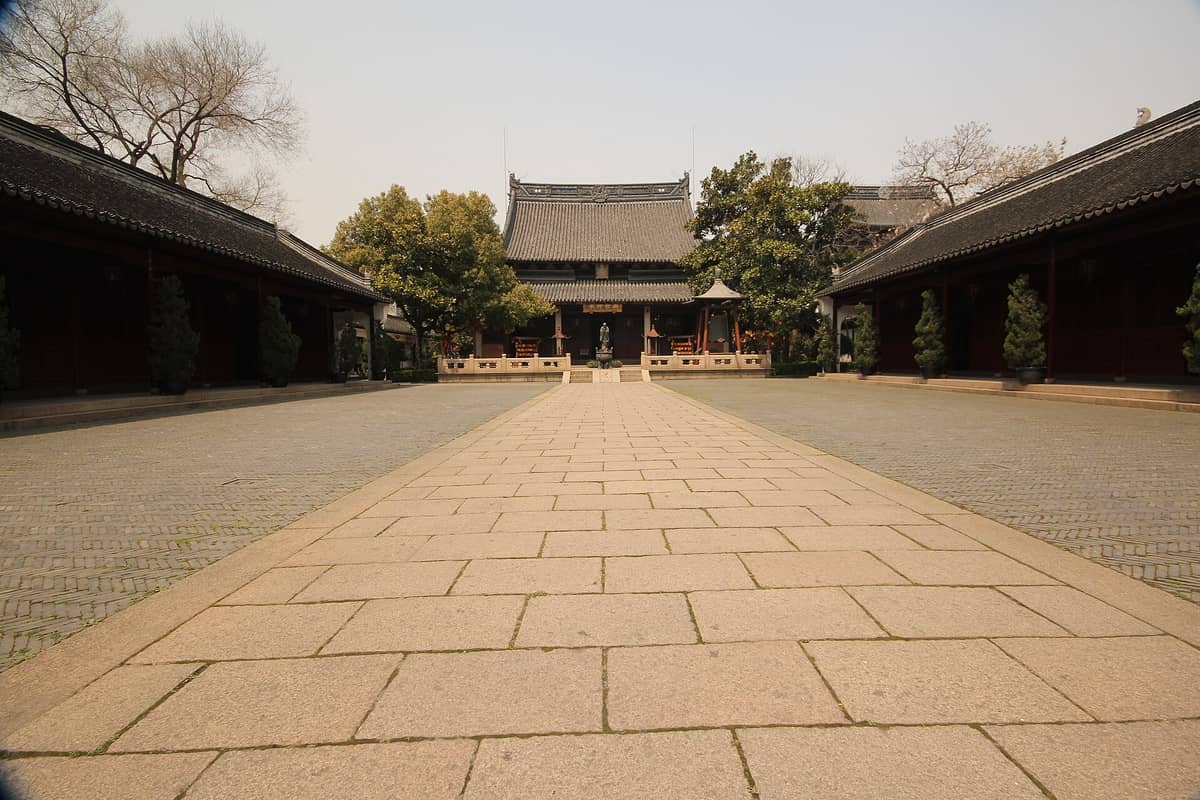
Passing through the ticket booth at the main gate, the noise of the street cuts off quickly. The compound is organized around a series of courtyards connected by covered walkways and moon gates. The central Dacheng Hall is the architectural centerpiece: a multi-tiered timber structure with upturned roof eaves and large stone plaques bearing classical inscriptions. The building's proportions are deliberately imposing, a reflection of the elevated civic status Confucian learning held in imperial China.
A large pond occupies the central courtyard, its surface covered in lotus pads during summer months. The reflection of the Dacheng Hall in the water on a clear morning is one of the more composed visual moments in this part of the city. Stone bridges cross the pond at two points, and the surrounding walkways frame the hall from different angles as you move through the space.
Secondary halls and galleries display rotating exhibitions relating to Confucian thought, traditional Chinese education culture, and local history. The quality and depth of these displays vary, and the explanatory text is predominantly in Chinese with limited English labeling. Visitors without Mandarin reading ability will still appreciate the architectural setting, but will absorb less of the interpretive content.
💡 Local tip
Photography tip: The best light falls on the Dacheng Hall facade in the morning, roughly between 09:30 and 11:00. By midday the courtyard is in flat overhead light. The pond reflection works best on windless days.
The Sunday Book Market: The Real Reason Many Locals Come
On Sunday mornings, the Confucian Temple hosts an open-air book market that transforms the character of the visit entirely. Vendors spread out second-hand books, old magazines, vintage maps, calligraphy scrolls, stamps, coins, and cultural ephemera across folding tables in the outer courtyards and along the approach lane. The market opens early, and the most committed collectors arrive before 08:00.
This is predominantly a local affair. Retired men in particular are the dominant demographic, digging through boxes of Cultural Revolution-era publications, Republican-period postcards, and dog-eared technical manuals. The atmosphere is quiet and focused, more like a reading room than a flea market. For visitors with an interest in printed matter, Sinology, or simply in watching a slice of Shanghai's intellectual culture, this Sunday market is the temple's most distinctive offering.
Bargaining is standard at book stalls but should be approached respectfully. Sellers are generally not aggressive, and low-ball offers on items clearly valued by the vendor will be declined without drama. Cash in small denominations is useful, though many vendors also accept WeChat Pay.
💡 Local tip
If the book market is your primary reason for visiting, arrive by 09:00 at the latest. By 11:30, foot traffic thickens and the best stalls have often sold their most interesting stock.
Historical and Cultural Context
Confucian temples (Wen Miao, literally 'Temple of Culture') served a dual civic and ritual function in imperial China. They were not places of congregational worship in the way Buddhist or Taoist temples were, but rather sites where local officials performed rites honoring Confucius and where the ideological foundations of the examination system were made material. Passing the imperial examinations was the primary path to administrative power, and the temple complex was architecturally designed to impress that weight upon students preparing for their exams.
Shanghai's temple is modest in scale compared to the great Confucian temples of Qufu or Beijing, but its survival in the center of one of the world's most densely redeveloped cities gives it an importance that transcends its physical size. For visitors tracing the city's pre-modern roots, a visit to Wen Miao fits logically alongside the nearby City God Temple and the surrounding Yu Garden complex, which together form the most concentrated layer of historic Shanghai still accessible to the public.
The surrounding old city is also covered in our Shanghai architecture guide, which places Wen Miao within the broader story of how the city's built fabric has changed across different eras.
How the Experience Changes by Time of Day
Weekday mornings before 10:30 are the calmest window for visiting. The courtyards are quiet enough that you can hear birds in the trees flanking the central pond. An older caretaker can often be seen sweeping the stone paths with a long-handled broom, and the temple's resident cats, a common presence in Chinese temple complexes, are still active rather than asleep in patches of shade.
By late morning on weekends and during Chinese public holidays, the compound fills with tour groups and families, and the lanes between halls become congested enough to interrupt the sense of calm. Afternoons are warmer and louder in summer. The temple is not large enough to absorb heavy crowds gracefully, and on those occasions the experience diminishes noticeably.
Winter visits have their own character. The bare branches above the courtyard pond, the muted stone palette, and the relative emptiness of the complex in January and February give the architecture more presence. Cold morning air sharpens the smell of incense from nearby vendors. If you visit Shanghai during the cooler months, this is an attraction that genuinely improves in low season.
⚠️ What to skip
During major public holidays (Golden Week in October, Chinese New Year in January/February), the surrounding Nanshi area becomes heavily congested. The temple itself may be crowded and the approach lane difficult to navigate. Budget extra time or adjust your schedule.
Practical Notes for Your Visit
The temple grounds feature traditional stone and brick flooring, steps between courtyard levels, and no elevator access to upper gallery areas. Visitors with mobility limitations should note that detailed accessibility information is not published by the temple, and the physical layout of a traditional Chinese courtyard complex typically includes uneven surfaces and raised thresholds at doorways. Comfortable flat shoes are advisable regardless.
Dress modestly as a matter of respect, though there is no enforced dress code. The ¥10 admission covers the full compound. Student and elderly discounts apply with valid ID. Payment methods should be checked locally before visiting.
Getting around the broader old town area efficiently is covered in our guide to getting around Shanghai. Metro Lines 8 and 10 at Laoximen Station remain the simplest approach from most central districts.
An Honest Assessment: Who This Suits and Who It Doesn't
Wen Miao is a small, low-key site. Visitors expecting the scale of major Chinese temple complexes, dramatic ritual activity, or richly curated bilingual exhibitions will likely feel the experience is thin. The temple's interpretive infrastructure is modest, and without background knowledge of Confucian history or the ability to read Chinese, the secondary halls offer limited engagement.
Travelers drawn to texture over spectacle, those who want to understand how the city looked and functioned before the twentieth century remade it, and anyone visiting on a Sunday with an appetite for the book market will find the temple genuinely worthwhile. At ¥10, the stakes are low enough that even a brief 45-minute visit leaves no sense of having wasted the trip.
For a fuller picture of what Shanghai's slower, older neighborhoods have to offer, the hidden gems guide covers several sites in this part of the city that share Wen Miao's unhurried character.
Insider Tips
- Sunday is the best day to visit, but arrive before 09:00 if the book market is your main draw. By 10:30 the most interesting stalls are picked over and foot traffic makes browsing less enjoyable.
- The temple's cats tend to congregate near the eastern side of the central courtyard in the morning. If you are traveling with children, this is a reliable source of entertainment between the halls.
- Wenmiao Road itself has a handful of small shops selling old coins, paper cuttings, and traditional stationery. These are worth browsing before or after the temple, and prices are generally lower than at tourist markets elsewhere in the city.
- If you want to combine the temple with a wider loop of the old city, walk south from Laoximen Station before entering the temple, then head east afterward toward Yu Garden and the City God Temple. The full circuit takes about three hours at a relaxed pace.
- English signage inside the compound is limited. Download a translation app before visiting, or use your phone camera's live translation function to get the gist of exhibition labels and inscriptions.
Who Is Confucian Temple (Wen Miao) For?
- History and culture travelers who want context on pre-modern Shanghai beyond the Treaty Port era
- Solo travelers looking for a calm, inexpensive morning visit away from tourist crowds
- Book collectors and Sinophiles drawn by the Sunday second-hand market
- Architecture enthusiasts interested in traditional Chinese courtyard design surviving within a modern megacity
- Travelers combining old-city sights into a half-day Nanshi walking itinerary
Nearby Attractions
Other things to see while in Old Town (Nanshi):
- City God Temple of Shanghai
The City God Temple of Shanghai (上海城隍庙) is an active Taoist temple at the center of the Old City's historic bazaar district. Part religious sanctuary, part cultural landmark, it offers a rare window into Shanghai's spiritual and mercantile past, just steps from Yu Garden.
- Yu Garden (Yuyuan Garden)
Built in 1559 during the Ming dynasty, Yu Garden is Shanghai's most celebrated classical Chinese garden. Spanning 2 hectares in the heart of the Old Town, it draws visitors with ornate rockeries, dragon-topped walls, lotus ponds, and more than 30 pavilions and halls. Understanding when to go and what to expect makes the difference between a rewarding experience and an overcrowded one.
- Yuyuan Bazaar
Yuyuan Bazaar is the sprawling commercial precinct surrounding Yu Garden and the City God Temple in Shanghai's Old Town district of Huangpu. Part traditional marketplace, part tourist hub, it rewards visitors who know how to navigate it — and frustrates those who don't.