Century Park Shanghai: Pudong's Green Lung, Now Free and Open Around the Clock
Century Park is the largest ecological urban park in downtown Shanghai, stretching across Pudong's grid of glass towers and wide boulevards. Since May 2024, entry is free and the fences are gone, making it one of the most accessible green spaces in the city. Whether you come at dawn for tai chi or late afternoon for a lakeside stroll, the park rewards visitors who know how to read it.
Quick Facts
- Location
- 1001 Jinxiu Road, Pudong New Area, Shanghai
- Getting There
- Century Park Station (Line 2, Exit 1) or Huamu Road Station (Line 7, Exit S)
- Time Needed
- 1.5 to 3 hours
- Cost
- Free (since 2021; 24-hour opening from 1 May 2024)
- Best for
- Morning walkers, families, cyclists, and anyone needing a break from Pudong's concrete pace
- Official website
- http://www.centurypark.com.cn
What Century Park Actually Is
Century Park, known in Chinese as 世纪公园 (Shìjì Gōngyuán), is one of the largest urban parks in Shanghai, located in the Pudong New Area at 1001 Jinxiu Road. Rated a national 4A-level tourist attraction, it was purpose-built as part of Pudong's late-20th-century urban development plan, combining Eastern and Western landscape design principles into a single continuous green space.
The park sits in direct contrast to everything surrounding it. Step a few hundred meters in any direction and you are back among Pudong's wide, traffic-heavy avenues and mid-rise office blocks. Inside the park boundary, the noise drops, the air cools noticeably on sunny days, and the pace changes entirely. Locals have used it as a daily refuge for decades, long before tourists discovered it.
The park is a short walk from several Pudong landmarks. The Shanghai Science and Technology Museum is reachable on foot from the adjacent metro station, and the broader Pudong New Area holds several of Shanghai's most dramatic architectural set pieces within a few kilometers.
ℹ️ Good to know
Since 1 May 2024, Century Park is fully open 24 hours a day, year-round. The perimeter fencing (over 3,000 meters of it) was removed, and the park now integrates directly with the surrounding street network. The park has been free to enter since 2021, so there are no gates, no ticket booths, and no closing time.
How the Park Changes by Time of Day
Early morning is when Century Park belongs to Shanghai's residents, not its visitors. By 6:30 a.m., groups of retired Shanghainese are already stationed under the larger trees: some practicing tai chi in slow synchronized clusters, others doing fan dances, a few playing erhu with quiet concentration. The grass holds overnight dew, and the smell is distinctly botanical, a mix of cut grass, earth, and whatever the lake is exhaling in the cool air.
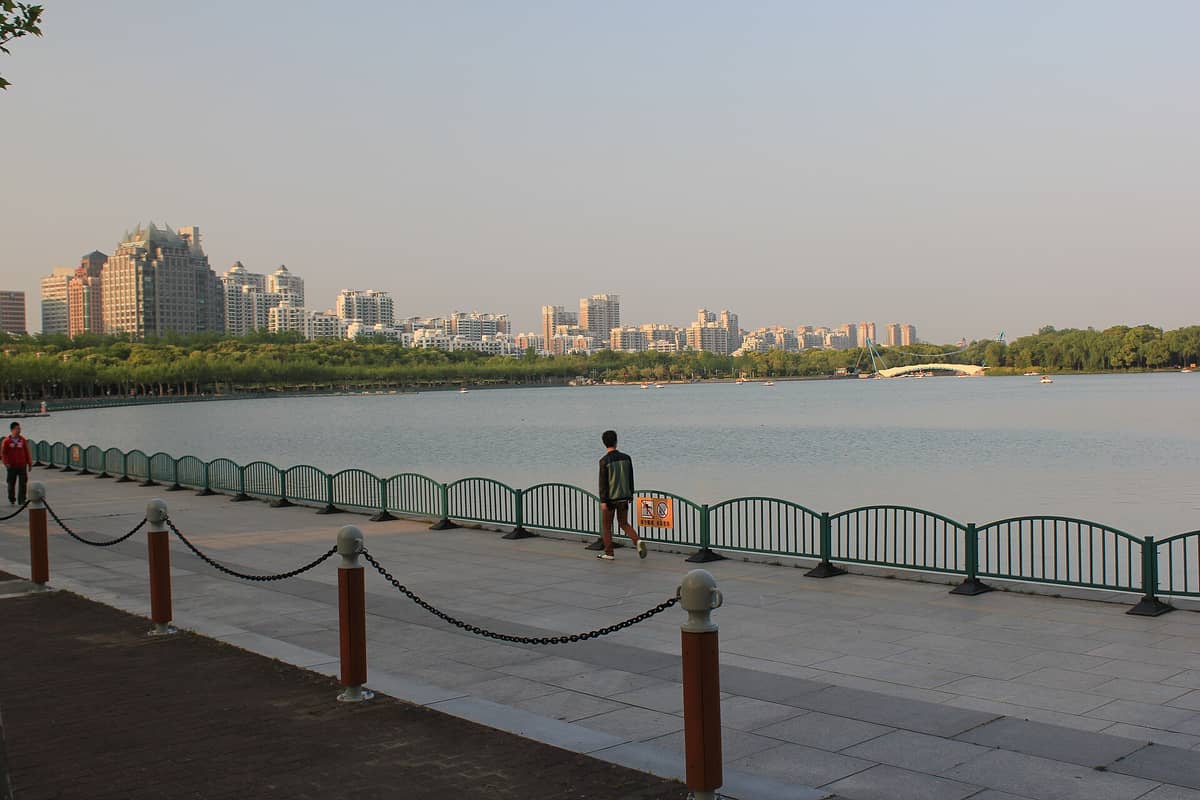
By mid-morning, the crowd shifts. Parents push strollers along the paved lakeside path. School-age children run ahead of grandparents. The sound layer becomes richer: bicycle wheels on gravel, ducks demanding attention near the water's edge, the occasional electric maintenance vehicle humming through on its rounds. This is the most social stretch of the day, and for visitors, the most photographically rewarding.
Midday in summer can be punishing. Shanghai's summer temperatures often exceed 32°C, and the park offers limited shade along its open lawn sections. The crowd thins, and those who remain tend to cluster near trees or the water. If you are visiting between June and August, plan your park time for before 10 a.m. or after 4 p.m. Autumn and spring middays are entirely different: mild air, long light, and comfortable enough to picnic on the grass.
Late afternoon brings a second social peak, especially on weekends. Couples walk the lake circuit, children use the open meadow areas, and the light becomes useful for photography: soft and angled, with the water taking on a gold tone in October and November. After dark, parts of the park remain in use. Since the 24-hour opening, evening walkers and night cyclists are common, though the interior lake areas are dimly lit, so bring a phone torch if you plan to explore off the main paths.
Tickets & tours
Hand-picked options from our booking partner. Prices are indicative; availability and final rates are confirmed when you complete your booking.
Shanghai city and Zhujiajiao water town private tour with lunch
From 371 €Instant confirmationFree cancellationShanghai private tour with iconic landmarks of the old and new city
From 284 €Instant confirmationFree cancellationShangai Yuyuan Garden entrance tickets
From 9 €Instant confirmationFree cancellation
The Landscape: What You Are Actually Looking At
The park's design draws from both Chinese garden traditions and European parkland principles. The result is a landscape that does not feel strictly like either. There is a substantial artificial lake at the center, with gentle banks, reeds at the edges, and a resident waterfowl population that has learned to lobby visitors for food with some persistence. The water is reasonably clear in cooler months and takes on a slight algal tint by late summer.
Paths divide the park into loose zones: areas of manicured lawn for open recreation, denser planted sections with shrubs and ornamental trees, and quieter corners where the design feels less managed. The tree canopy in the older sections is mature enough to provide genuine shade, and in autumn, the deciduous plantings turn reliably gold and amber. If you are planning a visit around seasonal color, October through early November is the most reliable window.
Photography is genuinely worthwhile here, particularly along the water in soft morning or late afternoon light. For a broader sense of Shanghai's best outdoor photography spots, the best photo spots in Shanghai guide covers the park alongside other locations worth planning around.
Getting There and Getting Around Inside
Three metro stations give reasonable access to Century Park. Century Park Station on Line 2 (Exit 1) is the most direct: a short walk north brings you to the park's former main entrance area, now open to the street. Shanghai Science and Technology Museum Station, also on Line 2, is one stop earlier and a longer walk west. Huamu Road Station on Line 7 (Exit S) approaches from the south and is useful if you are coming from Xintiandi or the former French Concession direction.
Bus routes including 184, 640, 794, and Pudong 35 stop near Jinxiu Road and Century Avenue. Taxi or Didi drop-off is straightforward, though traffic on Century Avenue during rush hours can slow the approach from the west.
Inside the park, paths are paved and wide enough for both pedestrians and cyclists. Bicycle hire is available within the park (verify current operators on-site, as concession arrangements change). The terrain is almost entirely flat, making it accessible for pushchairs, wheelchairs, and anyone who finds steps difficult. With the fencing now gone, you can enter and exit at numerous points along the perimeter rather than committing to a single gate, which makes it easy to integrate the park into a walking route rather than treating it as a destination-and-return.
💡 Local tip
If you are combining Century Park with the Shanghai Science and Technology Museum next door, plan the museum first (it runs on fixed hours and requires booking) and use the park for a late-afternoon decompression walk afterward. The two work well back-to-back.
Practical Details: Weather, Seasons, and What to Bring
Shanghai has a humid subtropical climate, meaning summers are genuinely hot and sticky (daily means around 25–29°C in June through August, with highs often above 32°C and high humidity). The meiyu plum rain season in June and early July brings persistent damp. The park is not an ideal destination in a downpour: the paths become slippery, and the lake views lose their appeal. Typhoon-related rain can affect the city from July to September.
Spring (April and May) and autumn (October and November) are the most comfortable seasons for an outdoor visit. Temperatures are moderate, humidity is lower, and the park's plantings are at their most photogenic. Winter visits are entirely possible: December through February is cool, with daily means around 4–7°C, and the park is noticeably emptier. Bring a proper coat, and you will have the lake largely to yourself.
For a fuller overview of how Shanghai's seasons affect sightseeing decisions, the guide to the best time to visit Shanghai breaks down each month with practical advice.
What to bring: comfortable flat shoes (the paths are smooth but long), water (there are vendors inside, but bringing your own is easier), sunscreen and a hat for summer, and a light layer for early morning visits in any season. Mosquito repellent is worth carrying between May and September, particularly near the lake edges in the evening.
Honest Assessment: Is It Worth Your Time?
Century Park is not a destination that will compete with Shanghai's historic or cultural landmarks for a place on a short itinerary. It has no dramatic architecture, no museum-quality exhibitions, and nothing you cannot find in other large urban parks. For a visitor with three days in Shanghai who has not yet seen the Bund, Yu Garden, or the French Concession, the park should probably wait.
That said, it earns its place for a specific kind of traveler. If you are spending time in Pudong already, combining a morning at Century Park with a visit to the Shanghai Science and Technology Museum or the skyline views from Shanghai Tower makes for a full and varied day without crossing the river.
Families with young children get real value here: open space, a lake with ducks, flat paths, and no entry cost. It is also genuinely useful for longer-stay visitors who need a break from the city's density. The 24-hour free access introduced in 2024 makes it more useful still. You can walk through at 7 a.m. before anywhere else opens, or decompress there after a late dinner, without planning ahead.
If green space and outdoor walking are central to your Shanghai plans, the free things to do in Shanghai guide lists other parks and walking routes across the city that offer similar value.
⚠️ What to skip
The interior of the park is not well-lit after dark in all areas. The main perimeter paths and the area near the former main entrance are reasonably lit, but the lake paths and quieter planted sections are dim. Night visits are common among locals, but orient yourself during daylight first if you plan an evening walk.
Insider Tips
- Enter from the Huamu Road Station (Line 7) side for a quieter approach with fewer tourists. Most visitors come from Line 2, so the southern sections of the park are noticeably less crowded at any time of day.
- The northwest corner of the lake, away from the former main entrance, is the most peaceful section of the park and holds the best unobstructed water views. Walk past the obvious stopping points and keep going for five more minutes.
- Weekend mornings between 7 and 9 a.m. are the best time to observe Shanghai's outdoor community life: the tai chi groups, the badminton games, the synchronized dance circles. This is entirely genuine local behavior, not staged for visitors.
- Autumn leaf color peaks roughly between late October and mid-November, depending on the year. The deciduous plantings near the lake's eastern bank are the most reliable spots for color.
- Since the fencing came down, you can use the park as a cut-through on a longer walking route rather than a there-and-back trip. Entering from Century Avenue and exiting toward Jinxiu Road allows you to thread the green space into a Pudong afternoon itinerary without backtracking.
Who Is Century Park For?
- Families with young children who need open space and a flat, manageable walk
- Visitors already spending a day in Pudong who want to add a low-effort outdoor break
- Early risers who want to observe Shanghai's morning community culture in an authentic setting
- Longer-stay visitors looking for a proper outdoor escape without leaving the city
- Autumn travelers chasing leaf color on a budget, with no entry fee required
Nearby Attractions
Other things to see while in Pudong:
- China Art Museum
The China Art Museum occupies the striking red former China Pavilion built for Expo 2010, making it one of the most architecturally dramatic museum experiences in Shanghai. Permanent collections are free, the scale is genuinely impressive, and most visitors are surprised by how much is on display across multiple floors.
- Jin Mao Tower
Standing 420.5 metres above Pudong's Lujiazui financial district, Jin Mao Tower is one of Shanghai's most architecturally distinctive skyscrapers. Its 88th-floor observatory delivers panoramic views across the Huangpu River and the historic Bund, while the building's pagoda-inspired silhouette remains one of the most recognisable on the city skyline.
- Lujiazui Riverside Promenade
The Lujiazui Riverside Promenade stretches roughly 2.5 km along Binjiang Avenue in Pudong, offering unobstructed views of the Bund from the opposite bank. It is open 24 hours, costs nothing to walk, and delivers one of the most dramatic urban skylines on earth at any time of day.
- Oriental Pearl Radio & Television Tower
The Oriental Pearl Tower is the defining landmark of Shanghai's Pudong skyline, a 468-metre structure whose pink-lit spheres have symbolised China's economic transformation since 1994. This guide covers what you actually see at each level, when to go, how much it costs, and whether it's worth your time.