Princes Street Gardens: Edinburgh's Most Dramatic Urban Park
Draped below Edinburgh Castle on the drained bed of a medieval loch, Princes Street Gardens is a 37-acre public park that sits at the physical and emotional heart of the city. Free to enter, historically loaded, and visually arresting at almost any hour, it rewards visitors who take the time to slow down and look up.
Quick Facts
- Location
- Princes Street, Edinburgh EH2 2HG — south side of Princes Street, New Town
- Getting There
- Princes Street tram stop and multiple bus stops along Princes Street
- Time Needed
- 45 minutes to 2 hours depending on pace; open daily from 7:00 AM (closing times vary seasonally)
- Cost
- Free admission
- Best for
- Castle views, a quiet midday break, photography, families, and history lovers
What Princes Street Gardens Actually Is
Princes Street Gardens is a pair of public parks, divided into East and West sections by The Mound, that run along the south side of Princes Street in central Edinburgh. Together they cover just over 37 acres, occupying the valley between the Georgian New Town above and the medieval Old Town ridge below. The result is one of the most dramatically positioned city parks in Europe: a flat green corridor with a volcanic castle crag looming overhead and the entire skyline of the Old Town visible across the railway cutting.
The gardens are genuinely free to enter and open every day of the year. They function simultaneously as a commuter shortcut, a lunch spot for office workers, a tourist thoroughfare, and a major event venue. That layering of uses means the atmosphere shifts significantly depending on the hour and the season.
ℹ️ Good to know
Gates open at 7:00 AM daily. Closing times vary by season — ranging from 6:00 PM in winter to 10:00 PM in midsummer. Note that gates begin closing approximately one hour before the stated closing time to clear the park safely.
A Loch That Became a Garden: The History Underfoot
The ground you walk on was, until the 18th century, covered by Nor Loch, a deliberately created defensive body of water that sat below the castle rock and formed the northern boundary of medieval Edinburgh. It was not a scenic feature. Contemporary accounts describe it as heavily polluted, used for waste disposal and, on occasion, for witch-drowning trials. When the city began expanding northward and the New Town was laid out in the 1760s, the loch's drainage became a practical necessity.
Drainage work began in the 1760s, design planning followed through the 1770s, and the gardens were formally inaugurated in 1820 after the loch bed had been fully reclaimed. The gardens were initially private, accessible only to residents of the surrounding streets. They became a fully public park in 1876. That transition from foul defensive loch to manicured public garden across roughly a century is one of the more remarkable urban transformations in Scottish history.
Understanding this history gives the castle views a different quality. When you stand on the garden lawn and look up at Edinburgh Castle on its basalt plug, you are standing on what was once a moat. The elevation difference between the garden floor and the castle esplanade above is on the order of 30 metres, which makes the vertical drama feel almost architectural in scale.
Tickets & tours
Live prices and dates from our booking partner. If you book, we may earn a commission at no extra cost to you.
West Highland Lochs, mountains and castles tour from Edinburgh
From 61 €Instant confirmationFree cancellationLoch Ness, Glen Coe and the Highlands tour from Edinburgh
From 66 €Instant confirmationFree cancellationDay Trip to Holy Island, Alnwick Castle and Northumbria from Edinburgh
From 60 €Instant confirmationFree cancellationLoch Ness Explorer Day Trip from Edinburgh
From 60 €Instant confirmationFree cancellation
East vs West: Two Parks With Different Personalities
The Mound, the constructed road and pathway that connects Princes Street to the Old Town, physically splits the gardens into two distinct halves. It is worth understanding the difference before you arrive.
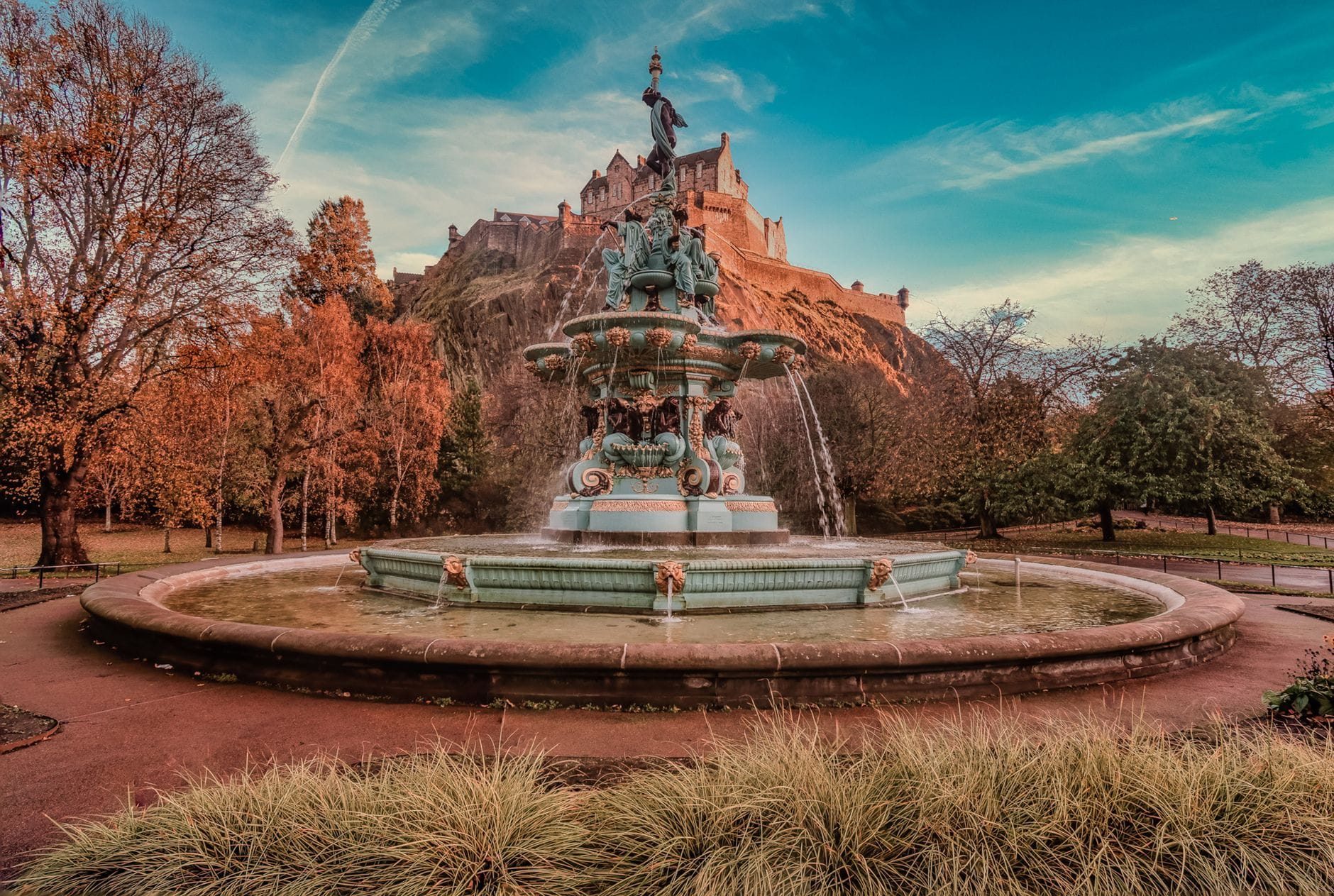
West Princes Street Gardens is the quieter, more residential-feeling section. It has a band rotunda that hosts free concerts during summer, open lawns used by locals for sunbathing and picnics, the Ross Fountain (a Victorian cast-iron ornamental fountain), and a clock built from flowers, known as the Floral Clock, that has been planted every year since 1903. The West Garden also contains the national memorial to Wojtek, the Syrian brown bear adopted by the Polish II Corps during World War Two, a sculpture that surprises nearly everyone who encounters it.
East Princes Street Gardens, closer to Waverley station and the top of The Mound, sees considerably more foot traffic. The Scottish National Gallery sits at its eastern edge, and The Mound itself provides an obvious access point from the Old Town. This section is flatter, more open, and tends to feel more exposed to wind. In summer, it is where large-scale event infrastructure often appears. The famous Ross Bandstand, used for major outdoor concerts, also sits in the West Gardens. At Christmas, the East Gardens host the main fairground section of Edinburgh's Christmas market.
If you are walking between the New Town and the Old Town, the gardens path via The Mound is both the most scenic and the most direct route. The climb up The Mound takes you past the Scottish National Gallery and delivers you onto the Royal Mile in about eight minutes from the Princes Street pavement.
How the Experience Changes Through the Day
Early morning, particularly between 7:00 and 9:00 AM, is when the gardens most resemble a local park rather than a tourist destination. Dog walkers, joggers, and commuters cut through on their way to work. The castle above catches the first light on its eastern face and the air still carries a chill regardless of season. This is the best time for unobstructed photography: the benches are empty, the paths are quiet, and the castle silhouette against morning sky is exceptionally clear.
Midday brings office workers and visitors in roughly equal measure. The lawns fill up on any dry day — Edinburghers have a practical relationship with sunshine and take it whenever it appears. The gardens can feel surprisingly social at lunch, with food from nearby cafes and the smell of cut grass carrying across the lawn in summer.
Late afternoon is the most photogenic window for castle shots. From around 3:00 PM onward in the western section, the light falls across the castle face rather than bleaching it from overhead. In midsummer, the gardens stay open until 10:00 PM (with gates closing from 9:00 PM), which means there is a golden-hour window that most visitors miss entirely because they assume parks close at dusk.
💡 Local tip
For castle photography, position yourself on the West Gardens lawn in the mid-to-late afternoon. The angle from there captures the castle, the Scott Monument to the east, and the tiered roofline of the Old Town in a single frame. Bring a wide-angle lens or use the panorama mode on a phone.
Seasonal Transforms: What to Expect by Time of Year
In January and February the gardens are skeletal and dramatic. Bare trees frame the castle without competing with it, and the low sun angle casts long shadows across the frost-hardened grass. Visitor numbers are minimal, which makes it one of the few times the gardens feel genuinely isolated.
Spring, roughly late March through May, is arguably the most beautiful period. Daffodils appear across the West Gardens in March and April in significant numbers, followed by cherry blossom and the first bedding plants. The Floral Clock is typically replanted and running by early May. Crowds grow but remain manageable compared to peak summer.
August transforms the gardens significantly. During the Edinburgh Fringe and the Royal Edinburgh Military Tattoo, the city's population effectively doubles and the gardens absorb a corresponding volume of people. The East Gardens in particular can feel congested. The Royal Edinburgh Military Tattoo performs on the castle esplanade directly above, and you can hear the pipes and drums clearly from the West Gardens lawn on performance nights — one of the more unexpected bonuses of sitting in the park after dark in August.
Winter brings Edinburgh's Christmas market, which occupies sections of both the East and West Gardens from late November through early January. Wooden stalls, ice rinks, and fairground rides appear where open lawn stood before. Some visitors love the transformation; others find it hard to reconcile with the park experience. If you are coming specifically for the gardens' natural character, Edinburgh's Christmas market period is worth factoring into your planning.
Getting There and Getting Around
Princes Street Gardens sits directly on Princes Street, Edinburgh's primary east-west artery. The tram line runs along Princes Street with a dedicated Princes Street tram stop serving the gardens, and the line continues westward; buses serving Princes Street are numerous and well-signed. From Waverley railway station, the East Gardens entrance is a 3-minute walk. The gardens are not hidden and require no navigation to find.
Within the gardens, paths are largely paved and accessible, though the terrain naturally slopes from east to west and some sections of the West Gardens have grass paths that become soft in wet weather. Public toilets are available within the gardens. For visitors with specific step-free requirements, the City of Edinburgh Council parks page provides detailed accessibility information.
⚠️ What to skip
Closing times vary significantly by season and the gates close earlier than the published time to allow the park to be cleared. If you plan to visit in the evening, check the current schedule on the Edinburgh Outdoors website before you go. Being locked inside the gardens is not a pleasant experience, particularly in winter.
What the Gardens Are Not
Princes Street Gardens is frequently described in shorthand as Edinburgh's answer to Central Park, which overstates both its size and its seclusion. At 37 acres, it is a long, relatively narrow corridor rather than an immersive green space. You are never far from the sound of the railway line that runs through the valley below Princes Street, and traffic noise from the street above is a constant presence in the East Gardens. The gardens are best understood as a dramatic urban pause rather than a countryside escape.
Visitors seeking wilder green space within the city will find more rewarding options at Holyrood Park, which surrounds Arthur's Seat and offers genuine hillside walking and near-silence. The Royal Botanic Garden Edinburgh in Inverleith, free to enter, provides a more composed horticultural experience. But for sheer drama of setting in the city centre, Princes Street Gardens has no close rival.
Insider Tips
- The Floral Clock in the West Gardens, planted annually since 1903, is one of the oldest working floral clocks in the world. Look for it near the junction of The Mound and Princes Street — it is often overlooked because visitors are looking up at the castle rather than down at their feet.
- On Tattoo nights in August you can hear the full performance from the West Gardens lawn. Bring a jacket and something to sit on, and you get a free auditory experience of one of Edinburgh's most sought-after ticketed events.
- The gates officially close one hour before the published closing time. In midsummer, the West Gardens gates close at 9:00 PM even though the park is listed as closing at 10:00 PM. Plan your evening visit accordingly.
- The path running along the base of the castle rock in the West Gardens is considerably less walked than the main lawn route. It runs close to the steep stone face and gives a sense of the rock's true scale that the open lawn view does not.
- The Scott Monument on the eastern edge of the gardens is climbable for a small fee and provides a unique low-altitude view back across the gardens toward the castle. It looks odd from the outside but the view from its upper platforms is genuinely unusual.
Who Is Princes Street Gardens For?
- First-time visitors who want the classic Edinburgh castle-and-skyline view without paying entry fees
- Photographers working on city portraits, especially in early morning or late afternoon light
- Families looking for free open space in the city centre with public facilities nearby
- Walkers using the gardens as part of a route between the Old Town and New Town
- Visitors attending the Fringe or Tattoo who want a calm counterpoint to the August crowds elsewhere
Nearby Attractions
Other things to see while in New Town:
- Calton Hill
Rising 103 metres above central Edinburgh, Calton Hill is a free, 24-hour public park packed with monuments, volcanic geology, and some of the most complete city panoramas in Scotland. It takes under 20 minutes to reach from Princes Street on foot, and the views repay every step.
- Charlotte Square
Charlotte Square sits at the west end of George Street as the architectural crown of Edinburgh's first New Town. Designed by Robert Adam in 1791 and completed in 1820, the square is a free, publicly accessible streetscape and a key part of the city's UNESCO World Heritage Site.
- Edinburgh Christmas Market
Spread across East and West Princes Street Gardens and George Street, Edinburgh's Christmas runs from mid-November to early January each year. Entry is free, the backdrop is Edinburgh Castle, and the atmosphere shifts dramatically depending on when you arrive.
- Edinburgh Gin Distillery
Opened on 6 December 2024, the Edinburgh Gin Distillery at The Arches on East Market Street is the brand home of one of Scotland's most recognised craft gins. Set inside dramatic stone vaulted arches beneath historic railway arches near Waverley, it offers tastings, tours, and a retail experience rooted in the city's growing reputation for artisan spirits.
Planning a trip? Discover personalized activities with the Nomado app.