Royal Botanic Garden Edinburgh: The Complete Visitor Guide
Founded in 1670 and free to enter, the Royal Botanic Garden Edinburgh spans 28 hectares in Stockbridge, offering world-class plant collections, sweeping views of the city skyline, and a pace of life that stands apart from the tourist trail. Whether you have an hour or a full afternoon, the garden rewards on every visit.
Quick Facts
- Location
- Inverleith Row, Edinburgh EH3 5LR
- Getting There
- Lothian Buses 8, 9, 23, 27 to East Gate (Inverleith Row); 24, 29 to West Gate (Arboretum Place)
- Time Needed
- 1.5 to 3 hours; longer if glasshouses are open
- Cost
- Garden entry free; Glasshouses approx. £5.50 adult, £4.50 concession, under-16s free (verify current rates)
- Best for
- Families, photographers, slow-travel visitors, and anyone needing a break from the Royal Mile
- Official website
- www.rbge.org.uk
What the Royal Botanic Garden Edinburgh Actually Is
The Royal Botanic Garden Edinburgh, universally known as RBGE or simply the Botanics, is one of the oldest scientific botanic gardens in the world. Founded in 1670 as a small physic garden near Holyrood Abbey, it was created to grow medicinal plants for Edinburgh's medical school. Three and a half centuries later, it has become a fully accredited scientific institution, an internationally recognised centre for plant conservation, and the kind of large green space that a city of Edinburgh's density rarely has room for.
The garden moved to its current Inverleith site in 1820, and those 28 hectares are now home to more than 13,000 plant species. This is not a manicured municipal park. It is a living research collection, which means you will find rockeries planted with specimens from the Himalayas next to a pond lined with giant Gunnera, a Victorian glasshouse range sheltering tropical species, and an arboretum of mature trees that pre-dates most of the buildings surrounding the garden today.
ℹ️ Good to know
Garden entry is free and the garden is open daily, with opening and closing times varying seasonally; check the RBGE website for current hours. Glasshouse admission is charged separately and opening hours may vary during restoration work — check the RBGE website before visiting.
The Experience: What You Actually See and Feel
Enter through the West Gate at the John Hope Gateway and you arrive into a broad, light-filled visitor centre with a cafe and exhibition space. It is a practical orientation point, but the real character of the garden reveals itself once you move deeper into the grounds. The first thing most visitors notice is the quiet. Despite being less than a ten-minute walk from the Stockbridge shops, there is a genuine reduction in urban noise inside the garden walls, replaced by birdsong, wind in the tree canopy, and the occasional creak of branches in older specimens.
The central lawn opens up a view that surprises many first-time visitors: a long, unobstructed sightline south toward Edinburgh Castle and the Old Town skyline. This is one of the best free views in the city, and it changes character across the day. In the morning, with low light coming from the east, the castle sits sharp and clear above the treeline. By mid-afternoon in summer, the same view softens. On grey days, the towers and spires take on a different, equally photogenic quality.
For visitors interested in Edinburgh's panoramas from multiple angles, the garden pairs well with a visit to Calton Hill, which offers elevated views over a different axis of the city.
Tickets & tours
Live prices and dates from our booking partner. If you book, we may earn a commission at no extra cost to you.
How the Garden Changes by Time of Day and Season
Arriving at opening time, around 10:00, means the garden is at its calmest. Dog walkers and joggers are present in the early hour, but the crowds that build by midday are nowhere near. Morning light through the glasshouses creates streaked, diffused warmth that is particularly useful for photography. The dew on the rock garden, the stillness in the pond area, and the relative emptiness of the paths make the early visit feel like a private experience.
By late morning and midday, particularly on weekends and during the summer months, families with young children dominate the central lawns. The atmosphere becomes genuinely lively rather than contemplative, which suits some visitors and not others. School groups are common on weekdays between April and June. If you want to move through the glasshouses at your own pace, mid-week mornings or any visit after 15:30 are noticeably quieter.
Seasonally, the garden is exceptional in spring, when the rhododendron collection flowers and the rock garden is at its most vivid. Summer brings full leaf cover and the large herbaceous borders in high color. Autumn turns the arboretum into a slow burn of copper and gold. Even in winter, the structure of the garden holds interest, and the glasshouses become especially appealing as a warm, humid refuge during cold or wet days.
💡 Local tip
The rhododendron walk, which runs along the northern boundary of the garden, is at its peak between late April and late May. Come before 11:00 on a weekday if you want to photograph it without other visitors in frame.
The Glasshouses: Inside the Victorian Range
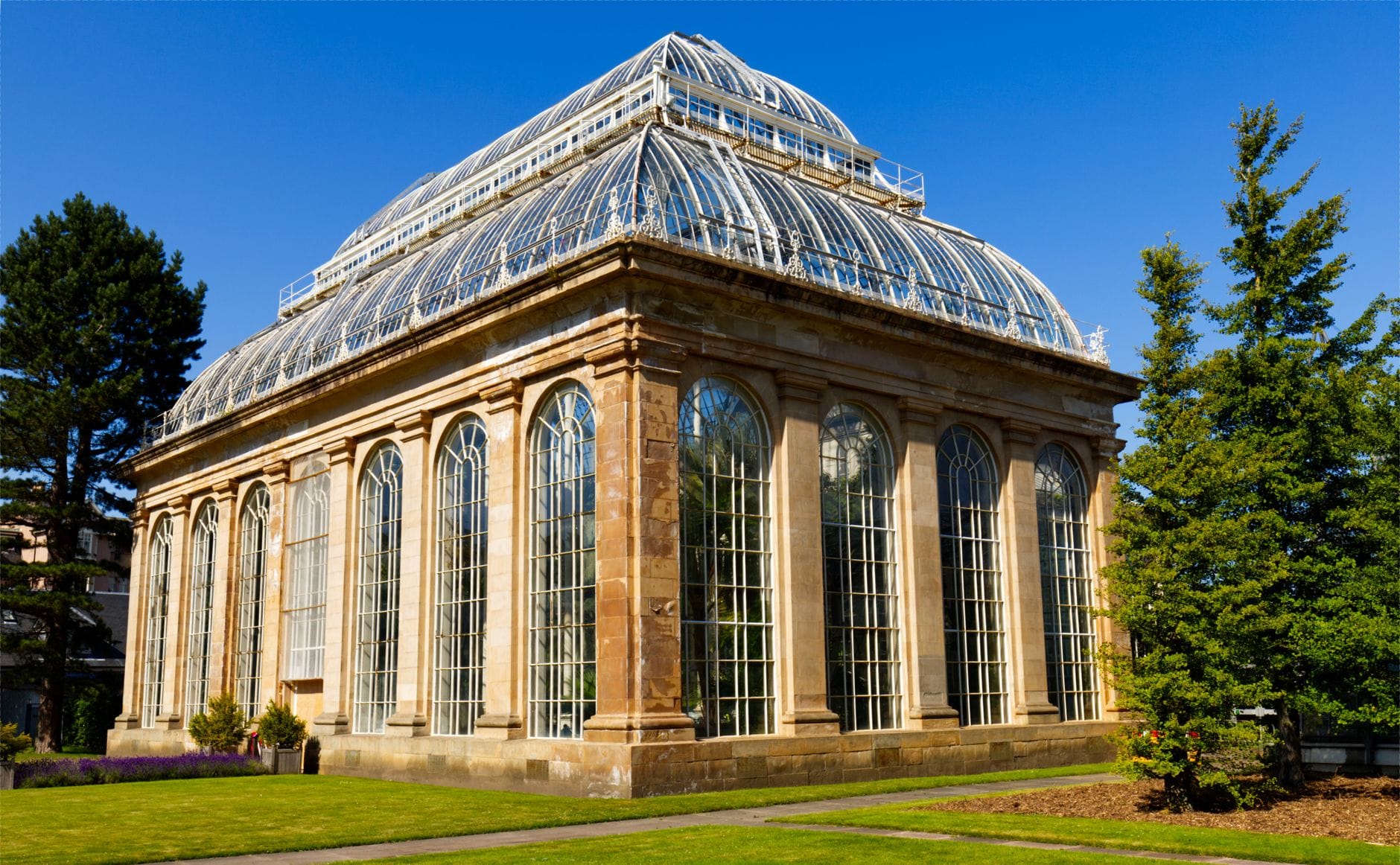
The Temperate Palm House is the centerpiece of the glasshouse range and the oldest surviving building on the site, completed in 1858. Inside, the air is warm and faintly humid, carrying the smell of soil and green growth that is noticeably different from anywhere else in Edinburgh. Towering palms press against the glass ceiling, some of them planted before the building was finished. The sense of scale is genuinely impressive in person in a way that photographs do not communicate.
Beyond the Palm House, the connected glasshouse range moves through desert ecosystems, a peat house with mosses and ferns, and a tropical zone where the temperature and humidity climb sharply. Children tend to respond strongly to the contrast: the shift from a cool Edinburgh morning to tropical warmth in the space of thirty seconds is a reliable source of commentary. Adults who find the rest of the garden politely interesting often find the glasshouses genuinely compelling.
Be aware that glasshouse sections have undergone phased restoration work in recent years. Some areas may be partially closed. Always check the RBGE website or the notice boards at the entrance before planning your visit around any specific section.
⚠️ What to skip
Glasshouse admission is charged separately from garden entry. Ticket prices listed here (approx. £5.50 adult, £4.50 concession, under-16s free) are sourced from third-party directories and may not reflect current rates. Verify on the official RBGE website before your visit.
History, Science, and What Sets This Garden Apart
RBGE is more than a garden in any recreational sense. It is the headquarters of a four-garden scientific institution that includes garden sites at Benmore, Logan, and Dawyck. The Edinburgh site alone holds one of the world's most important living plant collections, with a particular reputation for Sino-Himalayan flora, reflecting generations of plant hunting expeditions to China, Tibet, and the Indian subcontinent.
The Herbarium at Inverleith holds over three million preserved plant specimens, making it one of the largest botanical archives in the world. The library holds thousands of volumes, some dating to the seventeenth century. Neither the Herbarium nor the library is accessible to casual visitors, but they give the garden a weight and seriousness that you can sense in the overall character of the collections, where labeled specimens are treated as scientific objects as much as ornamental plantings.
If you are combining the garden with a broader exploration of Stockbridge and its surroundings, the Water of Leith Walkway passes just to the south and west of the garden boundary, connecting the area toward Dean Village and beyond.
Practical Walkthrough: Getting There and Getting Around
The garden has two main entrances. The East Gate on Inverleith Row is the simpler arrival point if you are coming by bus from the city centre: Lothian Buses 8, 9, 23, and 27 stop close by. The West Gate on Arboretum Place, which leads directly into the John Hope Gateway visitor centre, is served by buses 24 and 29. Both gates are fully accessible. The garden map available at each entrance is worth picking up, as the grounds are large enough that first-time visitors can easily spend time in the arboretum without realising they have not yet reached the glasshouses.
Paths throughout the garden are paved or compacted gravel. Steps can be avoided throughout the site using alternative routes, and the garden provides wheelchair loans and electric mobility scooters for visitors who need them. Pre-booking by phone is advised. Blue Badge parking is available on Arboretum Place near the West Gate. On-street metered parking is also available in the surrounding streets, though spaces fill quickly on weekends.
The Terrace Cafe near the West Gate serves hot food, coffee, and light meals. It is a comfortable space and works well as a starting or finishing point. There is also a smaller kiosk-style option elsewhere in the garden during busier seasons. Both are reasonably priced by Edinburgh standards.
If you are visiting as part of a wider day in the area, the garden sits at the northern edge of Stockbridge. From the East Gate, it is a ten to fifteen minute walk down to the Stockbridge Market (open Sundays), which is worth combining on the right day.
Who Should Think Twice Before Visiting
The Botanics are genuinely suited to a wide range of visitors, but there are people who will leave underwhelmed. If your primary interest is Scottish history, architecture, or urban atmosphere, a large garden may feel like a diversion from what you actually came to see. The garden has no strong narrative structure for visitors who are not already interested in plants: you walk, you look, and what you take from that depends heavily on your starting level of interest.
Visitors who prefer their green space with more dramatic terrain and physical challenge are likely better served by Arthur's Seat or the Salisbury Crags in Holyrood Park, both of which offer the kind of landscape spectacle that the Botanics deliberately do not.
On a rainy weekday in January when the glasshouses are partially closed, the garden is a quieter, cooler, and less rewarding experience than it is in spring or summer. It remains free, which lowers the stakes considerably, but managing expectations around weather and season is worth doing.
Insider Tips
- The view of the Old Town skyline from the central lawn is best photographed from the slight rise near the Inverleith House building, which puts the castle at a cleaner angle above the foreground trees. Most visitors photograph it from ground level on the main path and get a less composed image.
- The Pond area in the northeast corner of the garden is consistently quieter than the central lawn. On busy summer days, it is a useful retreat for a genuinely calm experience.
- If you are visiting on a Sunday, timing your trip to arrive at the garden at opening (10:00), spending an hour and a half inside, then walking south to Stockbridge Market before it peaks at midday makes for a well-paced morning.
- The garden is one of the only places in Edinburgh where you can observe the city skyline from a distance without paying for the privilege. The view from the north end of the central lawn is comparable in quality to several paid viewpoints.
- Carry a layer regardless of the season. Even on warm summer days, the glasshouses create temperature contrasts and Edinburgh's weather can shift sharply within an afternoon.
Who Is Royal Botanic Garden Edinburgh For?
- Families with children who need outdoor space without the intensity of the city centre
- Photography enthusiasts interested in botanical subjects, Victorian architecture, and Edinburgh skyline shots
- Visitors on a budget who want a full half-day experience at no cost
- Slow travellers who prefer depth over coverage and want to spend meaningful time in one place
- Anyone visiting Edinburgh in spring, when the rhododendron and cherry blossom collections are at their peak
Nearby Attractions
Other things to see while in Stockbridge:
- Circus Lane
Circus Lane is a curved, cobblestone mews street in Stockbridge, lined with converted stable cottages, window boxes, and a quiet residential character that shifts dramatically with the seasons. Free to visit at any time, it rewards early risers and photographers most of all.
- Stockbridge Market
Every Sunday morning, a corner of Stockbridge transforms into one of Edinburgh's most enjoyable outdoor markets. Free to enter and running year-round since 2011, Stockbridge Market draws locals and visitors alike with Scottish food producers, independent craftspeople, and a neighbourhood atmosphere that no indoor shopping centre can replicate.
Planning a trip? Discover personalized activities with the Nomado app.