Water of Leith Walkway: Edinburgh's Best Free Walk
The Water of Leith Walkway stretches roughly 12.25 to 12.75 miles (19-20 km) from Balerno through the heart of Edinburgh to Leith, following the city's main river the entire way. It is entirely free, open at all times, and passes through a wildly varied sequence of landscapes: gorge-like wooded sections, medieval mill villages, Georgian terraces, and finally the working port at Leith. Few walks in any European capital city offer this much contrast for no cost.
Quick Facts
- Location
- Edinburgh, Scotland — multiple access points from Balerno to Leith
- Getting There
- Multiple entry points served by Edinburgh city buses; Dean Village and Stockbridge reachable on foot from the city centre
- Time Needed
- 1.5 hrs for a single section (e.g. Dean Village to Stockbridge); 5-7 hrs for the full 12-mile route
- Cost
- Free — no ticket or permit required
- Best for
- Walkers, cyclists, nature lovers, and anyone wanting to escape the Royal Mile crowds
- Official website
- www.waterofleith.org.uk
What the Water of Leith Walkway Actually Is
The Water of Leith Walkway is a waymarked public footpath following the Water of Leith river for approximately 12.25 to 12.75 miles (19 to 20 km) across Edinburgh. It begins in Balerno, a village on the western edge of the city, and ends where the river meets the Firth of Forth near the Shore in Leith. The path is open at all times, entirely free to use, and is maintained by the City of Edinburgh Council. The continuous modern route was completed as a Millennium Project, though sections of the path have existed for decades before that.
A stretch of the western section between Balerno and Colinton follows the trackbed of the former Balerno Branch Railway, which means the gradient here is almost imperceptibly gentle. Further east, the path drops into the narrow wooded gorge at Colinton Dell before emerging into open parkland at Saughton and then threading back into the city's stone fabric through Gorgie, Dalry, and eventually Dean Village. Each section has a completely different character, which is part of what makes this walk so repeatedly rewarding.
💡 Local tip
You do not need to walk the full 12 miles. The most popular standalone section runs from Dean Village to Stockbridge, taking roughly 30 to 40 minutes and requiring no bus or car to reach from the city centre. It is genuinely one of the best short walks in Edinburgh.
The Route Section by Section
Balerno to Colinton: The Rural Beginning
The western stretch from Balerno through Currie and into Colinton is the most rural section of the whole route. The path follows the disused railway line for much of this distance, meaning it is wide and largely flat underfoot. The sound here is mostly water and birdsong. In spring and early summer, wildflowers colonise the embankments of the old railway cutting, and you can walk for long stretches without seeing another building.
Colinton itself is worth pausing for. The village sits in a deep wooded dell where the river cuts through a narrow gorge, and the atmosphere changes noticeably: the air feels cooler and damp, the path narrows, and the canopy closes above you. The Colinton Tunnel, a short curved railway tunnel with a colourful mural inside, passes beneath the grounds of what was once Merchiston Castle School. It is an unexpected piece of art in an otherwise natural corridor.
For a deeper look at that tunnel specifically, the Colinton Tunnel has its own entry worth reading before you visit.
Saughton to Dean Village: Urban Texture
Between Saughton Park and Dean Village the walk shifts into Edinburgh's urban fabric. Saughton Park itself has formal gardens and a rose garden worth visiting if they are in bloom. The path continues past old mill buildings, stone retaining walls, and occasional glimpses of the back gardens of Edinburgh's Georgian and Victorian tenements. At this stage the city is fully present: you can hear traffic above you and smell bakeries and coffee through garden walls.
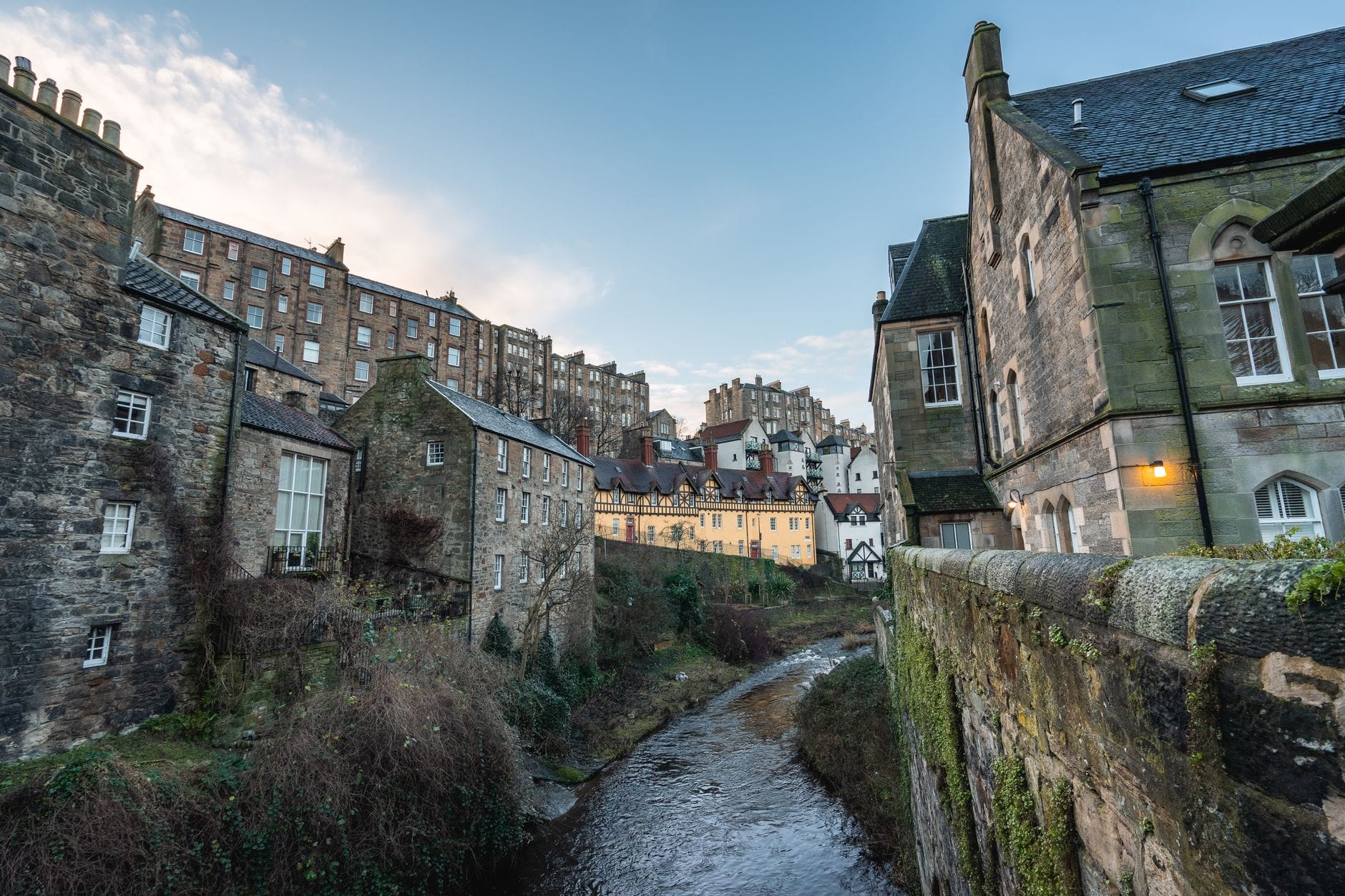
Dean Village is the set-piece of the entire walkway. This former milling community, once the industrial engine of Edinburgh's bread supply, is now one of the most photographed corners of the city. The old granary buildings and well-maintained stone tenements cluster around a bend in the river. On a clear morning the light picks out the detail of the stonework in a way that genuinely surprises first-time visitors. Arrive before 9am and you will often have it nearly to yourself. By 11am in summer, tour groups from nearby hotels begin trickling in.
Dean Village to Stockbridge: The Essential Short Walk
If you walk only one section, make it this one. From Dean Village the path continues beneath the dramatic Dean Bridge, designed by Thomas Telford and completed in 1832. Looking up at the bridge from river level is a different experience entirely from crossing it on foot above. Below, the river runs over smooth stone, and in wet seasons the sound of the water is loud enough to drown out most of the city noise.
The path then continues through a narrow wooded gorge before emerging into the back streets of Stockbridge, one of Edinburgh's most appealing residential neighbourhoods. The transition from enclosed riverbank to the open streetscape of Stockbridge, with its independent shops, delis, and the weekend market, is a satisfying arrival point.
Stockbridge makes a natural end point for a shorter walk. The Stockbridge Market runs on Sundays and is a good reason to time your walk accordingly.
Stockbridge to Leith: The Longer Finish
From Stockbridge the walkway continues north through Canonmills and Bonnington, eventually reaching the Shore at Leith where the Water of Leith empties into the Firth of Forth. This lower section is less dramatic scenically but passes through working Edinburgh neighbourhoods rarely seen by visitors. The path here is flatter and broader.
Leith itself rewards exploration once you arrive. The Shore is lined with restaurants and bars, and the Royal Yacht Britannia is docked nearby at Ocean Terminal. If you are walking the route end to end, finishing here with a meal at one of the waterfront restaurants is a sensible plan.
Tickets & tours
Live prices and dates from our booking partner. If you book, we may earn a commission at no extra cost to you.
West Highland Lochs, mountains and castles tour from Edinburgh
From 61 €Instant confirmationFree cancellationLoch Ness, Glen Coe and the Highlands tour from Edinburgh
From 66 €Instant confirmationFree cancellationDay Trip to Holy Island, Alnwick Castle and Northumbria from Edinburgh
From 60 €Instant confirmationFree cancellationLoch Ness Explorer Day Trip from Edinburgh
From 60 €Instant confirmationFree cancellation
When to Go and What the Route Feels Like at Different Times
Early morning is the most atmospheric time on the walkway. From roughly 7am to 9am, even in the central sections near Dean Village, the path is quiet enough that you notice the details: dippers bobbing on mid-river stones, mist sitting in the gorge below the Dean Bridge, the smell of damp earth and lichen. This is the time of day when the walkway most convincingly demonstrates how much wildlife has recolonised the river. Grey herons are reliably present throughout the year.
Weekend afternoons in summer bring out the full range of Edinburgh residents: families with dogs, joggers, cyclists, and visitors who have been given the Dean Village tip. The path is never so crowded that it becomes unpleasant, but the sense of quiet solitude disappears. If that matters to you, a weekday morning is a different walk entirely.
In autumn the section through Colinton Dell and the wooded gorge above Dean Village becomes genuinely beautiful. Leaf fall turns the water the colour of dark tea and the canopy goes through amber and copper in October and early November. Winter can be muddy in exposed stretches, and a few sections develop standing water after prolonged rain. Grip-soled shoes or boots are sensible for any season except high summer.
⚠️ What to skip
Sections of the path include steps and uneven stone surfaces that are not continuously wheelchair accessible. The railway-line section from Balerno to Colinton is largely flat and wide, but the gorge sections near Colinton Dell and Dean Village involve steps and narrow compacted earth paths that can be slippery when wet.
Practical Details: Access, Distances, and What to Bring
The walkway has no single entrance gate or ticket point. You can join it at dozens of points along its length. The most central and popular entry points are Dean Village (a 15-minute walk from Princes Street), Stockbridge, Saughton Park, Colinton, and Bonnington. The Water of Leith Visitor Centre is located at 24 Lanark Road, Edinburgh EH14 1TQ, near the Slateford section, and has maps, displays, and information about the river's ecology. Its separate opening hours are listed on the Water of Leith Conservation Trust website.
For the full route, the western start in Balerno is served by Edinburgh city buses from the centre. The eastern end at Leith is similarly well connected. If you plan to walk only the central section (roughly Dean Village to Stockbridge), no bus is needed: both ends are within easy walking distance of the Old Town and New Town respectively.
The walkway connects naturally to a broader Edinburgh on foot. If you are planning a full day around the river, the hiking in Edinburgh guide covers how to combine it with other green routes across the city.
- Wear shoes with grip. Pavement sections are fine in trainers but the gorge and dell sections are often muddy or slippery.
- Download the route map from waterofleith.org.uk before you go. Mobile signal is patchy in the deeper wooded sections.
- Dogs are allowed along most of the route but should be kept on a lead in sections near nesting birds. Check signage as you walk.
- Fishing requires a permit from the City of Edinburgh Council. Do not assume access to the riverbank for fishing is included in general path access.
- The walkway is open at all times. There are no gates, no closing times, and no admission charge.
Photography Notes
Dean Village is the most photographed spot on the route, and for good reason: the combination of old mill buildings, the 32-metre Dean Bridge overhead, and the river running through a stone-walled channel gives you multiple strong compositions in a small area. The best light for the key view looking upstream toward the bridge is in the morning when the sun is low and east-facing. By midday in summer the gorge goes into shadow and contrast becomes difficult.
The wooded gorge sections, particularly Colinton Dell, work well in flat light or overcast conditions where the texture of bark and moss reads more evenly. In autumn the colour contrast between golden leaf litter and dark water is striking. A polarising filter significantly reduces glare on the river surface if you are shooting with an interchangeable-lens camera.
If views and photography across Edinburgh are part of your trip, the best views in Edinburgh guide covers elevated spots to pair with the riverside perspective the walkway provides.
Who This Walk is For, and Who Might Not Enjoy It
The Water of Leith Walkway is one of the few Edinburgh experiences that works equally well for serious walkers putting in the full 12-mile route and for casual visitors looking for a 40-minute break from the Royal Mile. Its free cost and lack of booking requirements make it the easiest addition to any itinerary.
It is not, however, a walk for everyone. Visitors with limited mobility will find the gorge sections difficult and should stick to flatter access points like the Saughton section. Visitors who require dramatic payoff scenery comparable to Arthur's Seat or the Pentland Hills may find the lower sections underwhelming, as much of the route runs through wooded corridors where the views are inward rather than panoramic.
Those seeking open-air elevation and wide views across the city will find better options at Arthur's Seat or Calton Hill, both of which complement rather than duplicate what the walkway offers.
Insider Tips
- The Dean Village to Stockbridge section takes under an hour and can be done entirely on foot from the New Town with no planning required. It is the easiest way to see a genuinely beautiful part of Edinburgh that most day-trippers miss completely.
- Visit on a Sunday morning and finish in Stockbridge: the market runs weekly and you can combine the walk with breakfast or brunch from the market stalls without any detour.
- The walkway is signed with numbered marker posts. If you download the official map from waterofleith.org.uk before leaving, these markers help you keep track of where you are in the wooded sections where landmarks are sparse.
- Grey herons are reliably spotted near Dean Village throughout the year, and in quieter morning sessions you may also see kingfishers on the lower Stockbridge to Leith section, particularly in winter when vegetation is lower.
- If you want to walk the full route but not in one go, the section from Balerno to Colinton follows the old railway line and is wide and paved enough for a relaxed family walk with no significant climbing. It feels completely different from the central gorge sections.
Who Is Water of Leith Walkway For?
- Walkers wanting a free, no-planning-required escape from Edinburgh's tourist core
- Families with dogs looking for a flat, accessible route (particularly the Balerno to Colinton railway section)
- Photographers targeting atmospheric early-morning light at Dean Village
- Visitors staying in Stockbridge or Leith who want to understand the city's natural topography
- Anyone combining a full Edinburgh day on foot who needs a quieter counterpoint to the castle and the Royal Mile
Nearby Attractions
Combine your visit with:
- Colinton Tunnel
The Colinton Tunnel is a 137-metre Victorian railway tunnel on the Water of Leith Walkway, transformed into Scotland's largest heritage mural. Inspired by Robert Louis Stevenson's poem 'From a Railway Carriage', it's free to visit, fully accessible, and open around the clock.
- Craigmillar Castle
Craigmillar Castle is a remarkably complete medieval ruin sitting on a low hill 3 miles southeast of Edinburgh's centre. Once a retreat for Mary, Queen of Scots, it rewards visitors with genuine history, sweeping city views, and crowds that are a fraction of Edinburgh Castle's.
- Cramond Beach & Island
A short bus or drive from the city centre, Cramond Beach leads to one of Edinburgh's most unusual free attractions: a tidal island in the Firth of Forth, reachable only during a narrow low-tide window. Sandy shores, wartime concrete pylons, and quiet woodland paths make this a world away from the Royal Mile.
- Edinburgh Zoo
Set across 82 acres of wooded hillside in western Edinburgh, Edinburgh Zoo is Scotland's largest wildlife attraction and home to over 2,500 animals. It holds a remarkable place in zoo history as the first zoo in the world to successfully house and breed penguins, and it remains the only UK zoo incorporated by royal charter.
Planning a trip? Discover personalized activities with the Nomado app.