Colinton Tunnel: Scotland's Largest Heritage Mural on a Victorian Railway Line
The Colinton Tunnel is a 137-metre Victorian railway tunnel on the Water of Leith Walkway, transformed into Scotland's largest heritage mural. Inspired by Robert Louis Stevenson's poem 'From a Railway Carriage', it's free to visit, fully accessible, and open around the clock.
Quick Facts
- Location
- Bridge Road by Spylaw Park, Colinton, Edinburgh EH13 0JX
- Getting There
- Lothian buses 10, 16, 44, 45, or 400 to Colinton; walk through Spylaw Park to the Water of Leith Walkway
- Time Needed
- 30–60 minutes for the tunnel alone; 2–3 hours if walking a section of the Water of Leith Walkway
- Cost
- Free (voluntary donations welcomed to support maintenance)
- Best for
- Walkers, cyclists, art lovers, families, and anyone curious about Edinburgh's railway history
- Official website
- www.colintontunnel.org.uk
What Is the Colinton Tunnel?
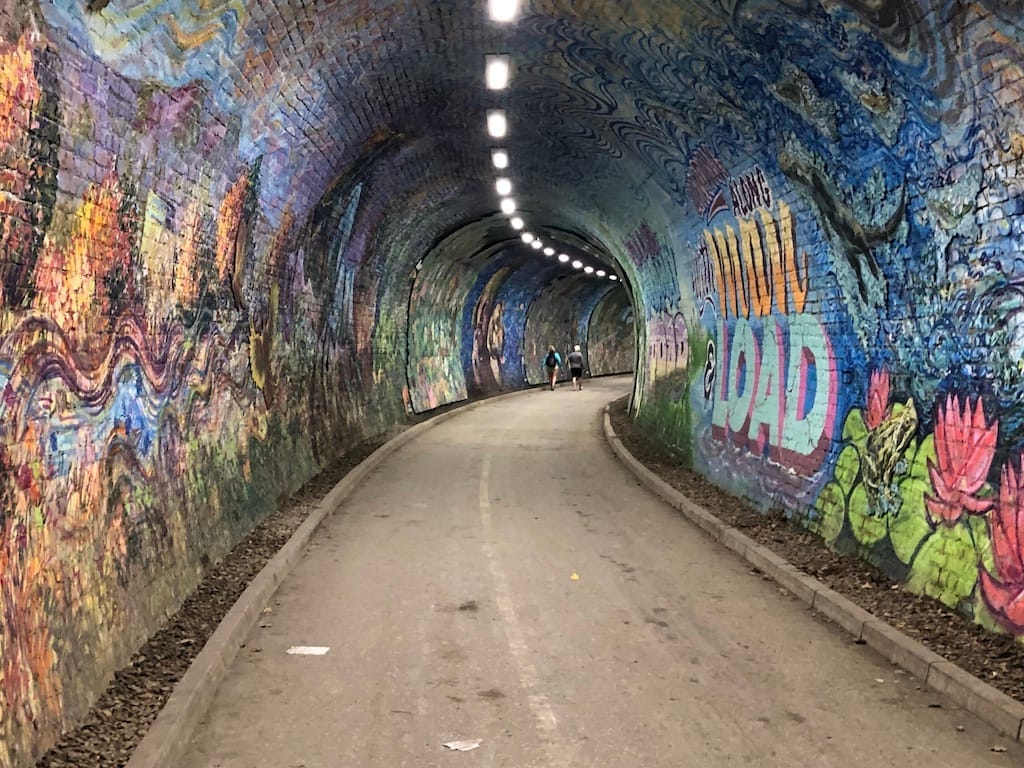
The Colinton Tunnel sits on the Water of Leith Walkway in south-west Edinburgh, roughly 5 km from the city centre. Built in 1874 as part of the Caledonian Railway's Balerno Branch Line, the tunnel carried freight and passengers through the hills above Colinton Village for nearly a century before the line closed in 1967. What was once a forgotten slice of industrial infrastructure has since been reimagined as one of Scotland's most unusual public art installations.
The tunnel is approximately 137 metres long, single-bore, and single-track in its original dimensions. Its interior walls, ceiling, and portals are now covered from end to end in a large-scale heritage mural inspired by Robert Louis Stevenson's poem 'From a Railway Carriage'. The project was developed in the late 2010s by a community-led group and is managed with support from the Water of Leith Conservation Trust. There is no entrance fee and no booking required.
💡 Local tip
Parking is no longer officially available under the Gillespie Road viaduct; instead, park on nearby streets off Gillespie Road or Bridge Road and walk down to the Water of Leith Walkway. From the Colinton-side path, the tunnel entrance is just 130 metres along the Water of Leith Walkway towards Slateford. The closest What3Words reference for the Colinton-side entrance is envy.pills.lands.
The Mural: What You Actually See
Walking into the tunnel from the Colinton end, the first thing that registers is the scale. The mural doesn't begin modestly at eye level — it wraps around the full circumference of the tunnel, floor to ceiling, in a continuous panoramic sequence. Scenes drawn from Stevenson's poem play out in layers: a steam train rushing through farmland, horses grazing, children waving from a bridge, meadows flickering past like frames from an early film.
The artwork references Colinton's own history directly. Stevenson spent time as a child at his grandfather's manse in Colinton Village, and the poem reflects the genuine experience of travelling through this landscape by rail. The mural weaves in local landmarks, period details, and ecological imagery specific to the Water of Leith corridor, giving it a quality that most public art projects don't achieve: it earns its location.
Lighting has been installed throughout the tunnel, which means the mural is visible at any hour. Midday delivers the clearest colours. At dusk or in low winter light, the tunnel glow creates a more atmospheric quality, though the detail in the artwork is slightly harder to read. Photography is straightforward with a wide-angle lens; the curved walls require patience to capture in a single frame without distortion.
ℹ️ Good to know
The tunnel is part of an active shared-use path. Cyclists travel through regularly. Walk to one side and listen for approaching bikes, especially if you stop to photograph.
Tickets & tours
Live prices and dates from our booking partner. If you book, we may earn a commission at no extra cost to you.
West Highland Lochs, mountains and castles tour from Edinburgh
From 61 €Instant confirmationFree cancellationLoch Ness, Glen Coe and the Highlands tour from Edinburgh
From 66 €Instant confirmationFree cancellationDay Trip to Holy Island, Alnwick Castle and Northumbria from Edinburgh
From 60 €Instant confirmationFree cancellationLoch Ness Explorer Day Trip from Edinburgh
From 60 €Instant confirmationFree cancellation
Historical Context: The Balerno Branch Line
The Balerno Branch Line was an approximately 6-mile Caledonian Railway route running from Slateford, in Edinburgh's south-west, out to Balerno and beyond. It opened in stages during the 1870s and served a mix of paper mills, farms, and commuter villages in the Water of Leith valley. The line was never a major artery but it was well-used locally for nearly a century.
The Colinton Tunnel was one of the engineering highlights of the route, bored through the hillside below what is now a residential neighbourhood. After the line closed in 1967, the trackbed was gradually incorporated into the Water of Leith Walkway, creating the long recreational path that now links Balerno in the south-west to Leith on the Firth of Forth. The tunnel became a damp, unused passage until the mural project gave it a new identity.
The wider story of Stevenson's connection to this part of Edinburgh is worth understanding before you visit. For context on other Stevenson-linked sites and Edinburgh's literary landmarks, see the Writers' Museum in the Old Town, which holds manuscripts, portraits, and personal effects from his life.
The Walk: Getting There and What's Around It
The tunnel doesn't exist in isolation. It sits at roughly the mid-point of a section of the Water of Leith Walkway that passes through Colinton Dell, one of the most wooded and secluded stretches of the route. The path follows the river closely, canopied by mature trees, with the sound of water audible almost continuously. In spring the dell fills with wild garlic; in autumn the leaf cover is dense and golden. Even on overcast days, this section of the walkway feels removed from the city.
From the Colinton Village end, the approach passes through Spylaw Park and then into the dell itself, where the path narrows and the tree cover increases. The tunnel entrance appears after a curve in the path, framed by the Victorian stone portal. From the Slateford end, the approach is flatter and more open, passing under the Gillespie Road viaduct where parking is available.
A logical extension is to continue along the Water of Leith Walkway towards Slateford or, in the other direction, deeper into the dell towards Juniper Green. The full walkway runs approximately 12 miles from Balerno to Leith. You don't need to walk all of it — but a 2–3 km stretch through the dell and back, using the tunnel as the turning point, makes a satisfying outing on its own.
⚠️ What to skip
The path through Colinton Dell can be muddy and slippery after rain, particularly in autumn and winter. Wear shoes with grip. The path surface inside the tunnel itself is paved and dry.
When to Visit and What to Expect at Different Times
The tunnel is open at all hours and there is no reason to rush the timing around entry windows. That said, visitor experience changes noticeably by hour and season. Weekday mornings are the quietest, with mostly dog walkers and commuter cyclists moving through quickly. Weekend afternoons, particularly in summer, bring families and casual walkers who tend to linger and take photographs. The tunnel never feels genuinely crowded, but during school holidays it can get busy enough that the space feels cramped if multiple groups stop simultaneously.
Early morning in spring or summer is the most rewarding window. The dell is at its quietest, birdsong carries from the riverbanks, and the low-angled light through the tunnel portal produces clean photography conditions. In winter, the tunnel visit itself is unaffected by weather, but the path outside can be waterlogged after prolonged rain, which makes wellies or trail shoes sensible preparation.
If you're building a half-day itinerary around this area, the tunnel pairs well with a walk through The Meadows or a visit to the Royal Botanic Garden on the way back into the city. Both are free and work well on the same outing for walkers who don't want to pay for anything.
Practical Details: Access, Directions, and Accessibility
By public transport, take Lothian Bus routes 10, 44, or 45 to Colinton. From the village, follow signs into Spylaw Park and then onto the Water of Leith Walkway heading towards Slateford. The walk from the bus stop to the tunnel takes around 10–15 minutes depending on pace. By car, use the postcode EH13 0JX or the Google Plus Code WP5Q+5X. Park on nearby streets off Gillespie Road or Bridge Road and walk down to the Water of Leith Walkway; the Slateford-side tunnel entrance is approximately 130 metres from the path access.
The tunnel has been confirmed as fully accessible, with wheelchair-friendly access routes, good lighting throughout the 24-hour period, and information panels near the entrances. The path through the tunnel itself is level and paved. Note that the wider Colinton Dell path is uneven in places and may not be practical for all mobility aids beyond the tunnel section itself.
There are no toilets, cafes, or visitor facilities at the tunnel itself. Colinton Village, a short walk away, has a small number of local shops and cafes that are suitable for a pre- or post-walk stop. Bring water if you plan to extend your walk along the Walkway.
💡 Local tip
The Colinton Tunnel project is maintained by a charitable organisation. If you enjoy the visit, a small cash donation left via the project's website helps fund ongoing conservation of the mural.
Honest Assessment: Is It Worth the Journey?
The Colinton Tunnel is not a blockbuster attraction. There is no interactive element, no guide, no audio tour, and no gift shop. You walk through a 137-metre tunnel, read some panels, photograph the mural, and leave. For a visitor with only two days in Edinburgh and a list of major sites to cover, the Colinton Tunnel is not a priority.
But for anyone who finds themselves drawn to the overlap of history, public art, and urban landscape, it earns its journey. The mural is genuinely accomplished — not the kind of decorative wall painting applied to brighten up a car park, but something that was designed with care for its location and its subject. The walk to reach it is pleasant in its own right. And the fact that it's completely free and open at any hour removes any friction from the decision to visit.
Travellers who enjoy Edinburgh's less-visited corners should also consider Craigmillar Castle, a paid Historic Environment Scotland site that tends to be overlooked in favour of Edinburgh Castle. Both reward visitors who are willing to travel slightly beyond the city's historic core.
Insider Tips
- Enter from the Slateford side if you're arriving by car. The Gillespie Road viaduct parking is directly adjacent and gives you the longer approach through the tunnel towards the more wooded Colinton Dell section.
- Bring a torch or use your phone's flashlight if you want to examine the upper sections of the mural closely. The installed tunnel lighting is adequate for walking, but some ceiling detail benefits from supplementary light when photographing.
- The tunnel acoustics are surprisingly good. Clap once or speak loudly and the sound bounces off the curved brick in a way that is noticeably different from any other public space in Edinburgh. Children particularly enjoy testing this.
- If you visit during or around the Edinburgh Festival in August, the area stays peaceful. This part of the city is far enough from the Fringe venues that it doesn't get swept up in the crowds, making it a useful escape during a busy visit. See our guide to the
- Check the Water of Leith Conservation Trust's website before visiting if you plan to extend your walk. The trust periodically updates information about path closures or maintenance on the Walkway.
Who Is Colinton Tunnel For?
- Walkers and cyclists using the Water of Leith Walkway as a route or recreational trail
- Art and mural enthusiasts interested in large-scale public heritage projects
- Families with children who can handle a 10–15 minute walk from the bus stop
- Budget travellers looking for free, high-quality experiences away from the main tourist corridor
- Literature enthusiasts with an interest in Robert Louis Stevenson and his connection to Edinburgh
Nearby Attractions
Combine your visit with:
- Craigmillar Castle
Craigmillar Castle is a remarkably complete medieval ruin sitting on a low hill 3 miles southeast of Edinburgh's centre. Once a retreat for Mary, Queen of Scots, it rewards visitors with genuine history, sweeping city views, and crowds that are a fraction of Edinburgh Castle's.
- Cramond Beach & Island
A short bus or drive from the city centre, Cramond Beach leads to one of Edinburgh's most unusual free attractions: a tidal island in the Firth of Forth, reachable only during a narrow low-tide window. Sandy shores, wartime concrete pylons, and quiet woodland paths make this a world away from the Royal Mile.
- Edinburgh Zoo
Set across 82 acres of wooded hillside in western Edinburgh, Edinburgh Zoo is Scotland's largest wildlife attraction and home to over 2,500 animals. It holds a remarkable place in zoo history as the first zoo in the world to successfully house and breed penguins, and it remains the only UK zoo incorporated by royal charter.
- Forth Bridge
The Forth Bridge is one of the most recognisable structures in Scotland, a Victorian-era cantilever railway bridge spanning the Firth of Forth near South Queensferry. Inscribed as a UNESCO World Heritage Site in 2015, it remains an active railway crossing and a landmark that rewards a dedicated half-day trip from Edinburgh.
Planning a trip? Discover personalized activities with the Nomado app.