The Writers' Museum: Edinburgh's Free Tribute to Burns, Scott, and Stevenson
Tucked inside a 1622 merchant's townhouse off the Royal Mile, the Writers' Museum holds one of Scotland's most personal literary collections. Entry is free, the rooms are intimate, and the exhibits connect three of Scotland's greatest writers to real objects they touched. It rewards slow, curious visitors.
Quick Facts
- Location
- Lady Stair's House, Lady Stair's Close, Lawnmarket, Royal Mile, Edinburgh EH1 2PA
- Getting There
- Short walk from Edinburgh Castle along the Royal Mile; nearest bus stops on Lawnmarket (Royal Mile). Waverley Station is roughly 10 minutes on foot.
- Time Needed
- 45 minutes to 1.5 hours depending on your interest in the three writers
- Cost
- Free admission; voluntary donations welcomed.
- Best for
- Literature lovers, Scottish history enthusiasts, families with older children, solo travelers
- Official website
- www.edinburghmuseums.org.uk/venue/writers-museum
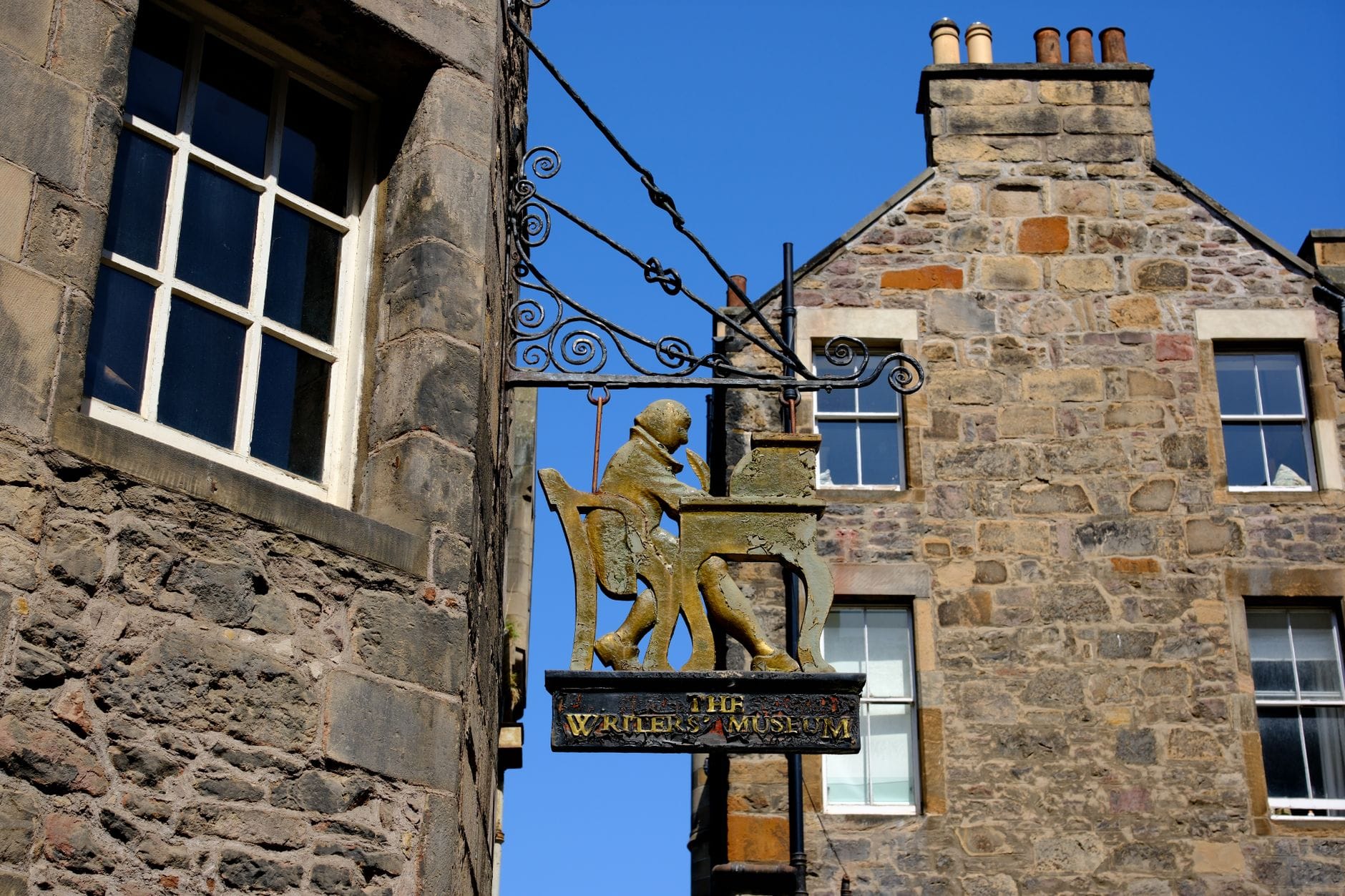
Finding the Museum: The Walk Through Lady Stair's Close
The Writers' Museum is easy to miss, which is part of its character. From the Lawnmarket section of the Royal Mile, you step into Lady Stair's Close, a narrow stone lane that drops slightly downhill and bends out of sight. Within seconds, the noise of tourist traffic on the Royal Mile fades behind you. The close opens into Makars' Court, a quiet cobbled courtyard where flagstone pavers are engraved with quotations from Scottish writers across the centuries. Take a moment here before going inside. The stones underfoot include lines from poets most visitors won't recognise alongside lines from Burns and Stevenson, and the contrast is quietly instructive about how deep Scotland's literary tradition actually runs.
The building at the end of the courtyard is Lady Stair's House, constructed in 1622 by Edinburgh merchant burgess William Gray. It's a compact, crow-stepped townhouse typical of early 17th-century Edinburgh domestic architecture: narrow, multi-storey, built upward rather than outward due to the confined topography of the Old Town ridge. The house later came into the possession of Elizabeth, Dowager Countess of Stair, who gives it its current name. In 1907, the building was gifted to the City of Edinburgh and subsequently became the home of the Writers' Museum.
💡 Local tip
Walk the full length of Makars' Court before entering the museum. The inscribed stone pavers contain quotations from dozens of Scottish writers, and they're easy to overlook if you head straight for the door.
What the Museum Covers: Three Writers, Three Floors
The Writers' Museum dedicates its collection to three figures: Robert Burns, Sir Walter Scott, and Robert Louis Stevenson. Each writer occupies a distinct section of the building, and the museum's modest scale means you genuinely move through rooms rather than galleries, with low ceilings, wood panelling, and the slightly uneven floors you'd expect from a four-century-old structure. The effect is more like visiting a private home than touring a conventional museum, which suits the material well.
The Burns collection includes a writing desk, a rare portrait painted during his lifetime, and manuscript material including an original draft of 'Scots Wha Hae'. The Scott section holds his dining chair from Abbotsford, a cast of Burns's skull displayed among the literary collections made after his death in 1832, and first editions of Waverley and Rob Roy. The Stevenson rooms feel the most personal: his riding boots, his fishing rod, his hand-annotated manuscripts, and a lock of his hair are among the items on display. The breadth of personal objects, not just printed books, is what distinguishes this collection from a library exhibit.
For context on how these writers fit into Edinburgh's literary geography, the Edinburgh literary walking routes offer a broader view of the city's writing culture, while the St Giles' Cathedral a few hundred metres down the Royal Mile holds memorials to Robert Louis Stevenson and other Scottish figures worth seeing in the same half-day.
Tickets & tours
Live prices and dates from our booking partner. If you book, we may earn a commission at no extra cost to you.
West Highland Lochs, mountains and castles tour from Edinburgh
From 61 €Instant confirmationFree cancellationLoch Ness, Glen Coe and the Highlands tour from Edinburgh
From 66 €Instant confirmationFree cancellationDay Trip to Holy Island, Alnwick Castle and Northumbria from Edinburgh
From 60 €Instant confirmationFree cancellationLoch Ness Explorer Day Trip from Edinburgh
From 60 €Instant confirmationFree cancellation
The Building Itself: What to Notice Architecturally
Lady Stair's House is one of relatively few surviving examples of early 17th-century Edinburgh domestic architecture in the Old Town. The building's exterior reads as plain stone, but the proportions of the windows, the crow-stepped gable ends, and the narrow turnpike staircase inside are characteristic of the period and worth attention. The staircase in particular, a tight spiral of worn stone steps connecting the floors, gives a physical sense of how Edinburgh's 17th-century merchant class actually lived: in buildings built for function rather than display, crammed onto a narrow ridge of volcanic rock.
The building is listed and protected, which means the museum works within significant physical constraints. Rooms are small, display cases are compact, and interpretive signage is understated rather than elaborate. Some visitors find this atmospheric; others find it slightly frustrating if they're expecting a large, well-lit gallery experience. Manage expectations accordingly.
When to Visit: Time of Day and Seasonal Considerations
The museum opens seven days a week from 10:00 to 17:00, with last entry at 16:30. Verify current hours directly with the museum before visiting, as hours have changed over recent years and listings across various tourism sites remain inconsistent.
The best time to visit is mid-morning on a weekday, between 10:00 and 11:30. The rooms are small enough that a group of twenty people feels crowded, and during August the Royal Mile draws enormous numbers of festival visitors, some of whom drop into the museum opportunistically. By late morning the courtyard in Makars' Court also catches decent light on clear days, making it a pleasant stop before or after your visit to photograph the inscribed stones.
If you're planning your visit around the festival period, the Edinburgh Fringe guide explains how August crowds affect Old Town logistics, including the streets immediately around the Royal Mile.
⚠️ What to skip
The museum is open seven days a week from 10:00 to 17:00, with last entry at 16:30. Always check current hours at edinburghmuseums.org.uk before making a dedicated trip. Always check current hours at edinburghmuseums.org.uk before making a dedicated trip.
The Experience in Practice: Sensory and Practical Details
Inside, the museum is quiet in a particular way: the thick stone walls and small windows absorb sound rather than reflect it. In winter, the building retains a slight chill that no amount of central heating fully eliminates, so an extra layer is worth having. In summer, the same walls keep the interior noticeably cooler than the street outside, which can feel like relief after a warm day on the Royal Mile.
Lighting is relatively low in parts of the collection, partly to protect manuscript material and partly because the windows are small. If you're interested in reading manuscript text closely, give your eyes a moment to adjust. The museum's staff are typically attentive and knowledgeable, and the smaller number of visitors compared to Edinburgh Castle or the Palace of Holyroodhouse means questions get real answers rather than scripted ones.
Photography is generally permitted without flash throughout the museum, though always defer to signage in individual rooms. The museum has no cafe, no cloakroom, and no gift shop of significant scale. It's not a facility-heavy experience. Nearest public toilets and coffee options are back on the Royal Mile.
Who This Museum Is For, and Who Might Not Connect With It
The Writers' Museum works best for people who already have some familiarity with at least one of the three writers. If you've read Treasure Island, Kidnapped, or Jekyll and Hyde, the Stevenson rooms carry real weight. If you know Burns mainly as a name on shortbread tins, the collection is still interesting but requires more interpretive effort. The museum's signage provides context, but it's not a deep-dive introductory experience in the way that a larger national institution might be.
Families with younger children may find the space less engaging than the interactive exhibits at the National Museum of Scotland, which is a ten-minute walk away and covers Scottish history and culture at a scale and interactivity level better suited to mixed-age groups.
Visitors with mobility limitations should be aware that the building's age and listed status create real access constraints. The turnpike staircase is steep and narrow, and some areas of the museum may not be reachable for wheelchair users or those with limited mobility. Contact the museum in advance to confirm which sections are accessible on any given visit.
Combining the Writers' Museum With the Surrounding Old Town
The museum sits at the top of the Royal Mile, which means it fits naturally into a morning that starts at Edinburgh Castle and works down toward Holyrood. The castle is roughly a three-minute walk uphill from Lady Stair's Close. The Writers' Museum makes a useful counterpoint to the castle's military and royal focus: it offers an interior, literary, and domestic perspective on Edinburgh's history that the castle doesn't provide.
Further down the Royal Mile, Gladstone's Land is another preserved 17th-century Old Town tenement managed by the National Trust for Scotland, and pairing the two gives a richer sense of how this part of Edinburgh actually looked and functioned four centuries ago. The Real Mary King's Close is a short walk in the same direction for those interested in the underground archaeology of the Old Town, though that attraction carries an entry charge.
For a broader orientation to what Old Town Edinburgh offers as a neighborhood, the Old Town Edinburgh area guide covers key streets, landmarks, and how to navigate the closes and wynds efficiently.
Insider Tips
- Read the Makars' Court pavestones in sequence before entering: they run chronologically from early Scottish poetry to contemporary writers and function as a kind of outdoor anthology that sets the museum's context far better than any introductory panel inside.
- The Stevenson section is typically the least crowded, even when the Burns rooms have a cluster of visitors. If you want the most time with the most personal objects, start there and work backwards.
- The museum is an ideal rainy-day stop precisely because it's small: you won't feel pressured to rush through to justify a ticket price, and the thick stone walls make it genuinely comfortable shelter.
- A suggested donation of around £3 is welcomed by the museum. As a free attraction operated by the City of Edinburgh, it depends partly on voluntary contributions, and the collection's quality warrants it.
- If you're visiting during August, arrive when the museum opens at 10:00. By late morning the close and courtyard fill with festival foot traffic, and the small interior rooms can become uncomfortably crowded by early afternoon.
Who Is The Writers' Museum For?
- Literature enthusiasts with existing knowledge of Burns, Scott, or Stevenson
- Solo travelers who prefer a quiet, reflective cultural stop over large gallery crowds
- Budget travelers and those on a free-attractions itinerary
- Architecture and history visitors interested in 17th-century Edinburgh domestic buildings
- Visitors combining a Royal Mile walking itinerary with depth stops rather than quick photo opportunities
Nearby Attractions
Other things to see while in Old Town:
- Camera Obscura & World of Illusions
Perched at the top of the Royal Mile beside Edinburgh Castle, Camera Obscura & World of Illusions combines a Victorian optical instrument with five floors of hands-on illusions and a rooftop view over the Old Town. It is one of Edinburgh's most distinctive indoor attractions, best suited to curious minds of all ages.
- Edinburgh Castle
Edinburgh Castle dominates the Old Town skyline from its perch atop a 135-metre volcanic crag. From the city's oldest building to the Scottish Crown Jewels, here is everything you need to decide whether it deserves a half-day of your trip.
- The Edinburgh Dungeon
The Edinburgh Dungeon is a live-actor walk-through experience covering 1,000 years of Scotland's darkest history, staged beneath the Old Town streets. Theatrical, loud, and deliberately unsettling, it suits thrill-seekers and older children more than museum-goers expecting quiet reflection.
- Edinburgh Farmers' Market
Every Saturday morning, Castle Terrace fills with around 40 to 60 stalls selling Scottish produce directly from the people who grow, rear, and make it. Edinburgh Farmers' Market has been running since around 2000 and is widely regarded as one of the largest weekly farmers' markets in Scotland by stall count. Entry is free, and the market wraps up by 2pm sharp.
Planning a trip? Discover personalized activities with the Nomado app.