Edinburgh Farmers' Market: One of Scotland's Biggest Weekly Food Markets
Every Saturday morning, Castle Terrace fills with around 40 to 60 stalls selling Scottish produce directly from the people who grow, rear, and make it. Edinburgh Farmers' Market has been running since around 2000 and is widely regarded as one of the largest weekly farmers' markets in Scotland by stall count. Entry is free, and the market wraps up by 2pm sharp.
Quick Facts
- Location
- Castle Terrace, Edinburgh, EH1 2EN (below Edinburgh Castle)
- Getting There
- 10-min walk from Haymarket station; Lothian Buses 23, 24, 27, 41, 42 on Lothian Road; tram to Princes Street then walk
- Time Needed
- 45 minutes to 2 hours, depending on how much you browse and eat
- Cost
- Free entry; budget £5–£20 for food and produce purchases
- Best for
- Food lovers, self-catering visitors, Saturday morning wanderers, families
- Official website
- www.edinburghfarmersmarket.co.uk
What Is Edinburgh Farmers' Market?
Edinburgh Farmers' Market is an outdoor weekly market held every Saturday on Castle Terrace, a wide paved street that runs along the southern base of Edinburgh Castle's volcanic rock. It is one of One of Scotland's largest weekly farmers' marketss by stall count, with between 40 and 60 producers setting up from 9am to 2pm, year-round, most weeks of the year.
The market has been running on this site since the early 2000s, starting as an event organized by the City of Edinburgh Council before transferring to Edinburgh City Centre Management and shifting to its current weekly format. In 2006, Country Life Magazine named it Britain's Favourite Farmers' Market, and in 2007 it received the FARMA Certified Farmers' Market of the Year award. Both recognitions point to something that regular visitors already know: the stall criteria here are strict, and the sourcing is genuine.
ℹ️ Good to know
Stallholders must meet specific criteria to trade here — produce must be grown, reared, caught, or made by the seller. You are buying directly from the producer, not a wholesaler or reseller.
The Market Experience: What You'll Actually Find
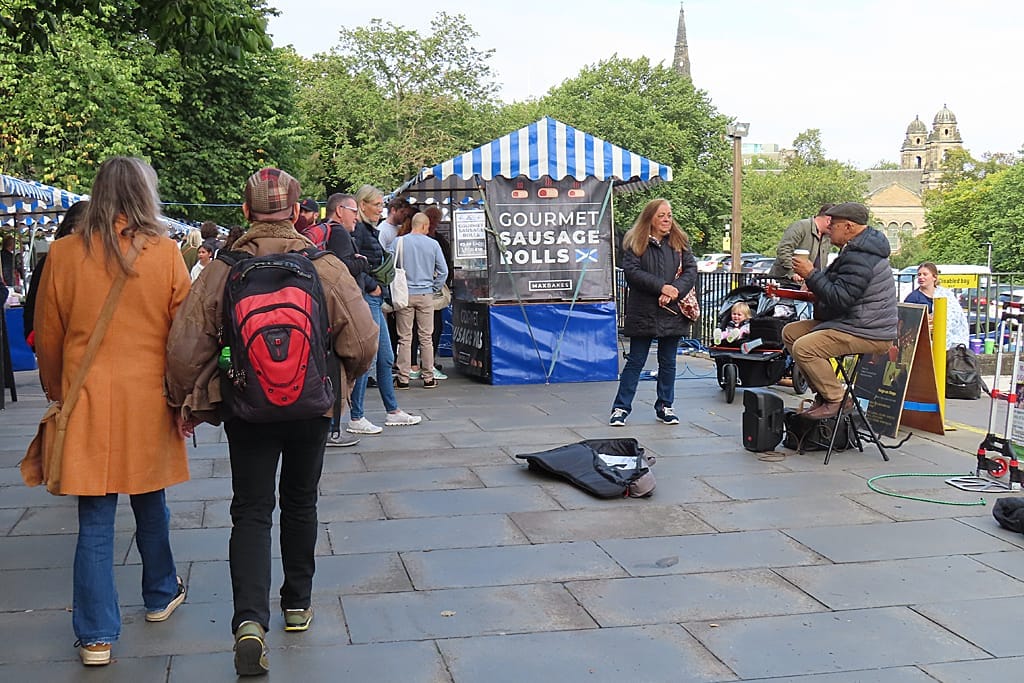
Walking onto Castle Terrace on a Saturday morning, the first thing you notice is the smell: woodsmoke from a grill, something baking, coffee from a small espresso setup. The stalls are arranged along the street in a rough double row, which means you can move through the whole market and back without retracing your steps.
Typical produce includes Scottish beef, lamb, venison, and pork from farms across the Borders, Perthshire, and the Highlands. Alongside meat, you'll find artisan cheeses, cold-pressed rapeseed oil, fresh vegetables, smoked fish, jams, honeys, sourdough bread, and a rotating selection of ready-to-eat hot food. The hot food stalls tend to draw the longest queues, particularly anything involving slow-cooked meat or filled rolls.
Not every stall appears every week. Producers rotate depending on the season and their own harvest schedules, which means the market in October looks noticeably different from the market in May. Winter brings root vegetables, game meat, and warming soups. Spring and summer introduce salad leaves, fresh herbs, and seasonal berries. This seasonal variation is part of what keeps regular visitors coming back.
If you want to understand what Edinburgh's food culture actually tastes like beneath the tourist surface, this market is one of the more honest starting points. It connects directly to the city's wider food identity, which you can explore further in the Edinburgh food guide.
Tickets & tours
Live prices and dates from our booking partner. If you book, we may earn a commission at no extra cost to you.
West Highland Lochs, mountains and castles tour from Edinburgh
From 61 €Instant confirmationFree cancellationLoch Ness, Glen Coe and the Highlands tour from Edinburgh
From 66 €Instant confirmationFree cancellationDay Trip to Holy Island, Alnwick Castle and Northumbria from Edinburgh
From 60 €Instant confirmationFree cancellationLoch Ness Explorer Day Trip from Edinburgh
From 60 €Instant confirmationFree cancellation
Timing: When to Arrive and When to Avoid
The market opens at 9am and closes at 2pm. Arriving early, between 9am and 10am, gives you the quietest experience and the best selection at every stall. Popular items, particularly artisan bread, smoked fish, and certain cheese varieties, often sell out before noon. If you're hoping to buy specific things, don't leave it until 1pm.
Between 10:30am and noon, the market reaches its busiest point. Families with pushchairs, groups of friends, and tourists on walking itineraries all converge at this time. The aisles between stalls narrow quickly when it gets crowded, and the hot food queue can stretch to a 10-to-15 minute wait. If you dislike that kind of Saturday morning density, aim for arrival right at 9am or just after 1pm when things begin to thin out.
💡 Local tip
Bring a reusable bag. Most stallholders provide paper bags for smaller purchases, but for a larger shop you'll want your own carry capacity. There's no single checkout — you pay at each stall individually, and many now accept card, but some smaller producers are cash-only.
Weather matters significantly for this market because it is entirely outdoors with no cover overhead. On dry days it functions exactly as described. In rain, a number of stalls run under their own canopies but the overall atmosphere becomes considerably less pleasant, and foot traffic drops sharply. Edinburgh in winter means a realistic chance of cold, wet Saturdays, so check the forecast the evening before.
Location and Getting There
Castle Terrace sits directly below the castle rock, which means the market operates with one of the more dramatic backdrops of any food market in the UK. Looking north from the stalls, the castle looms above. It's a setting that tends to produce a lot of photographs, particularly in good light.
From Edinburgh Waverley station, the walk takes around 10 minutes: west along Princes Street, then south via either the steps at the western end of Princes Street Gardens or Lothian Road. From Haymarket station, the walk is about 10 minutes east along Morrison Street and then onto Castle Terrace. Lothian Buses routes 23, 24, 27, 41, and 42 stop on Lothian Road, which puts you about 3 minutes' walk from the market entrance. The nearest Edinburgh Trams stop is Princes Street, from which the walk is roughly 8 to 10 minutes.
The market sits at the edge of the Old Town, making it easy to combine with a morning walk along the Royal Mile or a visit to the castle. Castle Terrace also has a multi-storey car park immediately adjacent, with paid parking available for those driving in.
Historical and Cultural Context
The farmers' market movement in Scotland gained significant momentum in the late 1990s, driven partly by public concern following the 1996 BSE crisis and a broader cultural shift toward knowing where food comes from. Edinburgh's market launched in this context, and its strict producer-only criteria were built in from the start rather than retrofitted later.
Running continuously for over two decades on the same site has given the market a permanence unusual among urban food markets. Stalls that started in the early 2000s still appear regularly, and the intergenerational nature of some farming families means you'll sometimes find the same surname on a stall that appeared in the market's first years.
The market sits within a neighborhood defined by historic institutions. A few minutes' walk east along the Royal Mile puts you at St Giles' Cathedral, while the castle above is Edinburgh Castle, one of the country's most visited paid attractions. The Saturday morning timing means you can combine the market with either, though the castle itself typically gets busy from mid-morning.
Photography, Accessibility, and Practical Notes
Castle Terrace is a paved, level surface throughout, which means the market is navigable with a pushchair or wheelchair without significant difficulty. The stalls themselves vary in height and layout, but most produce is displayed at a standard counter level. For specific accessibility queries, contacting the market operator directly via the official website is the most reliable route, as no formal accessibility statement is published.
For photography, the best light arrives early. Between 9am and 10am in summer, the low morning sun catches the castle rock from the east and throws useful directional light across the stall displays. By late morning, the market is shadowed on its north side as the castle rock blocks direct sunlight. If you want clean shots of the market with the castle in the background, arrive early and position yourself at the eastern end of the stalls looking west.
⚠️ What to skip
The market closes at 2pm without exception. Several visitors arrive at 1:45pm expecting a full market and find many stalls already packing down. If you want the full experience, arrive before noon.
Who Should Skip This
If you're visiting Edinburgh with less than a full day and your priority is major landmarks, the farmers' market might not justify the time unless you happen to be there on a Saturday morning and are already walking past. It is not a spectacle in the way that Edinburgh Castle or Holyrood Park are spectacles; it's a working food market that rewards engagement more than observation.
Visitors on very tight budgets who plan not to spend anything may find a free pass through the stalls feels thin after a few minutes. The market is most satisfying when you're buying, tasting, and talking to producers. It's also not a good fit for anyone who struggles with crowds between 10:30am and noon, particularly in the narrow stall corridors that form when foot traffic peaks.
Those looking for something broader in scope, with more non-food retail and a different atmosphere, might prefer to explore Stockbridge Market on a Sunday morning instead, which has a different character and neighbourhood feel.
Insider Tips
- Arrive before 10am if you want bread from the artisan bakers — sourdough loaves and specialty rolls often sell out within the first hour.
- Look for producers who offer tasting samples before you buy. Many cheese and charcuterie stalls encourage this, and it's part of the point of a certified farmers' market.
- The stalls at the western end of Castle Terrace near the car park entrance tend to have shorter queues than those in the middle of the market run. If you spot something you want at a busy stall, check whether a similar producer nearby has a shorter wait.
- Some stallholders take card payments through mobile readers, but the supply of change runs low at popular cash-only stalls by mid-morning. Carry at least £10 in small notes and coins.
- On cold winter mornings, the hot food stalls draw the biggest crowds earliest. If you want a coffee and a warm roll without queuing, skip the most prominent stall and look for the smaller setups at each end of the market.
Who Is Edinburgh Farmers' Market For?
- Food-focused travelers who want to eat Scottish produce bought directly from the farmer or maker
- Self-catering visitors staying in apartments who want to stock up on quality local ingredients
- Families with children looking for an easy Saturday morning activity with food involved
- Photographers after a distinctive urban-food-market setting with a castle backdrop
- Anyone with an hour free on a Saturday morning who wants something genuinely local rather than tourist-facing
Nearby Attractions
Other things to see while in Old Town:
- Camera Obscura & World of Illusions
Perched at the top of the Royal Mile beside Edinburgh Castle, Camera Obscura & World of Illusions combines a Victorian optical instrument with five floors of hands-on illusions and a rooftop view over the Old Town. It is one of Edinburgh's most distinctive indoor attractions, best suited to curious minds of all ages.
- Edinburgh Castle
Edinburgh Castle dominates the Old Town skyline from its perch atop a 135-metre volcanic crag. From the city's oldest building to the Scottish Crown Jewels, here is everything you need to decide whether it deserves a half-day of your trip.
- The Edinburgh Dungeon
The Edinburgh Dungeon is a live-actor walk-through experience covering 1,000 years of Scotland's darkest history, staged beneath the Old Town streets. Theatrical, loud, and deliberately unsettling, it suits thrill-seekers and older children more than museum-goers expecting quiet reflection.
- Edinburgh Festival Fringe
Every August, the Edinburgh Festival Fringe transforms the Scottish capital into the world's largest performing arts festival. Spread across hundreds of venues from grand theatres to pub back rooms, it draws thousands of performers and hundreds of thousands of visitors over three weeks. Here is how to make sense of it.
Planning a trip? Discover personalized activities with the Nomado app.