St Giles' Cathedral: The Heart of Edinburgh's Royal Mile
Standing at the centre of the Royal Mile, St Giles' Cathedral, formally the High Kirk of Edinburgh, has shaped Scottish religious and political life for nine centuries. Entry is free, the architecture is genuinely extraordinary, and the Thistle Chapel alone justifies the detour.
Quick Facts
- Location
- High Street, Edinburgh EH1 1RE (Royal Mile, Old Town)
- Getting There
- Walk from Waverley Station (10 min) or take any bus to North Bridge / High Street
- Time Needed
- 45–90 minutes
- Cost
- Currently free with donations welcome; from September 2026 non-Scotland residents may pay a tourist admission fee — check the official site. Some events and tours may be ticketed.
- Best for
- History, architecture, quiet reflection, photography
- Official website
- www.stgilescathedral.org.uk
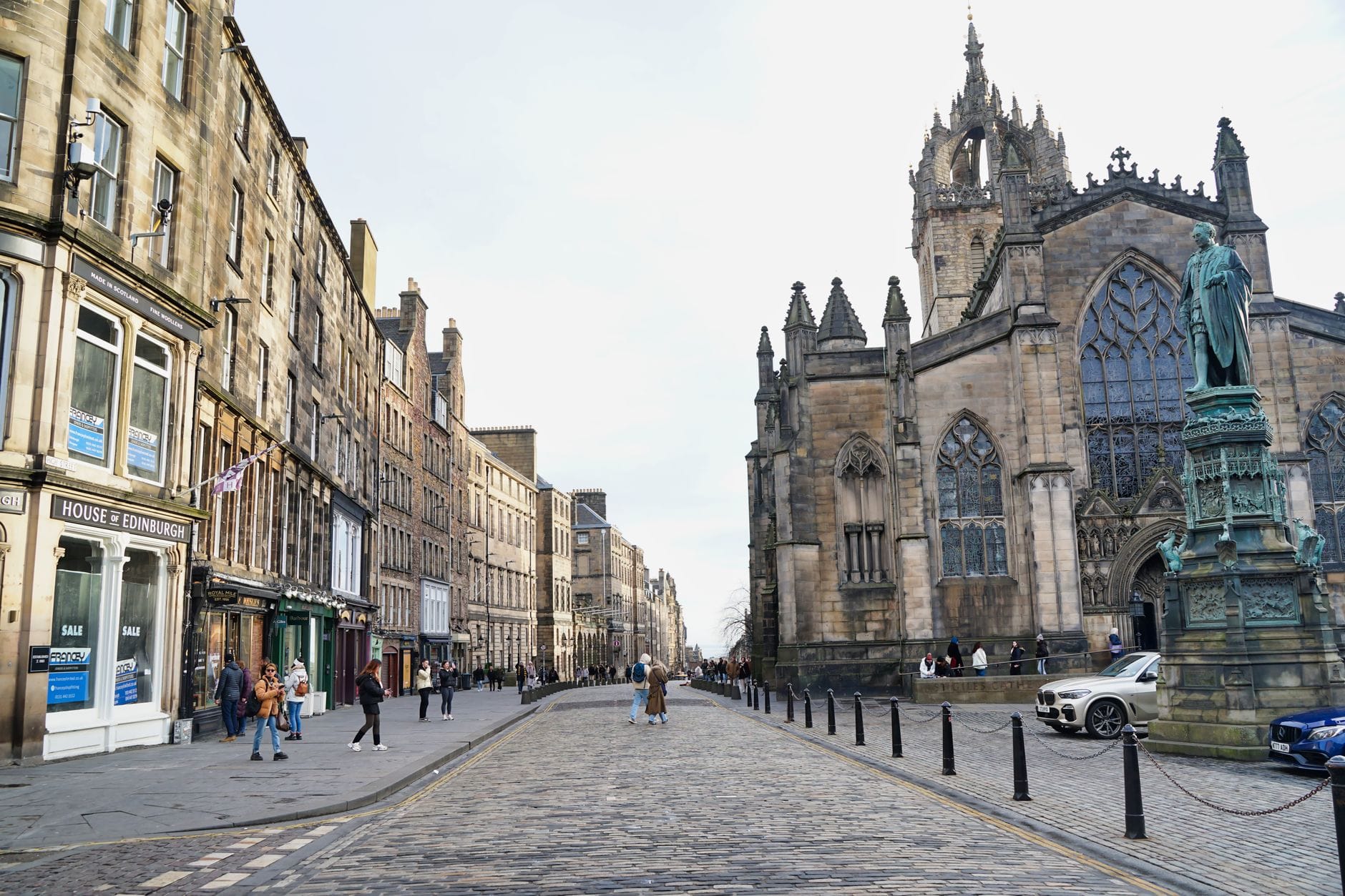
What Is St Giles' Cathedral?
St Giles' Cathedral, officially the High Kirk of Edinburgh, is the spiritual and civic centrepiece of the Old Town. It sits midway along the Royal Mile, between Edinburgh Castle uphill and the Palace of Holyroodhouse at the foot of the slope. On all sides, the grey stone rises into a distinctive crown spire, one of only four surviving medieval crown spires in all of Scotland, visible from streets below and a reliable orientation point as you navigate the Old Town.
Despite its popular name, St Giles' has only briefly functioned as a true cathedral. It held that status in two periods: 1633 to 1638 and again 1661 to 1689, when Edinburgh temporarily had a bishop. Today it operates as the principal Church of Scotland parish church for this part of the Old Town, not a Roman Catholic institution, and not under the authority of Canterbury. That distinction matters for understanding the building's interior, which is restrained compared to the incense-heavy grandeur of Continental Catholic cathedrals, but no less powerful.
ℹ️ Good to know
Opening Hours: Sunday services are held at 9:30am and 11:00am, with a 15 minute prayer service every weekday at noon. Hours may vary around services and events. Check the official site before visiting. Hours may vary around services and events. Check the official site before visiting.
Nine Centuries of History on One Site
A church was founded on this site in 1124 by King David I, making it one of the oldest places of continuous Christian worship in Scotland. The structure you walk into today was largely built in the 14th century and extended into the early 16th century, meaning the stone underfoot and the nave columns around you have stood through the Reformation, the Jacobite uprisings, two world wars, and the creation of the Scottish Parliament.
The Reformation of 1560 changed St Giles' fundamentally. John Knox, the thunderous preacher who led Scotland's Protestant revolution, served as minister here and preached from this pulpit. His influence shaped not just the building, which was stripped of many Catholic decorations, but the character of Scottish religious life for centuries. A statue of Knox stands in the nave, stern-faced and pointing as if mid-sermon.
Knox's legacy is also central to Edinburgh's broader story. If you want to understand the man beyond the myth, the John Knox House on the Royal Mile is a short walk east and provides rich context for what you'll see inside St Giles'.
One of the most contested moments in the building's history came in 1637, when Jenny Geddes, a local market trader, reportedly hurled her stool at the dean during an attempt to impose Anglican worship on the Scottish congregation. The event triggered riots and set in motion the chain of events that would eventually lead to the English Civil War. A plaque marks where she is said to have sat. It is, by some distance, the most famous stool in Scottish history.
Tickets & tours
Live prices and dates from our booking partner. If you book, we may earn a commission at no extra cost to you.
Walking tour of Glasgow City Centre
From 14 €Instant confirmationFree cancellationCity Sightseeing Hop-On Hop-Off Bus Tour of Glasgow
From 0 €Instant confirmationFree cancellationPrivate Glasgow dark side tour
From 87 €Instant confirmationFree cancellationPrivate Glasgow City Centre walking tour
From 87 €Instant confirmationFree cancellation
The Thistle Chapel: The Detail That Stops People
Built between 1909 and 1911 to a design by Robert Lorimer, the Chapel of the Order of the Thistle is the most visually dense space in the entire building. The Order of the Thistle is Scotland's highest order of chivalry, equivalent in prestige to England's Order of the Garter, and its chapel here is where knights are installed and their heraldic achievements displayed.
The carving is extraordinary. Every surface of the small chapel seems to contain something: angels playing Scottish instruments, intricate foliage, the armorial bearings of current and past knights, and the carved oak stalls where members sit during ceremonies. The craftsmanship is so dense that visitors who rush through the main nave often stop completely when they reach this corner and don't move for ten minutes. Look upward at the vaulted ceiling, and look closely at the individual carvings on the stall canopies, where some of Scotland's most celebrated woodcarvers left their mark.
💡 Local tip
Photography tip: The Thistle Chapel is small and often has other visitors. Visit on a weekday morning for a quiet moment with the carvings. The stained glass is best lit in the afternoon.
What It Feels Like to Visit
The exterior plaza in front of St Giles' is one of the busiest points on the Royal Mile. Guided tour groups gather, street performers occasionally set up on the cobbles, and the Heart of Midlothian, a heart-shaped mosaic set into the cobblestones nearby, draws visitors who stop to spit on it for luck. It is all very lively, and it ends the moment you step through the doors.
Inside, the noise drops sharply. The stone walls, thick nave columns, and high vaulted ceiling absorb sound in a way that immediately changes your pace. The interior is lit partly by stained glass and partly by overhead lighting that picks out the stonework. In the morning, when light comes from the east-facing windows, the nave has a cool, filtered quality. By mid-afternoon, the west end catches warmer light and the colours in the glass shift noticeably.
The space is not overwhelming in scale, nothing like the sheer size of Notre-Dame or Westminster Abbey, but it is richly layered. There are memorials to historical figures, regimental remembrances, monuments to the Covenanters, and that famous statue of Knox. Visitors tend to move slowly and read, which gives the space a contemplative atmosphere even when there are thirty people in the building simultaneously.
Sunday afternoons are the quietest window for a reflective visit, though hours are shorter (13:00–17:00). Weekday mornings before 11:00 are also relatively calm. Avoid the 10:30–13:00 window on weekday mornings in summer, when the Royal Mile reaches peak foot traffic and the cathedral receives the bulk of its tourist flow.
Practical Information for Your Visit
Entry to St Giles' is free. Donations are genuinely welcome and support the building's ongoing conservation. There is no obligation, but the suggested donation boxes are placed near the entrance and at the Thistle Chapel. If you've spent twenty minutes in the Thistle Chapel alone, a small contribution feels appropriate.
Saturday mornings from 09:00 to 10:00 are designated as a Quiet Hour, designed to provide a calmer experience for visitors who benefit from reduced noise and crowds. This includes families with young children who might find the standard visitor flow overwhelming, and anyone seeking a more meditative visit. For accessibility-specific information, including step-free access and facilities, contact the cathedral directly via the official website, as detailed accessibility information is not comprehensively listed in general sources.
St Giles' sits on the Royal Mile in the heart of Edinburgh's Old Town. Waverley Station is roughly a ten-minute walk downhill via the North Bridge or the Waverley Steps. Numerous Lothian Buses stop at nearby High Street and North Bridge, making it accessible from most parts of the city without needing to plan around specific routes.
⚠️ What to skip
The cathedral closes for services, special events, and occasional private ceremonies. If you're making a specific trip, check the official calendar at stgilescathedral.org.uk before you go.
St Giles' in the Wider Context of the Royal Mile
St Giles' Cathedral does not exist in isolation. It is the midpoint of one of Europe's most historically loaded streets, and the attractions around it reward a half-day walk. Uphill, Edinburgh Castle dominates the skyline. Downhill, the Palace of Holyroodhouse marks the Royal Mile's end. If you are building an itinerary around this stretch, St Giles' works best as a mid-morning stop between the castle and a walk down toward Holyrood.
The street-level area around St Giles' also puts you within a few minutes of the Real Mary King's Close, the underground network of 17th-century streets preserved beneath the Royal Mile, and Gladstone's Land, a rare surviving example of a 17th-century Edinburgh tenement, now managed by the National Trust for Scotland.
For those working through Edinburgh's history methodically, the 3-day Edinburgh itinerary places St Giles' within a logical sequence that avoids doubling back across the Old Town.
Who This Attraction Is Not For
If you have no interest in religious history, Scottish political history, or architecture, St Giles' may feel like one more stone interior on a street full of stone interiors. The building does not have the interactive exhibits of Dynamic Earth or the sheer dramatic spectacle of the castle. It is a working church, quiet by design, and its rewards are proportional to how much attention you bring to it. Visitors who prefer attractions with audio tours, clearly signposted displays, or hands-on elements may find the experience underwhelming.
Children under ten may struggle to engage unless they are unusually interested in medieval buildings, though the Thistle Chapel's animal carvings and heraldic shields have been known to capture younger imaginations unexpectedly. For families primarily looking for interactive experiences, the National Museum of Scotland on Chambers Street, a ten-minute walk away, is a better starting point.
Insider Tips
- Visit during the Saturday Quiet Hour (09:00–10:00) if you want the building largely to yourself. The atmosphere before the Royal Mile wakes up is genuinely different from the standard tourist window.
- Look up at the crown spire from the cobblestones directly outside the main entrance before going in. It is one of only four surviving medieval crown spires in Scotland and best appreciated from street level.
- The Thistle Chapel requires a separate moment of attention. Do not treat it as a footnote at the end of your visit. Give it ten to fifteen minutes on its own, and bring your phone camera set to portrait mode for the carving detail.
- The Heart of Midlothian mosaic in the cobblestones outside is not inside the cathedral but is immediately adjacent. Local tradition holds that spitting on it brings good luck. It is, authentically, a slightly bizarre piece of Edinburgh street culture and worth knowing about before you witness it for the first time.
- The cathedral has a small shop near the entrance. It stocks Scottish-made items and publications on the building's history. If you want a detailed guide to the interior, this is the place to find one rather than relying solely on the information panels inside.
Who Is St Giles' Cathedral For?
- History enthusiasts who want to understand the Reformation's impact on Scotland
- Architecture lovers drawn to medieval stonework and early 20th-century craft carving
- Travellers seeking a free, quiet counterpoint to the Royal Mile's commercial pace
- Those tracing Edinburgh's literary and political heritage along the Old Town
- Visitors with limited time who want a high-quality, no-cost cultural stop
Nearby Attractions
Other things to see while in Old Town:
- Camera Obscura & World of Illusions
Perched at the top of the Royal Mile beside Edinburgh Castle, Camera Obscura & World of Illusions combines a Victorian optical instrument with five floors of hands-on illusions and a rooftop view over the Old Town. It is one of Edinburgh's most distinctive indoor attractions, best suited to curious minds of all ages.
- Edinburgh Castle
Edinburgh Castle dominates the Old Town skyline from its perch atop a 135-metre volcanic crag. From the city's oldest building to the Scottish Crown Jewels, here is everything you need to decide whether it deserves a half-day of your trip.
- The Edinburgh Dungeon
The Edinburgh Dungeon is a live-actor walk-through experience covering 1,000 years of Scotland's darkest history, staged beneath the Old Town streets. Theatrical, loud, and deliberately unsettling, it suits thrill-seekers and older children more than museum-goers expecting quiet reflection.
- Edinburgh Farmers' Market
Every Saturday morning, Castle Terrace fills with around 40 to 60 stalls selling Scottish produce directly from the people who grow, rear, and make it. Edinburgh Farmers' Market has been running since around 2000 and is widely regarded as one of the largest weekly farmers' markets in Scotland by stall count. Entry is free, and the market wraps up by 2pm sharp.
Planning a trip? Discover personalized activities with the Nomado app.