John Knox House: Edinburgh's Oldest Royal Mile Survivor
John Knox House at 43–45 High Street is one of the oldest surviving medieval buildings on Edinburgh's Royal Mile, dating to around 1470. Now a compact museum integrated with the Scottish Storytelling Centre, it offers a rare chance to step inside an authentically preserved Old Town townhouse and explore the turbulent lives of two figures central to Scottish history.
Quick Facts
- Location
- 43–45 High Street (The Netherbow), Royal Mile, Edinburgh EH1 1SR
- Getting There
- 10-min walk southeast from Edinburgh Waverley station; multiple city buses serve the Royal Mile
- Time Needed
- 30–60 minutes
- Cost
- Adults £7 / Concessions £5.50 / Children 7–16 £1.50 / Under 7 free (verify current rates)
- Best for
- History enthusiasts, Reformation-era Scotland fans, architecture lovers
- Official website
- www.scottishstorytellingcentre.com/john-knox-house
What John Knox House Actually Is
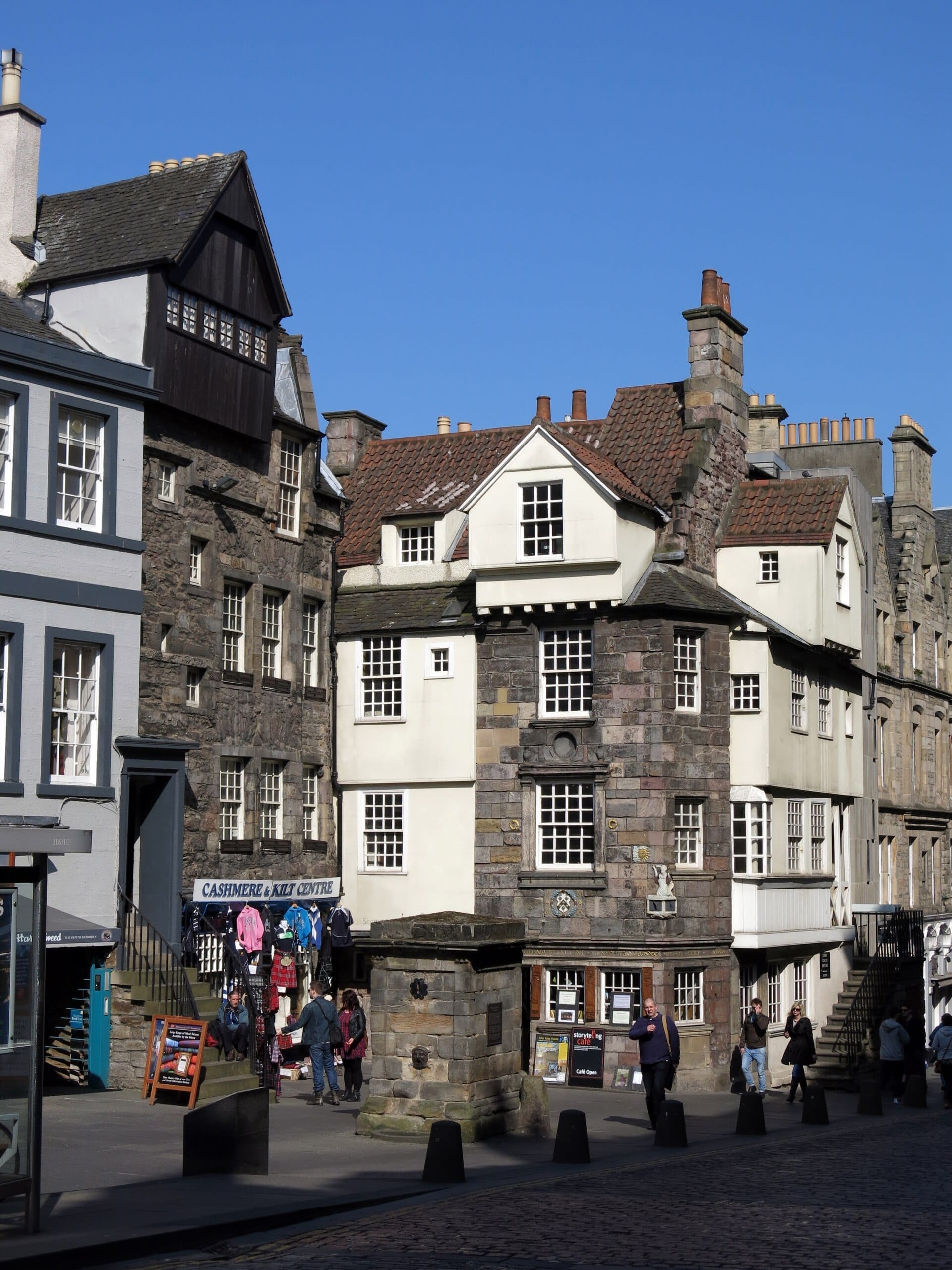
John Knox House is not a grand monument. It is a narrow, timber-fronted medieval townhouse that juts slightly over the pavement at The Netherbow, the old eastern gateway of Edinburgh's city walls. That jutting upper storey, the painted wooden gallery, and the rough stone base give it a silhouette you won't mistake for anything else on the Royal Mile. It dates to around 1470, which makes it one of the oldest original structures still standing on the entire street.
Today it operates as a small museum attached to the Scottish Storytelling Centre, which occupies the modern building directly beside it. The two are connected inside, but admission is charged specifically for John Knox House rather than the wider centre. The museum is compact: four or five rooms spread across several floors, each furnished and interpreted to reflect the building's 16th-century heyday. It is not a major collection-based museum in the style of the National Museum of Scotland a few streets away. What it offers is something harder to find: the physical experience of being inside a building that was already old when Mary, Queen of Scots was on the throne.
💡 Local tip
Check the Scottish Storytelling Centre website before visiting. Opening hours are currently Monday–Sunday 10:00–18:00 (last admission 17:00), but they can shift around events and seasonal programming.
The History Behind the Name
The name attached to this house is historically complicated, and the museum is honest about that. John Knox, the Protestant reformer whose preaching reshaped Scottish religious and political life in the 16th century, is believed to have lived here briefly in the final years of his life, around 1572. But the evidence for this is partial, and the museum does not oversell it. The house is named for Knox largely because his association with it, however brief, became the reason Edinburgh Town Council agreed to preserve the building rather than demolish it during 19th-century street widening.
The figure whose story actually dominates the interpretation is James Mossman, a goldsmith who served Mary, Queen of Scots and who lived here during the building's most significant period of development in the mid-16th century. Mossman was the royal goldsmith responsible for making the Scottish Crown Jewels as they exist today, and he was a committed Marian loyalist at a time when that position was becoming dangerous. He was eventually executed in 1573 after holding Edinburgh Castle for the queen's party long after her cause was lost. His initials and those of his wife, Mariota Arres, can still be seen carved into the building's exterior.
These two men, Knox and Mossman, stood on opposite sides of one of the most consequential political and religious conflicts in Scottish history. The museum uses that tension well. If you are planning a deeper dive into Reformation-era Edinburgh, combining this visit with St Giles' Cathedral, where Knox preached, makes for a coherent and rewarding half-day.
Tickets & tours
Live prices and dates from our booking partner. If you book, we may earn a commission at no extra cost to you.
Self-guided audio tour on the history of witchcraft in Scotland
From 5 €Instant confirmationWest Highland Lochs, mountains and castles tour from Edinburgh
From 61 €Instant confirmationFree cancellationLoch Ness, Glen Coe and the Highlands tour from Edinburgh
From 66 €Instant confirmationFree cancellationDay Trip to Holy Island, Alnwick Castle and Northumbria from Edinburgh
From 60 €Instant confirmationFree cancellation
The Physical Experience of the Building
The staircase is steep and the ceilings are low. The floors creak. Rooms are small and the windows, with their thick glass and deep stone sills, let in surprisingly little of the Royal Mile's noise. This is not a reconstructed period room in a glass case: you are moving through the actual structure, touching walls that have stood for five and a half centuries.
The painted ceiling in one of the upper rooms is a particular highlight, with 16th-century religious inscriptions and decorative motifs that survived because layers of later plaster protected them. Fragments of original timber framing are exposed in places. The overall effect is one of genuine age rather than period theatre. For anyone accustomed to heritage sites that have been sanitised into smooth visitor experiences, John Knox House is a useful corrective.
The ground floor connects to the Scottish Storytelling Centre's café and common areas, which are free to enter. On the Royal Mile side, the building's exterior is worth spending a few minutes with before you go in. The carved stone panel above the door, the wooden gallery on the upper floor, and the corbelled projection are among the best examples of 16th-century domestic architecture left in the city.
When to Visit and How Crowds Work
John Knox House sits on one of the most heavily walked stretches of the Royal Mile, between the Palace of Holyroodhouse and the main tourist cluster around the castle. Most of the foot traffic outside stays outside: the admission charge and the modest profile of the museum mean it never reaches the queue lengths of Edinburgh Castle or the Camera Obscura. In practice, you are unlikely to wait more than a few minutes at the ticket desk even in summer.
The best time to visit is mid-morning on a weekday, when the building is quiet enough that you can linger in each room without feeling pressured to move on. Late afternoon on summer weekends can feel slightly compressed as other visitors filter through the same small spaces. During the Edinburgh Festival Fringe in August, the Scottish Storytelling Centre itself becomes a busy venue, which can add some background activity to the shared areas.
ℹ️ Good to know
The upper floors are not accessible to wheelchair users. Only the ground floor is available to visitors with mobility impairments. If full access matters to your visit, contact the Scottish Storytelling Centre in advance.
John Knox House is a natural stop on any walk through the Old Town, particularly if you are working your way from the castle end of the Royal Mile down towards Holyrood. The walk itself takes around 15–20 minutes end to end, and this house sits roughly at the two-thirds mark.
Photography and Practical Notes
The exterior is best photographed in the morning, when the light falls on the timber-fronted facade from the east and the street below is less crowded with tourist groups. From across the road, you can capture the full height of the building against the Old Town roofline. The carved panel and Mossman initials are on the street-level stonework to the right of the main entrance.
Inside, lighting is dim in the upper rooms to protect the original surfaces, so a phone camera will struggle with the painted ceiling details. A slightly wider lens setting and patience with natural light from the windows will give better results than flash. The wooden gallery visible from the Royal Mile is not publicly accessible but can be seen clearly from the pavement below.
If you are building a day around Old Town history, Gladstone's Land on the Lawnmarket offers a comparable experience of a preserved medieval tenement, and the two complement each other well. For something with a darker atmosphere in the same neighbourhood, Greyfriars Kirkyard is a 15-minute walk away.
Is It Worth Your Time?
At £7 for adults and under 90 minutes, John Knox House is not a major investment. The question is whether the subject matter interests you. If the Scottish Reformation, the conflict between Protestant and Catholic factions in 16th-century Edinburgh, or the physical texture of medieval domestic architecture holds any appeal, this is one of the best places in the city to engage with those subjects at close quarters.
If you are primarily drawn to large collection museums, sweeping views, or interactive family experiences, you will probably find it thin. The museum is text-heavy in places, the rooms are small, and there are no major artefacts in the conventional sense. It rewards curiosity and a slow pace rather than a quick walk-through.
Visitors who find this kind of intimate historic building rewarding might also enjoy the Writers' Museum nearby, which takes a similarly compact approach to telling stories about specific Scottish figures through a preserved Old Town close. Both can be done comfortably in a single morning.
⚠️ What to skip
John Knox House is not suitable for visitors with significant mobility limitations beyond the ground floor. The steep internal staircase and low ceilings also make it uncomfortable for anyone who struggles with confined historic spaces.
Insider Tips
- Look at the carved stonework and initials on the building's exterior before you enter — the Mossman family inscriptions are easy to miss once you are focused on getting your tickets.
- The Scottish Storytelling Centre café on the ground floor is free to enter without a museum ticket. It is a genuinely good place to stop for coffee even if you are not visiting the museum.
- Ask staff about the painted ceiling when you arrive. The interpretation boards near it are useful but brief; the staff tend to know considerably more about its survival and what the inscriptions mean.
- If you visit during the Edinburgh Festival Fringe in August, check the Scottish Storytelling Centre programme. The venue hosts storytelling events that pair well with a museum visit and are often reasonably priced.
- The building's exterior corbelling and timber gallery are most visible from the opposite pavement on High Street, at a slight angle looking west. This is the shot most visitors miss by standing too close.
Who Is John Knox House For?
- History enthusiasts interested in the Scottish Reformation and 16th-century Edinburgh
- Architecture lovers drawn to surviving medieval domestic buildings
- Travellers following the full length of the Royal Mile who want to stop with purpose rather than just walk through
- Anyone interested in Mary, Queen of Scots and the political conflicts of her reign
- Solo visitors or couples who prefer quiet, slow-paced heritage experiences over crowded attractions
Nearby Attractions
Other things to see while in Old Town:
- Camera Obscura & World of Illusions
Perched at the top of the Royal Mile beside Edinburgh Castle, Camera Obscura & World of Illusions combines a Victorian optical instrument with five floors of hands-on illusions and a rooftop view over the Old Town. It is one of Edinburgh's most distinctive indoor attractions, best suited to curious minds of all ages.
- Edinburgh Castle
Edinburgh Castle dominates the Old Town skyline from its perch atop a 135-metre volcanic crag. From the city's oldest building to the Scottish Crown Jewels, here is everything you need to decide whether it deserves a half-day of your trip.
- The Edinburgh Dungeon
The Edinburgh Dungeon is a live-actor walk-through experience covering 1,000 years of Scotland's darkest history, staged beneath the Old Town streets. Theatrical, loud, and deliberately unsettling, it suits thrill-seekers and older children more than museum-goers expecting quiet reflection.
- Edinburgh Farmers' Market
Every Saturday morning, Castle Terrace fills with around 40 to 60 stalls selling Scottish produce directly from the people who grow, rear, and make it. Edinburgh Farmers' Market has been running since around 2000 and is widely regarded as one of the largest weekly farmers' markets in Scotland by stall count. Entry is free, and the market wraps up by 2pm sharp.
Planning a trip? Discover personalized activities with the Nomado app.