Greyfriars Kirkyard: Edinburgh's Most Atmospheric Graveyard
Greyfriars Kirkyard has been a burial ground since 1562, and it remains one of Edinburgh's most layered and rewarding places to spend an hour. Free to enter, heavy with history, and genuinely affecting at any time of day, it draws visitors for its notable graves, its literary connections, and its reputation as one of Britain's most haunted sites.
Quick Facts
- Location
- 26A Candlemaker Row, Edinburgh EH1 2QQ (immediately beside the Greyfriars Bobby statue at the corner of Candlemaker Row and George IV Bridge, Old Town)
- Getting There
- 15-minute walk from Edinburgh Waverley station via George IV Bridge; Lothian Buses serve George IV Bridge and Forrest Road stops nearby
- Time Needed
- 45 minutes to 1.5 hours for self-guided visit; 1.5–2 hours if joining a guided tour
- Cost
- Free entry to the kirkyard; paid guided tours (e.g. Covenanters' Prison) available at an additional charge — verify current prices locally
- Best for
- History enthusiasts, literary visitors, ghost tour seekers, photography, solo explorers
- Official website
- greyfriarskirk.com/visit/kirkyard
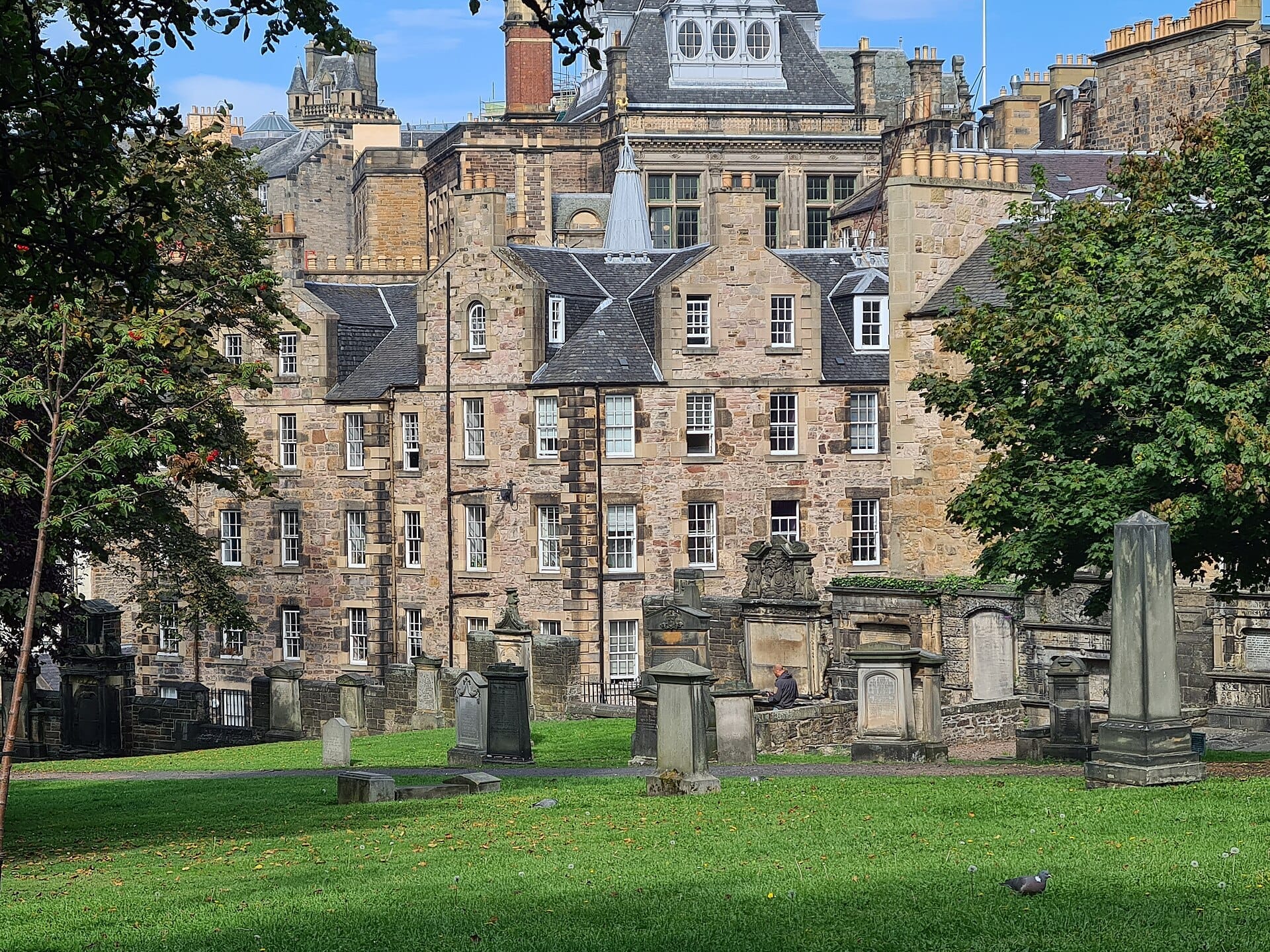
What Greyfriars Kirkyard Actually Is
Greyfriars Kirkyard is a historic burial ground surrounding Greyfriars Kirk, a working Church of Scotland congregation in Edinburgh's Old Town. The kirkyard was established in 1562 to relieve the overcrowded burial ground at St Giles' Cathedral, and it has received the dead of Edinburgh for more than four and a half centuries since. It is a Category A listed site, meaning its monuments and layout carry the highest level of historic protection in Scotland.
The ground sits at the junction of Candlemaker Row and George IV Bridge, pressed against the wall of George Heriot's School to the south and within easy walking distance of the National Museum of Scotland. The setting feels emphatically urban, yet once inside the gates, the city noise softens considerably. The kirkyard occupies roughly 2.5 acres of uneven, sloping ground covered with centuries-old gravestones, table tombs, and carved monuments ranging from the elegantly restrained to the extravagantly macabre.
💡 Local tip
Entry to Greyfriars Kirkyard is free and the site is open 24 hours a day according to Greyfriars Kirk's own guidance, though access may occasionally be restricted for maintenance or safety. Arrive in daylight for monument reading; arrive at dusk for atmosphere.
How the Experience Changes Through the Day
In the morning, roughly 9:00 to 11:00, the kirkyard receives students cutting through from Candlemaker Row and early visitors from nearby guesthouses. The light is low and raking in autumn and winter, which throws the carved inscriptions into sharp relief and makes it the best possible time for reading epitaphs and photographing details. The stone carvings here, skulls, crossed bones, hourglasses, and cherubs that look more threatening than comforting, are worth examining closely. In summer, morning visits feel almost tranquil.
Midday tends to bring coach-tour visitors and school groups, which concentrates foot traffic around the most famous graves. If you find the site feeling crowded at this hour, move toward the back sections, away from the main path from the Candlemaker Row gate. The older portions of the kirkyard, particularly the sections nearer George Heriot's wall, receive far fewer visitors and contain some of the most weathered and visually striking monuments on the site.
Late afternoon, especially in the hour before dusk in spring and autumn, transforms the atmosphere entirely. The stone takes on a warmer tone, shadows lengthen between the upright markers, and the number of visitors drops sharply. This is the hour most professional photographers choose, and for good reason. It is also the hour when the ghost tour groups begin assembling at the gates, adding a theatrical dimension that is either entertaining or intrusive depending on your expectations.
Tickets & tours
Live prices and dates from our booking partner. If you book, we may earn a commission at no extra cost to you.
Dark history of Edinburgh - self-guided audio tour using an app
From 10 €Instant confirmationWest Highland Lochs, mountains and castles tour from Edinburgh
From 61 €Instant confirmationFree cancellationLoch Ness, Glen Coe and the Highlands tour from Edinburgh
From 66 €Instant confirmationFree cancellationDay Trip to Holy Island, Alnwick Castle and Northumbria from Edinburgh
From 60 €Instant confirmationFree cancellation
The History Beneath Your Feet
Few places in Edinburgh carry as much concentrated historical weight as Greyfriars Kirkyard. The site takes its name from a Franciscan friary that occupied the land before the Reformation; the friary was dissolved and the land repurposed, first as a garden and then, from 1562, as a public burial ground. The kirk itself was built in 1620, making it one of the earliest churches constructed in Scotland after the Reformation.
The kirkyard's single most significant historical moment came on 28 February 1638, when the National Covenant was signed here, a declaration by Scottish Presbyterians rejecting the imposition of Anglican-style church governance by Charles I. Some accounts record that when paper ran out, signatories continued using their own blood. The document helped trigger a series of conflicts that eventually fed into the Wars of the Three Kingdoms. A copy is held inside Greyfriars Kirk, and the signing is commemorated within the grounds.
The Covenanters' Prison, a walled enclosure at the back of the kirkyard, was used to detain approximately 1,200 Covenanting prisoners after the Battle of Bothwell Brig in 1679. Conditions were severe, with prisoners held outdoors in all weather and poorly fed. Around 400 died in captivity. Today, access to the prison enclosure is restricted and generally only available through guided tours. For more on how Edinburgh's troubled religious past shaped its landscape, the St Giles' Cathedral nearby is an essential companion visit.
Notable Graves and What to Look For
The kirkyard holds the remains of a remarkable number of people who shaped Scottish culture, science, and law. Among the most visited is the grave of William Smellie, the first editor of the Encyclopaedia Britannica. James Craig, the architect who designed Edinburgh's New Town, is buried here. Memorials connected with John Gray, the Skye terrier owner whose dog allegedly guarded his tomb for fourteen years, are near the main entrance and remain among the most photographed spots in the city.
The monument of Sir George Mackenzie of Rosehaugh, the Advocate-General who prosecuted the Covenanters, sits in the kirkyard and has become something of a focal point for Edinburgh's ghost tourism industry. Mackenzie, known as 'Bluidy Mackenzie,' oversaw the trials and executions of many Covenanters, and his mausoleum is the starting point for several ghost tours that depart from this spot each evening. If the supernatural dimension interests you, the Edinburgh ghost tours guide covers the best options in detail.
Many of the grave markers are in advanced states of weathering, and some inscriptions are no longer legible without supplementary reference. A printed map or a smartphone-based guide to notable graves will help you navigate the more dispersed monuments rather than clustering at the three or four that everyone photographs.
ℹ️ Good to know
Greyfriars Kirkyard is also associated with Harry Potter connections: author J.K. Rowling wrote portions of the series in nearby cafes, and names on tombstones here, including Thomas Riddell and William McGonagall, have been widely noted by fans. Whether the connections are direct inspirations or coincidence remains debated.
Getting There and Navigating the Site
The kirkyard is on Candlemaker Row, a short, steeply rising street that connects the Cowgatehead roundabout at the bottom with George IV Bridge at the top. From Edinburgh Waverley station, the walk takes roughly 15 minutes: head south on North Bridge, continue onto South Bridge, then turn right onto Chambers Street past the National Museum, and look for the kirkyard entrance on Candlemaker Row. From the Grassmarket, it is a 5-minute uphill walk along Candlemaker Row.
There are two main pedestrian entrances from Candlemaker Row. The lower entrance involves a short flight of steps, which may present difficulty for visitors using wheelchairs or prams. The upper entrance, closer to George IV Bridge, is more accessible. Lothian Buses serve both George IV Bridge and Forrest Road with multiple routes, but given the location is central and walkable from most Old Town accommodation, buses are rarely necessary.
The surrounding streets form one of the most historically rich corners of the Old Town. The National Museum of Scotland is a three-minute walk and offers free entry, making it a natural pairing for an afternoon visit. The Old Town as a whole rewards slow, attentive walking.
Photography and Practical Considerations
Greyfriars Kirkyard is outstanding photographic territory. The carved stonework on older monuments, particularly the 17th-century memento mori carvings, repays close attention with a macro lens or phone camera zoom. Overcast days, which are common in Edinburgh, actually produce better monument photography than bright sun, since flat light brings out carving detail without harsh shadows. Early morning and late afternoon in autumn and winter offer the longest shadows and most dramatic directional light.
Wear shoes with grip. The paths are a mix of flagstone, gravel, and grass, and the ground can be slippery after rain. Edinburgh's weather tends toward wet and changeable, so carrying a waterproof layer is simply practical regardless of the season. In winter, the kirkyard can be icy in shaded areas, particularly the northern sections that receive little direct sun.
⚠️ What to skip
Please treat the site with care. Greyfriars Kirkyard is a working burial ground and an active place of Christian worship. Touching or leaning on monuments, particularly fragile 17th-century markers, can cause damage. Some visitors still engage in 'boggling' (deliberate disturbance of the Mackenzie mausoleum) — this is disrespectful to the site and to current worshippers.
Who Will Enjoy This and Who Might Not
Greyfriars Kirkyard rewards visitors who are comfortable with slow, exploratory walking and have some interest in Scottish history, funerary art, or Edinburgh's literary connections. It pairs well with a self-guided walk of the Royal Mile or a visit to Edinburgh's underground vaults, and it makes an evocative evening starting point for ghost tour groups.
Visitors who find graveyards distressing, or who are looking for an active or visually bright attraction, will find the experience unrewarding. Families with young children should know that the ghost tour crowds in the evening and the morbid iconography on many stones can be unsettling for small children, though the space itself is open and safe. The site is not particularly wheelchair accessible at all entrances, and the interior paths can be uneven enough to require care.
If your primary interest is Edinburgh's ghost folklore rather than the history, consider booking a specialist evening tour, since the kirkyard's atmosphere after dark and the guided narrative around the Mackenzie mausoleum are genuinely compelling. The Edinburgh ghost tours guide outlines the most reliable operators currently running. Those more interested in the broader sweep of Old Town history might also consider The Real Mary King's Close as a contrasting underground experience nearby.
Insider Tips
- Visit on a weekday morning in spring or autumn for the best combination of light, quiet, and legible carvings. Saturdays between 11:00 and 15:00 see the heaviest foot traffic, particularly during festival season.
- Pick up a printed guide to the notable graves from inside Greyfriars Kirk before walking the kirkyard. The layout can be confusing, and the signage for individual monuments is minimal in many sections.
- The rear sections of the kirkyard, near the Covenanters' Prison wall, are quieter than the main paths even on busy days. Some of the most interesting 17th-century monuments are in these less-visited corners.
- If you want to photograph the Greyfriars Bobby statue without crowds, go before 9:00 in the morning. The statue sits just outside the kirkyard beside the Greyfriars Bobby pub at the corner of Candlemaker Row and George IV Bridge, and it sees continuous activity during the day.
- The kirkyard sits directly opposite the main entrance to the National Museum of Scotland. Combining both in a half-day costs nothing and covers a wide sweep of Scottish history from the prehistoric to the present.
Who Is Greyfriars Kirkyard For?
- History and heritage visitors with an interest in Scottish religious and political history
- Photography enthusiasts drawn to funerary architecture and atmospheric stonework
- Literary visitors following Edinburgh's connections to authors from Allan Ramsay to J.K. Rowling
- Ghost tour participants looking for the most atmospheric starting point in the city
- Solo travelers who prefer self-paced exploration over structured sightseeing
Nearby Attractions
Other things to see while in Old Town:
- Camera Obscura & World of Illusions
Perched at the top of the Royal Mile beside Edinburgh Castle, Camera Obscura & World of Illusions combines a Victorian optical instrument with five floors of hands-on illusions and a rooftop view over the Old Town. It is one of Edinburgh's most distinctive indoor attractions, best suited to curious minds of all ages.
- Edinburgh Castle
Edinburgh Castle dominates the Old Town skyline from its perch atop a 135-metre volcanic crag. From the city's oldest building to the Scottish Crown Jewels, here is everything you need to decide whether it deserves a half-day of your trip.
- The Edinburgh Dungeon
The Edinburgh Dungeon is a live-actor walk-through experience covering 1,000 years of Scotland's darkest history, staged beneath the Old Town streets. Theatrical, loud, and deliberately unsettling, it suits thrill-seekers and older children more than museum-goers expecting quiet reflection.
- Edinburgh Farmers' Market
Every Saturday morning, Castle Terrace fills with around 40 to 60 stalls selling Scottish produce directly from the people who grow, rear, and make it. Edinburgh Farmers' Market has been running since around 2000 and is widely regarded as one of the largest weekly farmers' markets in Scotland by stall count. Entry is free, and the market wraps up by 2pm sharp.
Planning a trip? Discover personalized activities with the Nomado app.