National Museum of Scotland: What to See, When to Go, and Why It Earns a Full Day
The National Museum of Scotland on Chambers Street is one of Britain's great free museums, covering everything from Pictish stones to Formula One racing cars across two architecturally distinct buildings. It anchors Edinburgh's Old Town and rewards repeat visits far more than a single rushed lap.
Quick Facts
- Location
- Chambers Street, Edinburgh EH1 1JF (Old Town)
- Getting There
- 10-min walk from Waverley Station; buses stop on George IV Bridge. No dedicated tram stop — nearest tram is at St Andrew Square.
- Time Needed
- 2–4 hours for highlights; a full day if you explore seriously
- Cost
- Free general admission; charges apply for some temporary exhibitions
- Best for
- Scottish history, world cultures, families, rainy days, architecture enthusiasts
- Official website
- www.nms.ac.uk/national-museum-of-scotland
What the National Museum of Scotland Actually Is
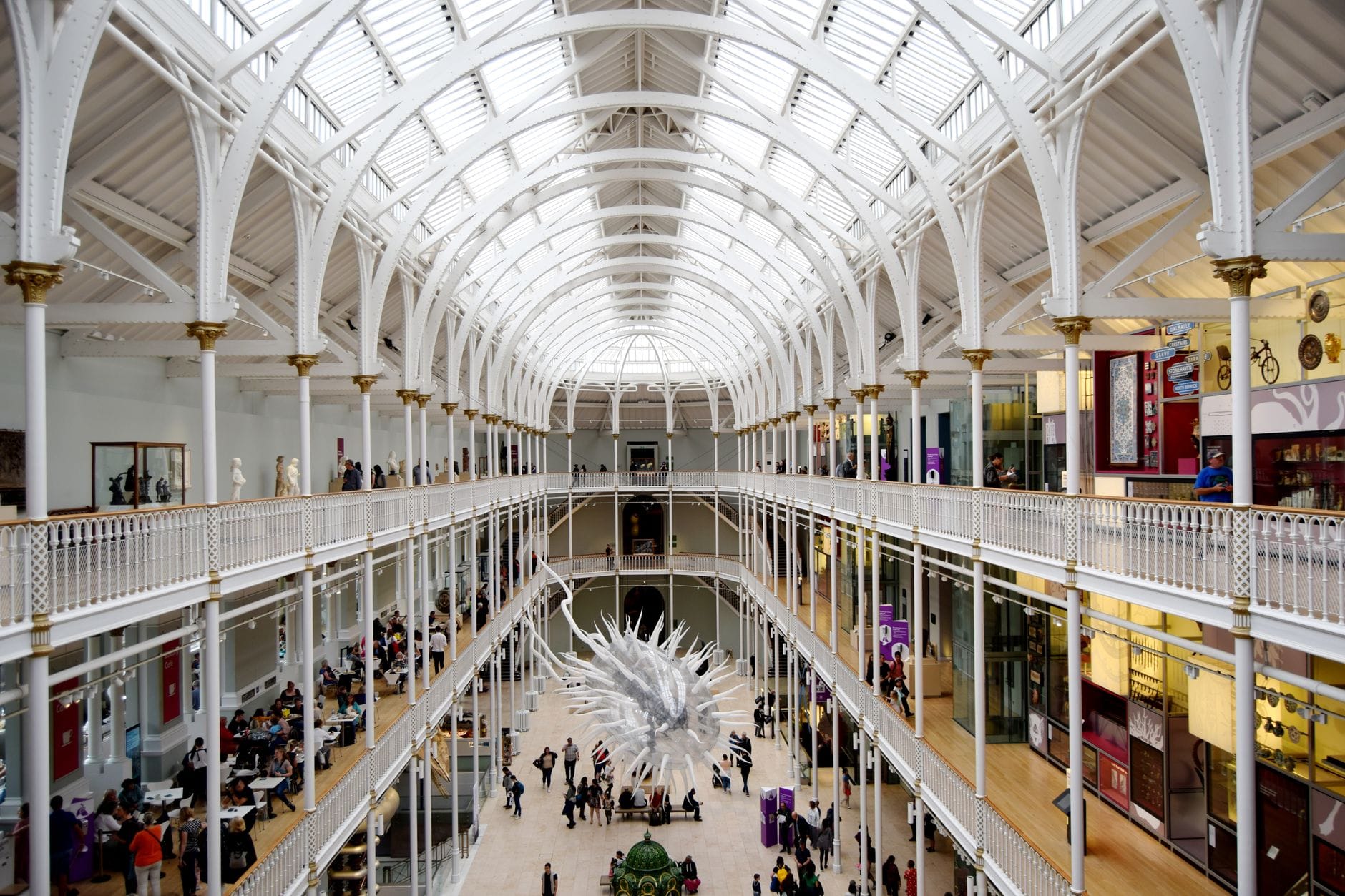
The National Museum of Scotland is not a single building with a single story. It is two architecturally and temperamentally different museums joined at the hip. The older wing, known until 2011 as the Royal Museum, opened in 1866 and was designed by Francis Fowke in a grand Victorian style, with a soaring iron-and-glass atrium at its centre that feels closer to a railway terminus than a conventional gallery. The newer Museum of Scotland wing, opened in 1998 and designed by Benson and Forsyth, is a deliberate counterpoint: sandstone-clad, angular, its circular tower referencing Edinburgh Castle's rock from certain angles. Together they cover natural history, world cultures, science and technology, art and design, and, in the Scottish wing, the full arc of Scotland's history from geological formation to the present day.
The combined complex sits on Chambers Street in Edinburgh's Old Town, one block south of the Royal Mile. It is one of the most-visited attractions in Scotland, drawing well over two million visitors in peak years, yet the sheer scale means it rarely feels overcrowded on the upper floors.
ℹ️ Good to know
General admission is free. Some temporary exhibitions carry a ticket charge. The museum is open daily 10:00–17:00, closed 25 December. On 26 December and 1 January it opens at 12:00 rather than 10:00.
The Grand Gallery: First Impressions and the Victorian Atrium
You enter the Victorian wing through the Grand Gallery, and the space makes a statement immediately. The iron-framed glass roof rises roughly 24 metres above a chequered marble floor lined with display cases and punctuated by a full-scale cast of an allosaurus skeleton. Natural light filters down in a way that changes noticeably throughout the day. In the morning, the atrium is bright and almost luminous. By mid-afternoon in summer, the light turns warmer and more diffuse. On a grey Edinburgh day the gallery holds a quieter, more focused atmosphere that suits careful looking.
The objects arranged around the ground level of the Grand Gallery read as a deliberate exercise in curiosity: an Egyptian mummy case, a Polynesian war canoe, a model steam engine. It is not thematically organised in the way modern museums often are. That can feel disorienting at first, but it also makes the space excellent for children, who tend to move from object to object without needing a narrative thread to follow.
Tickets & tours
Live prices and dates from our booking partner. If you book, we may earn a commission at no extra cost to you.
Self-guided audio tour on the history of witchcraft in Scotland
From 5 €Instant confirmationNational Museum of Scotland In-App Audio Guided Tour
From 9 €Instant confirmationSelf-guided audio tour of the witchcraft history in Scotland
From 7 €Instant confirmationLoch Ness and the Highlands of Scotland day trip from Edinburgh
From 69 €Instant confirmationFree cancellation
The Scottish Galleries: Scotland's Story in Stone and Steel
The 1998 Museum of Scotland wing is organised chronologically, beginning in the basement with Geology and Early People and rising floor by floor through medieval Scotland, the Reformation, the Act of Union, industrialisation, and the 20th century. The material is dense and the interpretation is serious; this is not a heritage theme park version of Scottish history.
Stand-out objects include the Monymusk Reliquary, a tiny house-shaped casket believed to have been carried at the Battle of Bannockburn in 1314; the Lewis Chessmen, 12th-century Norse gaming pieces found on the Outer Hebrides, displayed here alongside pieces held in London; and industrial machinery that illustrates how Scotland's economy transformed between the 18th and 20th centuries. The room covering the Jacobite risings gives the political and human context that many visitors only know in cartoon form from films.
The uppermost level of the Scottish wing reaches the 20th century and ends at a rooftop terrace with views across the Old Town towards the castle. The terrace is frequently overlooked by first-time visitors and is best accessed by the lift inside the Scottish wing. On a clear day the view north across the rooftops to Calton Hill and Arthur's Seat is one of the better free elevated perspectives in the city.
For visitors wanting to see more of Edinburgh from above, Calton Hill and the Vennel Viewpoint offer different angles on the skyline without requiring a museum visit.
Science, Technology, and World Cultures Galleries
The Victorian wing's upper floors house natural history specimens, science and technology displays, and world cultures galleries covering Africa, Asia, the Pacific, and the Americas. The science and technology floors are notably good for families with older children. A Formula One car, early computing hardware, and exhibits on Scottish inventors (the telephone's Alexander Graham Bell was born in Edinburgh) give younger visitors concrete anchors.
The world cultures galleries are uneven in depth but contain some genuinely striking objects, particularly in the East Asia and South Asia rooms. The natural history galleries include taxidermied specimens and a large whale skeleton that hangs overhead in a way that commands your attention even if you were not planning to stop.
💡 Local tip
If you have limited time, prioritise the Scottish galleries in the 1998 wing first, then return to the Victorian atrium for its atmosphere rather than systematic object-by-object exploration.
When to Visit and How the Experience Changes by Hour
The museum opens at 10:00 and the first 30 minutes tend to be the quietest of the day. School groups typically arrive from around 10:30 onward on weekdays during term time, so if you want the ground floor and main Scottish galleries without competing with primary-school tours, arriving at opening is worth the slight inconvenience. Midday on weekends is the peak period for the Grand Gallery atrium.
Late afternoon, roughly 15:30 to 17:00, often sees another quiet window as families with younger children head home. The upper floors of both wings feel genuinely calm at this point. The museum closes at 17:00 without exception (aside from special evening events), so a 16:00 arrival will not get you through more than one or two galleries.
The museum is an excellent option on wet days, but be aware that rain drives significantly more visitors indoors. On a heavy-rain weekend afternoon, the ground floor of the Grand Gallery becomes noticeably crowded. The upper floors remain relatively uncongested regardless of weather.
The museum's location in the Old Town means it fits naturally into a day that also includes Greyfriars Kirkyard (two minutes' walk) or a walk along the Royal Mile to St Giles' Cathedral.
Practical Information for Your Visit
The museum is roughly a 10-minute walk from Edinburgh Waverley railway station. From the station, head down Cockburn Street or the steps at Fleshmarket Close onto the Royal Mile, then south down George IV Bridge to Chambers Street. Buses on George IV Bridge stop directly adjacent. There is no dedicated on-site car parking; paid parking is available in multi-storey facilities nearby but Old Town driving is generally inconvenient.
The café and restaurant are located in the Victorian wing and vary in quality. For a full meal, Chambers Street and the surrounding area offer better alternatives than the in-house offering. The museum shop on the ground floor is above average for museum retail, with a reasonable selection of Scottish design objects, books, and reproductions.
Bags can be left in the cloakroom near the main entrance, which is useful if you are arriving with luggage. Prams and pushchairs are permitted throughout, and lifts access all floors in both wings, though the 1998 wing's layout can be slightly complex to navigate on a first visit. Printed floor plans are available at the information desk near the entrance.
⚠️ What to skip
The museum closes at 17:00 sharp. There are no late openings on standard days. Check the official website for special evening event dates, which do occur periodically.
Honest Assessment: Who Will Love This and Who Will Not
The National Museum of Scotland is genuinely one of the better free museums in the United Kingdom. For anyone with even a passing interest in Scottish history, it provides context that visiting castles and historic sites alone cannot supply. The objects are real, the interpretation is generally rigorous without being academic, and the building itself is worth experiencing.
That said, visitors looking for a quick, curated 45-minute highlight experience may find the scale frustrating rather than rewarding. The museum does not lend itself well to brief visits; the best galleries require time to absorb, and the layout means you cannot easily skip between the Scottish and Victorian wings without retracing steps. If your Edinburgh itinerary is very tight, the museum is better approached with honesty: either give it a proper two-to-three hour block or accept that you are seeing a fraction of it.
Visitors travelling with children may also want to consider the Museum of Childhood on the Royal Mile, which is smaller, entirely free, and specifically designed for younger visitors.
Insider Tips
- The rooftop terrace on the top floor of the 1998 wing is one of the best free elevated views in Edinburgh's Old Town. Access it via the lift inside the Scottish history galleries. Many visitors leave without discovering it.
- The Lewis Chessmen displayed here are only a portion of the total found in 1831. The British Museum holds the majority. The NMS pieces are exhibited in a dedicated case with full context, and the comparison of what Edinburgh holds versus London is itself a small story worth reading.
- If you are visiting with school-age children on a weekday, arrive at 10:00 sharp. School groups from across Scotland use this museum regularly, and the ground floor in particular can fill with organised tours by 10:45.
- The Victorian Grand Gallery looks entirely different in morning light versus afternoon light. If photography matters to you, aim for a weekday morning in summer when the sun hits the glass roof at an angle that fills the atrium with diffuse natural light.
- Audio guides and family trails are available from the information desk. These are not always prominently advertised but significantly improve navigation for first-time visitors who find the scale of the collection disorienting.
Who Is National Museum of Scotland For?
- Travellers who want to understand Scottish history before visiting sites like Edinburgh Castle or Holyrood
- Families with children of any age, particularly the science and technology galleries for older kids
- Rainy or cold days when outdoor Edinburgh attractions are less appealing
- Architecture enthusiasts interested in the contrast between Victorian iron-and-glass design and late-20th-century Scottish sandstone modernism
- Budget travellers: free entry with no pressure to spend beyond the optional café or shop
Nearby Attractions
Other things to see while in Old Town:
- Camera Obscura & World of Illusions
Perched at the top of the Royal Mile beside Edinburgh Castle, Camera Obscura & World of Illusions combines a Victorian optical instrument with five floors of hands-on illusions and a rooftop view over the Old Town. It is one of Edinburgh's most distinctive indoor attractions, best suited to curious minds of all ages.
- Edinburgh Castle
Edinburgh Castle dominates the Old Town skyline from its perch atop a 135-metre volcanic crag. From the city's oldest building to the Scottish Crown Jewels, here is everything you need to decide whether it deserves a half-day of your trip.
- The Edinburgh Dungeon
The Edinburgh Dungeon is a live-actor walk-through experience covering 1,000 years of Scotland's darkest history, staged beneath the Old Town streets. Theatrical, loud, and deliberately unsettling, it suits thrill-seekers and older children more than museum-goers expecting quiet reflection.
- Edinburgh Farmers' Market
Every Saturday morning, Castle Terrace fills with around 40 to 60 stalls selling Scottish produce directly from the people who grow, rear, and make it. Edinburgh Farmers' Market has been running since around 2000 and is widely regarded as one of the largest weekly farmers' markets in Scotland by stall count. Entry is free, and the market wraps up by 2pm sharp.
Planning a trip? Discover personalized activities with the Nomado app.