Calton Hill: Edinburgh's Open-Air Monument Park with Unbeatable City Views
Rising 103 metres above central Edinburgh, Calton Hill is a free, 24-hour public park packed with monuments, volcanic geology, and some of the most complete city panoramas in Scotland. It takes under 20 minutes to reach from Princes Street on foot, and the views repay every step.
Quick Facts
- Location
- Calton Hill, Edinburgh EH7 5AA — beyond the east end of Princes Street, near Waterloo Place
- Getting There
- 10–15 min walk east along Waterloo Place from Princes Street; stone steps behind the old Royal High School on Regent Road
- Time Needed
- 45 minutes to 2 hours depending on monument visits
- Cost
- Free to enter the hill and park; small fee to climb the Nelson Monument tower; Collective gallery free
- Best for
- City panoramas, photography, evening light, Edinburgh history, and no-budget sightseeing
- Official website
- ewh.org.uk/calton-hill
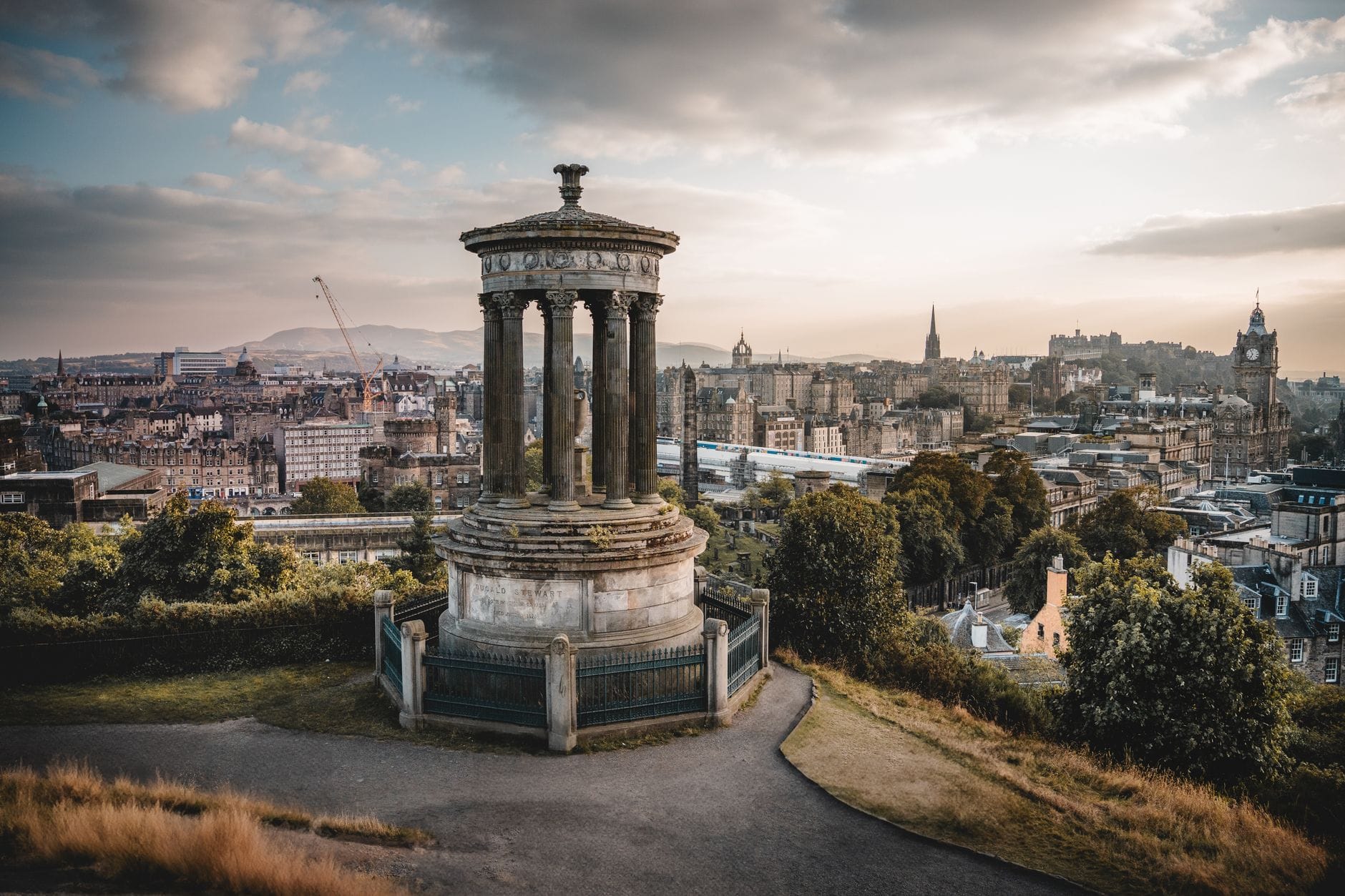
What Calton Hill Actually Is
Calton Hill is an extinct volcanic hill that rises just beyond the eastern end of Princes Street, right at the boundary between Edinburgh's New Town grid and the older city fabric to the south. It stands 103 metres (338 feet) above sea level, and from its summit plateau you can see Arthur's Seat, Edinburgh Castle, the Firth of Forth, the Pentland Hills, and on a clear day, the mountains of the Highlands beyond Stirling. The hill is part of Edinburgh's UNESCO World Heritage Site and was purchased by Edinburgh Town Council as far back as 1724, making it one of the oldest public parks in Britain.
It is not a manicured botanical garden or a ticketed attraction. The hill is raw, open, and feels distinctly public in the best sense: dog walkers share the path with tourists photographing the skyline, and students sit on the grass next to people who have been climbing here for decades. That democratic quality is part of what makes it work. There is no entrance gate to funnel you through, no gift shop at the top, and no queue.
💡 Local tip
The hill is open 24 hours, 365 days a year. Sunrise and sunset visits are possible year-round and are often far quieter than the midday rush. In summer, expect crowds from late morning to early evening.
The Monuments: What You Are Actually Looking At
The summit plateau is unusually dense with monuments for a public park, each with its own story. The most visually arresting is the National Monument of Scotland, a row of twelve massive Doric columns that stand incomplete on the hill's western brow. Construction began in 1826 as a memorial to the Scottish soldiers and sailors who died in the Napoleonic Wars, modelled on the Parthenon in Athens. Funding ran dry after just twelve columns were erected, and the project was abandoned in 1829. Edinburghers nicknamed it 'Edinburgh's Disgrace' with a mix of embarrassment and dark affection, but the ruin reads better than the finished article would have: those twelve columns against an open sky have more drama than any completed colonnade.
The Nelson Monument is the tall tower visible from much of central Edinburgh, erected to commemorate Admiral Horatio Nelson's death at the Battle of Trafalgar in 1805. It is shaped loosely like an upturned telescope. For a small fee you can climb inside and stand on the narrow viewing gallery near the top, which offers a more intimate, framed view of the city compared to the open panorama at ground level. A white time ball at the tower's summit drops daily at 1pm, originally to allow ships in the Firth of Forth to set their chronometers, and it still drops today.
Elsewhere on the hill you will find the circular Dugald Stewart Monument (1831), commemorating the philosopher; the Robert Burns Monument in the Greek Revival style; and the Political Martyrs' Monument, which commemorates five Scottish reformers transported to Australia in the 1790s for advocating political reform. The old City Observatory complex, designed by William Playfair and completed in 1818, has been reimagined as Collective, a contemporary art gallery with a free-entry café that makes a good midway stop.
Tickets & tours
Live prices and dates from our booking partner. If you book, we may earn a commission at no extra cost to you.
West Highland Lochs, mountains and castles tour from Edinburgh
From 61 €Instant confirmationFree cancellationLoch Ness, Glen Coe and the Highlands tour from Edinburgh
From 66 €Instant confirmationFree cancellationDay Trip to Holy Island, Alnwick Castle and Northumbria from Edinburgh
From 60 €Instant confirmationFree cancellationLoch Ness Explorer Day Trip from Edinburgh
From 60 €Instant confirmationFree cancellation
How the Experience Changes Through the Day
Early morning on Calton Hill is a different place from the afternoon version. Before 9am, especially on weekdays, you are likely to share the summit with runners, dog walkers, and a handful of photographers chasing the low-angle light that rakes across the monuments and throws long shadows toward the Old Town. The air smells of grass and sometimes the faint brine of the Forth. The city below is quiet enough that you can hear it rather than feel swamped by it.
By midday in summer, the hill fills with visitors, particularly around the Nelson Monument and the National Monument. Coach-tour groups tend to arrive in late morning; the columns become a backdrop for phone photography. The atmosphere is still pleasant, just louder and more populated. Wind is a near-constant presence on the summit plateau regardless of season, so bring a layer even on warm days: the exposed top of the hill catches weather that the streets below do not.
The best light for photography is in the hour before sunset, when the Edinburgh skyline to the west catches gold and the Castle becomes silhouetted. This is also when the hill hosts a mix of couples, solo walkers, and people who have clearly made it a weekly ritual. In the depth of winter, the hill is quieter still, and the low sun gives an almost theatrical quality to the view even at 3pm. Rain makes the stone steps slippery, so good footwear is worth prioritising.
⚠️ What to skip
The stone steps on the Regent Road approach can be slippery when wet. Wear shoes with grip. This path is not suitable for pushchairs or wheelchairs; blue badge holders can access a gated vehicle route via Regent Road by the Royal High School.
The View: What You Can and Cannot See
The 360-degree panorama from the summit is one of the most complete urban views in Scotland. Looking west, you have a direct sightline to Edinburgh Castle on its own volcanic rock, with the New Town's Georgian grid laid out below you. To the south, Arthur's Seat dominates the skyline, its basalt ridge looking close enough to touch. North, the Firth of Forth spreads wide, and on clear days you can see Fife and the distinctive outline of the Forth Bridge at South Queensferry. East, the horizon opens toward the coast and East Lothian's farmland. The view is not obscured by trees, advertising hoardings, or modern construction in any meaningful way, which is increasingly rare in a European capital.
What this view is not: it does not offer a bird's-eye aerial perspective. At 103 metres, you are looking across Edinburgh rather than down on it, which makes the skyline feel inhabited and immediate rather than abstract. If you want height, the Nelson Monument tower adds a few extra metres and a more vertiginous sensation through narrow windows. If you want the elevated view from inside the city's most iconic structure, Edinburgh Castle's half-moon battery offers a different angle entirely.
Those looking for a broader context on Edinburgh's best elevated spots should also consider the Nelson Monument tower visit and the comparison available in the best views in Edinburgh guide, which covers several alternatives across the city.
Getting There and Getting Around the Hill
The most straightforward approach from the city centre is to walk east from Princes Street along Waterloo Place, which becomes Regent Road after a short stretch. The stone steps up the hill are signposted and begin just behind the old Royal High School building, itself a stripped-Greek Revival structure that was prepared in the 1970s as a potential home for a Scottish Assembly that was never established. The walk from Princes Street takes 10 to 15 minutes at a moderate pace. The steps themselves take around five minutes to climb.
A second footpath entrance exists from Royal Terrace on the north side of the hill, which is quieter and approached through a residential street of Georgian townhouses. This route is useful if you are coming from Broughton or Leith Walk. There is no general public car parking at the summit; parking is restricted to blue badge holders only. Nearest paid parking options are on-street along Regent Road or the Q-Park Omni multi-storey nearby.
Calton Hill is best combined with a walk along the eastern edge of the New Town or a visit to the lower ground of Princes Street Gardens to the west. Those planning a longer day should consider building Calton Hill into a walking tour of Edinburgh that connects the hill with the Royal Mile via the Canongate and Holyrood.
Calton Hill During Major Events
The hill takes on a different character during Edinburgh's festival season in August, when the population of the city swells and the Fringe turns every available public space into a performance venue or a meeting point. Calton Hill becomes a gathering spot in the evenings, with informal groups watching the light fade over the skyline. During Hogmanay, Edinburgh's New Year celebration, the hill is one of the city's prime vantage points for watching the fireworks above the Castle, and it fills with large crowds. Arrive well before midnight if you plan to use it as a viewing spot during Hogmanay.
The Beltane Fire Festival, held on the hill on 30 April each year, is a ticketed event that draws on ancient Celtic traditions marking the beginning of summer. It is one of Edinburgh's more theatrical annual events, with fire performers and a large procession around the monument plateau. This is a completely different atmosphere from the daytime park experience and is worth researching separately if your visit coincides with late April.
Who Should Skip It (and Why)
Visitors with significant mobility limitations should know that the primary pedestrian access is via uneven stone steps with no lift or ramp alternative on the main routes. The gated vehicle access on Regent Road exists for blue badge holders, but the summit path itself is an uneven grassed and paved area that can be difficult with a wheelchair or pushchair. If getting to the top is not possible, the view from Regent Road looking up at the monuments and the hill's silhouette still gives a sense of its scale.
If you are visiting Edinburgh for only a few hours and have to prioritise, Calton Hill rewards those who have time to pause rather than those rushing between landmarks. The view takes a few minutes to absorb properly, and the monuments require at least some walking around the plateau to appreciate. Those on a very tight schedule may prefer to spend the time inside the National Museum or walking the Royal Mile rather than making the detour east.
Insider Tips
- The east-facing slope of the hill is almost always quieter than the summit plateau. If you want a view without the crowd, find a spot on the grass looking toward the Firth of Forth rather than clustering around the National Monument columns with everyone else.
- The time ball on the Nelson Monument drops at exactly 1pm daily. Position yourself on the plateau around 12:55pm and you can watch it fall from the ground below, no tower ticket required.
- The Collective gallery inside the old City Observatory compound has a café that is warm, serves decent coffee, and is almost unknown to first-time visitors. It makes a good shelter if the wind picks up.
- Beltane Fire Festival tickets sell out months in advance. If your trip falls on 30 April and you want to attend, book well before arrival in Edinburgh.
- For the cleanest photography of the National Monument columns against the sky, shoot from the east in the morning when the light comes from behind you. In the afternoon, the columns face away from the sun and appear flat.
Who Is Calton Hill For?
- Photographers wanting a 360-degree city panorama without paying for a viewpoint ticket
- Visitors interested in Scottish neoclassical architecture and monument history
- Those who want to understand Edinburgh's physical geography from a single vantage point
- Sunrise and sunset seekers looking for minimal crowds and maximum atmosphere
- Budget-conscious travellers who want a genuinely rewarding free experience
Nearby Attractions
Other things to see while in New Town:
- Charlotte Square
Charlotte Square sits at the west end of George Street as the architectural crown of Edinburgh's first New Town. Designed by Robert Adam in 1791 and completed in 1820, the square is a free, publicly accessible streetscape and a key part of the city's UNESCO World Heritage Site.
- Edinburgh Christmas Market
Spread across East and West Princes Street Gardens and George Street, Edinburgh's Christmas runs from mid-November to early January each year. Entry is free, the backdrop is Edinburgh Castle, and the atmosphere shifts dramatically depending on when you arrive.
- Edinburgh Gin Distillery
Opened on 6 December 2024, the Edinburgh Gin Distillery at The Arches on East Market Street is the brand home of one of Scotland's most recognised craft gins. Set inside dramatic stone vaulted arches beneath historic railway arches near Waverley, it offers tastings, tours, and a retail experience rooted in the city's growing reputation for artisan spirits.
- Georgian House
Designed by Robert Adam and completed in 1796, The Georgian House at 7 Charlotte Square is one of Edinburgh's most precisely restored historic interiors. Managed by the National Trust for Scotland, it offers a floor-by-floor portrait of upper-class life at the height of the New Town's golden age.
Planning a trip? Discover personalized activities with the Nomado app.