Arthur's Seat: Edinburgh's Ancient Volcano Worth Every Step
Rising around 250 metres above the city, Arthur's Seat is an extinct volcano sitting at the heart of Edinburgh, free to climb year-round. It rewards the effort with unobstructed views across the Scottish capital, the Firth of Forth, and the Lothian hills. This is not a polished tourist attraction — it is raw, windswept, and genuinely spectacular.
Quick Facts
- Location
- Holyrood Park, Edinburgh EH8 8HG — roughly 1.6 km east of Edinburgh Castle
- Getting There
- Buses 35 and other city services stop near Holyrood/Abbeyhill Crescent, a short walk from the park entrance at Holyrood Palace
- Time Needed
- 2–3 hours for a relaxed return hike to the summit; allow more if you plan to explore the full park
- Cost
- Free — no tickets, no gates, no booking required
- Best for
- Hikers, photographers, anyone wanting a genuine outdoor escape without leaving central Edinburgh
- Official website
- www.historicenvironment.scot/visit/all/holyrood-park
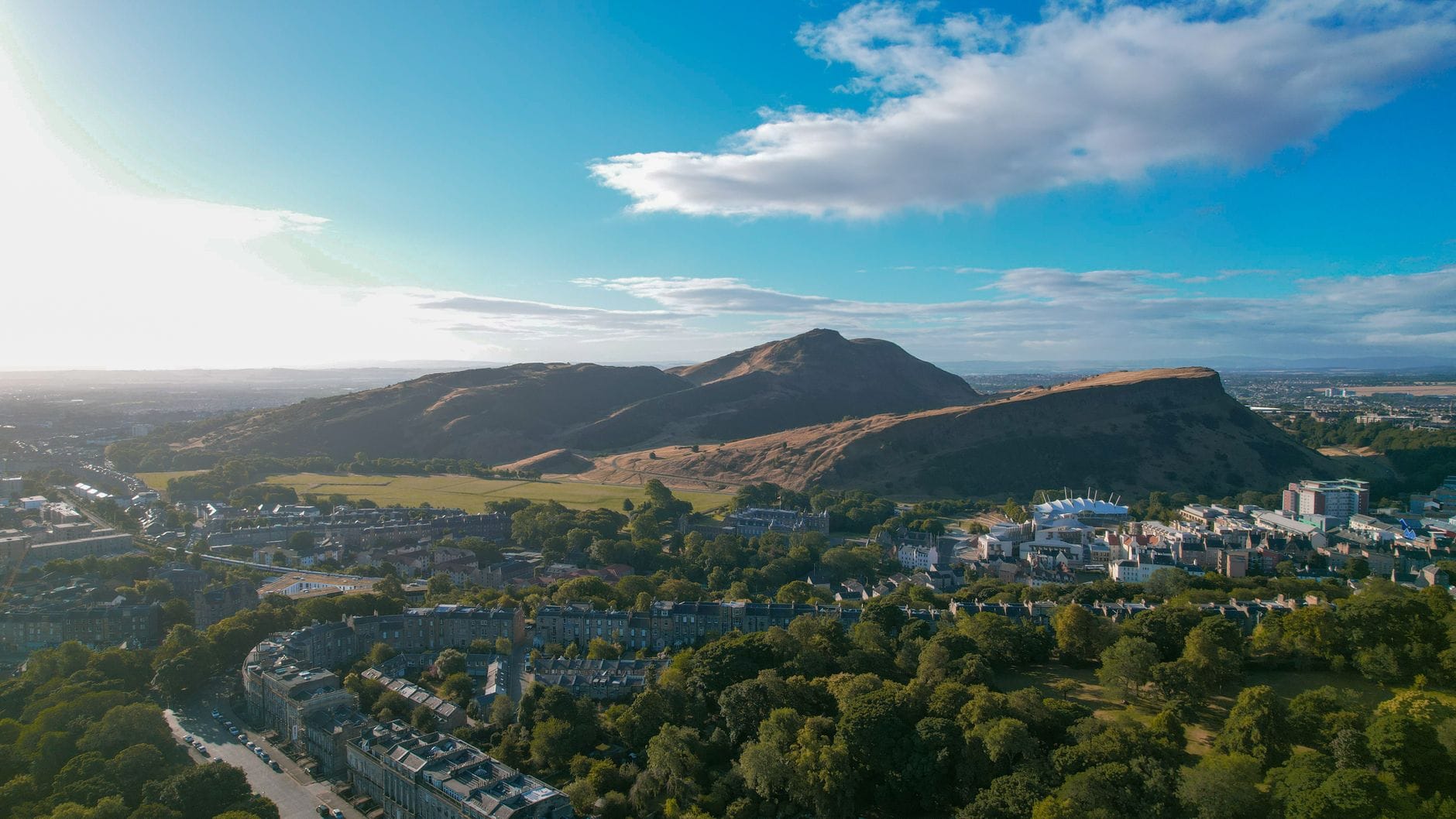
What Arthur's Seat Actually Is
Arthur's Seat is the main peak of a group of hills formed by an ancient volcano, rising to around 250 metres (about 820 feet) above sea level in the middle of Edinburgh. It sits within Holyrood Park, an expanse of open land of roughly 650 acres managed by Historic Environment Scotland, and it is visually dominant from almost everywhere in the city. On a clear day the summit is visible from Princes Street, from the castle ramparts, and from the shores of Leith.
The volcanic rock that forms Arthur's Seat solidified roughly 340–360 million years ago, during the Carboniferous period. What you are walking on is the eroded remnant of a lava vent, shaped further by glaciation during the last ice age. The landscape has a rawness to it that feels at odds with the Georgian terraces visible in every direction. Grass gives way to exposed basalt near the top, and the final push to the summit involves hands-on scrambling over bare rock.
The hill takes its English name from a record first written in 1562, though the origin of the name is genuinely uncertain. The Scottish Gaelic name, Suidhe Artair, translates simply as Arthur's Seat. Whether the Arthur in question refers to the legendary king, a local chieftain, or a phonetic shift from an older name is unresolved. The hill was also the site of an Iron Age hillfort approximately 2,000 years ago, one of four such sites around Edinburgh alongside Castle Rock, Calton Hill, and Craiglockhart Hill. Faint traces of the fort's ramparts remain visible if you know where to look.
💡 Local tip
The most popular route starts from the car park beside St Margaret's Loch, near the park entrance at the east end. Follow the path up Haggis Knowe and then along the ridge. It is well-trodden and straightforward in dry conditions, though it can be slippery on wet rock.
The Climb: What to Expect on the Ground
There is no single official route to the summit. Most visitors approach from the north, starting near St Margaret's Loch, a small ornamental loch at the base of the hill where mute swans and mallards congregate year-round. From the loch, a broad path climbs steadily through short grass, with the saddle between Haggis Knowe and the main summit visible ahead. The path splits repeatedly; the most direct line up the southern ridge is steep but manageable for anyone with reasonable fitness and grip-soled footwear.
The upper section is where Arthur's Seat earns its reputation. The gradient increases sharply, and the final 50 metres involve navigating a narrow rocky path with a drop to one side. In wet weather, exposed sections of basalt can be treacherous. In strong wind — common even on sunny days — the exposed ridge demands care. None of this requires technical climbing skill, but it is a real hill walk, not a stroll.
An alternative and gentler approach follows lower paths around the base of the Salisbury Crags (Radical Road access is often restricted) before curling up toward the summit from the south. This adds distance but avoids the steepest rocky section. A third option begins from the Dunsapie Loch car park on the eastern side, offering the shortest ascent from road level to summit, though the road to Dunsapie is closed to motor vehicles on Saturdays and Sundays.
⚠️ What to skip
Footwear matters more than most visitors expect. Trainers are acceptable in dry summer conditions, but waterproof walking shoes or boots are strongly advisable in autumn, winter, and spring. The rock near the top is polished smooth in places and can be genuinely dangerous when wet.
Tickets & tours
Live prices and dates from our booking partner. If you book, we may earn a commission at no extra cost to you.
West Highland Lochs, mountains and castles tour from Edinburgh
From 61 €Instant confirmationFree cancellationLoch Ness, Glen Coe and the Highlands tour from Edinburgh
From 66 €Instant confirmationFree cancellationDay Trip to Holy Island, Alnwick Castle and Northumbria from Edinburgh
From 60 €Instant confirmationFree cancellationLoch Ness Explorer Day Trip from Edinburgh
From 60 €Instant confirmationFree cancellation
Views From the Top and What You'll See
The summit view is a 360-degree panorama with almost no obstruction. Immediately below to the west lies the full sweep of Edinburgh: the castle on its volcanic plug, the long ridge of the Royal Mile descending toward Holyrood, and the geometric order of the New Town's Georgian streets extending north. On a clear day the Forth Road Bridge and the Forth Bridge are visible to the northwest, and Ben Lomond can sometimes be identified on the western horizon.
To the north, the Firth of Forth stretches across the middle distance, with Fife on the far shore. East and south, the Lothian plain opens up toward East Lothian's coastal farmland and the North Sea. The sense of being atop a freestanding peak in the middle of a capital city is unusual and genuinely hard to replicate. If you are interested in comparing city viewpoints, Calton Hill offers an easier walk and a different angle, but Arthur's Seat provides the more commanding position.
Photographers will find the summit most useful at golden hour. In summer, sunrise comes early and lights the castle and Old Town from behind, casting the western skyline in warm orange tones. Sunset, viewed from the top, illuminates the entire city below. In winter, snow on the surrounding hills and frost on the grass can produce striking conditions, though the shorter days and colder temperatures demand preparation.
How the Experience Changes by Time of Day and Season
Early morning, particularly on weekdays, the park is occupied mainly by local dog walkers and solo runners doing circuits of the loch. The air smells of wet grass and, in autumn, of damp earth and gorse. By 10am on a weekend, the number of people on the main summit path increases noticeably, and by midday in summer the exposed ridge can feel genuinely busy, with groups queuing at the rocky scramble section near the top.
The clearest skies in Edinburgh typically come in spring (April to May) and in autumn (September to October). Summer offers the longest daylight hours and the warmest temperatures, but also the highest visitor numbers and the most cloud cover from haar, the cold sea mist that rolls in from the Firth of Forth and can reduce visibility to near zero within minutes. Winter ascents are quieter and the frost-sharpened air can offer exceptional clarity, but ice on the upper rocks requires particular caution.
During the Edinburgh Festival Fringe in August, visitor numbers in the park spike significantly alongside the wider city footfall. If you are visiting during this period, an early morning ascent before 8am is the most reliable way to have the summit largely to yourself. The August in Edinburgh guide covers the full picture of what the city is like during the festival period.
ℹ️ Good to know
Haar can descend very quickly in any season, eliminating the view that makes the climb worthwhile. Check the local weather forecast before setting out, and if the forecast shows low coastal cloud, consider a morning visit before the mist typically thickens.
Getting There and Practical Logistics
Holyrood Park is accessible on foot from the Old Town in around 15 minutes. From the Royal Mile, walk east to the Scottish Parliament and Palace of Holyroodhouse; the park entrance is immediately adjacent. The main path toward the summit begins on the north side of the park, past St Margaret's Loch.
By bus, route 35 and other city services stop near Holyrood and Abbeyhill Crescent, both within a short walk of the park. There is car parking at several locations within the park, including near the palace and at St Margaret's Loch, though the park's internal roads are closed to motor vehicles on Saturdays and Sundays. If you are spending time in the Holyrood and Canongate area more broadly, the park entrance is a natural focal point for the day.
There are no cafes, toilets, or facilities on the hill or within most of the park. The nearest public toilets are at the Dynamic Earth visitor centre on Holyrood Road, a short walk from the park entrance. Bring water — the climb is more demanding than it looks from street level, and there is no water source on the hill.
The hill is not suitable for wheelchairs or pushchairs beyond the lower flat paths near the loch. Visitors with limited mobility can still access the park and enjoy close-up views of the crags and loch from the lower paths, which are flat and well-maintained.
Honest Assessment: Who This Is For and Who Should Pass
Arthur's Seat is regularly described as one of the finest things to do in Edinburgh, and for active visitors with appropriate footwear and a decent weather window, that reputation is deserved. The combination of real geological drama, genuine physical effort, and a city panorama of that quality within walking distance of a capital's centre is genuinely rare.
That said, it is not the right choice for everyone. Visitors with knee or ankle problems will find the descent harder than the ascent; loose rock and steep gradients make trekking poles a sensible addition. Anyone expecting a manicured park experience will be caught off guard — the terrain is uneven, the wind at the top can be sharp even in summer, and there are no guardrails or formal viewpoint platforms. If you want panoramic Edinburgh views without the physical commitment, Calton Hill is the more accessible alternative, or the Vennel Viewpoint offers a striking view of the castle with no climbing required.
For families, the lower sections of the park around St Margaret's Loch are suitable for young children and offer a pleasant half-day without attempting the summit. The full climb is appropriate for children who are comfortable on rough ground and can be closely supervised on the rocky upper section. For wider context on bringing children to Edinburgh's outdoor spaces, the Edinburgh with kids guide has practical suggestions.
Insider Tips
- The Dunsapie Loch route on the eastern side of the park is significantly quieter than the main north-facing path and offers a more gradual ascent. It is only accessible by car on weekdays; on Saturdays and Sundays, you will need to walk in from the Queen's Drive entrance.
- If you are aiming for sunrise in summer, Edinburgh's sky begins to lighten before 4am in June. The summit at that hour is almost deserted and the light on the castle and Old Town is exceptional.
- Gorse covers large sections of the lower slopes and blooms bright yellow in spring, releasing a faint coconut-like scent that is distinctly different from the smell of wet heather on the upper section. The colour contrast with the dark basalt above is worth noting for photography.
- Signed lower paths around Salisbury Crags are a good option if conditions at the top are poor: the crags are impressive at close range and the path offers good city views without requiring summit conditions.
- Wind speed at the summit is consistently higher than in the city below, sometimes dramatically so. A light jacket that works in the Old Town may be inadequate at 251 metres, even on a sunny afternoon.
Who Is Arthur's Seat For?
- Active visitors who want a genuine outdoor hike within walking distance of the city centre
- Photographers targeting panoramic city views at golden hour
- History and geology enthusiasts interested in Edinburgh's volcanic and Iron Age past
- Travellers on tight budgets looking for a free, full-morning experience with real payoff
- Visitors staying in the Holyrood or Canongate area who want to make the most of the park on their doorstep
Nearby Attractions
Other things to see while in Holyrood & Canongate:
- Dynamic Earth
Dynamic Earth is an interactive science centre at the foot of Salisbury Crags, telling the 4.5-billion-year story of the planet through immersive galleries and planetarium shows. It sits beside the Scottish Parliament and pairs well with Holyrood Park nearby. Strong on family appeal, it rewards those who take time to work through each zone rather than rush.
- Holyrood Abbey Ruins
Founded by King David I in 1128, Holyrood Abbey stands as one of Scotland's most atmospheric medieval ruins. The roofless nave, with its soaring Gothic arches open to the Edinburgh sky, is accessed through the Palace of Holyroodhouse and offers a rare encounter with raw, unadorned history at the foot of Arthur's Seat.
- Holyrood Park
Holyrood Park is a 260-hectare sweep of volcanic rock, grassland, and lochs sitting right at the edge of Edinburgh's Old Town. Free to enter at any hour, it holds Arthur's Seat, the Salisbury Crags, and Duddingston Loch inside a boundary set by a royal decree in 1541. Few capital cities have anything like it.
- Palace of Holyroodhouse
The Palace of Holyroodhouse is the British monarch's official residence in Scotland, a working royal palace with over 500 years of history. Sitting at the foot of the Royal Mile with Arthur's Seat rising behind it, the palace offers a rare combination of royal ceremony, dramatic architecture, and dark historical intrigue.
Planning a trip? Discover personalized activities with the Nomado app.