Holyrood Abbey Ruins: Nine Centuries of Stone, Sky, and Royal History
Founded by King David I in 1128, Holyrood Abbey stands as one of Scotland's most atmospheric medieval ruins. The roofless nave, with its soaring Gothic arches open to the Edinburgh sky, is accessed through the Palace of Holyroodhouse and offers a rare encounter with raw, unadorned history at the foot of Arthur's Seat.
Quick Facts
- Location
- Canongate, The Royal Mile, Edinburgh EH8 8DX — eastern end of the Royal Mile, adjacent to the Palace of Holyroodhouse
- Getting There
- 15–20-minute walk from Edinburgh Castle along the Royal Mile; local buses serve the Scottish Parliament / Holyrood stop
- Time Needed
- 30–45 minutes for the abbey alone; 2–3 hours if combining with the Palace of Holyroodhouse
- Cost
- Included with Palace of Holyroodhouse ticket; check current adult, child, and young person prices on the official Royal Collection Trust website. Children under 5 free. Verify current rates at palaceofholyroodhouse.co.uk
- Best for
- History enthusiasts, architecture lovers, photographers, and anyone walking the Royal Mile
- Official website
- palaceofholyroodhouse.co.uk/holyrood-abbey
What You're Actually Looking At
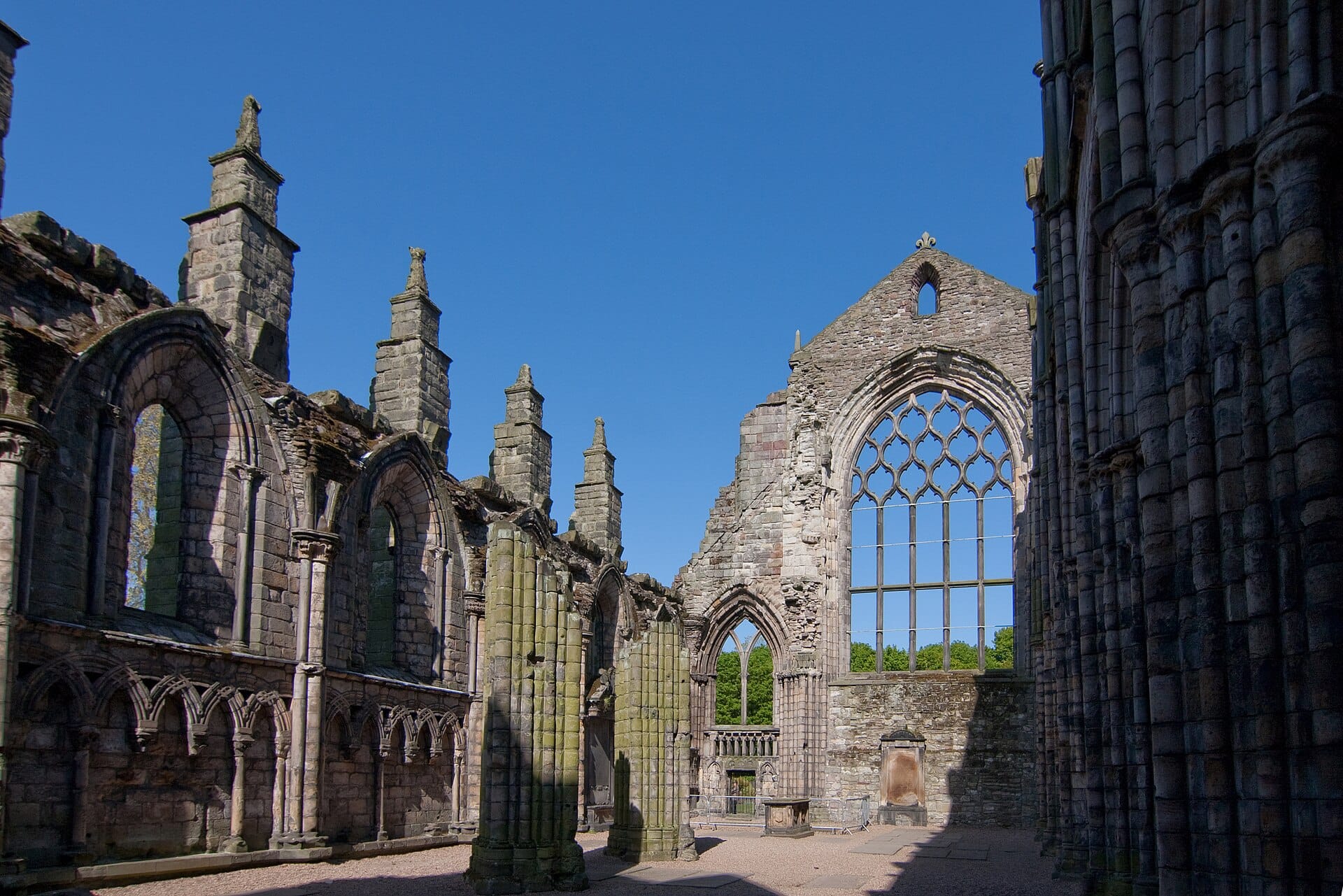
Holyrood Abbey Ruins are exactly that: the skeletal remains of a once-grand Augustinian abbey church, now roofless, weathered, and entirely open to the Scottish sky. The nave walls still stand to near-full height in places, their lancet windows empty of glass, framing views of cloud and pale blue in ways no architect could have planned. The effect is one of accidental grandeur — a building that became more visually striking through centuries of decay than it ever was when intact.
Founded in 1128 by King David I of Scotland, the abbey was rebuilt on a larger and more ambitious scale during the 13th century, which is when the Gothic stonework visible today took its essential form. For several centuries it served as both a religious house and an occasional royal chapel. It functioned as a parish church well into the 17th century, long after Scotland's Reformation had fundamentally altered its purpose. The roof had largely collapsed by the later 18th century, and no serious attempt at reconstruction was ever made. What remains is a scheduled monument, legally protected from alteration.
ℹ️ Good to know
The abbey ruins are accessed through the Palace of Holyroodhouse on the same ticket. Open April–October 09:30–18:00 (last admission 16:30); November–March 09:30–16:30 (last admission 15:15). The palace occasionally closes for royal events — check palaceofholyroodhouse.co.uk before visiting.
The Experience: Light, Stone, and Open Air
Walking into the abbey after passing through the palace's state apartments is a genuine shift in register. The palace interior is furnished, gilded, and carefully curated. The abbey is none of those things. You step out into roofless space and the scale of the original building becomes immediate: the nave is long, the walls thick with age, and the carved stonework on the surviving window surrounds is precise enough to show what medieval masons were capable of when given royal patronage and sufficient time.
The floor is largely grass and compacted earth, which softens the acoustics and gives the ruins an unhurried quality. On dry days, light falls across the interior in long diagonal shafts that shift through the morning and afternoon, catching the texture of the sandstone differently depending on the hour. Early in the day, when the palace has just opened and tour groups haven't yet arrived in numbers, the abbey can feel remarkably quiet — close to contemplative.
By midday in peak season (June through August), the space fills with visitors moving between the palace and the adjacent gardens, and the atmosphere becomes more sociable than solemn. Neither version is wrong, but they are different experiences. If the choice is available, arriving at opening time rewards patience.
Tickets & tours
Live prices and dates from our booking partner. If you book, we may earn a commission at no extra cost to you.
Self-guided audio tour on the history of witchcraft in Scotland
From 5 €Instant confirmationGuided tour from Edinburgh of Rosslyn Chapel, Stirling Castle and Dunfermline Abbey
From 47 €Instant confirmationFree cancellationFamily-Friendly Cycle Tour to the Coast of Edinburgh
From 50 €Instant confirmationFree cancellationWest Highland Lochs, mountains and castles tour from Edinburgh
From 61 €Instant confirmationFree cancellation
Historical Context: Why This Site Matters
The founding of Holyrood Abbey in 1128 was a politically deliberate act. David I was engaged in modernizing Scottish governance along Anglo-Norman lines, and establishing Augustinian houses was part of that project. The name 'Holyrood' comes from the Scots word for Holy Cross — tradition holds that David founded the abbey on the site where he had a vision of a stag bearing a cross between its antlers, though the more prosaic explanation is that he possessed a relic of the True Cross. The Palace of Holyroodhouse that eventually grew up beside the abbey began as a guesthouse for royal visitors to the abbey, which gives you a sense of which building originally took precedence.
The abbey's history is entangled with some of the most turbulent episodes in Scottish royal history. Mary, Queen of Scots was married in the abbey church. Her son, the future James VI of Scotland (and James I of England), was baptized at Stirling Castle. The building was damaged during English invasions in the 16th century and suffered further decline in the following centuries. By the time the roof gave way in the 18th century, the building had already been repurposed, neglected, and partially rebuilt more than once. The collapse was less a single catastrophic event than the final outcome of centuries of accumulated damage.
For visitors interested in the broader sweep of Scottish history, the abbey makes most sense when understood alongside the other institutions clustered at this end of the Royal Mile. The Scottish Parliament sits directly opposite, and Dynamic Earth is a short walk away. The concentration of major sites in this small area reflects Holyrood's long-standing role as a seat of Scottish power.
Architecture Up Close: What to Look For
The surviving fabric of the abbey repays close attention. The west front retains the most elaborate decorative stonework, with interlaced arcading and carved mouldings that show the influence of Romanesque and early Gothic traditions in dialogue. The transition from rounded Romanesque arches in the older sections to the pointed Gothic forms introduced in the 13th-century rebuild is visible if you know to look for it — the stonework shifts in character as you move along the nave.
The royal vault beneath the abbey floor was used for burials for centuries. Several Scottish monarchs are interred here, though the vault was disturbed during later renovations and not all remains are accounted for with certainty. There are no elaborate tomb monuments visible at ground level; the connection to royalty is present more in documented history than in visible display.
💡 Local tip
Photography: The open roof creates dramatic lighting, but heavy overcast days can flatten the stone into uniform grey. Clear days with moving cloud give the most texture and contrast. A wide-angle lens or smartphone in portrait mode helps capture the full height of the nave walls from inside the ruins.
Practical Walkthrough: Getting the Most From Your Visit
The abbey ruins are not a separate attraction — they are a component of the Palace of Holyroodhouse visit. You enter through the palace ticket hall on the Canongate side of the building, work through the state apartments and historic rooms, and then exit into the abbey precinct. Attempting to visit the abbey without a palace ticket is not possible. If you are specifically drawn to the ruins rather than the palace interiors, it is worth knowing that you will spend the majority of your visit inside before reaching the open-air ruin. The palace itself is substantive, taking most visitors at least 60–90 minutes. Plan your day accordingly. For a broader sense of what fills this part of the city, the Holyrood and Canongate neighborhood rewards a longer explore before or after your visit.
The abbey ruins are partially accessible to visitors with mobility considerations: the palace route is largely step-free, and most of the abbey floor can be reached without significant obstacles. However, the historic surfaces are uneven in places, and some sections may be less straightforward for visitors using wheelchairs or with limited mobility. Royal Collection Trust staff can advise; contacting them in advance is recommended for anyone requiring specific assistance.
Wear comfortable shoes with grip. Even in dry weather, the stone and compacted earth surfaces can be slippery. In wet weather — which Edinburgh provides reliably across all seasons — the interior becomes wetter than you might expect from a 'covered' attraction, because it is not covered. The open roof means the ruins are fully exposed to rain. A waterproof layer is worth carrying regardless of the morning forecast.
⚠️ What to skip
The palace closes on certain dates for royal events and official functions, sometimes with short notice. Always check the official website before visiting, especially during May, June, and late June to early July when the palace is most likely to close for extended periods.
Honest Assessment: Is It Worth Your Time?
The abbey ruins are not the primary reason most visitors buy a Holyroodhouse ticket, and they shouldn't be. The palace interiors carry more historical content and more interpretive support. But the ruins are a genuine bonus: a moment of outdoor space and architectural drama that resets the pace of a busy sightseeing day. Visitors who have already seen the palace on a previous trip sometimes feel the ruins alone don't justify re-entry. That is a reasonable position. For first-time visitors to Edinburgh, the combined experience is coherent and worth the cost. For a wider view of what to prioritize across the city, the guide to Edinburgh's best museums helps set expectations across different types of attractions.
Visitors who are mainly interested in dramatic outdoor medieval ruins with complete freedom of movement and no admission fee may find that Craigmillar Castle offers a comparable experience with fewer crowds and a more expansive sense of space. It depends on whether your priority is the Holyrood history specifically or simply the texture of Scottish medieval stonework under open sky.
Those with an interest in Edinburgh's broader architectural and cultural heritage will find the abbey fits naturally into a full day that includes St Giles' Cathedral at the other end of the Royal Mile and perhaps Greyfriars Kirkyard in the afternoon — three very different encounters with the long history of Scottish religious architecture.
Insider Tips
- Book palace tickets online in advance: while any price difference between gate and online tickets may vary, online booking lets you select a timed entry slot, which matters on busy summer days when queues at the door can run 20–30 minutes.
- The abbey faces roughly east-west, so late afternoon light enters through the west window openings and catches the carved stonework on the facade at its most dramatic. If you have flexibility, aim to reach the ruins in the last 90 minutes before closing rather than first thing.
- The name Holyrood relates to the term for Holy Cross, and the Palace of Holyroodhouse appears in Gaelic place-name sources as Taigh an Ròid Naoimh — worth knowing if you want to connect the site to its broader Gaelic-language context during any guided conversation or research.
- If the palace is closed for a royal event, the adjacent Holyrood Park and the path up to Salisbury Crags remain fully open and free. A closure day can become an excellent outdoor day without changing your plans entirely.
- Children often engage better with the abbey if they have already visited a living church interior earlier in the day — the contrast between a functioning building and a roofless ruin makes more intuitive sense with a reference point.
Who Is Holyrood Abbey Ruins For?
- History and architecture enthusiasts who want to understand Scotland's medieval royal past beyond Edinburgh Castle
- Photographers looking for dramatic natural-light compositions with ancient stonework
- Visitors completing a full Royal Mile walk from Edinburgh Castle to Holyrood who want a meaningful endpoint
- Families with older children (roughly 8 and above) who can engage with explanatory context
- Travellers combining a cultural itinerary with outdoor time in the adjacent Holyrood Park
Nearby Attractions
Other things to see while in Holyrood & Canongate:
- Arthur's Seat
Rising around 250 metres above the city, Arthur's Seat is an extinct volcano sitting at the heart of Edinburgh, free to climb year-round. It rewards the effort with unobstructed views across the Scottish capital, the Firth of Forth, and the Lothian hills. This is not a polished tourist attraction — it is raw, windswept, and genuinely spectacular.
- Dynamic Earth
Dynamic Earth is an interactive science centre at the foot of Salisbury Crags, telling the 4.5-billion-year story of the planet through immersive galleries and planetarium shows. It sits beside the Scottish Parliament and pairs well with Holyrood Park nearby. Strong on family appeal, it rewards those who take time to work through each zone rather than rush.
- Holyrood Park
Holyrood Park is a 260-hectare sweep of volcanic rock, grassland, and lochs sitting right at the edge of Edinburgh's Old Town. Free to enter at any hour, it holds Arthur's Seat, the Salisbury Crags, and Duddingston Loch inside a boundary set by a royal decree in 1541. Few capital cities have anything like it.
- Palace of Holyroodhouse
The Palace of Holyroodhouse is the British monarch's official residence in Scotland, a working royal palace with over 500 years of history. Sitting at the foot of the Royal Mile with Arthur's Seat rising behind it, the palace offers a rare combination of royal ceremony, dramatic architecture, and dark historical intrigue.
Planning a trip? Discover personalized activities with the Nomado app.