Dynamic Earth Edinburgh: What to Expect, Tips, and How to Visit
Dynamic Earth is an interactive science centre at the foot of Salisbury Crags, telling the 4.5-billion-year story of the planet through immersive galleries and planetarium shows. It sits beside the Scottish Parliament and pairs well with Holyrood Park nearby. Strong on family appeal, it rewards those who take time to work through each zone rather than rush.
Quick Facts
- Location
- 112–116 Holyrood Road, Edinburgh EH8 8AS (foot of Salisbury Crags)
- Getting There
- Walkable from the Royal Mile; city buses run along Holyrood Road; 24-hour car park available
- Time Needed
- 2–3 hours for exhibitions; add 30–45 min for a planetarium show
- Cost
- Approx. £21.50 adults / £13.50 children (verify current prices at dynamicearth.co.uk before visiting); under-4s free; planetarium add-on varies
- Best for
- Families with children, science enthusiasts, rainy-day escapes
- Official website
- www.dynamicearth.co.uk
What Dynamic Earth Actually Is
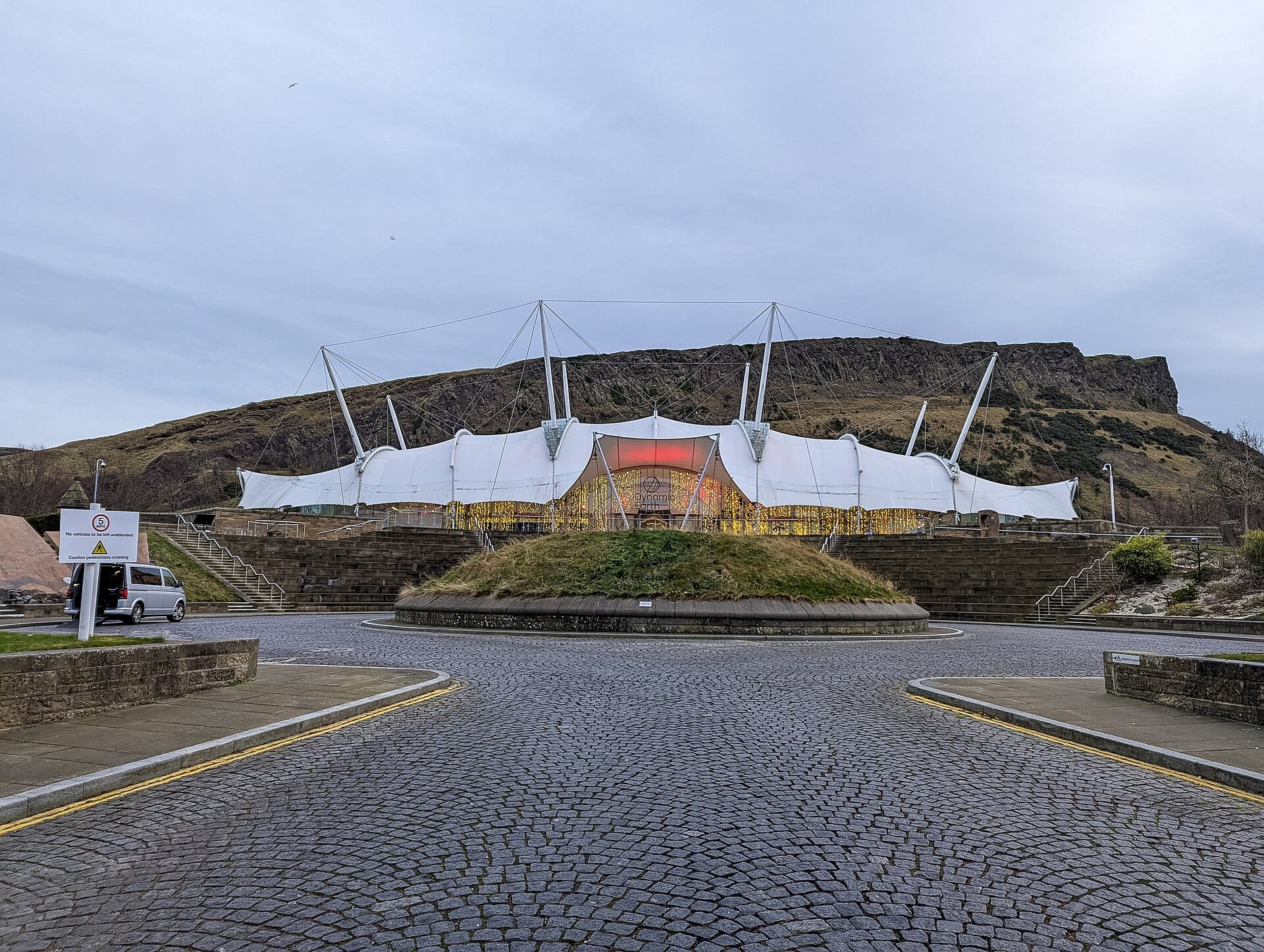
Dynamic Earth is an interactive Earth science centre housed in a striking tent-like structure on Holyrood Road, opened in 1999. It sits on reclaimed industrial land, at the point where Edinburgh's Old Town meets the raw volcanic landscape of Holyrood Park. It sits on reclaimed industrial land, part of which was once a brewery, at the point where Edinburgh's Old Town meets the raw volcanic landscape of Holyrood Park. The contrast is immediate and dramatic: on one side, centuries of urban history; on the other, the rough basalt faces of Salisbury Crags rising behind the building like a natural backdrop to the whole enterprise.
The centre tells the story of Earth's 4.5 billion years through a series of themed galleries, special effects chambers, and a full-dome digital planetarium. It was conceived not as a traditional museum of static displays but as an experiential journey, physically moving visitors through environments designed to represent geological epochs, ocean floors, polar ice, and tropical rainforests. For families especially, this format holds up well against the competition.
The building itself is worth noting. Designed by Hopkins Architects and completed in June 1999 following a construction period beginning in August 1997, the white tensile roof canopy has become part of Edinburgh's architectural vocabulary, a deliberate counterpoint to the medieval stone that defines most of the Holyrood and Canongate area. The approximately 4,000 m² structure also incorporates part of the southerly wall and a turret from the old town, so history literally runs through the foundations.
The Journey Through the Galleries
The experience follows a roughly linear path through distinct zones, beginning with the formation of the universe and moving through volcanic activity, ice ages, ocean systems, and ultimately to human civilization and the current climate crisis. The route is clearly signposted, which matters when you have children in tow, but the pacing feels slightly rushed toward the end, as though the final galleries received less budget than the opening spectacles.
Highlights that consistently draw crowds include the time machine elevator that kicks off the journey, the earthquake simulator (a platform that replicates tremor vibrations with satisfying physical punch), and the polar regions gallery where the air temperature drops noticeably and visitors get a tactile sense of what extreme cold actually feels like. The tropical rainforest zone is loud, humid by Edinburgh standards, and genuinely immersive. Children tend to stop and explore here far longer than parents expect.
The planetarium shows operate on a separate ticketing basis and run throughout the day at set times. The full-dome format is well-suited to astronomy and deep-time geology content, and the shows change periodically. If you are considering this add-on, book it when you buy your main tickets rather than assuming slots will be available on the day, particularly during school holidays.
💡 Local tip
Planetarium shows fill up fast on school holidays and weekends. Book your show slot at the same time as your main admission ticket on the Dynamic Earth website to avoid disappointment.
Tickets & tours
Live prices and dates from our booking partner. If you book, we may earn a commission at no extra cost to you.
West Highland Lochs, mountains and castles tour from Edinburgh
From 61 €Instant confirmationFree cancellationLoch Ness, Glen Coe and the Highlands tour from Edinburgh
From 66 €Instant confirmationFree cancellationDay Trip to Holy Island, Alnwick Castle and Northumbria from Edinburgh
From 60 €Instant confirmationFree cancellationLoch Ness Explorer Day Trip from Edinburgh
From 60 €Instant confirmationFree cancellation
When to Visit and What Changes by Time of Day
Dynamic Earth opens at 10:00 daily during its main operating season, and the first hour, roughly 10:00 to 11:00, is consistently the quietest period. School groups tend to arrive mid-morning, typically between 10:30 and 11:30, so independent visitors who arrive right at opening can move through the early galleries ahead of the wave. By midday, the café and the more popular interactive zones are noticeably more crowded.
Late afternoon, the 14:30 to 16:00 window, sees another quieter spell as school groups depart and before the after-school family visit rush. Last entry is typically 16:00 in spring and autumn, 16:30 in July and August. Arriving after 14:00 gives you the galleries at their most manageable, but check current last-entry times carefully before planning a late visit.
Seasonal opening hours vary significantly. The centre typically operates 10:00 to 17:30 in April through June and September through October, extends to 18:00 in July and August, and reduces to 17:00 in November and December. It closes in January for annual maintenance, and is closed on Christmas Day and Boxing Day. These schedules change, so verify on the official site before your visit.
⚠️ What to skip
Dynamic Earth closes in January for annual maintenance and is shut on Christmas Day and Boxing Day. Always check current hours at dynamicearth.co.uk before planning your visit, as seasonal schedules shift year to year.
The Setting: Holyrood's Unique Geography
Part of what makes a visit to Dynamic Earth rewarding is where it sits. The building is within easy walking distance of the Scottish Parliament and the Palace of Holyroodhouse, making Holyrood Road one of the more historically and architecturally layered streets in the city. If you approach on foot from the Royal Mile, you pass through Canongate, with its close-packed tenements and historic kirkyard, before the landscape opens suddenly onto the green expanse of Holyrood Park.
That park, with Salisbury Crags and Arthur's Seat forming the skyline immediately behind Dynamic Earth, is itself a piece of living geology. The volcanic rock formations visible from outside the building are among the best surface examples of igneous geology in any European capital. This physical proximity to the science being discussed inside gives the centre an authenticity that a landlocked site would lack.
In practical terms, this means a visit to Dynamic Earth pairs very naturally with time in Holyrood Park. On a clear day, consider arriving at Dynamic Earth when it opens, spending two to three hours inside, then walking directly into the park for an afternoon. The contrast between the constructed drama of the galleries and the real geological theatre outside is not accidental; it is the experience the site's location was designed to reinforce.
Practical Logistics: Getting There, Accessibility, and What to Bring
The address is 112–116 Holyrood Road, Edinburgh EH8 8AS. On foot from the Royal Mile, walk down Canongate and continue along Holyrood Road. The walk takes around ten to fifteen minutes from the heart of the Old Town and is almost entirely flat until you reach the site. City buses serve Holyrood Road, making it accessible without walking if needed. The walk takes around ten to fifteen minutes from the heart of the Old Town and is almost entirely flat until you reach the site. City buses serve Holyrood Road, making it accessible without walking if needed.
A 24-hour car park is available on site, which is useful if you are arriving from outside the city centre or combining the visit with Holyrood Park. Edinburgh city centre parking can be expensive, so the on-site option is worth factoring into your planning if you are driving.
Accessibility is well handled. The building was designed as a modern science centre with step-free routes throughout the exhibitions. Visitors with specific mobility requirements are advised to contact the venue directly for the most current details, as show formats and temporary exhibitions occasionally affect access arrangements.
There is a café on site. It functions adequately for a midday break but is not a destination in its own right. If you want a proper lunch, the Canongate area and the streets immediately north of Dynamic Earth have a better range of options. Bring a layer even in summer: the polar gallery genuinely is cold, and Edinburgh itself can turn sharp in the afternoon regardless of season.
Honest Assessment: What Works and What Does Not
For families with children between roughly five and fourteen, Dynamic Earth delivers strong value. The interactive format, the special-effects chambers, and the planetarium keep attention well. Younger children will respond to the sensory environments; older children who are curious about science will get more out of the explanatory content, which is well-written and does not condescend.
For adults visiting without children, the calculus is different. The experience leans toward spectacle over depth, and science-literate adults may find the content covers familiar ground without much new nuance. The building, the setting, and the planetarium offer genuine interest, but if your time in Edinburgh is short and your priorities run toward history, art, or architecture, Dynamic Earth may not be the most efficient use of two to three hours.
It is also worth being honest about cost. At approximately £21.50 for adults, the ticket price is on the higher end for Edinburgh attractions, particularly given that major institutions like the National Museum of Scotland are free to enter. If budget is a constraint, Edinburgh's free attractions offer significant competition. That said, the Dynamic Earth experience is not easily replicated elsewhere in the city, and for the right visitor, the price point is fair.
ℹ️ Good to know
Annual passes are available and represent good value if you plan multiple visits or have children who would return. Annual passes are available and represent good value if you plan multiple visits or have children who would return. Adult annual pass is approximately £49.50; child (4–15) approximately £39.50. Check current pricing on the official site. Check current pricing on the official site.
Insider Tips
- Arrive at 10:00 on the dot to get through the first three galleries before school groups arrive. The earthquake simulator in particular has zero queue at opening time and a significant one by 11:00.
- Book planetarium show tickets online at the same time as your main admission. Show slots, especially the afternoon screenings, sell out on weekends and school holidays with no on-the-day alternatives.
- The polar gallery is genuinely cold enough to be uncomfortable in short sleeves. Bring or wear a light jacket regardless of outside temperature.
- Combine the visit with Holyrood Park afterward: the geology you have just read about inside is visible in raw form on the Salisbury Crags face directly behind the building. It is a surprisingly effective continuation of the same subject matter.
- If you are visiting with teenagers who find the early galleries too simple, the climate and human impact section toward the end of the route tends to generate more engagement, as it connects the science to current events.
Who Is Dynamic Earth For?
- Families with children aged 5–14 seeking an interactive, all-weather activity
- Visitors on rainy days who want a structured indoor experience lasting two to three hours
- Science and geology enthusiasts curious about Edinburgh's volcanic landscape
- Groups combining Dynamic Earth with a walk through Holyrood Park or Arthur's Seat
- Visitors interested in millennium-era British architecture alongside the science content
Nearby Attractions
Other things to see while in Holyrood & Canongate:
- Arthur's Seat
Rising around 250 metres above the city, Arthur's Seat is an extinct volcano sitting at the heart of Edinburgh, free to climb year-round. It rewards the effort with unobstructed views across the Scottish capital, the Firth of Forth, and the Lothian hills. This is not a polished tourist attraction — it is raw, windswept, and genuinely spectacular.
- Holyrood Abbey Ruins
Founded by King David I in 1128, Holyrood Abbey stands as one of Scotland's most atmospheric medieval ruins. The roofless nave, with its soaring Gothic arches open to the Edinburgh sky, is accessed through the Palace of Holyroodhouse and offers a rare encounter with raw, unadorned history at the foot of Arthur's Seat.
- Holyrood Park
Holyrood Park is a 260-hectare sweep of volcanic rock, grassland, and lochs sitting right at the edge of Edinburgh's Old Town. Free to enter at any hour, it holds Arthur's Seat, the Salisbury Crags, and Duddingston Loch inside a boundary set by a royal decree in 1541. Few capital cities have anything like it.
- Palace of Holyroodhouse
The Palace of Holyroodhouse is the British monarch's official residence in Scotland, a working royal palace with over 500 years of history. Sitting at the foot of the Royal Mile with Arthur's Seat rising behind it, the palace offers a rare combination of royal ceremony, dramatic architecture, and dark historical intrigue.
Planning a trip? Discover personalized activities with the Nomado app.