Salisbury Crags: Edinburgh's Volcanic Cliffs Above the City
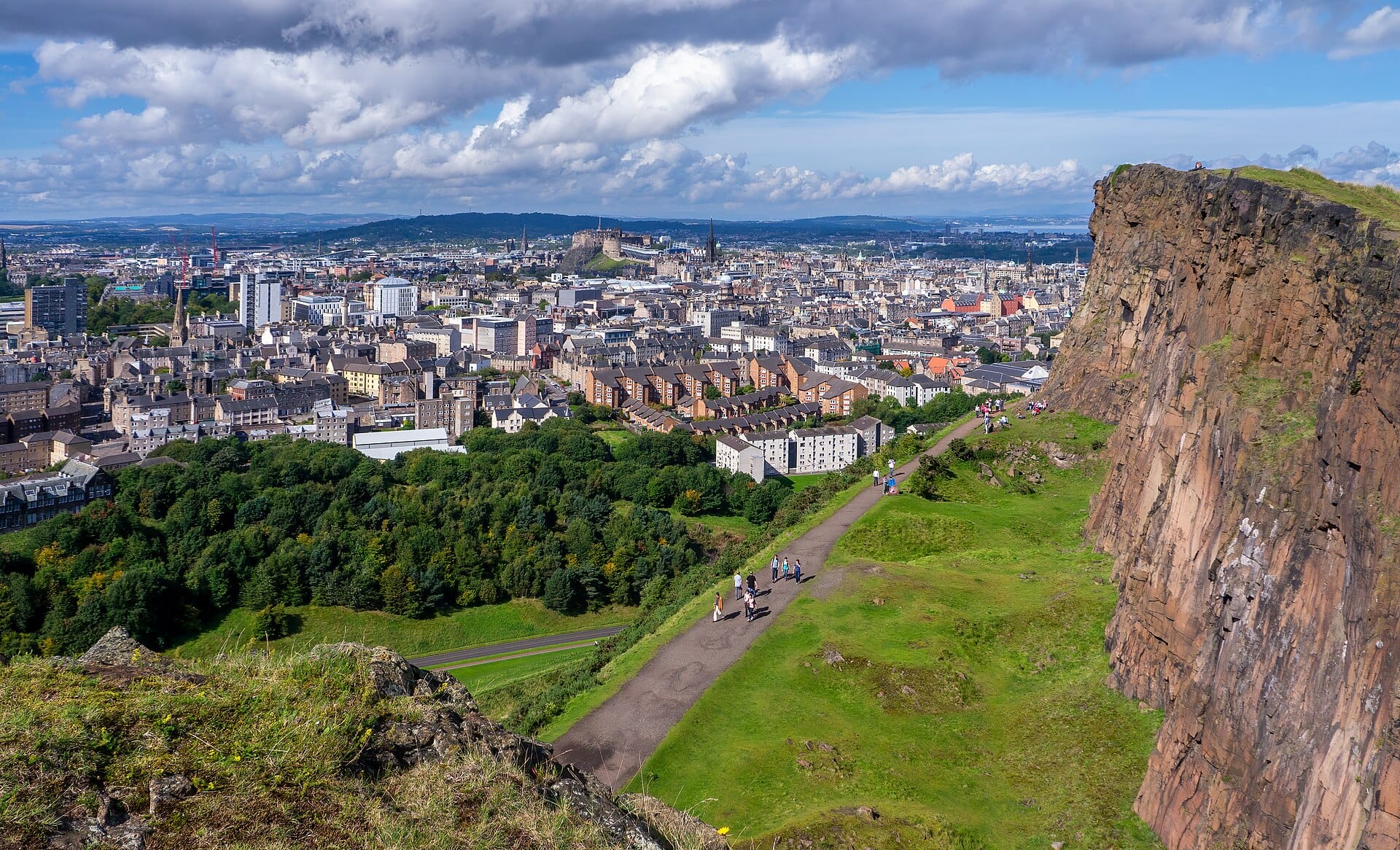
Rising 46 metres above the city on the western flank of Holyrood Park, Salisbury Crags are a dramatic set of dolerite cliffs that reward a short uphill walk with sweeping views across Edinburgh. Free to enter and open at all times, this is one of the most accessible pieces of wild geology in any European capital.
Quick Facts
- Location
- Holyrood Park, Edinburgh (Holyrood and Canongate)
- Getting There
- On foot from Holyrood Palace at the foot of the Royal Mile; bus stops on Horse Wynd and Holyrood Road
- Time Needed
- 1 to 2 hours for signed crag-side walks (Radical Road access is often restricted); longer if combining with Arthur's Seat
- Cost
- Free. No ticket required. Rock climbers need a free permit from the park education centre for the South Quarry only.
- Best for
- Hikers, photographers, geology enthusiasts, solo walkers, and anyone wanting city panoramas without a queue
- Official website
- www.historicenvironment.scot/visit-a-place/places/holyrood-park
What Are Salisbury Crags?
Salisbury Crags are a long, curving wall of dolerite cliffs sitting on a spur of Arthur's Seat in the centre of Holyrood Park. They rise approximately 46 metres (151 feet) above the park floor and stretch in a pronounced arc along the western edge of the hill, visible from much of central Edinburgh. This is not a viewpoint you reach by elevator or ticket booth. You walk up, on uneven stone paths, with the wind usually reminding you that Scotland is not the Mediterranean.
The cliffs formed roughly 340 million years ago during the Carboniferous period, when molten rock intruded into sedimentary layers and cooled into the hard dolerite you see today. Glacial action during the last ice age stripped away the softer surrounding material, leaving the crags exposed and vertical on the west side while the hill slopes away more gently to the east. The result is one of the most striking examples of an igneous sill formation in the British Isles, and a site of significant importance in the history of geology.
ℹ️ Good to know
Holyrood Park was enclosed in 1541, when King James V enclosed the land including 'Arthurs Sett, Salisborie and Duddingston craggis.' The landscape you walk through today carries five centuries of history.
James Hutton and the Birth of Modern Geology
Salisbury Crags holds a specific place in scientific history that most visitors walk past without realising. In the late 18th century, Edinburgh geologist James Hutton came here to study the contact zone between the igneous dolerite and the older sedimentary rock. What he observed at Salisbury Crags, rock intruded into pre-existing layers rather than laid down by biblical flood, helped him articulate the principle that Earth's features form through slow, continuous processes over vast time spans. His 1788 paper 'Theory of the Earth' is considered a foundation of modern geology as a science.
A specific feature known as 'Hutton's Section' marks the spot near the foot of the crags where this observation was made. It is not dramatically signposted, but geology-minded visitors who do a little research before arriving will find it along the lower path. The Geological Society of London has designated Arthur's Seat and Salisbury Crags as one of its 100 Great Geosites for this reason.
Tickets & tours
Live prices and dates from our booking partner. If you book, we may earn a commission at no extra cost to you.
West Highland Lochs, mountains and castles tour from Edinburgh
From 61 €Instant confirmationFree cancellationLoch Ness, Glen Coe and the Highlands tour from Edinburgh
From 66 €Instant confirmationFree cancellationDay Trip to Holy Island, Alnwick Castle and Northumbria from Edinburgh
From 60 €Instant confirmationFree cancellationLoch Ness Explorer Day Trip from Edinburgh
From 60 €Instant confirmationFree cancellation
The Walk: What to Expect on the Ground
The classic cliff-base path is the Radical Road, which has been largely closed since 2018 due to rockfall risk; check Holyrood Park notices for any limited reopening and use signed alternative routes. It was built in the 1820s using unemployed weavers from the west of Scotland, reportedly at the suggestion of Sir Walter Scott. The path starts from near Holyrood Palace and curves around to rejoin the park road closer to Duddingston. It is surfaced in places but involves uneven rock sections and some gradient. Sturdy footwear is not optional on a wet day.
For those wanting elevation rather than just the base walk, paths zigzag up from the park road and from the area near Holyrood Palace to reach the cliff-top ridge. The ridge walk itself offers an entirely different experience: open ground above the vertical drop, with Edinburgh spread below you to the north and west. On a clear day you can see the Forth, Fife, the Pentland Hills, and the full sweep of the New Town grid from this position. The wind at ridge level is consistently stronger than on the paths below, sometimes significantly so.
⚠️ What to skip
Sections of path near the cliff base have been closed periodically due to rockfall risk. Always follow current closure signs in the park. Do not attempt to climb the crags outside the designated South Quarry area, and do not walk close to the cliff edge on the ridge in icy or very windy conditions.
The crags sit immediately adjacent to other major sites in Holyrood and Canongate. From the base of the path you can see the Palace of Holyroodhouse and the Scottish Parliament. Most visitors combine the walk with a loop around Holyrood Park or continue uphill toward Arthur's Seat for a longer half-day outing.
How It Changes by Time of Day
Early morning is the most rewarding time to be on the crags. Between roughly 7am and 9am on a weekday, open crag-side paths often have only a handful of walkers and the occasional runner. The city noise drops to almost nothing, replaced by wind and birdsong, and the light hits the cliff face from a low angle that emphasizes the texture of the dark rock. Haar, the coastal fog that rolls in from the Firth of Forth, sometimes sits below the ridge while the crags themselves are in clear air, an effect that makes Edinburgh look like a city adrift in cloud.
By mid-morning and through the afternoon on weekends and in summer, the paths become considerably busier. Families, tourist groups, and joggers all share the route. The experience remains worthwhile but the sense of solitude disappears. Sunset visits in summer draw a specific crowd to the ridge, and the light on the city at that hour is genuinely good for photography, with the castle lit orange and the New Town stretching west toward the sun. Bring a head torch if you plan to stay past dusk, as the paths are unlit.
In winter the crags have a particular character. The reduced daylight and near-empty paths give the place a severity that suits the geology. Ice forms on shadowed sections of the path, and the views on clear winter days have a sharpness that summer haze often removes. Winter visits require appropriate layers and grip-enhanced footwear.
Getting There and Practical Logistics
The most natural approach is on foot from the Old Town. Walking down the Royal Mile to its foot, past the Scottish Parliament, brings you directly to the park entrance nearest the Salisbury Crags paths. This takes around 15 to 20 minutes from the High Street at a moderate pace. Bus stops on Holyrood Road serve the area near Dynamic Earth, which sits close to the park boundary.
There is a car park on the Queen's Drive loop road inside the park, which gives access to various trail starts. If you are planning a longer day that includes Dynamic Earth or the Palace of Holyroodhouse, you can combine those visits in the same area without additional travel.
There are no cafes, toilets, or facilities inside Holyrood Park itself. Bring water, particularly in summer or if you are planning a longer walk that includes Arthur's Seat.
💡 Local tip
Photography tip: The cliff face of Salisbury Crags photographs best in morning light from the park floor below, with the city in the background. For city panoramas from the ridge, late afternoon and early evening in summer give the warmest light on the skyline.
Rock Climbing at the South Quarry
Salisbury Crags includes a designated climbing area at the South Quarry, a section of shorter cliff faces that have been used by Edinburgh climbers for generations. Climbing here requires a free permit from Holyrood Park's education centre. The quarry offers routes across a range of grades and is primarily used by local clubs and those already familiar with the site. It is not a commercial climbing experience and there are no guides or equipment rentals on-site.
Climbing on any part of the crags outside the South Quarry is not permitted. The cliff faces are protected under the park's conservation management, and the rock quality in areas beyond the designated zone is not considered safe for climbing.
Who Should Manage Their Expectations
Salisbury Crags are sometimes described as a quick city viewpoint, but the approach involves a real uphill walk on rough terrain. Visitors with limited mobility will find the main paths inaccessible without considerable difficulty. If a panoramic view with easier access is the goal, Calton Hill offers comparable views of the city with gentler paths and paved surfaces. Salisbury Crags reward effort; they do not accommodate a casual stroll in dress shoes.
The crags themselves are cliffs, not a manicured viewpoint, so there are no railings along the ridge and the drop on the west face is serious. Children and dogs need active supervision. The park is also large and the signage is minimal, which can disorient first-time visitors who arrive without a map or a trail app loaded.
Insider Tips
- Where open, the lower Radical Road path gives you the most dramatic sense of the cliff scale, with the basalt wall rising directly above you. Most visitors head straight for the ridge, missing this perspective entirely.
- Hutton's Section, where James Hutton made his foundational geological observations in the 1780s, is marked near the base of the crags but is easy to miss. Look for the information board along the lower path before the path curves around toward Duddingston.
- If the Radical Road section is closed due to rockfall (check the park entrance notice boards), the alternative approach via the park road on the eastern side and then up to the ridge from the south adds only around 15 minutes and the views from the south ridge looking back toward the crags and Arthur's Seat are worth it in their own right.
- In summer, carrying a windproof layer specifically for the ridge is useful even when it is warm lower down. The exposed top of the crags channels wind in a way the paths below do not.
- The path from the Holyrood Palace end of the park early on a weekday morning is often almost entirely empty. If you want the city panorama without the weekend crowd, a 7:30am Tuesday visit is a different experience from a 1pm Saturday one.
Who Is Salisbury Crags For?
- Walkers who want wild terrain within 20 minutes of the city centre
- Geology enthusiasts interested in Hutton's foundational observations
- Photographers seeking elevated city panoramas without admission fees or queues
- Solo travellers who want space to think and a genuine sense of landscape
- Visitors combining a morning walk with an afternoon visit to Holyrood Palace or Dynamic Earth
Nearby Attractions
Other things to see while in Holyrood & Canongate:
- Arthur's Seat
Rising around 250 metres above the city, Arthur's Seat is an extinct volcano sitting at the heart of Edinburgh, free to climb year-round. It rewards the effort with unobstructed views across the Scottish capital, the Firth of Forth, and the Lothian hills. This is not a polished tourist attraction — it is raw, windswept, and genuinely spectacular.
- Dynamic Earth
Dynamic Earth is an interactive science centre at the foot of Salisbury Crags, telling the 4.5-billion-year story of the planet through immersive galleries and planetarium shows. It sits beside the Scottish Parliament and pairs well with Holyrood Park nearby. Strong on family appeal, it rewards those who take time to work through each zone rather than rush.
- Holyrood Abbey Ruins
Founded by King David I in 1128, Holyrood Abbey stands as one of Scotland's most atmospheric medieval ruins. The roofless nave, with its soaring Gothic arches open to the Edinburgh sky, is accessed through the Palace of Holyroodhouse and offers a rare encounter with raw, unadorned history at the foot of Arthur's Seat.
- Holyrood Park
Holyrood Park is a 260-hectare sweep of volcanic rock, grassland, and lochs sitting right at the edge of Edinburgh's Old Town. Free to enter at any hour, it holds Arthur's Seat, the Salisbury Crags, and Duddingston Loch inside a boundary set by a royal decree in 1541. Few capital cities have anything like it.
Planning a trip? Discover personalized activities with the Nomado app.