Holyrood Park: Edinburgh's Wild, Ancient Landscape at the City's Edge
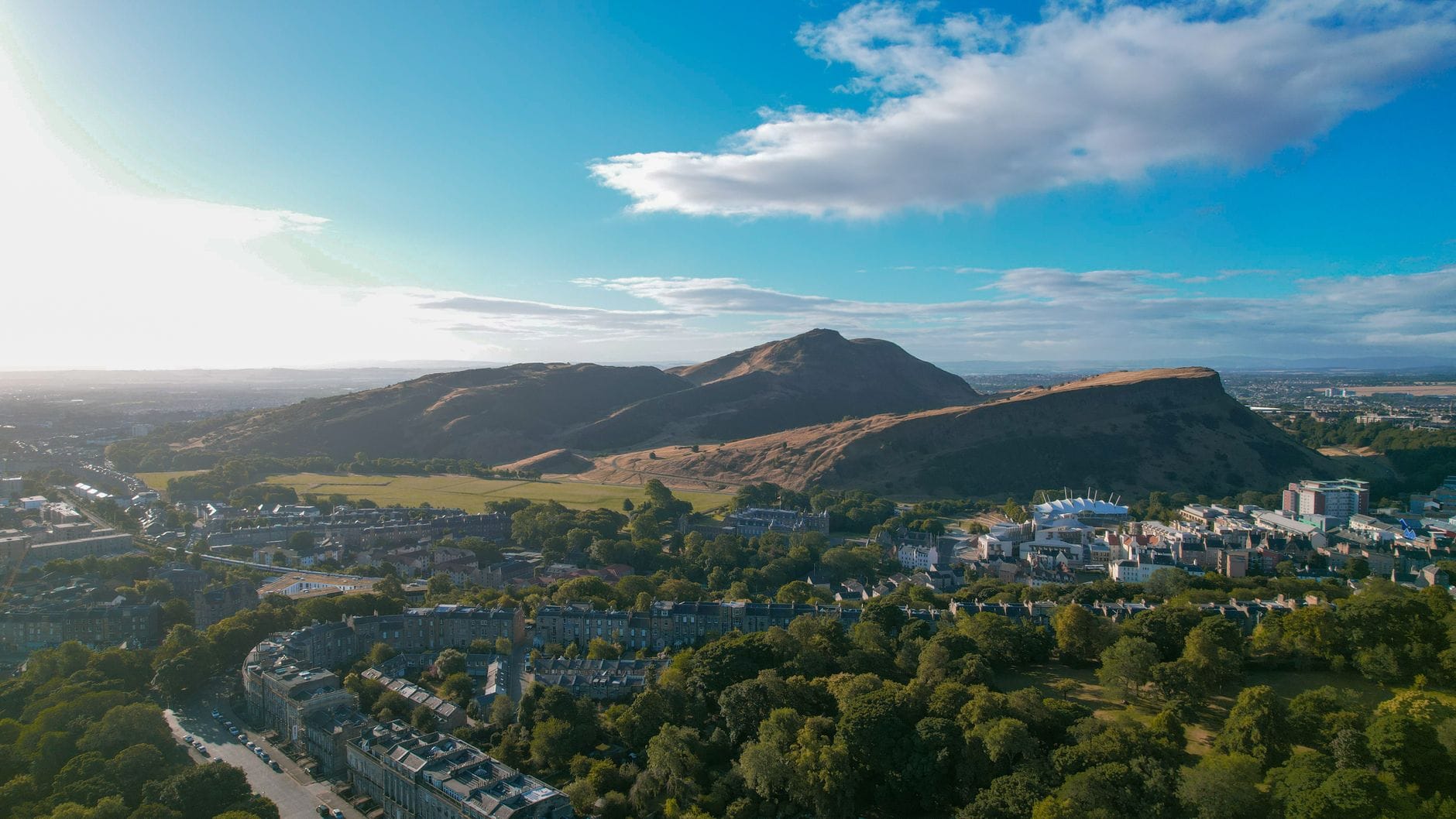
Holyrood Park is a 260-hectare sweep of volcanic rock, grassland, and lochs sitting right at the edge of Edinburgh's Old Town. Free to enter at any hour, it holds Arthur's Seat, the Salisbury Crags, and Duddingston Loch inside a boundary set by a royal decree in 1541. Few capital cities have anything like it.
Quick Facts
- Location
- Queen's Drive, Edinburgh EH8 8HG — east edge of the Old Town, beside the Palace of Holyroodhouse
- Getting There
- Bus routes 35, 36, and 300 serve the park perimeter; the Royal Mile entrance is a 15–20-minute walk from Waverley Station
- Time Needed
- 1 hour for a lakeside stroll; 2.5–3.5 hours for the full Arthur's Seat summit circuit
- Cost
- Free to enter. Parking near Holyrood Palace: £1/hr (08:30–17:30 weekdays; free on weekends and public holidays)
- Best for
- Hikers, photographers, families wanting outdoor space, and anyone wanting to understand Edinburgh's geology
- Official website
- www.historicenvironment.scot/visit/all/holyrood-park
What Holyrood Park Actually Is
Holyrood Park is a royal park and scheduled ancient monument covering approximately 260 hectares (around 640–650 acres) of volcanic landscape in the heart of Edinburgh. It is managed by Historic Environment Scotland and sits immediately east of the Palace of Holyroodhouse, roughly one mile from Edinburgh Castle. The park is free to enter at any time of day or night, every day of the year.
The park's defining feature is Arthur's Seat, an extinct volcano and Edinburgh's highest point at about 251 metres (823 feet). Surrounding it are the sharp basalt cliffs of the Salisbury Crags, the peaceful Duddingston Loch, a string of smaller ponds, and wide open grassland that feels entirely removed from the city pressing in on all sides.
The park is not a manicured city green. It is rough, windswept, and geologically dramatic. If you are arriving from the Old Town, the transition from cobbled closes to open moorland happens within minutes, which is part of what makes it so striking.
💡 Local tip
The park road around Queen's Drive is closed to private vehicles on weekends. This is actually a benefit for walkers and cyclists, who have the full circuit to themselves on those days.
A Brief History: From Royal Hunting Ground to Public Park
Holyrood Park was formally enclosed in 1541 when King James V had a stone dyke built around Arthur's Seat and the surrounding ground, creating a private hunting reserve adjacent to the Palace of Holyroodhouse. The enclosure brought together land that had been farmed and settled for thousands of years before that, which is why the park still contains the remains of prehistoric terraced cultivation — called 'cord rig' — visible on the lower slopes when the light is low and raking.
The park passed through various degrees of royal and state management over the centuries and is now listed under the care of Historic Environment Scotland. Its official designation as a scheduled ancient monument reflects the density of archaeological features within its boundaries: hill forts, a Bronze Age burial cairn on Arthur's Seat, and remnants of early medieval settlement around Duddingston. Depending on the reigning monarch, the park is also colloquially referred to as Queen's Park or King's Park, though Holyrood Park remains the formal name used by Historic Environment Scotland.
The volcanic geology that shaped Arthur's Seat and the Salisbury Crags was famously studied here in the late 18th century by geologist James Hutton, whose observations in the park directly contributed to the founding principles of modern geology. It is not an exaggeration to say that science changed here. For those interested in this legacy, the park pairs naturally with a visit to the Dynamic Earth science centre, which sits directly on the park's northwest boundary and covers Holyrood's volcanic story in detail.
Tickets & tours
Live prices and dates from our booking partner. If you book, we may earn a commission at no extra cost to you.
What You Actually See: The Park's Main Features
Arthur's Seat
The summit of Arthur's Seat is the obvious focal point. The climb from the Holyrood Palace car park takes roughly 45 minutes at a steady pace. Multiple routes exist: the most direct ascent goes up the north ridge from St Anthony's Chapel ruins, while a gentler approach curves up from Dunsapie Loch on the east side. On clear days the view from the top takes in the Firth of Forth, the Forth bridges to the west, the Fife coastline, and Edinburgh spread out below in a way that no rooftop bar or observation deck quite replicates. For a focused exploration of the summit experience, the full guide to Arthur's Seat covers every route option in detail.
Salisbury Crags
The Salisbury Crags are the long ridge of exposed basalt columns that dominate the park's western face. The path running below them, the Radical Road, was reputedly built in 1820 using unemployed weavers. Walking it takes about 20 minutes and delivers dramatic close-up views of the cliff face as well as wide views across the city toward the Scottish National Gallery and the New Town skyline. The Crags are particularly photogenic in early morning light.
Duddingston Loch
Duddingston Loch occupies the southeast corner of the park and operates as a bird sanctuary. It is one of Edinburgh's lesser-visited corners and feels genuinely quiet even on busy summer weekends. The loch borders the village of Duddingston, which contains one of Edinburgh's oldest pubs (the Sheep Heid Inn, dating from the 14th century) just outside the park boundary. Birdwatchers will find it worth the detour; tufted ducks, pochards, and grey herons are regular residents.
St Margaret's Loch and St Anthony's Chapel
St Margaret's Loch sits near the park's northeast entrance and is usually occupied by swans, making it a natural stopping point for families. Above it, on a crag above the loch, are the skeletal ruins of St Anthony's Chapel, thought to date from the 15th century and purpose unknown. The ruins are small but photogenic and serve as a useful orientation landmark on the way up to Arthur's Seat.
How the Park Changes Through the Day
Early morning, roughly 6:00 to 8:30, is when the park genuinely belongs to the people who use it daily: runners on the Radical Road path, dog walkers across the lower grassland, and the occasional photographer positioned for the first light on the Crags. In midsummer this window also delivers low-angle golden light across the volcanic geology that is noticeably different from the flat midday brightness.
From mid-morning onward, particularly on weekends between May and September, the park sees a steady increase in visitors heading for Arthur's Seat. By noon on a clear summer Saturday, the summit path is moderately congested and the car park fills early. Afternoon visits in summer still work, but expect company on the main routes.
Late afternoon from around 4:00 is an underrated time. Tour groups have largely left, the light starts to warm again, and the walk along the base of the Crags has a different quality, especially in autumn when the bracken turns rust-brown. Winter visits are genuinely rewarding if the weather cooperates: snow on Arthur's Seat is dramatic and crowds are minimal, but ice on the summit paths requires attention. Appropriate footwear is not optional in winter or wet conditions.
⚠️ What to skip
The summit of Arthur's Seat is exposed to wind in all seasons. Even in summer, temperatures at the top can be significantly colder than at street level. A waterproof layer and sturdy footwear are necessary regardless of what the city centre weather looks like when you set out.
Getting There and Practical Logistics
The park has no single main entrance. Its perimeter is largely open and accessible at multiple points around Queen's Drive. Coming from the Old Town, the most common approach is down the Royal Mile to Holyrood Palace, then directly into the park through the gates near the palace. From Waverley Station this is roughly a 15–20-minute walk.
Several Lothian Buses routes pass the park. Route 35 runs from Princes Street along the south side of the Old Town and stops near the palace entrance, and route 36 also serves stops near the park. The park is not served by Edinburgh's tram network; buses or walking are the practical options for most visitors arriving without a car.
Parking is available near Holyrood Palace on Broad Pavement at £1.00 per hour, charged between 08:30 and 17:30 on weekdays. Parking is free on Saturdays, Sundays, Christmas Day, Boxing Day, New Year's Day, and Easter Monday. The park road around Queen's Drive is closed to private vehicles on weekends, which removes the option of driving a circuit of the park.
Toilets and a small visitor and education centre are located near the Education Centre behind Holyrood Palace. The park's ranger service offers guided walks, which are a practical way to understand the geology and archaeology in context; check Historic Environment Scotland's website for current schedules.
ℹ️ Good to know
Photography tip: The view from the base of the Salisbury Crags looking west toward Edinburgh Castle is one of the most underused shots in the city. It works best in the hour before sunset, when the castle is lit from the side rather than washed out by overhead sun.
Who Will Love This, and Who Should Think Twice
Holyrood Park suits hikers, trail runners, families with children old enough to walk a mile or two, birdwatchers, landscape photographers, and anyone with an interest in geology or Scottish history. It is one of the few places in Edinburgh where the sense of scale shifts: for a moment, the city disappears and you are in open countryside.
Visitors with limited mobility will find the lower paths around St Margaret's Loch and the grassland near the palace accessible, though the terrain is uneven and the summit is not reachable by wheelchair. Those primarily interested in museums, dining, or architecture will find the park less compelling than Edinburgh's built attractions, though it pairs naturally with the Palace of Holyroodhouse or the Scottish Parliament directly next door.
The park is not the right choice in heavy rain without proper waterproofs. The paths on the upper slopes become slick and the wind across the summit is not manageable without preparation. On days of low cloud or fog, the views disappear entirely. The lower loops and the Radical Road path remain worthwhile in most weather, but the summit experience depends heavily on conditions.
Insider Tips
- Dunsapie Loch, in the east of the park, is where the gentler approach to Arthur's Seat begins. It is quieter than the main palace-side trail, the car park here has more space mid-week, and the loch often has more interesting birdlife than St Margaret's Loch near the main entrance.
- The prehistoric cord rig cultivation terraces on the lower northwest slopes are only clearly visible when the sun is low and casting shadows across the hillside. Late afternoon in autumn or early morning in spring are the best times to spot them. Most people walk straight past without noticing.
- The Queen's Drive circuit on foot is approximately 4 kilometres and takes about an hour at an easy pace. On weekends when the road is closed to cars, cyclists use it heavily. If you want a peaceful circuit, weekday mornings are the right call.
- For a different perspective on the park altogether, the view back toward Arthur's Seat from Calton Hill to the northwest gives the full volcanic profile and shows how the park sits in relation to the city. Many visitors never reverse the angle.
- If you are visiting in winter or early spring, check whether the park is hosting one of its organised events or ranger-guided geology walks. Historic Environment Scotland runs a programme that is low-profile but genuinely informative and free to join.
Who Is Holyrood Park For?
- Hikers and trail runners looking for a proper climb within city limits
- Families wanting open outdoor space without an admission cost
- Photographers chasing Edinburgh views beyond the standard castle-and-skyline shots
- Geology and natural history enthusiasts with an interest in James Hutton's work
- Visitors combining a morning in the park with an afternoon at Holyroodhouse or the Scottish Parliament
Nearby Attractions
Other things to see while in Holyrood & Canongate:
- Arthur's Seat
Rising around 250 metres above the city, Arthur's Seat is an extinct volcano sitting at the heart of Edinburgh, free to climb year-round. It rewards the effort with unobstructed views across the Scottish capital, the Firth of Forth, and the Lothian hills. This is not a polished tourist attraction — it is raw, windswept, and genuinely spectacular.
- Dynamic Earth
Dynamic Earth is an interactive science centre at the foot of Salisbury Crags, telling the 4.5-billion-year story of the planet through immersive galleries and planetarium shows. It sits beside the Scottish Parliament and pairs well with Holyrood Park nearby. Strong on family appeal, it rewards those who take time to work through each zone rather than rush.
- Holyrood Abbey Ruins
Founded by King David I in 1128, Holyrood Abbey stands as one of Scotland's most atmospheric medieval ruins. The roofless nave, with its soaring Gothic arches open to the Edinburgh sky, is accessed through the Palace of Holyroodhouse and offers a rare encounter with raw, unadorned history at the foot of Arthur's Seat.
- Palace of Holyroodhouse
The Palace of Holyroodhouse is the British monarch's official residence in Scotland, a working royal palace with over 500 years of history. Sitting at the foot of the Royal Mile with Arthur's Seat rising behind it, the palace offers a rare combination of royal ceremony, dramatic architecture, and dark historical intrigue.
Planning a trip? Discover personalized activities with the Nomado app.