Scottish Parliament: Architecture, Democracy, and a Free Day Out in Holyrood
The Scottish Parliament Building sits at the foot of the Royal Mile, where bold contemporary architecture meets one of Europe's youngest democratic institutions. Entry is free, and the public galleries, exhibitions, and guided tours make it one of Edinburgh's most substantive visits.
Quick Facts
- Location
- Foot of the Royal Mile, Holyrood, Edinburgh (next to the Palace of Holyroodhouse)
- Getting There
- Lothian Buses service 35 serves the Holyrood area; the building is a 15-minute walk from Waverley Station along the Royal Mile
- Time Needed
- 1 to 2 hours for exhibitions and a guided tour; longer if you attend a debate
- Cost
- Free admission
- Best for
- Architecture enthusiasts, politics and history buffs, curious travellers seeking substance over spectacle
- Official website
- www.parliament.scot
What Is the Scottish Parliament Building?
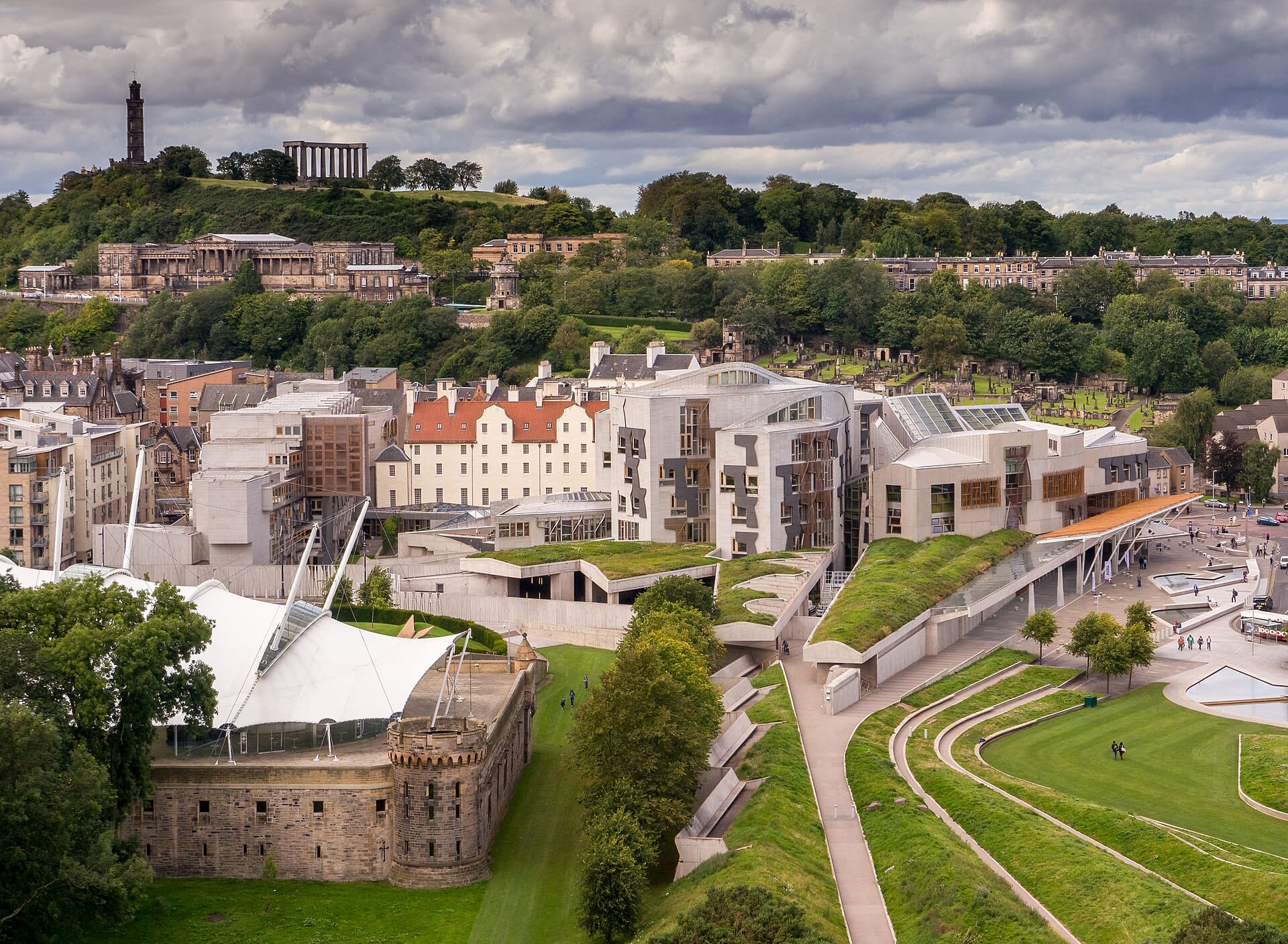
The Scottish Parliament, officially Pàrlamaid na h-Alba in Scottish Gaelic, is the devolved legislature of Scotland, established in 1999 following the Scotland Act 1998. It moved into its purpose-built permanent home in September 2004, a building designed by Catalan architect Enric Miralles and completed posthumously by his firm EMBT in partnership with Edinburgh-based Benedetta Tagliabue and RMJM Scotland. The building itself is as much the attraction as the institution it houses.
What you get here is not a stuffy civic monument. The Scottish Parliament Building is genuinely strange and genuinely ambitious: all curves, angled windows, leaf-shaped skylights, and layered materials that seem to grow from the volcanic landscape at its back. Whether you find it beautiful or baffling probably depends on your tolerance for deconstructivist architecture, but there is no question it commands attention.
💡 Local tip
Entry is free and no ticket is required for self-guided visits. For guided tours and access to the public debating chamber gallery, check availability on the official parliament.scot website in advance, as popular slots fill up.
The Architecture: What Makes This Building Remarkable
Enric Miralles drew on several poetic sources for the design: the curve of an upturned fishing boat, the forms of leaves, the contours of the landscape itself. The result is a building that resists a single, obvious reading. Standing outside on Horse Wynd, the main public entrance, you notice an almost organic quality to the facade, the way the windows protrude at odd angles like eyes looking in multiple directions simultaneously.
The debating chamber is the centrepiece. Light enters from above through irregular skylights so that on overcast Edinburgh days (which is most of them), the room still feels remarkably bright. The wooden structure of the chamber ceiling references the motif of upturned boats that runs through the entire complex. MSPs sit in a horseshoe arrangement rather than the adversarial facing-benches format of Westminster, a deliberate architectural and philosophical choice made to encourage consensus rather than combat.
The complex also includes MSP offices, committee rooms with distinctive Miralles-designed oak furniture, and the Garden Lobby, a glass-roofed space that connects various parts of the building. If you are exploring the Holyrood and Canongate area, the contrast between this building and the ancient Palace of Holyroodhouse directly opposite is worth pausing to consider.
Tickets & tours
Live prices and dates from our booking partner. If you book, we may earn a commission at no extra cost to you.
Scottish National Gallery In-App Audio Guided Tour
From 9 €Instant confirmationRosslyn Chapel and Scottish Borders small-group day tour
From 43 €Instant confirmationFree cancellationJacobite Steam Train and Scottish Highlands Tour from Edinburgh
From 218 €Instant confirmationFree cancellationLoch Lomond, The Trossachs National Park and Stirling Castle from Glasgow
From 48 €Instant confirmationFree cancellation
What You Can Actually Do Inside
The Parliament is open to the public throughout the year, and access goes well beyond peering through a door. On non-sitting days, visitors can view the Main Hall and access the public galleries of the debating chamber and committee rooms. Guided tours are available and provide access to the debating chamber floor itself, which is otherwise closed when Parliament is in session.
When Parliament is sitting, you can attend debates from the public gallery. Check the parliament.scot website for visitor gallery arrangements if you want to watch a specific debate, particularly First Minister's Questions (held on Thursdays). Watching live democracy unfold adds a dimension that no exhibition can replicate.
There are also permanent and rotating exhibitions about Scottish democracy, the devolution process, and the history of Scottish governance. The quality is higher than many government visitor centres: the content is honest about the contested nature of Scottish political history, not merely promotional. A gift shop and cafe are on site.
ℹ️ Good to know
Parliament sitting dates and tour schedules are confirmed on the official website. Check before making a special trip, as visitor arrangements can change on public holidays and during official events.
Time of Day and Crowd Patterns
Mornings on weekdays, particularly between 9am and 11am, are the quietest time to visit. By midday the area fills with tourists working their way down the Royal Mile from Edinburgh Castle, and school groups often arrive en masse. Weekend visits are calmer in terms of political activity but busier with leisure tourists.
The light inside the building shifts noticeably through the day. The skylights over the debating chamber and Garden Lobby create a different atmosphere depending on cloud cover, so a bright morning visit shows the interior at its best. In winter, arriving just after opening gives you the cleanest views of the exterior against the grey sky and the dark basalt of Salisbury Crags rising immediately behind.
If you are planning a full day in the area, the Parliament pairs naturally with the Palace of Holyroodhouse directly across the road and Dynamic Earth, Edinburgh's science and earth history visitor centre, just a few minutes' walk away.
Historical and Political Context
Scotland had its own Parliament from the 13th century until the Acts of Union in 1707, when it merged with the Parliament of England to form the Parliament of Great Britain. The Scottish Parliament as it exists today was re-established in 1999, following a referendum in 1997 in which Scots voted for devolution. It has legislative powers over areas including health, education, justice, and taxation, while Westminster retains control over reserved matters such as defence and foreign policy.
The decision to build a new, landmark parliament building rather than repurpose an existing one was deliberate. It was a statement about the seriousness and permanence of devolution. The building came in significantly over budget and behind schedule, which generated considerable controversy at the time, but the architectural result has since been widely recognised as one of the most significant buildings constructed in Scotland in the 20th and 21st centuries.
For broader context on Scotland's democratic and cultural history, the National Museum of Scotland on Chambers Street covers Scottish history from prehistoric times to the present day.
Practical Information for Visitors
The building is at the foot of the Royal Mile in the Holyrood area of Edinburgh. The walk from Waverley Station takes approximately 15 minutes along the Royal Mile, passing St Giles' Cathedral and the John Knox House. It is a downhill walk from the castle end, which makes for an easy approach if you are already on the Mile.
Security screening is in place at the entrance, similar to an airport security check. You will need to pass your bag through a scanner and walk through a metal detector. This is quick and straightforward, but it is worth knowing about in advance. Photography policies vary depending on where you are in the building and whether Parliament is in session, so follow the guidance of staff on the day.
The Holyrood area connects directly to Holyrood Park, which spreads out immediately to the south and east. After your visit to the Parliament, it is straightforward to walk into the park and up toward Salisbury Crags or continue further to Arthur's Seat.
⚠️ What to skip
The Parliament building can be closed to visitors on certain days when high-security official events take place. Always check parliament.scot for current visitor information before planning your trip around this attraction.
Is It Worth Your Time?
For travellers with a genuine interest in architecture or politics, this is one of Edinburgh's most rewarding free visits. You are not just looking at a pretty facade: you can go inside, understand the institution, and sometimes watch it in action. That combination is rare in any capital city.
For travellers primarily interested in scenery, shopping, or the castle-and-whisky circuit, the Parliament is probably not a priority. It is not a building that reveals itself from the outside alone, and without some curiosity about what happens inside, the visit will feel incomplete. If your Edinburgh time is short, note that the building is naturally on the route between the Royal Mile and Holyrood Park, so you can always take in the exterior without committing to a full visit.
Insider Tips
- First Minister's Questions on Thursdays is the most animated session of the parliamentary week. If your visit coincides with a sitting Thursday, check the parliament.scot visitor gallery page early in the week as demand for public gallery places is highest then.
- The exterior is best photographed from Horse Wynd on the south side in morning light, with the dark face of Salisbury Crags as a backdrop. The contrast between the contemporary building and ancient volcanic rock is the defining image of this site.
- The Garden Lobby inside the building has a skylight structure that rewards looking up. Most visitors rush through it; take a moment to stand still and study the ceiling geometry, which is among the most distinctive interior spaces in contemporary Scottish architecture.
- If you walk the full Royal Mile from Edinburgh Castle down to the Parliament, you end at the entrance facing Holyroodhouse. This is the logical direction of travel for a downhill walk, and it means you arrive at the Parliament with the full sweep of historic Edinburgh behind you.
- Guided tours that access the debating chamber floor are offered when Parliament is not sitting. These are free but popular, and booking in advance through the official website is strongly recommended rather than turning up and hoping for availability.
Who Is Scottish Parliament For?
- Architecture enthusiasts interested in late 20th and early 21st century public buildings
- Politics and current affairs travellers who want to see devolved democracy in person
- Visitors on a tight budget looking for a substantive, free indoor experience
- History-focused travellers tracing the arc from the Acts of Union 1707 to devolution in 1999
- Anyone combining Holyrood Park or Arthur's Seat with a cultural stop at the beginning or end of their walk
Nearby Attractions
Other things to see while in Holyrood & Canongate:
- Arthur's Seat
Rising around 250 metres above the city, Arthur's Seat is an extinct volcano sitting at the heart of Edinburgh, free to climb year-round. It rewards the effort with unobstructed views across the Scottish capital, the Firth of Forth, and the Lothian hills. This is not a polished tourist attraction — it is raw, windswept, and genuinely spectacular.
- Dynamic Earth
Dynamic Earth is an interactive science centre at the foot of Salisbury Crags, telling the 4.5-billion-year story of the planet through immersive galleries and planetarium shows. It sits beside the Scottish Parliament and pairs well with Holyrood Park nearby. Strong on family appeal, it rewards those who take time to work through each zone rather than rush.
- Holyrood Abbey Ruins
Founded by King David I in 1128, Holyrood Abbey stands as one of Scotland's most atmospheric medieval ruins. The roofless nave, with its soaring Gothic arches open to the Edinburgh sky, is accessed through the Palace of Holyroodhouse and offers a rare encounter with raw, unadorned history at the foot of Arthur's Seat.
- Holyrood Park
Holyrood Park is a 260-hectare sweep of volcanic rock, grassland, and lochs sitting right at the edge of Edinburgh's Old Town. Free to enter at any hour, it holds Arthur's Seat, the Salisbury Crags, and Duddingston Loch inside a boundary set by a royal decree in 1541. Few capital cities have anything like it.
Planning a trip? Discover personalized activities with the Nomado app.