Nelson Monument: Edinburgh's Telescope Tower with Panoramic Views
Standing at the highest point of Calton Hill, the Nelson Monument is a 143-step tower built between 1807 and 1816 to honour Admiral Horatio Nelson's victory at Trafalgar. The climb rewards visitors with some of the finest 360-degree views in Edinburgh, taking in the castle, the Firth of Forth, and Arthur's Seat.
Quick Facts
- Location
- 32 Calton Hill, Edinburgh EH7 5AA
- Getting There
- 10-15 min walk from Waverley Station or Princes Street; no direct bus to the summit
- Time Needed
- 45–90 minutes including the climb and museum
- Cost
- Tower: £6 | Ground-floor museum: free (£3 donation suggested)
- Best for
- City panoramas, history enthusiasts, photographers
- Official website
- www.edinburgh.gov.uk/directory-record/1086068/nelson-monument
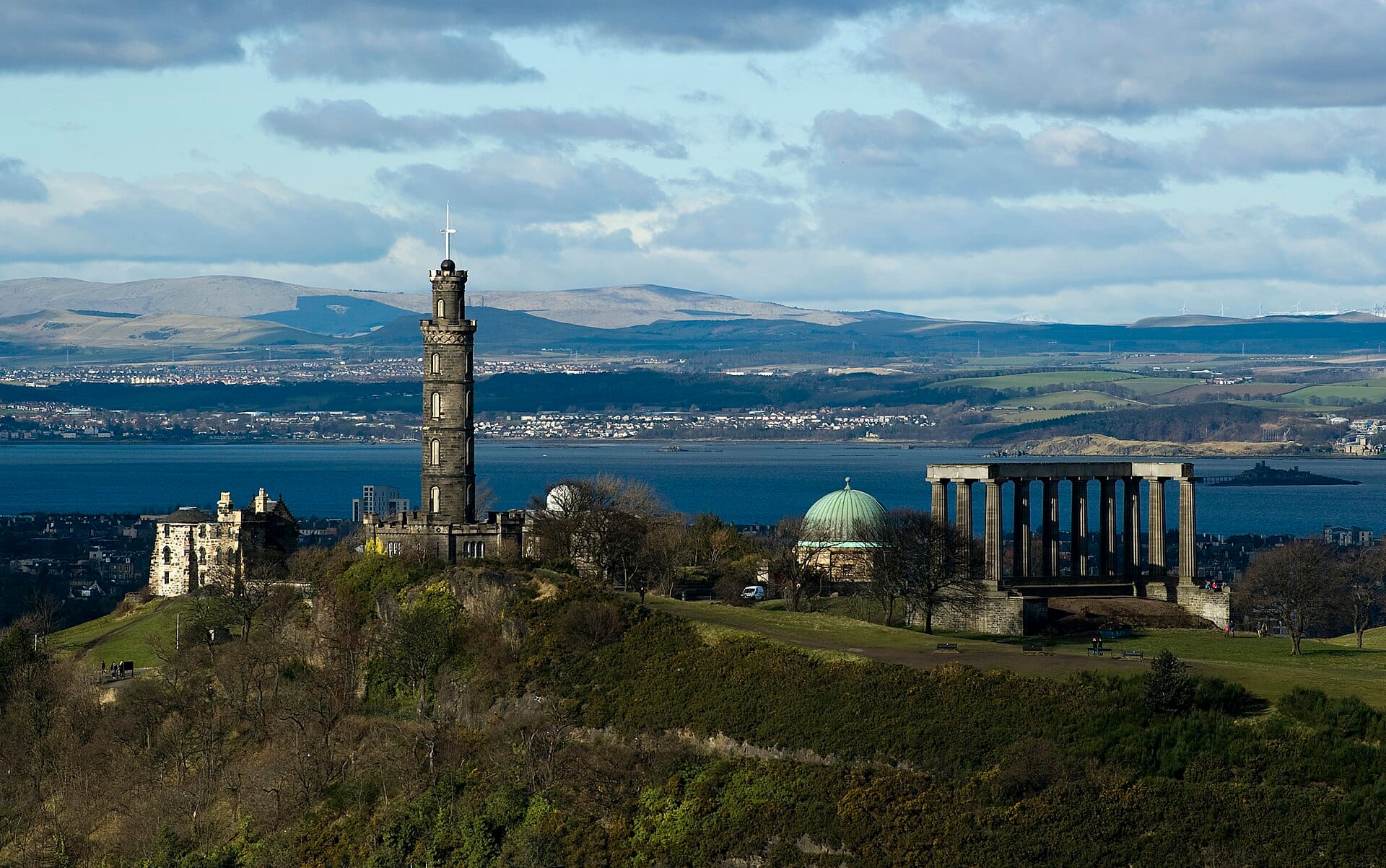
What the Nelson Monument Actually Is
The Nelson Monument is a commemorative tower on Calton Hill in Edinburgh, built between 1807 and 1816 to honour Vice Admiral Horatio Nelson, who was killed at the Battle of Trafalgar in October 1805. It is not a statue, not a gallery, and not a war museum. It is a climbable tower, roughly 32 metres tall, designed by architect Robert Burn in a form that deliberately echoes an upturned telescope. The shape is both symbolic and striking: a fitting tribute to a naval commander.
At ground level, a small museum space introduces the monument's history and Nelson's life free of charge, with a suggested donation of £3. Climbing the tower costs £6 and requires tackling approximately 143 steps up a tight internal staircase. The staircase is narrow enough that groups need to coordinate passing on the way up and down. At the top, a compact viewing gallery opens up to one of the most complete city panoramas in Edinburgh.
ℹ️ Good to know
Opening hours vary by season. April to September: Monday 1pm–6pm, Tuesday to Saturday 10am–6pm. October to March: Monday to Saturday 10am–3pm. Check current Sunday opening on the City of Edinburgh Council website before visiting.
The Climb and What You See at the Top
The 143-step climb takes most visitors around five to eight minutes at a steady pace. The staircase winds tightly upward and the stone walls press close on both sides. It smells faintly of damp stone, particularly after rain. The steps are uneven in places, worn smooth by generations of visitors, and the handrail is essential in the lower sections where the light is poor.
Emerging at the top is genuinely arresting. Edinburgh Castle sits directly to the west, framed against its basalt crag. To the north, the Firth of Forth stretches flat and grey-blue toward Fife, with the Forth Bridge visible on clear days. Arthur's Seat rises to the southeast, and the long Georgian grid of the New Town fills the foreground below. On still mornings, the city is largely silent from up here apart from wind and occasional seagulls. On summer afternoons, you will hear the crowd noise from Princes Street rising faintly.
The viewing gallery is small, accommodating perhaps eight to ten people comfortably. Photographers should note that the railings are close together and shooting through them requires patience. For comparison, Calton Hill itself offers open, unobstructed sightlines from the surrounding ground without the fee or the climb, though you lose the elevated height advantage the tower provides.
Tickets & tours
Live prices and dates from our booking partner. If you book, we may earn a commission at no extra cost to you.
West Highland Lochs, mountains and castles tour from Edinburgh
From 61 €Instant confirmationFree cancellationLoch Ness, Glen Coe and the Highlands tour from Edinburgh
From 66 €Instant confirmationFree cancellationDay Trip to Holy Island, Alnwick Castle and Northumbria from Edinburgh
From 60 €Instant confirmationFree cancellationLoch Ness Explorer Day Trip from Edinburgh
From 60 €Instant confirmationFree cancellation
A Working Time Signal Since 1852
One of the monument's less-noticed features is its time ball, mounted at the top of the tower. Installed in 1853, the ball drops at exactly 1pm every day, coordinated with the firing of Edinburgh Castle's famous One O'Clock Gun. The system was designed to give ships anchored in the Firth of Forth a visual time signal to set their marine chronometers accurately, a critical navigational requirement before radio communication.
The time ball is still operational today. If you are at the monument near 1pm, watch for it. The ball rises to the top of its mast shortly before the hour, then drops sharply (except on Sundays). It is a quiet, functional detail that connects a 19th-century scientific practice to the present day, and most visitors walk past without noticing the mechanism at all.
Historical Context: Why Calton Hill, Why 1807
The foundation stone was laid on 21 October 1807, exactly two years after the Battle of Trafalgar. Nelson's death during his greatest victory had generated intense public grief across Britain, and Edinburgh's response was swift. The choice of Calton Hill was deliberate: the hill was already being shaped into Edinburgh's civic ceremonial landscape during this period, and the monument's silhouette would be visible from most of the city.
Construction took around eight to nine years, completing by the mid-1810s. The tower sits within a broader collection of monuments and neoclassical structures on the hill, including the National Monument and the City Observatory. Together, they earned Calton Hill its occasional nickname as the 'Athens of the North' reference point, a reflection of Edinburgh's Enlightenment-era ambitions. The Royal Observatory on nearby Blackford Hill took over the city's astronomical functions later, but the observatory building on Calton Hill remains part of the hill's distinctive skyline.
Best Time to Visit and How the Experience Changes
Mornings on weekdays are the quietest period. The tower rarely gets fully crowded, but summer afternoons between noon and 4pm bring the most foot traffic, partly because visitors combine the monument with a broader walk across Calton Hill. If you want the viewing gallery to yourself, arrive shortly after opening on a Tuesday or Wednesday morning.
Light quality shifts significantly through the day. Morning light from the east illuminates the New Town and Princes Street directly below. Late afternoon light from the west catches the castle and the Old Town skyline in warmer tones, which works well for photography. On overcast days, the views are still readable but lack the depth that clear days provide. Edinburgh's weather changes quickly, so an overcast morning can clear by midday.
Winter visits have an underrated appeal. The shorter hours (closing at 3pm October through March) require planning, but visitor numbers drop sharply and the air is clear. Snow on Arthur's Seat, visible to the southeast, makes for a memorable composition. For a broader sense of what Edinburgh's viewpoints offer in different seasons, the best views in Edinburgh guide covers the trade-offs between Calton Hill, the castle esplanade, and other high points.
Getting There and Practical Logistics
Calton Hill is accessible via a path that begins on Waterloo Place, the eastern continuation of Princes Street. The main path from Waterloo Place reaches the summit in about ten minutes on foot. There is also an access route from Regent Road on the south side of the hill. The walk from Waverley Station takes around ten to fifteen minutes.
There is no step-free access to the tower due to its historic construction. The 143 steps are the only route to the viewing platform, and the staircase is not suitable for pushchairs, wheelchairs, or visitors with limited mobility. The ground-floor museum area is accessible without climbing.
Wear shoes with grip. The stone steps inside the tower can be slippery when moisture tracks in from visitors' feet on wet days. If you are combining this with a broader walk across Calton Hill or continuing toward the Princes Street Gardens below, allow at least two hours total. The hill path surfaces are uneven in sections, particularly on the northern side.
⚠️ What to skip
The time ball does not operate on Sundays. This catches many visitors off guard, particularly those timing a weekend visit for the 1pm signal. Plan accordingly.
Who Will Get the Most Out of This, and Who Might Not
The Nelson Monument is a solid choice for visitors who want elevated views with a layer of genuine historical content, rather than just an observation platform. If city panoramas are your primary goal and you are comfortable with heights and steps, the tower delivers. History enthusiasts, particularly those with an interest in naval history or 19th-century Edinburgh, will find the ground-floor museum a worthwhile starting point before the climb. Photographers working on Edinburgh skyline compositions will find angles here that differ usefully from those on the Scott Monument or Edinburgh Castle.
Visitors who find steep, enclosed staircases uncomfortable should reconsider the tower climb. The staircase has no windows and limited ventilation on the lower sections, and there is no option to stop on a landing if you need to let others pass easily. Families with young children who cannot manage 143 steps independently will find the tower section impractical. For those categories of visitor, the free ground-floor museum and the open hill surrounding the monument still offer a worthwhile stop.
If you have already visited Calton Hill and walked its summit paths, the tower adds a meaningful vertical jump in view quality, but the improvement is incremental rather than transformational. For comparison, Arthur's Seat offers a more dramatic elevation gain with broader outward views, though it requires a longer and more demanding walk.
Insider Tips
- The time ball drops at exactly 1pm every day. Position yourself outside the tower with a clear sightline to the top of the mast a few minutes before the hour to see it fall.
- Tuesday morning, shortly after opening, is often one of the quietest slots of the week. The viewing gallery can be yours alone for several minutes.
- The staircase doubles back on itself and is barely wide enough for two people side by side. If you hear someone descending as you ascend, press against the wall and let them pass rather than trying to continue upward.
- Bring a wind layer regardless of ground-level conditions. The viewing gallery at the top channels the prevailing westerly wind and can feel considerably colder than the hill below.
- The ground-floor museum is free to enter without purchasing a tower ticket. If the weather turns or you decide the climb is not for you, you can still access the historical content and see the monument's interior architecture from the base.
Who Is Nelson Monument For?
- History enthusiasts interested in Napoleonic-era Britain and naval history
- Photographers looking for angles on Edinburgh Castle and the New Town grid
- Visitors who want structured views with historical context rather than just an open hilltop
- Travellers with a full day in Edinburgh who are already walking Calton Hill
- Those travelling on a modest budget who want an elevated viewpoint for £6
Nearby Attractions
Other things to see while in New Town:
- Calton Hill
Rising 103 metres above central Edinburgh, Calton Hill is a free, 24-hour public park packed with monuments, volcanic geology, and some of the most complete city panoramas in Scotland. It takes under 20 minutes to reach from Princes Street on foot, and the views repay every step.
- Charlotte Square
Charlotte Square sits at the west end of George Street as the architectural crown of Edinburgh's first New Town. Designed by Robert Adam in 1791 and completed in 1820, the square is a free, publicly accessible streetscape and a key part of the city's UNESCO World Heritage Site.
- Edinburgh Christmas Market
Spread across East and West Princes Street Gardens and George Street, Edinburgh's Christmas runs from mid-November to early January each year. Entry is free, the backdrop is Edinburgh Castle, and the atmosphere shifts dramatically depending on when you arrive.
- Edinburgh Gin Distillery
Opened on 6 December 2024, the Edinburgh Gin Distillery at The Arches on East Market Street is the brand home of one of Scotland's most recognised craft gins. Set inside dramatic stone vaulted arches beneath historic railway arches near Waverley, it offers tastings, tours, and a retail experience rooted in the city's growing reputation for artisan spirits.
Planning a trip? Discover personalized activities with the Nomado app.