Scott Monument: Edinburgh's Gothic Spire Above Princes Street
Rising 61 metres above Princes Street Gardens, the Scott Monument is one of the largest monuments to a writer anywhere in the world. A Victorian Gothic tower packed with carved figures, it rewards those who make the climb with some of the most dramatic rooftop views in Edinburgh.
Quick Facts
- Location
- East Princes Street Gardens, Edinburgh EH2 2EJ
- Getting There
- Edinburgh Waverley station (2-min walk); buses 19, 29, 36, 37, 41, 42, 43, 47 along Princes Street
- Time Needed
- 45–90 minutes including the climb
- Cost
- Adults ~£8, Children/Students ~£6, Family ~£20 (verify current prices before visiting)
- Best for
- Architecture enthusiasts, city views, literary history, photography
- Official website
- www.edinburgh.gov.uk/directory-record/1086071/scott-monument
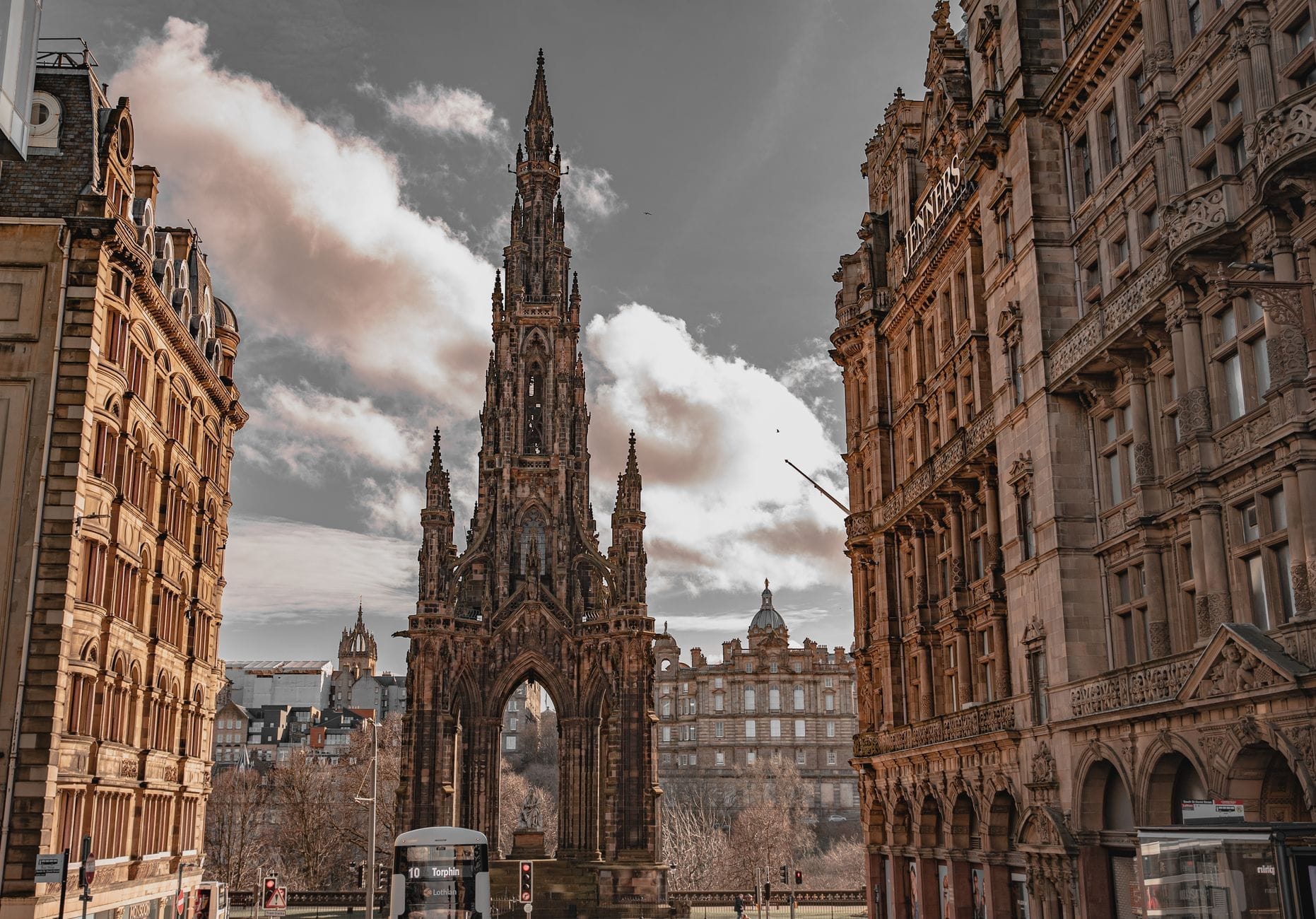
What the Scott Monument Actually Is
The Scott Monument is a Victorian Gothic memorial tower in the heart of Edinburgh, built to honour Sir Walter Scott, the novelist and poet who did more than almost anyone to shape the world's image of Scotland. At roughly 61 metres tall, it is the second-largest monument to a writer on earth, and it dominates the eastern end of Princes Street Gardens with a silhouette that looks more like a cathedral spire than a public statue.
Designed by self-taught architect George Meikle Kemp, whose foundations were laid in 1840 and the structure largely completed by 1844, with a formal opening in 1846. The tower is encrusted with 68 carved stone figures: Scott himself sits at the base alongside his favourite deerhound Maida, while characters from his novels populate niches all the way up the exterior. The sandstone has darkened over the decades to a near-black, giving the monument a brooding quality that suits both the Gothic style and Edinburgh's frequently grey skies.
It is not a passive monument. Visitors can climb 287 steps through four internal galleries to reach the uppermost viewing platform, which sits above the rooflines of New Town and looks directly across to Edinburgh Castle on its volcanic rock. The interior is narrow, steep, and quite dark in places, which matters when you are deciding whether to buy a ticket.
How the Experience Changes by Time of Day
The monument usually opens at 10:00 daily, and the first hour tends to be the quietest. Midmorning light from the east catches the carved stonework at a lower angle, bringing out the texture of the figures in a way that flat afternoon light does not. If photography is your priority, this is the window to be here.
From around noon onward, the gardens below fill with office workers, tourists heading toward the Royal Mile, and shoppers from Princes Street. The queue for the interior, if there is one, typically peaks between 12:00 and 15:00. Note that the monument closes for a lunch break around 12:30 to 13:45 on most days, so arriving just before noon or after 14:00 avoids both the closure and the worst of the afternoon crowds.
In summer, the monument typically stays open until around 16:30, and the late afternoon hours between 15:30 and 16:30 offer something genuinely different: the castle turns golden-orange in the western light, and the gardens below are at their greenest and most atmospheric. Winter hours can close as early as 15:30–16:00, which limits this window considerably.
💡 Local tip
The monument closes for a lunch break most days (approximately 12:30–13:45). Verify current times with the City of Edinburgh Council before visiting, as hours also shift seasonally: roughly April–October 10:00–16:30, November–March 10:00–15:30/16:00.
Tickets & tours
Live prices and dates from our booking partner. If you book, we may earn a commission at no extra cost to you.
Scottish National Gallery In-App Audio Guided Tour
From 9 €Instant confirmationRosslyn Chapel and Scottish Borders small-group day tour
From 43 €Instant confirmationFree cancellationJacobite Steam Train and Scottish Highlands Tour from Edinburgh
From 218 €Instant confirmationFree cancellationLoch Lomond, The Trossachs National Park and Stirling Castle from Glasgow
From 48 €Instant confirmationFree cancellation
The Climb: What to Expect on the Way Up
The climb is genuinely physical. The 287 steps are divided into four levels, each offering a progressively higher viewing gallery. The staircase is a tight, worn spiral, and at certain pinch points only one person can pass at a time. You will hear other climbers before you see them. The walls are close, the steps uneven in places, and the air inside is cool regardless of the season.
The first gallery, roughly a third of the way up, is where most people catch their breath and get their first decent view over Princes Street. By the second gallery, the Old Town ridge is visible in full, and the geometry of the New Town grid becomes clear to the north. The third and fourth galleries thin out considerably, partly because the staircase narrows further and partly because some visitors decide the second gallery is enough.
The top platform is genuinely exposed. In wind or rain, it is not comfortable, and there is no cover. On a clear day, the panorama takes in Arthur's Seat to the east, the Firth of Forth to the north, and the Castle to the west, with the volcanic geology that defines Edinburgh's landscape suddenly making complete sense when seen from this height.
⚠️ What to skip
The interior is not accessible to wheelchair users or those with mobility difficulties. The spiral staircase has no lift or step-free alternative. The exterior and surrounding gardens are accessible at ground level.
The Architecture and the Man It Honours
George Meikle Kemp entered an anonymous design competition for the monument in 1836 under a pseudonym. He won, despite having no formal architectural training. His design drew on the Gothic tracery of Melrose Abbey, and the result is less a simple tower than an accumulation of canopies, pinnacles, and niches that rewards close inspection from the ground. Kemp himself never saw it completed; he drowned in the Union Canal in 1844, two years before the formal opening.
Sir Walter Scott died in 1832, nine years before construction even began. By that point he had already written Ivanhoe, Rob Roy, Waverley, and the Waverley novels that gave their name to the railway station a two-minute walk from this spot. Scott's influence on Edinburgh's identity was considerable: he stage-managed the visit of King George IV to Scotland in 1822, essentially inventing the tartan-and-kilts pageant that became the template for Scottish national image. The monument reflects the scale of that cultural debt.
For a deeper dive into Edinburgh's literary connections, the Writers' Museum in the Old Town holds Scott's chess set, his printing press, and manuscripts, and pairs well with a visit to the monument.
Ground Level: What You See Without Buying a Ticket
A significant portion of what the Scott Monument offers is available without paying anything. The exterior is extraordinary at close range. Walk around the base and look up: the canopy above the seated Scott figure is carved with a level of precision that most visitors walking along Princes Street never notice. The deerhound Maida is sculpted with surprising naturalism for a memorial in this scale. The stone figures in the niches represent characters from across Scott's novels, and a key identifying them is sometimes available at the entrance.
The surrounding Princes Street Gardens are free to enter and form one of the most pleasant open spaces in the city centre. Sitting on the grass with the monument above you and the Castle on the skyline is one of Edinburgh's better free experiences, especially in summer when the gardens are crowded with people eating lunch on the grass.
Looking north from the monument's base, you get a direct line of sight up the slope of the New Town toward the Firth of Forth on clear days. At dusk, with the monument lit from below and the Georgian facades of Princes Street catching the last light, this is one of the more photogenic corners of the city. A tripod is useful; a wide-angle lens helps if you want the full tower in frame from street level.
Honest Assessment: Is the Climb Worth It?
Edinburgh has several elevated viewpoints, and this one has real competition. Calton Hill is free, more accessible, and offers a broader panorama. Arthur's Seat is significantly higher and gives a full 360-degree view of the city and beyond. If your only goal is a rooftop view, there are cheaper and easier ways to get one.
What the Scott Monument climb offers that neither of those alternatives can match is the specific experience of being inside a Victorian Gothic structure, the vertiginous sense of ascending through a narrow spire, and the view looking directly down onto Princes Street from within the monument itself. That framing, with the gardens and castle in the middle distance, is unique to this spot.
It is also genuinely claustrophobic in the upper sections, and the return descent on the same tight staircase, while others are still climbing, requires patience. Anyone with vertigo, a fear of tight spaces, or significant mobility difficulties should skip the interior entirely and enjoy the monument from ground level. The exterior is extraordinary enough to justify the detour even without climbing a single step.
If you are building a broader itinerary, the Scott Monument works well as part of a New Town morning: walk along Princes Street, visit the Scottish National Gallery at the western end of the gardens, then double back to the monument. The whole loop takes two to three hours at a relaxed pace.
Insider Tips
- Visit in the first hour after opening (usually 10:00–11:00) to avoid the midday crowds and catch the best light on the carved stonework from the east.
- The monument closes for lunch most days around 12:30–13:45. Plan your arrival for before 12:00 or after 14:00 to avoid wasted trips.
- From the second gallery, the view of Edinburgh Castle is arguably better composed than from the top, because you are roughly at the same elevation as the castle esplanade and can see it head-on rather than looking down at it.
- The base of the monument is a reliable landmark for meeting people and navigating central Edinburgh: it is directly visible from the Waverley station exit and from most points along Princes Street.
- On rainy days, the interior galleries offer shelter while you wait for weather to clear, making this a better wet-weather option than it might first appear, as long as you have already bought a ticket.
Who Is Scott Monument For?
- Architecture enthusiasts drawn to Victorian Gothic design and ornamental stonework
- Literary travellers with an interest in Sir Walter Scott and Scotland's Romantic-era cultural history
- Photographers looking for elevated city views with a distinctive framing device
- Visitors who want a structured, ticket-based experience rather than an open hillside walk
- Families with older children who can manage a sustained staircase climb
Nearby Attractions
Other things to see while in New Town:
- Calton Hill
Rising 103 metres above central Edinburgh, Calton Hill is a free, 24-hour public park packed with monuments, volcanic geology, and some of the most complete city panoramas in Scotland. It takes under 20 minutes to reach from Princes Street on foot, and the views repay every step.
- Charlotte Square
Charlotte Square sits at the west end of George Street as the architectural crown of Edinburgh's first New Town. Designed by Robert Adam in 1791 and completed in 1820, the square is a free, publicly accessible streetscape and a key part of the city's UNESCO World Heritage Site.
- Edinburgh Christmas Market
Spread across East and West Princes Street Gardens and George Street, Edinburgh's Christmas runs from mid-November to early January each year. Entry is free, the backdrop is Edinburgh Castle, and the atmosphere shifts dramatically depending on when you arrive.
- Edinburgh Gin Distillery
Opened on 6 December 2024, the Edinburgh Gin Distillery at The Arches on East Market Street is the brand home of one of Scotland's most recognised craft gins. Set inside dramatic stone vaulted arches beneath historic railway arches near Waverley, it offers tastings, tours, and a retail experience rooted in the city's growing reputation for artisan spirits.
Planning a trip? Discover personalized activities with the Nomado app.